WHY THE ALLIGATOR LIGHT WAS DARK.
Reading edition
AN ADVENTURE IN A FLORIDA LIGHT-HOUSE.
BY WILLIAM DRYSDALE.
"Rex, don't it make you feel like a real old Crusoe, or a Swiss Family Robinson, or something, to be left to ourselves here on this key, with only Cudjoe to cook for us, and a fine black squall coming up from the southeast, and—"
"It does give a fellow some such feeling, that's a fact, Nick. But the black squall coming is just what I don't like to see. The Pelican ought to be back some time early this evening, if I'm any judge of wind and weather; and I'd rather have her in before the squall comes."
"Oh, pshaw!" Nick Jenner exclaimed. "I guess our fathers know how to take care of themselves in a squall. The Pelican is a sound little schooner, and they have two good sailors aboard."
"They'll be all right, of course; but I'd rather see them back before it begins to blow," Rex answered. His name was not Rex at all, but Harry King; but his schoolmates said that as Rex was Latin for King, that would be a good nickname for him.
It was on the piazza of a rambling old house on Indian Key, among the Florida reefs, that the boys sat watching the coming storm. There was no other house on the island, and no other island within eight or ten miles. The great Alligator Light-house stood out in front of them, five miles out to sea, built on a hidden reef. The nearest store was in Key West, eighty miles away; so was the nearest doctor, the nearest everything. That made it all the jollier, the boys thought.
There was nothing mysterious in Nick Jenner and Harry King being together in this lonely house on a lonely island, with the colored boy Cudjoe to cook for them. The boys live in a sea-coast city in Rhode Island, where they have boats of their own. Their fathers, Lawyer Jenner and Dr. King, are not only expert amateur sailors, but are also very fond of fishing and shooting. When their fathers determined to run away from work for a month and enjoy themselves among the Florida Keys, they wisely took the boys with them; for Rex being past fifteen and Nick almost sixteen, they could make themselves useful while they were enjoying it all.
The house was not part of the original programme, for they expected to live on the boat; but the man from whom they chartered the schooner in Key West owned the house too, as well as the island; and when he offered the use of the house, partly furnished, they did not refuse it—particularly as a neat little sharpie called the Dolphin belonged with the house, and lay at anchor just off the beach.
"How white the light-house stands out against the black sky!" Nick exclaimed. "It is queer the water should be shallow for five miles out to the light-house, and then go right off deep into the Florida straits, deep enough for the biggest ships. I like to see them going past—the big Spanish steamers bound for Havana, and the American fellows for Key West and New Orleans."
"I am glad to have the old light-house there to-night," Rex retorted. "Since our fathers did have to run down to Key West to reach the telegraph office, the light will help them find the way back if they come to-night. No matter how many squalls come, nor how dark the night, the light is always a sure thing. You know there are three keepers, and two of them have to be always on duty."
"Yes," Nick answered, "this Alligator Light is one of the largest and most important on the whole coast—a 'light of the first order,' they call it, visible 20¾ miles. They say it's 135 feet high, and cost nearly $200,000."
"Phew!" Rex whistled. "It ought to be a good one at that price. Well, the light will be blinking at us pretty soon now. I notice they always light it at sunset, and that can't be many minutes off."
"Now, den, gemmens, yo' suppahs is all ready, sahs," came the welcome voice of Cudjoe from the hall door. The boys had been longing for this call, for a day's fishing had made them hungry.
"What's this, Cudjoe?" Rex asked, as they entered the dining-room and saw the meal the "boy" had prepared. "More green turtle soup to-night?"
"No, sah; dat loggerhead turtle soup dis time, sah. I ketch him on de beach dis mawnin', sah. An' here's minced turtle, sah, an' dere is some b'iled turtle eggs. Under de kiver is some fried flyin'-fish, sah; an' I done think you might like some sweet pineapple fresh ourn de field, sah."
"You're a famous old cook, Cudjoe," Nick exclaimed, as they both fell to eating. "I'm afraid we're living too high down here with our turtle soup every day."
"We're getting to be regular al—" Rex was about to say aldermen, but before he could finish the word there came a sharp flash of lightning, with a tremendous peal of thunder right on top of it. The boys looked at each other, but before they could speak the wind and rain followed. A squall among the Florida Keys comes with a crash and a flood of water; trees bend to the ground, houses shake and sometimes fall; everything is black and grand and wet. The old house trembled under the blow, and the rain on the roof sounded like tons of water falling upon the shingles.
"There's the squall," Rex said, after a few seconds had passed. "I hope it doesn't turn into anything worse, and I think I'd give something nice if the folks were safe on shore."
"So should I," Nick answered, "but I think they'll be all right. And as we can't stop the storm, we may as well finish our suppers."
That was comforting philosophy for two hungry fishermen, and the boys ate while the storm raged, and made up for much lost time. They could not look out, because there is no glass in the windows of the Keys, only board shutters, and Cudjoe had shut the shutters.
Rex was the first to find that he positively could eat no more, and leaving Nick still seated at the table, he pushed back his chair and went out to the piazza to look at the weather. An instant later the cry rang through the house:
"Nick! Nick!"
It was such a cry of alarm that Nick immediately sprang up and ran out to see. Everything outside was pitch dark, and Rex, in all the wind and rain, was holding to one of the piazza pillars.
"I must be blind, Nick!" Rex shouted. "Look! Where's the light-house?"
"The light-house?" Nick answered, wonderingly, and looked out seaward. But he saw no light. "Why—why, there is no light! No light in all this darkness! What can it mean?"
Instead of answering, Rex dashed into the house and returned in a few seconds with Cudjoe.
"Look at that, Cudjoe!" he shouted; "there is no light!"
At first Cudjoe would not believe it. He ran to one end of the piazza and then to the other, looking in all directions for a light.
"Well I 'clar' to goodness!" he exclaimed, and his face was as ashy as such a black face could become. "I 'ain't never seed dat light out afore, gemmen. Dey'll be wracks along dis coas' to-night, sho!"
"Something has happened out there, Nick!" Rex exclaimed. "They are in trouble, or they would never leave that lamp unlighted."
"The light-house may have been struck by lightning," Nick suggested; "you know it is made of iron."
"Yes, I've thought of that," Rex replied; "or lightning may have killed the men. There's no telling what it is, but it's sure to be serious. All we know is that there is no light, and our fathers are both out on the water depending on that light. It may cost both their lives, and hundreds of other lives, too. I feel as if we ought to do something, Nick."
"So do I," said Nick, "but I don't see what we can do. It's terrible to think of our fathers out there looking for the light, and of all those steamers that may be lost."
"And besides that," Rex broke in, "the light-house people may be in trouble. Perhaps the thing has been blown over. They may be clinging to the wreck, waiting for somebody to help them. Oh! I can't stand it, Nick. I'm going out there in the sharpie, to see whether I can be of any assistance."
"What! out to the light-house!" Nick exclaimed. "In that little sharpie, in this storm! Why, you'd never even find the light-house in the darkness."
"Oh yes, I will," Rex answered, confidently. "I'm enough of a sailor to handle a boat on a worse night than this. The wind has gone down a good deal, and the rain won't hurt anybody. Besides. Nick," he added, laying his hand tenderly on his friend's arm, "suppose you and I were out there in the schooner, and our fathers were here on shore, and the light failed like this, what would they do?"
"Right you are, old man!" and Nick seized Rex's hand and gave it a hearty squeeze. "They'd go out and have that light burning if there was as much as a wick left! And that's what we'll do, for, of course, I shall go along."
"We must leave Cudjoe here, in case the schooner gets in," Rex said, "and to keep a lantern burning to guide us back. And the fewer clothes we wear the better, Nick, for we may have to swim."
Cudjoe protested with all his might against the boys risking their lives in the storm and darkness, but it did no good. They sent him for the lantern and tied it to a corner post of the piazza, explaining to him the importance of keeping it burning at all hazards.
"After all, it's not going to be as bad out on the water as it looks," Nick suggested, while they were making ready. "The wind has gone down a great deal since the first blast, and these heavy rains keep the sea down. Darkness always makes things seem worse than they are, too."
Rex was very thoughtful and quiet, now that the surprise was past, and had little to say. He knew the danger of trying to make a landing against the exposed light-house in the midst of a storm. But just before they set out for the beach he said to Cudjoe:
"Cudjoe, if my father gets safely back while we are gone, I want you to tell him that we went out to the light-house because we thought it our duty to go. We are not going to make such a trip for sport."
It was work for men, and good sailormen too, going out in a sharpie to find a dark light-house on such a night. The wind was dead against them, and they had to beat out, and the rain was still falling in torrents. Rex took the tiller and handled the sheets, and it was as much as Nick could do to keep the boat clear of water.
The little Dolphin seemed to feel that many lives might depend upon her performance that night. Rex declared than she never rode the seas so well before, nor answered her helm so quickly. She was soon out far enough to be near the light-house, and the boys almost held their breaths; for the iron columns of the light-house rise directly out of the water, and in the darkness they might strike one of them at any moment. Keeping a lookout was useless, for they could not see two feet before the bow.
"If only a good flash of lightning would come!" Rex exclaimed; "then we could see something. But there hasn't been a flash since the storm first broke."
As if in answer to his wish there came a flash at that moment that illuminated the whole heavens.
"THERE SHE IS," BOTH BOYS CRIED.
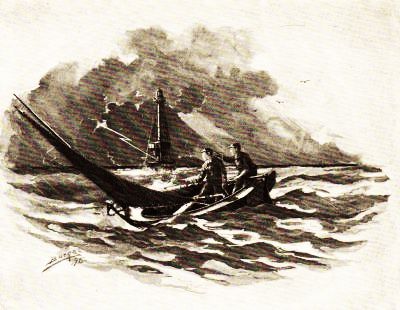
"There she is!" both boys cried. In that second of glare they both saw the great light-house looming up hardly a quarter of a mile in front of them.
"That's one point settled!" Nick declared, with a sigh of relief. "The light-house is all right, anyhow. So the trouble must be either with the keepers or the lantern."
From that moment the skies seemed to favor their work. Every few seconds the lightning flashed, and before many minutes they ran up safely to the lee side of the light-house and made the sharpie fast to a round of the perpendicular iron ladder that runs down into the water. They had been there before, and knew just what to look for: first four or five rounds of the iron ladder leading to a little iron platform, and from there a steep iron stairway leading to the deck, twenty feet above, on which the keeper's house stands.
"Ahoy-oy-oy, there, in the light-house!" Rex shouted.
"Halloo-oo-oo!" Nick echoed.
Without wasting more time Rex seized the lantern and sprang up the iron ladder with Nick close at his heels. With his first step on the narrow platform Rex stumbled, but saved himself from falling by catching the rail.
"Look out here!" he called; "there's something lying here that tripped me." And he turned and held the lantern down.
"It's a man!" Nick exclaimed. "Hello, here, mister!" And he stooped down and seized the man's arm and shook it. But there was no reply.
"We'll see to him later, Nick!" Rex cried; "the light's the first thing;" and stepping over the man they both sprang up the steep iron stairs. In a moment they were in the first room of the keeper's house. It was empty and silent.
"Halloo-oo-oo!" both boys shouted.
"Here, here!" came back the answer, in a low, weak voice.
Instantly they fell to opening doors to look for the owner of the voice, and Rex chanced upon the door opening upon the great spiral staircase that winds up and up through a tower to the lantern. There in the little passageway lay the principal keeper, groaning, coiled up in a heap, his face covered with blood.
"Why, Mr. Pinder," Rex cried, "what's the—"
"The lamp, the lamp!" the keeper groaned. "Never mind—me. Light the lamp! Matches on—on—the—table. Oh!" and amid his groans Rex managed to catch the words; "open the small brass door; light all three wicks; pull the lever to start the machinery!"
The boys waited to hear no more. Up they flew through the narrow iron tower, up the 158 winding iron steps, round and round till their heads swam, higher with every step, till they were in the little room beneath the lantern, then up a few straight steps into the lantern itself.
Nick pressed the match-box into Rex's hand, and seized the knob of the little brass door.
"It's for you to light the lamp, Rex," he said; "this is all your doing."
Rex struck a match and touched it to the wicks, and cautiously pulled the lever by his side.
Click, click! Whir, whir! came from the clock-work that moves the machinery. The blaze sped around the three broad circles of wick. Something began to revolve.
"Hurrah! hurrah!" The boys could not help it, even with the two injured men lying below. For Alligator Light was burning again, sending its red and white flashes over the black water every five seconds for the comfort and safety of many a mariner at sea that stormy night!
To look after the injured keepers was the next work. They hurried down the stairs, and when near the bottom they heard Mr. Pinder asking, in his weak voice, full of pain:
"Is it burning? Is the lamp burning?"
"Yes, sir; the lamp is all right," the boys answered.
"Oh, God be praised for that!" he moaned. "No, never mind me," he went on, as the boys stooped to pick him up. "My—partner. He's down—below on the landing. I dragged him there after I—I—was hurt. Go see to him."
Saying so much exhausted the keeper, and his head sank back on his arm. To pacify him the boys started down after the other man, who was still lying precisely as they had left him. It was not an easy matter to carry him up the steep stairs, but they did it, and laid him out on the floor of the front room.
"His heart is still beating," Rex said, after putting his hand under the man's vest. "He must have been stunned. I think we had better leave him here and look after Mr. Pinder."
But Mr. Pinder had strong objections to being touched. "Oh, my leg!" he groaned, when they tried to raise him. Then, "Oh, my back! Let—me lie; please let me lie—where I am."
Rex found a towel and water, and washed the blood from the injured man's face and bathed his temples; and while he was at this the boys were startled by a cry from below of "Hello here, in the light-house!" and the clattering of boots on the iron stairs; but before they could reply the door opened and their fathers stepped in.
"Why, what are you boys doing here?" Mr. Jenner asked, in astonishment. "And what was the matter with the light?"
"There has been some accident, sir," Nick replied, "but we don't know yet what. Rex and I came out and found both these men hurt, and we have just been up to light the lantern."
"There seems to be work here for me," said Dr. King, who had been looking about with a professional eye. "You can tell us about it afterward, boys; just now we must attend to these men."
The two keepers were soon laid out on comfortable beds, and under Dr. King's treatment it was not long before the assistant began to show signs of consciousness.
"He has been stunned by a blow on the head," the doctor said, "and we will soon bring him around." But with Mr. Pinder, the principal keeper, it was different. "Bad fracture of the right leg," he announced, after a hasty examination; "some bruises on the back and side, and cuts on the forehead. I think that after receiving the injury to his leg he tried to drag himself up the stairs to light the lantern, but his strength failed, and he fell back, and so received these other injuries."
By the time that Mr. Pinder was made comfortable, the assistant was able to tell what had happened. With the first moment of consciousness he sprang up, and exclaimed:
"The lamp! the lamp! Is the light burning?"
Being assured that all was well with the light, he rested his head on his hands for a moment, and began:
"You see, there are three keepers here, and two required to be always on duty. This morning the second assistant went off to Key West in the schooner, with his wife and Mr. Pinder's wife. That left me and Mr. Pinder here alone. Well, sir, early this evening, about ten or fifteen minutes before it was time to light the lamp, there came a big squall of wind, and picked up a bamboo rocking-chair we had out on the deck, and carried it right over the rail.
"'You lower the boat an' get that chair,' says Mr. Pinder to me; 'we may as well save the chair.'"
"Well, sir, I lowered the boat, and soon got the chair, but I saw it was going to be tight work getting back to the ladder in that sea and wind. Mr. Pinder he saw it too, and he run down to help me; and as I came in a big roller came just at the wrong minute, and bang went my head against one of the iron beams, as near as I can tell. That was the last I knew; but the roller must have caught Mr. Pinder's leg between the boat and the ladder and crushed it. Then, after draggin' me up on the platform, the poor man's tried to crawl up to light the lamp, and he's fell back and cut himself, just as you say."
"I don't know what I can say to these brave lads who came out and lit the lamp for us," the man went on. "I'd rather been killed outright than had that light fail."
"We have something to say about that," Mr. Jenner interrupted. "We were bound for Indian Key, in the schooner Pelican, and when we found there was no light we determined to stand out into deep water till daylight. But we must have lost our bearings, for when the first flash of the light came, we saw that we were heading in shore. In two minutes more we should have been on the reefs."
"Yes, that light saved our lives by just about two minutes," said Dr. King. "So we ran down here to see what was the matter. When is your mate coming back from Key West?" he asked the keeper.
"In two or three days," the man answered.
"Then the boys shall stay and assist you till he comes," the doctor went on, "for Mr. Pinder will be unfit for duty for a month or more. The government will not pay you for that, boys," he added, laying a hand on each boy's head, "but Jenner and I will. When you get home you can pick out the best boat in the harbor; and you shall call her the Alligator Light, in memory of this night's good work."