IN THE TOWER OF MANY STORIES.
Reading edition
BY MRS. LEW. WALLACE.
THE LITTLE PRINCES.
THE BLOODY TOWER.
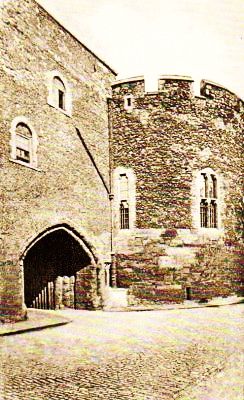
There is no breath to stir the old shadows, no voice nor hearing, only a still, solemn past telling, as we tread the pavement in the great Tower of London, its many stories that belong to that historic prison. In this scene of blackest crimes nothing remembered is half so sorrowful as the murder of the two Princes who were sent to the Tower by their uncle, Richard III., King of England. You have heard it, for it is an old tale and often told. He is usually called the Hunchback; some say he was not deformed, except in having a very short neck and one shoulder higher than the other. He was lame, but this defect was soon forgotten in the beauty of his face. He had pale olive skin, delicate features, smooth forehead, and proud lips quick to express the feeling which shone in his deep black eyes. His will was law, and he sprang on his enemies like the tiger on its prey if they were between him and his aims.
In the first year of his reign he cleared away all who were suspected of plots, till no heirs to the throne were left except his two nephews, sons of Edward IV. The wicked heart of the Hunchback was moved to one more crime; then, he believed, the crown of England would be secured. They were graceful boys of eight and twelve years, with clear bright eyes, rosy cheeks, long flowing hair like threads of gold, and the courteous manner early taught to those who expect to rule a great nation.
Edward, Prince of Wales, was stolen while on a journey; he was the elder; and Richard, Duke of York, the second son of the late King, was demanded of his mother, the widowed Queen of Edward IV. She was a high-born lady, famous for beauty when chosen from among the many who longed to sit on the throne. She was without power to resist, and how she begged the brutal Richard to be allowed to keep her youngest darling let other mothers tell.
The little fellows were lodged in the Garden Tower, so called from its opening into pleasure-grounds with a terraced walk, which in sunny days gave to view the river and bridge. It was the cheerfulest room in the doleful pile, and was lighted on both sides, so the captives could watch what stir there was in the inner wards, and the shipping along the wharf and on the Thames. It had a separate entrance to the promenade, where in fine weather they had leave to run and play, chasing each other into forgetfulness that they were doomed never to leave their prison-house alive.
But Richard could not feel at ease while his nephews lived. So one day Sir James Tyrrel, Master of Horse, "a trusty knight," brought an order under the royal seal that Brackenbury, the Lieutenant of the Tower, should for one night give up the keys and absent himself from his office. Brackenbury had already refused to make away with the Princes. The tale runs that Tyrrel was much agitated in mind while riding out with two men—professional murderers—by name John Dighton and Miles Forrest. They, thought their master, are not weak like Brackenbury, and will not mind getting these brats out of the way any more than wringing the necks of a couple of house sparrows; they will never blench or quiver even at sight of the blood of the Lord's anointed.
The keeper of the keys feared and hated the King, but dared not disobey him. He gave up his place and trust for the time ordered.
After the long twilight, when the night fell, they crept around the winding stairs and through black corridors lighted only by the lanterns they carried.
When the death-men entered the chamber they paused awhile before the living picture there, the fairest under the wide curtains of darkness.
Youth seems younger and loveliness lovelier in the helpless hours of sleep. The Princes lay in the sweet slumber of healthful childhood, sinless and confiding, nestled close in each other's arms. To kill them was like sending spirits ready for heaven home too soon. Some pretty belongings, toys and playthings given by their mother, were scattered about, and a book of prayers, open on a table at the bed's head, almost changed the mind of the guilty wretches.
But they did not linger; the sleepers made swift passage to the dreamless sleep which has no waking, smothered with the pillows of their own bed. If there was moan or outcry the Tower walls are thick, and in the midnight hush only the listening angels on airy wings might hear.
Singers have sung the woful story, and artists have painted the piteous scene. The great poet's touch brings it before our eyes. The hardened villains melted into tenderness and mild compassion when they reported to their master:
"'O thus,' quoth Dighton, 'lay the gentle babes.' 'Thus, thus,' quoth Forrest, 'girdling one another Within their alabaster, innocent arms: Their lips were four red roses on a stalk, Which, in their summer beauty, kissed each other.'"
By a private stairway the trusty Tyrrel slipped in from the gate, where he waited impatiently, felt their pulses to be certain there was no life left, and sought the Tower priest to make him help in hiding the devilish deed. They carried the warm bodies down. Oh, what a sight it was! the soft limbs not yet stiffened for the grave, the delicate hands dragging the steps. Without coffin, shroud, or winding-sheet, with neither hymn nor prayer, they were thrown into a hole dug by the wall. Rapidly the grave was filled with loose soil and stones from scattered building-material left lying in heaps some months before; then the pit was smoothed till there was no sign of disturbance or violence, silence settled over all, and the tragedy seemed ended forever.
"Trusty" Tyrrel mounted his horse and rode in the dewy daybreak along green lanes and blossoming hedges to the palace. He was cruel as a blood-hound, yet tears ran down his face like rain when he described to the satisfied monarch how the "gentle babes," his brother's sons, would trouble the kingdom no more.
THE TOWER OF MANY STORIES.
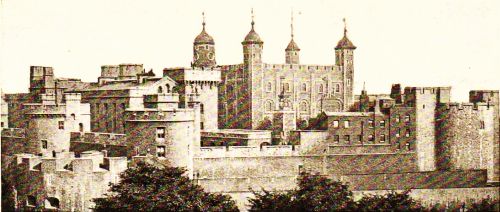
Richard had been crowned with great pomp, feasting, and shouting. He sat on a marble seat in Westminster Hall, with a nobleman on each side, and told the crowd assembled there he meant to be just and maintain the laws and respect the rights of his people. But this was mere talk. The reign begun in murder continued the same way. His spies learned that titled subjects drank healths in private to the Princes in the Tower, and he thought best to announce the truth, though he had intended to keep their fate a secret. Besides, Uncle Richard's sleep was broken by bad dreams come of the hideous sin. The crown of his nephew did not rest easy on his head, bloody fingers pulled at it; the lights burned blue at midnight; strange calls, as from desolate shores, answered each other across his bed; he heard muffled groans, and ghosts that would not down sat heavy on his soul. Eyes starting from their sockets glared at him; visions of baby throats purple with strangling and pale faces bedabbled with blood haunted the pillow of the last Plantagenet.
He woke in a cold sweat of terror from dreams of a tomb which opened of itself; where the earth cracked with a hollow noise and showed a coffin wide and short, and hair living and golden streaming out under the lid.
RICHARD'S NEPHEWS.
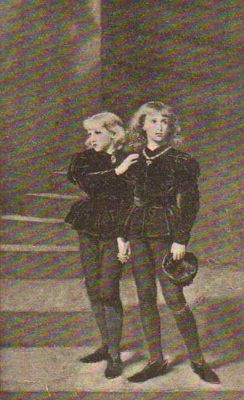
Were the boys indeed buried? And why should their white souls ride the winds on crimson clouds in the dead hours of the night?
To banish the spectres and quiet the shrieks in his ears he commanded the Tower chaplain to unearth the corpses and have them better placed, under the marble floor of some shrine or safe in a corner of the court-yard of the Tower. It was done. None ever knew when or with what holy rite they were buried the second time, because the priest soon afterward died, and with him went the knowledge of their resting-place.
Richard did not long enjoy his throne, but in his brief reign noble ladies and gallant gentlemen were imprisoned in grim strongholds, and marched from dungeons to death on the headsman's block. Sometimes he would have drums beat and trumpets sound, so that the last words of the dying could not be heard by the assembled crowds, for he feared an uprising of his subjects.
Only two years afterward he dashed into the thickest of the fight at Bosworth, and there lost his kingdom and his life. Under a hawthorn-bush Lord Stanley found the crown of England, which the tyrant had worn to the battle-field. It was badly bruised and trampled on, the jewels dim with dust and clouded with blood. Stanley placed it just as it was on the head of Henry, Earl of Richmond, and the soldiers of the royal army shouted with joy, "Long live King Henry VII."
Later in the day the body of the Hunchback was pulled out of the mire, stripped naked, tied across a horse's back like a sack of worthless clay (which indeed it was,), and taken to a near church-yard for burial. Nobody cared for the monster, nor minded how his blood ran down in the dust of the road on its way to the grave which had no mourners.
The new King marched in the splendor of banners and with triumphal music to the Tower, at that time used as a palace. He was attended by a princely escort, gentlemen on horseback wearing jewelled armor, and long trains of gilded coaches filled with ladies in brilliant robes, making altogether a brave show. Chambers tapestried in silk were set apart for the court, beds were canopied with velvet, soft carpets and rich hangings—gold, crimson, violet—covered the rough stones, and there was much high feasting and much merry-making. When the ceremonies were over, Henry thought of the murdered innocents, and made inquiry about them. Forrest and the priest were dead, and the other two accomplices—to whom was offered pardon on confession—knew nothing of the second burial. It was supposed the chaplain would, if possible, lay the Princes in consecrated ground. St. Peter's Cathedral was rummaged, many coffins were opened and stared into, and the near church-yard was upturned and searched for the precious relics, but none were discovered. Court flatterers pretended to believe the children had been sent out of the country, and were still alive somewhere in the provinces.
The ancient fortress grew grayer and drearier than ever, and portions of it began to crumble and rot. Then the murder came to light, proved by best evidence—the remains of the Princes themselves. Some workmen making a new stairway to the royal chapel found under the steps, hidden close to the wall and covered with earth, two skeletons answering exactly to the missing youths long sought.