THE IMP OF THE TELEPHONE.
Reading edition
BY JOHN KENDRICK BANGS.
III.—ELECTRIC COOKING.
"Hurrah!" cried Jimmieboy, in ecstasy. "This is great, isn't it?"
"Pretty great," assented the Imp, proudly. "That is, unless you mean large. If you mean it that way it isn't great at all; but if you mean great like me, who, though very, very small, am simply tremendous as a success, I agree with you. I like it here very much. The room is extremely comfortable, and I do everything by electricity—cooking, reading, writing—everything."
"I don't see how," said Jimmieboy.
"Oh, it's simply a matter of buttons and batteries. The battery makes the electricity, I press the buttons, and there you are. You know what a battery is, don't you?"
"Not exactly," said Jimmieboy. "You might explain it to me."
"Yes, I might if I hadn't a better way," replied the Imp. "I won't explain it to you, because I can have it explained to you in another way entirely, though I won't promise that either of us will understand the explanation. Let's see," he added, rising from his chair and inspecting a huge button-board that hung from the wall at the left of the room. "Where's the Dictionary button? Ah, here—"
"The what?" queried the visitor, his face alive with wonderment.
"The Dictionary button. I press the Dictionary button, and the Dictionary tells me whatever I want to know. Just listen to this."
The Imp pressed a button as he spoke, and Jimmieboy listened. In an instant there was a loud buzzing sound, and then an invisible something began to speak, or rather, to sing:
"She's my Annie, I'm her Joe. Little Annie Rooney—"
"Dear me!" cried the Imp, his face flushing to a deep crimson. "Dear me, I got the wrong button. That's my Music-room button. It's right next the Dictionary button, and my finger must have slipped. I'll just turn 'Annie Rooney' off and try again. Now listen."
Again the Imp touched a button, and Jimmieboy once more heard the buzzing sound, followed by a squeaking voice, which said:
"Battery is a noun—plural, batteries. In baseball the pitcher and catcher is the battery; in electricity a battery is a number of Leyden jars, usually arranged with their inner coatings connected, and their outer coatings also connected, so that they may be all charged and discharged at the same time."
"Understand that, Jimmieboy?" queried the Imp, with a smile, turning the Dictionary button off.
"No, I don't," said Jimmieboy. "But I suppose it is all right."
"Perhaps you'd like an explanation of the explanation?" suggested the Imp.
"If it's one I can understand, I would," returned Jimmieboy. "But I don't see the use of explanations that don't explain."
"They aren't much good," observed the Imp, touching another button. "This will make it clear, I think."
"The Dictionary doesn't say it," said another squeaking voice, in response to the touch of the Imp on the third button; "but a battery is a thing that looks like a row of jars full of preserves, but isn't, and when properly cared for and not allowed to freeze up, it makes electricity, which is a sort of red-hot invisible fluid that pricks your hands when you touch it, and makes them feel as if they were asleep if you keep hold of it for any length of time, and which carries messages over wires, makes horse-cars go without horses, lights a room better than gas, and is so like lightning that no man who has tried both can tell the difference between them."
Here the squeaking voice turned into a buzz again, and then stopped altogether.
"Now do you understand?" asked the Imp, anxiously.
"I think I do," replied Jimmieboy. "A battery is nothing but a lot of big glass jars in which 'lectricity is made, just as pie is made in a tin plate and custard is made in cups."
"Exactly," said the Imp. "But, of course, electricity is a great deal more useful than pie or custard. The best custard in the world wouldn't move a horse-car, and I don't believe anybody ever saw a pie that could light up a room the way this is. It's a pretty wonderful thing, electricity is, but not particularly good eating, and sometimes I don't think it's as good for cooking as the good old-fashioned fire. I've had pie that was too hot, and I've had pie that was too electric, and between the two I think the too-hot pie was the pleasanter, though really nothing can make pie positively unpleasant."
"So I have heard," said Jimmieboy, with an approving nod. "I haven't had any sperience with pie, you know. That and red pepper are two things I am not allowed to eat at dinner."
"You wouldn't like to taste some of my electric custard, would you?" asked the Imp, his sympathies aroused by Jimmieboy's statement that as yet he and pie were strangers.
"Indeed I would!" cried Jimmieboy, with a gleeful smile. "I'd like it more than anything else!"
"Very well," said the Imp, turning to the button-board, and scratching his head as if perplexed for a moment. "Let's see," he added. "What is custard made of?"
"Custard?" said Jimmieboy, who thought there never could be any question on that point. "It's made of custard. I know, because I eat it all up when I get it, and there's nothing but custard in it from beginning to end."
The Imp smiled. He knew better than that. "You are right partially," he said. "But there aren't custard-mines or custard-trees or custard-wells in the world, so it has to be made of something. I guess I'll ask my cookery-book."
Here he touched a pink button in the left-hand upper corner of the board.
"Milk—sugar—and—egg," came the squeaking voice. "Three-quarters of a pint of milk, two table-spoonfuls of sugar, and one whole egg."
"Don't you flavor it with anything?" asked the Imp, pressing the button a second time.
"If you want to," squeaked the voice. "Vanilla, strawberry, huckleberry, sarsaparilla, or anything else, just as you want it."
Jimmieboy's mouth watered. A strawberry custard! "Dear me!" he thought. "Wouldn't that be just the dish of dishes to live on all one's days!"
"Two teaspoonfuls of whatever flavor you want will be enough for one cup of custard," said the squeaky voice, lapsing back immediately thereafter into the curious buzz.
THE ELECTRIC CUSTARD.
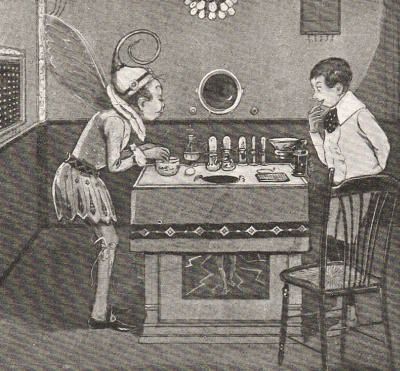
"Thanks," said the Imp, returning to the table and putting down the receipt on a piece paper.
"You're welcome," said the buzz.
"Now, Jimmieboy, we'll have two cup custards in two minutes," said the Imp. "What flavor will you have?"
"Strawberry cream, please," said Jimmieboy, as if he were ordering soda-water.
"All right. I guess I'll take sarsaparilla," said the Imp, walking to the board again. "Now see me get the eggs."
He pressed a blue button this time. The squeaky voice began to cackle, and in a second two beautiful white eggs appeared on the table. In the same manner the milk, flavoring, and sugar were obtained; only when the Imp signalled for the milk the invisible voice mooed so like a cow that Jimmieboy looked anxiously about him, half expecting to see a soft-eyed Jersey enter the room.
"Now," said the Imp, opening the eggs into a bowl, and pouring the milk and flavoring and sugar in with them, and mixing them all up together, "we'll pour this into that funnel over there, turn on the electricity, and get our custard in a jiffy. Just watch that small hole at the end of the funnel, and you'll see the custard come out."
"Are the cups inside? Or do we have to catch the custards in 'em as they come out?" asked Jimmieboy.
"Oh, my!" cried the Imp. "I'm glad you spoke of that. I had forgotten the cups. We've got to put them in with the other things."
The Imp rushed to the button-board, and soon had two handsome little cups in response to his summons; and then casting them into the funnel he turned on the electric current, and Jimmieboy watched carefully for the resulting custards. In two minutes by the clock they appeared below, both at the same time, one a creamy strawberry in hue, and the other brown.
"It's wonderful!" said Jimmieboy, in breathless astonishment. "I wish I had a stove like that in my room."
"It wouldn't be good for you. You'd be using it all day and eating what you got. But how is the custard?"
"Lovely," said Jimmieboy, smacking his lips as he ate the soft creamy sweet. "I could eat a thousand of them."
"I rather doubt it," said the Imp. "But you needn't try to prove it. I don't want to wear out the stove on custard when it has my dinner still to prepare. What do you say to listening to my library a little while? I've got a splendid library in the next room. It has everything in it that has ever been written, and a great many things that haven't. That's a great thing about this electric-button business. Nothing is impossible for it to do, and if you want to hear a story some man is going to tell next year or next century you can get it just as well as you can something that was written last year or last century. Come along."
[to be continued.]

By defeating St. Paul's at Garden City a week ago Saturday, Pratt Institute won the Long Island interscholastic football championship for 1895. If the players and the students of the Institute are satisfied with the methods by which this victory was obtained they should be welcome to the empty honor. The Pratt eleven is a good one, and might very probably have won the game by fair and square football; but to send one of their players to Garden City as the guest of that school a number of times during the early fall, and to allow him to make note of the signals and the plays in use by his hosts, and then to play against St. Paul's, armed with this ill-gotten knowledge, is an act beneath contempt, and one for which any sportsman must turn away in disgust. The man who did this can offer no excuse for his sneaking and dishonorable conduct. When caught in the act of taking the St. Paul's signals he was driven like a malefactor from the field, but he returned brazenly with his companions, and put his ill-gotten knowledge to disgraceful use in a contest with gentlemen. The guilt of all the Pratt Institute football players is second only to that of their informant, for by using the information he obtained by such dishonorable means they showed approbation of his course, and placed themselves upon a level with him who violated the confidence of a host.
The St. Paul's team this year is a very good one. The men have not had the advantage of as many games as the other teams of the Long Island League, but there is a strong school spirit at Garden City and an excellent system of training, both of which tend to the development of good athletes. I have seen several of the league teams play this fall, and have carefully noted the game put up by each eleven. St. Paul's plays a harder, faster, and more scientific game than any other team on Long Island. Their play is more like that of a college Freshman team. This is well illustrated by the way they line up, the quick work of the quarter in giving signals, and the knack which all the men have of getting into every play. The offensive play is much stronger and better than the defensive, the latter being rather weak. I noticed little fumbling by the St. Paul's players, and that is the hardest of any fault to overcome.
In the game with Pratt Institute, the play on both sides was sharp and snappy throughout, in spite of the fact that the Garden City team was badly crippled. Glenny, the right guard, broke a rib while skylarking just before the game, and played against the advice of his physician. E. Starr was also laid up with an injury to his knee, and could not play. The line was therefore considerably weakened, and the team did not put up the game it is capable of. Only eight points were scored in the first half—one touch-down and goal, and a safety. During the first three minutes of play in the second half, St. Paul's carried the ball to Pratt's five-yard line, but lost it on a fumble. This seemed to dishearten the team, and after that Pratt forced the centre for long and steady gains. The halves were of twenty-five and thirty minutes' duration, and the final score was 26-0. St. Paul's took their defeat manfully, and do not intend, as has been reported, to enter any protest against the Pratt team. There is another and a better course for them to pursue.
An agreement has been made between St. Paul's and the Berkeley School, covering a period of three years, to play an annual game of football on Thanksgiving day, the first contest of the series to take place (at Manhattan Field, if possible) a week from Thursday, in the morning. This is a good thing, for it will bring together representative schools from the sister cities, and the great game cannot fail to be benefited thereby. Such annual contests between large schools, if properly conducted, should soon attract almost as much of the public interest as inter-collegiate contests, for there are more school-boys in New York and Brooklyn than there are college men, and if not as many persons interested in the sports of the former as in those of the latter, they are at least of a better and less promiscuous class. The schools should aim to have these tournaments as free as possible from the quarrels and bickerings that have lately characterized inter-collegiate football, and that frequently crop up in interscholastic sport; but between two institutions of the standing and make-up of Berkeley and St. Paul's there should be small likelihood of any such unpleasant occurrences. One good feature of the meetings that I have already heard of is that the admission fee will be twenty-five cents. The debarring thus of the speculative evil on the part of the managers is a good omen.
The Berkeley School team that is to meet St. Paul's is undoubtedly the strongest that the school has ever put into the field. It is made up of excellent material, and has been coached by a man thoroughly familiar with the game. By defeating De La Salle at the Berkeley Oval a week ago the team won first honors in the second section of the New York League, and it will undoubtedly take the championship on the 29th. Immediately after the Pratt-St. Paul's game Berkeley challenged Pratt Institute to play a match at any time, but the Pratt Captain hesitated about accepting, and the matter is still unsettled. As there is no agreement for an inter-city game this year, it is to be hoped that the Pratt management will have sufficient sporting spirit to accept the challenge.
Lawrenceville and the Hill School of Pottstown will meet on the gridiron next Saturday, and the contest should be a close one, for up to date of writing the Pennsylvania School has met no defeat this season. Their chief victory was over the Princeton second eleven, and their hardest game against U. of P. '98, in which neither side scored. The team is a light one—very much lighter than Lawrenceville's—but it has had good training, although it has suffered from a lack of frequent games with other elevens. This last disadvantage will tell in the contest with Lawrenceville, and, although I expect to see the Jersey men win, they will by no means have a walk-over.
Schuyler, r.h.-b. Davis, r.e. Kiefer, l.h.-b. (Capt.) Lowndes, r.t. Mills, r.g. Paxton, r.t. Dean, l.g. Dallam, sub. Monypeny, f.-b. Rodgers, l.e. Fincke, q.-b. Chadick, c. THE HILL SCHOOL FOOTBALL TEAM.
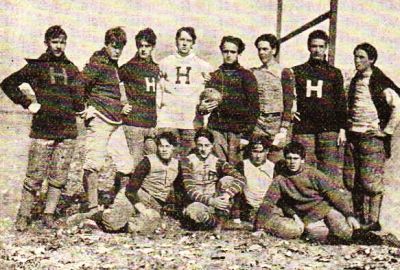
The Hill School eleven is particularly strong behind the line, where Kiefer, Schuyler, and Monypeny make a trio of backs of which any preparatory school might well be proud. Kiefer, Captain, who plays left half-back, has played several years on the team. He is the fastest runner in the school, and a remarkably clever dodger. His punting has improved noticeably this year, and he tackles hard and low. Schuyler, the right half-back, was also a member of last year's eleven. He is a brilliant though unsteady player, running low and hard. When he hits the line he rarely fails to make his distance. Owing to his tendency to fumble he is not so reliable as the other backs. Monypeny, who fills the position of full-back, has proved a great surprise. Last year he played on the second eleven, but was never regarded as anything above an ordinary player. Since the present season opened he has shown steady improvement, until at present he is regarded as one of the best all-around men on the eleven. He is a strong line backer, and for hard and sure tackling is not surpassed by any man on the team. Fincke, at quarter, is another old man. He is cool and clear-headed, his strongest point being his ability to get into the interference quickly. His tackling has improved greatly over that of last year. In the line, Chadick, at centre, is new to the position. Compared with the average centre he is small and light, but what he lacks in these respects is more than offset by his strength and grit.
The guards are being played by Dean and Mills. Dean played on the second eleven last year, and has improved steadily through the season. Mills is a new man, but has the making of a good football player in him. Carelessness seems to be his main fault. Lowndes and Paxton, the tackles, are also old men, though the former has played one of the guards before this year. As an all-round football player Lowndes undoubtedly excels any other man who ever represented the Hill. He is not as heavy as could be desired, but he more than makes up for this lack by his great strength and activity. In every play his tackling is fierce, and as a ground-gainer he can always be relied on. His early football experience was obtained at St. Paul's. Paxton, the right tackle, still shows the effects of a severe illness, which necessitated his leaving school last year. His work, though, has shown steady improvement of late, and in the interference he is especially strong. The ends are looked after by Davis and Rodgers, both members of last year's second eleven. Davis has developed into one of the best ends the school has ever had, while Rodgers, who plays a sandy game, is somewhat handicapped by his light weight.
Owing to the Hill School's somewhat isolated location—isolated in the sense of neighborhood to other large private schools—it has no close rival, such as Andover used to have in Exeter and now has in Lawrenceville, and such as the Berkeley School in this city and St. Paul's of Garden City are gradually becoming. At present Lawrenceville comes the nearest to occupying this position, but the Jersey school is so much larger in point of numbers that it out-classes the Hill in most contests. Considering this superiority of Lawrenceville's, therefore any victory over her by the Hill School must be doubly creditable.
The difficulty between the Brooklyn Latin and High-Schools has been referred to a committee for settlement, although it seems as if the Association ought to have decided upon the question at once at their last session. The dispute originated in the recent football contest between the two schools. When the game was about half over, Captain Lutkins of the Latin School team protested to the officials that the High-School team were playing their ends back of the line, which he said was a violation of Rule 30, Section C. The officials held different opinions as to the interpretation of the rule, and the game was allowed to go on as before. At the League meeting the representatives from the Latin School protested the game for this reason, but the protest was not decided, and a special committee was appointed to pass on the question. The umpire, in a letter to the League, said that an agreement was entered into, previous to the game, by which it was understood that both teams could play both ends back of the line. The referee in his letter has denied that any agreement was entered into before the game relative to this point. To complicate matters further, it appears that the umpire had been coaching the High-School, and the referee was an ex-member of the Latin School. (The moral-seeker will find food for meditation in this situation!)
The absurdity of the argument that both teams had agreed to allow the ends to play back of the line is apparent. The teams were playing under the rules of the L.I.I.S.F.B.A., and these rules clearly state that in football contests the Intercollegiate code is to be followed. This code is equally clear in its statement that "Not more than three men shall group themselves at a point behind the line of scrimmage before the ball is in play. Seven men or more shall be on the line of scrimmage until the ball is in play, except that the man playing the position of either end rusher may drop back, provided he does not pass inside the position occupied by the man playing adjacent tackle before the ball is put in play." A delegate from Poly. Prep. quoted this paragraph at the League meeting, and very justly objected that the captains had no right to make any agreement, even if they had done so, because such an agreement obviously violated the rules.
The League delegates, however, in their ponderous wisdom did not take this view of the question, and threw the responsibility from their shoulders by appointing a committee to decide the knotty issue. The latter ought to have but little difficulty in doing this if they can read the English language. Two things are plain: 1st. That the rules were violated if two end-men played back of the line, whether or not the captains had an agreement. 2d. That both the referee and the umpire who officiated at the game are ignorant of the rules, and incompetent, and should never be permitted to act as officials again until they have proved themselves capable of fulfilling the duties required of them. Further, the Latin School Captain is entirely in the right in the matter, and the game should go to his men, or, better, since both elevens violated the rules, the match should be void.
Comment on the game between Bridgeport and Hartford High-Schools for the championship of the Connecticut High-School League must be deferred until next week, owing to lack of space in this number. It was a stirring contest, and I want to devote more space to it than I should be able to to-day. A criticism of the Berkeley School team is also crowded out.
The Graduate.
STARVED TO DEATH
in midst of plenty. Unfortunate, yet we hear of it. The Gail Borden Eagle Brand Condensed Milk is undoubtedly the safest and best infant food. Infant Health is a valuable pamphlet for mothers. Send your address to N. Y. Condensed Milk Co., N. Y.—[Adv.]