THE GIRL WHO COMES TO EARN A LIVING IN NEW YORK.
Reading edition
BY ELIZABETH BISLAND.
To-day in many families of modest means the daughters, as well as the sons, begin, as the school days draw to a close, to consider seriously the question of a career and the best means of earning a living. Every wise girl interests herself not only in the possibilities for success held out by the various professions, but the best method of so ordering her working life that it may result not only in success, but in pleasure and happiness as well. The one does not necessarily imply the other. One may rise in one's profession and earn an excellent income, and yet miss happiness and fail of true success. A wise old lady writing to a young girl of great wealth about to make her début in society, said:
"The really important matter is to succeed. Don't make the mistake of thinking that I mean mere success of fashion, money, and rank—though they are all most desirable and delightful things too. I am speaking of the success of being loved, of being popular, useful, and important. To my mind a woman is a success when she holds such a place in the world that her going out of it, at any age, is a severe loss to many people. There must be many so dependent upon her for love, for help, for advice, for pleasure and amusement, that her death leaves a wide gap and a bitter grief. Thousands of women die every day whose going affects no one deeply, except, perhaps, with a sense of relief, and such women I consider failures, whether they were rich or poor, humble or proud."
This is an excellent piece of advice for the girl about to enter on a life of labor, as well as for one destined for a fashionable career. Let a girl then fix her ambition upon a real all-round success, and be content with nothing less.
The most important thing to settle in the beginning is her way of living, which—while the style of it depends in large measure upon her earnings; or upon the allowance she receives from home while she is preparing herself to earn—is capable of infinite variations between the levels of comfort and discomfort, according to her own skill.
There are some so-called women's hotels in New York, but these are, without exception, to be avoided by a young girl with all her might. They are very cheap, but are dirty, squalid, and vulgar. They contain no provision for decent privacy, for adequate bathing, or for proper cleanliness; the food is unwholesome and uninviting, and the society no better than the accommodations, being composed in large part of broken-down failures of the sex, who are little likely to inspire a young girl with hopefulness or high ideals. Their one recommendation is the exclusion of men, which is not, after all, a matter of importance, since there is no reason why a self-respecting girl should not meet men and enjoy their acquaintance when circumstances and the proprieties admit of it. There is an enterprise on foot to build a woman's apartment-house, where the rooms and flats will be rented only to women working for a living who can furnish adequate and respectable references; where the rent will be low, the accommodations pleasant and pretty, and a restaurant of moderate prices in the building; but as yet this admirable scheme remains unrealized in New York, though similar Ladies' Chambers are settled and profitable institutions in London.
Perhaps the best thing a girl unacquainted with New York can do is to write and secure a room for two weeks at the Margaret-Louisa Home in East Seventeenth Street. This home—one of the many admirable foundations made by the Vanderbilt family—was built for the purpose of providing a safe and comfortable stopping-place for women of small means, and is closely connected with the Young Women's Christian Association in the next street. Owing to the constant demand for admission, no one person may remain longer than two weeks, which, after all, allows quite sufficient time for the search of a permanent abiding-place. In the interim one pays $3 a week for a room, and finds meals in the restaurant below at very moderate prices. That is to say, one can live there, with economy, at the rate of about seventy-five cents a day.
The best permanent arrangement for a girl young and alone is to find lodgings in a boarding-house. Excellent accommodations in the pleasantest quarters of the city can be had for $10 a week. This means a small hall room, the use of the bath-room and of the drawing-room, light, heat, attendance, and three meals a day. Two girls can usually arrange to lessen their expenses and double their comfort by taking a double room at $16. This plan is advisable, because it gives one a home in a clean, healthy, and agreeable part of town; provides ample food, which a girl hard at work requires; and insures attendance and consideration in case of illness. From a social point of view it provides her with entire protection and respectability; she meets and makes friends with a nice class of men and women living in the house, and has a pleasant reception-room in which to receive visits. Madison Avenue and the side streets leading out of Fifth Avenue contain a rich choice of such boarding-houses, but here and there certain streets are considered undesirable places to live, and it is well to select a boarding-house which appears quiet and dignified in its aspect, and whose landlady has the same appearance.
Another method is to take a room in a house that furnishes merely lodgings, where one can be housed for a sum ranging between $3 and $5 a week. A small gas-stove will serve for preparing breakfast and a light supper at night, and the hearty meal of the day can be had at a restaurant at one o'clock, when others are lunching. When two girls club together this is not a bad plan. The quickly cooked oatmeal, an egg, and a cup of tea will serve for breakfast; jam, a roll, and a glass of milk make a supper; and there are many cheap restaurants where a table d'hôte midday dinner of the most ample description is to be had for fifty cents, and one portion is ample for two. There are, of course, in the less-fashionable quarters of town, plain, cheap boarding-houses where everything is included for from $6 to $7 a week, but these rarely give the use of a general drawing-room, and the accommodations are very plain. Still, in Washington Square, Lafayette Place, and similar places one may by careful search sometimes find excellent lodgings at a most reasonable rate.
Still another method is to rent a large empty room somewhere, usually a sort of loft at the top of a house, and furnish it one's self. This is a popular plan among the girls in the art schools who wish a home and studio combined. They divide off the corners of the room by cheap screens into bedrooms and kitchen, and leave the centre for sitting and work room. They paint their floor to save a carpet, content themselves with a divan or two, a table, and a few chairs, and they do "light housekeeping" by the aid of a gas-stove, tinned goods, and the delicatessen stores, where one can find all manner of cooked dishes needing only to be warmed. When two or three girls combine on such a scheme they can keep their expenses down to about $18 or $20 a month each, and have a very good time of it.
There is also apartment life, which is not very dear, and is often most agreeable. Indeed, if it can be afforded, it is the pleasantest of all, since no one appreciates the pleasant privacy and relaxation of home life more than the woman who must face the world and fight her own battle. These housekeeping flats may be had all the way from $25 a month up, according to size, location, and convenience. A maid-of-all-work will serve as laundress, cook, and house-maid for from $12 to $15 a month, and the other expenses can be regulated according to one's means; but when two or three share the expenses, and the pennies are looked after closely, this is not an expensive mode of life.
Dress is possibly the next most important point for consideration, for nowhere is a woman judged more by her appearance than in New York. This does not imply that a girl unable to dress expensively need ever suffer from that fact, but it does mean that gewgaws, frippery, loud colors, affectations of masculinity, slovenliness, or eccentricities of costume will severely militate against the success, socially and financially, of a girl who comes to New York to earn her living. New-Yorkers possibly more than others are very sensitive as to the appearance of persons they are seen with, and many a pleasant clever girl has found it hard to get on here because she could not or would not realize that people did not like to be seen walking with her in the street, and shrank from presenting her to their friends because her appearance seemed to require an explanation on their part that she was better than she looked.
It is not infrequent that a high-spirited girl, when warned of this, replies proudly that those who judge her by her clothes are unworthy of her consideration, and are no loss as friends, but such an answer, though natural perhaps, is certainly foolish. Strangers and new acquaintances are necessarily ignorant of her qualities of mind and heart, and their only clew to her character is her outward appearance. Very properly they reason that a dignified, well-bred girl would be likely to dress with quiet, inconspicuous neatness, and if they find no such outward indication of refinement, they see no particular reason to continue the acquaintance on the possible chance of their being mistaken. Of course capable women can conquer this prejudice in time, but it certainly seems hardly worth while to deliberately place in one's path an obstacle to be overcome.
Avoid fierce frizzy untidy fringes, fluttering ribbons, cheap finery, high-heeled shoes; flee the short-haired, mannish, hands-in-pocket swagger, the dirty plush and draggled cheese-cloth attempt at æstheticism, and, above all, eschew the still more unforgivable offence of dingy fingernails, greasy skin, unbrushed skirt edges, and unblackened shoes. There is still another type of girl who needs a suggestion. She of plain appearance, who apparently has become convinced of the uselessness of any attempt to beautify herself, and who screws her hair into an uncompromising knot at the most unbecoming angle; wears, if she is near-sighted, great steel-bowed spectacles instead of pince-nez, and arrays herself in colors and costumes which seem specially chosen for their unsuitability to her coloring and figure. Each and all of these need to be reminded that success in life consists as much in being a charming and agreeable-looking woman, sought after as an acquaintance and companion by refined and pleasant people, as in winning fame and money by one's own efforts.
The wardrobe needed by a girl who is in New York for work instead of play is very simple, and not at all expensive. The serge or cloth tailor gown, consisting of a skirt and coat, has grown to be as much a uniform of the well-dressed business woman as the simple regulation morning suit is that of the business man. These can be had at prices ranging from $12 to $30, ready made in the big shops, or can be ordered from a tailor for about $35 or $40. The latter is the more advisable purchase, as the material is so good and the cut so recent that a serge gown, if of medium weight, can be worn summer and winter for two years. An addition of a heavy outer coat or cape makes such a costume sufficiently warm for any weather one is exposed to in New York, and by leaving off the coat and wearing the skirt with a bodice, the hottest weather of summer can be endured. If, added to this, one possesses a pretty silk costume, with one high-necked and one low-necked bodice, one is provided to meet all social as well as work-a-day demands upon one's wardrobe. In New York one either wears street dress and a bonnet, or else full dress. A demi-toilet is not necessary except when one can afford to indulge one's tastes regardless of economy. To the theatre, to restaurants in the evening, for calling, at afternoon teas or luncheons, for any social event, in fact, that occurs in the daytime or in a public place one wears a street dress and bonnet or hat. For even the simplest dinner parties—unless, indeed, one is the only guest and the invitation is impromptu—evening dress is the correct wear, and if by chance one has an invitation to a box at the opera, it is again customary to wear evening dress. Sitting in the orchestra stalls in the opera one would wear street dress and bonnet.
For morning and business wear the tailor skirt and coat, worn with a quiet-colored bodice, would be accompanied by a plain walking hat, with no more trimming than a few cocks' plumes, low-heeled walking shoes, and heavy dark gloves. If one's business lay in an office there should be worn as few rings or jewelry of any description as possible. It is considered a sign of great carelessness to go upon the street with no gloves, or with gloves half on, or not tidily buttoned; and nothing has a more provincial appearance than to have one's feet crowded into high-heeled boots.
Certainly New York provides as much innocent and inexpensive amusement for the girl who earns her living as any other city in this country—if one knows where to look for it. Two girls can go alone together to the theatre at night in perfect safety—that is, if their manner is quiet and dignified, and not such as to attract attention. A very respectable and respectful class of neighbors is found up in the cheap, fifty-cent galleries of the better class of theatres, and one may see all the best actors for small sums and in perfect comfort. The Sunday night concerts at Carnegie Hall and the Berkeley Lyceum afford one a chance to hear the best music and listen to the most famous soloists and singers for prices ranging from two dollars to fifty cents; and here again it is quite correct to go in couples without other escort.
A little pains will keep one cognizant of the many free lectures. Five dollars is the cost of a yearly subscription to the Mercantile Library, and provides one with the best books, and the Astor and Lenox libraries are open without charge to those who have time to use their reading-rooms. The Museum of Art, with its ever-growing collection of pictures, models from the antique, gems, statues, musical instruments, silver, laces, tapestry, etc., is open without charge five days of the week, and this museum, the zoo, and the Museum of Natural History are all in Central Park, which affords one all the loveliness of nature, as well as tennis, skating, and boating.
In summer a few cents will make one very familiar with New York Harbor by means of its many ferry lines to all the various points, and for tiny sums one can go by the elevated trains and their continuations, in the form of steam trains and trolleys, upon fifty charming country excursions. There are a number of working-girls' clubs, where one can find companionship of one's own age, and can join classes for learning to make one's own dresses, trim one's bonnets, typewrite, embroider, dance, and endless other accomplishments. The churches offer, beside spiritual help and benefit, the best music, the most inspired eloquence, and in many instances splendid ceremonials and treasures of art. Much is said about the loneliness of strangers in New York, but loneliness and ennui in such a city simply arise from laziness and lack of intelligence. A girl with only half a dozen acquaintances here can still find some expedition, some delightful musical, artistic, dramatic, or literary experience, to fill every moment that she can spare from her work.
Socially New York is a delightful place for a girl of small means who is yet agreeable, intelligent, and refined. But let her from the first carefully refrain from making the mistake of forming intimacies without discrimination. She should make up her mind as to the class of persons she wishes to know, and wait for that class. The easy conquest of an inferior grade of social life will only prevent her ever gratifying her better ambitions, for acquaintances once made are not easily got rid of, and she will be unfavorably judged by those she wishes to know when they see her associates. Let her fill her life with such pleasures as are to be had for the taking, and let her wait for the natural course of events to bring her friends. The first year is always the hardest and loneliest, but suddenly one finds after about a twelvemonth that people have become aware of one's existence, and begin to recognize whatever one may possess of amiability or cleverness. Then one's "good times" begin. The New-Yorkers are generous, hospitable, and friendly, and are glad to offer all the pleasantest forms of amusement and hospitality to an agreeable girl who looks neat and attractive and is amiable and vivacious.
In conclusion, it may be suggested that a girl would do well to connect herself with some church and interest herself in some charity. There are none so poor and so friendless that others do not need their aid, and apart from all the moral help and restraint to be found in serving others, such work brings one in contact with the very best and noblest women, from whom one learns to form noble ideals, and to discriminate between apparent and real success in life.

BY CAROLINE A. CREEVEY AND MARGARET E. SANGSTER.
THE NIGHT BEFORE THANKSGIVING.
CHARACTERS:
Ethel Forrester.
Elise Forrester, sister of Ethel.
First Fairy.
Second Fairy.
Elgin, a fairy messenger.
Genius of Thanksgiving.
Purveyor of Turkeys (a boy).
Miss Maize.
Miss Corn Tassel.
Rosy-cheeked Apple (a girl).
Golden Pumpkin (a boy).
Nuts and Raisins (a boy).
Red Cranberry (a girl).
Beets, Carrots, and Turnips (a boy).
Miss Grape.
Miss Mince Pie.
Miss Celery.
Scene.—Ethel's bedroom.
Enter Ethel Forrester. She throws off her hat and shawl, and sits upon her cot-bed.
Ethel. So tired! So tired! Shall I ever get rested? To-morrow is a holiday, but for me a sad one. I have no nice dinner for mamma and Elise. I hoped something would turn up. But nothing has. After all, things don't turn up. You have to wade right through things. It's foolish to expect, for instance, a nice dinner to drop from the clouds for us, mamma and Elise and me; yet unless one does we shall not stand much chance of anything except bread and tea. Here are my car fares, though. I will buy an orange for mamma, and two apples for Elise. They've got to be content with that. What time is it? (Clock strikes outside.) Twelve, I do declare. Well, I'm too tired to undress. I am sleepy—and hungry. To-morrow is—Thanksgiv— [Falls on the bed, and sleeps.]
Enter two Fairies. They stand, one on each side of Ethel's head, wave wands over her, and sing "The Fairies' Sleep Charm."
Sleep, dear one, sleep, and close thy tired eyelids; Good angels wake and watch till morning light. Love sees the trouble and the brave endurance, And soon, for thee, dear child, will all be bright.
First Fairy. She seems quite exhausted.
Second Fairy. She does indeed.
First Fairy. A brave little struggler?
Second Fairy. She is.
First Fairy. But she is trying to carry too big a burden.
Second Fairy. Much too big.
First Fairy. I love to see her rest.
Second Fairy. She is smiling now, and reposing.
[The Fairies walk away from the bed and sit down.]
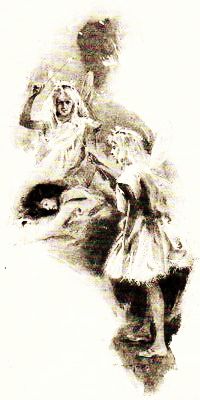
First Fairy. Do you know why she is so late in getting to bed?
Second Fairy. No.
First Fairy. She carried a bonnet to Miss Van Noir, with strict orders to see the lady herself, and find out whether the bonnet suited. Miss Van Noir was at dinner with a party of friends, and the maid would not disturb her. It was ten o'clock before the lady saw the little girl and tried on the bonnet. After that, to save her car fare, Ethel walked home. So, no wonder she is late and tired.
Second Fairy. I see no preparations for a Thanksgiving dinner in this house.
First Fairy. Ethel's mother is ill. She has lain in bed some weeks, and may never get well. If she could go to the hospital and have good nursing, she might recover. But she will not leave her little girls. She thinks she can look after them, although so ill. But there is no prospect of a Thanksgiving dinner here. That is plain to see.
Second Fairy. What does Ethel do to earn money?
First Fairy. She is cash-girl and errand-girl in a milliner's establishment. Every one in the house wants her, and sends her on countless errands, so that madame herself is not so tired sometimes at night as my little Ethel there.
Second Fairy. Poor little soul! How much better off she would be if she were a fairy! I never heard of a sick or tired fairy. Did you?
First Fairy. No. But though we never feel fatigue nor suffer hardship, we sympathize with mortals.
Second Fairy. Oh yes, we do!
First Fairy. Now I am thinking.
Second Fairy. What?
First Fairy. Could we get somebody to give these little girls a home and put their mother in a hospital, how nice it would be!
Second Fairy. Nice indeed.
First Fairy. I will summon the elfin messenger, and see what can be done.
Second Fairy. Count on my assistance.
[Fairies arise, make motions with their hands, and repeat,]
Hither hasten, lovely boy, Whom we fairy-folk employ; Here are errands to be done, Finished ere to-morrow's sun.
Enter Elgin, the messenger, a boy of six to eight years.
Elgin (bowing).
Fairies dear, I heard your call; Elgin is my name.
First Fairy. Come hither, good Elgin. Wilt run errands in the air for us to-night?
Elgin.
Only let me know your wish, I will do that same.
First Fairy. Behold yon sleeping child.
Second Fairy. She sleeps sweetly under our loving enchantment. Do you see her?
Elgin. Fairies, I do. 'Tis a young and gentle face.
First Fairy. Knowest thou a lady rich and lonely who would give a home to this girl and her sister?
Elgin.
You ask a most uncommon thing. Most mortals are so cold and hard, To wealth and luxury they cling, And if they give, they seek reward.
Second Fairy. But, Elgin, think. Rich, lonely, and with loving hearts. Are there no such among mortals?
Elgin.
A few, no doubt; To find one out, That is the enterprise. One can but try, And that will I Beneath the starry skies.
First Fairy. But prithee think quickly, Elgin, boy. Time waits not.
Elgin (musing). Idle and frivolous—she won't do. How would a maiden lady do? I know one living in a large and beautiful house, her father's dying gift. She has no one to love her, and no one to love. Shall I go to her, Fairies? One can but try.
First Fairy. Now you are my sweet Elgin. Ask her in dreams to-night. And, dear boy, on thy way bid hither the Genius of Thanksgiving and many of his sprites. We can arrange a little dinner for to-morrow.
Elgin. Depend on me, good fairies dear. [Exit.]
Second Fairy (walking to Ethel). She sleeps and smiles. Rest, sweet one.
Enter Rosy-cheeked Apple, a girl dressed in red cheese-cloth, and Golden Pumpkin, a boy in yellow.
Both Fairies. Welcome, sprites—Rosy-cheeked Apple and Golden Pumpkin. We have work for you to-night.
Rosy-cheeked Apple. It's frosty out to-night, so we ran and tumbled, and Golden Pumpkin there, jolly boy, rolled till we came hither.
Golden Pumpkin. 'Twas a merry game of tag, sister, and I won.
Rosy-cheeked Apple. Naughty boy, I won. Last tag was mine.
Golden Pumpkin. Well, then it's mine now.
[Touches her, and together they play tag around the room, nearly knocking over Nuts and Raisins, Red Cranberry, and Beets, Carrots and Turnips, who enter.]
Nuts and Raisins (dressed in brown). Why, here's fun! Let's join the game.
[All play tag.]
[Enter Genius of Thanksgiving, fat, jolly, corn-husks for hair, trimmed in any fantastic way with pop-corn, strings of raisins, apples, etc.]
Genius of Thanksgiving. Tut, tut, sprites! Not so fast, my fine fellows. Here, now. Peace! Silence!
[Catches one by the ear, shakes another, and soon the sprites are quiet.]
Nuts and Raisins. We were but having a little game of tag, master.
Genius of Thanksgiving. Another time, sprites. Now there's work to be done. Have you made your manners to the ladies? Oh, saucy children! Fairies, forgive them.
First Fairy. Since the sleeping child was not disturbed, 'twas of no consequence, sir. You were kind to come at our call, Genius of Thanksgiving. Here is a family that you have overlooked. There is no dinner provided for to-morrow. Is it too late?
WHY, NO, THE NAME IS NOT HERE!
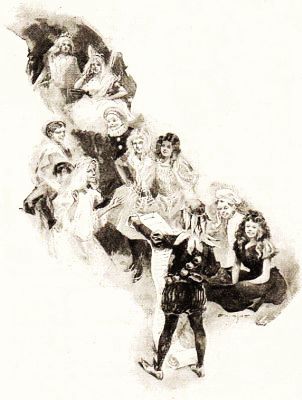
Genius of Thanksgiving. Why, how comes that? (Looks over a long list of names.) No, the name—what is it, Forrester?—is not here. Well, that's a sad omission. No, ma'am, it's not too late. Sprites, you must hustle and bustle, and get up a first-class dinner for the Forresters. Do you hear?
Sprites all. We hear—we will.
Genius of Thanksgiving. Are we all present? No. [Impatiently taps on the floor.]
Enter Purveyor of Turkeys, strutting. He gobbles.
Purveyor of Turkeys. Good-evening, master, and you, Fairies.
Genius of Thanksgiving. Sirrah, Purveyor of Turkeys, you're late. Have you a fine fat turkey left?
Purveyor of Turkeys. I have, sir. The demand was terrible this year, but I have laid by a few, thinking they would be wanted for late dinners.
Genius of Thanksgiving. Save us a good one, then—twelve-pound weight. Is that big enough, Fairies? The family is small, I believe.
First Fairy. That will do, sir.
Genius of Thanksgiving. Will you have it cooked or uncooked.
Second Fairy. Uncooked. But pray do not forget the stuffing.
Enter Miss Maize and Miss Corn Tassel, dressed in white and yellow.
Miss Maize. Who speaks of turkey stuffing? I will attend to that.
Miss Corn Tassel. Yes, we will furnish the bread and biscuit, the butter and thyme, and I can add the eggs.
Genius of Thanksgiving. Miss Maize and Miss Corn Tassel, young ladies, you are late. But there are others later still.
Enter Miss Grape, elegantly attired in purple.
Nuts and Raisins. Ah! See Miss Grape, our purple sprite. So pretty, so graceful! Did Master Frost speak with thee, child?
Miss Grape. He did indeed take my hand, and waltz me hither.
Genius of Thanksgiving. Nay, I warrant me, he stopped not there.
Miss Grape. He pressed a kiss upon my cheek. He said 'twould give it a richer bloom.
Genius of Thanksgiving. Well, naughty, pretty child, canst give us grapes for our Thanksgiving dinner?
Miss Grape. That can I, both white and black, pretty to look upon, sweet to taste, and no harm within.
Genius of Thanksgiving. So? Good! Child, do. And you shall have my thanks.
Enter Miss Mince Pie, dressed in mixed black and white.
All shout. Oh, late Mince Pie! What has made thee late?
Miss Mince Pie. Your honor, I got lost. I thought I would take a short way hither, and it proved thrice as long as the other. I came whizzing, and nearly left my breath behind me.
Genius of Thanksgiving. Next time, Miss Mince Pie, take your shortening in your crust, and don't put it into your feet. But listen. Have you spices and boiled cider, apples and beef, so as to make us a right merry mince pie to eat after the Forresters' turkey to-morrow? Good heavens! It's to-day. The night is waning. We must hasten.
Miss Mince Pie. Your honor, as fine a mince pie as ever went on a Thanksgiving table shall be ready for Ethel Forrester's dinner to-morrow.
Genius of Thanksgiving. Thanks. And now where is the cranberry jelly?
Red Cranberry. Your honor, I have a fine mould ready.
Genius of Thanksgiving. Ah! Red Cranberry, you are just the sprite to attend to that. And Beets, Carrots, and Turnips?
Beets, Carrots, and Turnips. Here, sir. I will furnish a goodly array of vegetables.
Genius of Thanksgiving. Golden Pumpkin, a pie from you, rich, thick, and yellow. Plenty of cream and eggs, sirrah.
Golden Pumpkin. I know a good pie when I see it.
Genius of Thanksgiving. Rosy-cheeked Apple, some of your best, please?
Rosy-cheeked Apple. I have beauties, sir.
Enter Elgin.
Elgin. Good-morning, your honor, and you, sprites. I was hurrying here, and passed a beautiful young lady combing her hair. She seemed nowise in a hurry. Miss Celery—
All. Miss Celery! Where is she? No dinner can be complete on Thanksgiving day without her.
Enter Miss Celery, dressed in white and green.
Miss Celery. Did you call? I did but sleep a little, but methought you called.
Genius of Thanksgiving (sternly). We did call. 'Tis no time to sleep, the night before Thanksgiving. Have you, miss, two nice crisp bunches of celery?
Miss Celery. Yes, your honor, four if you like.
Genius of Thanksgiving. No, two. But your very best. And now, Fairies, the dinner is arranged. The night passes. My sprites must be busy. Go, children, weave a spell over the ovens. Let nothing burn. Have everything well baked. See to the dinners of the poor as well as the rich. Let no one go hungry on Thanksgiving day. And see to it that Ethel Forrester's dinner is complete.
First Fairy. Dear good Genius of Thanksgiving! How can we thank you enough?
Second Fairy. Dear friend, how old are you? Pardon the question, but I am mystified—you seem so old and so young.
Genius of Thanksgiving.
Ah! ask me an easier question; I am older than any one thinks. Why, I've perched on the eaves of Palmyra, And slept on the breast of the Sphynx. But yet I am young as the youngest, With a heart that can never grow old, For my work is Love's own inspiration, Defiant of hunger and cold. So, Fairies, to you let me bow my adieu. Come, sprites, with a whir and a flurry, To get this well done will be jolly great fun, But I tell you we'll all have to hurry.
[Exeunt Genius and sprites.]
First Fairy. What a splendid fellow Genius of Thanksgiving is! So well preserved!
Second Fairy. Doubtless he may live a thousand years yet.
First Fairy. I hope he may.
Elgin. As fine a fellow as ever breathed. But, Fairies, the morning dawns. Have you further commands for your most willing servant?
First Fairy. No, thank you, boy. You have nobly done. We can only thank you.
Elgin. The Fairies' thanks are sweet reward. I go, then, to my mountain cave, where all the day I lie and sleep, and when night comes I wake again and fly and run in the sparkling night air. [Exit Elgin.]
Second Fairy. This night's work could not have been done save for that merry boy.
First Fairy. True. He is a treasure. But now we must remove the charm from Ethel, and waken her.
[Both advance to the bed, and stand one on each side of Ethel. Fairies repeat the waking charm:]
Wake, dear one, wake; unclose thy rested eyelids; The night is gone, the beauteous morning breaks. The angels know the day will bring you gladness, So please accept the gifts that Heaven makes.
[Ethel stirs, the Fairies step lightly towards the door.]
Second Fairy. They say mortals do not believe in us.
First Fairy. Perhaps Ethel will when she sees the basket of good things which even now I hear the sprites leaving at the door. But let us hasten—the dawn will come.
[Exeunt Fairies. Ethel moves, sits up on the bed, looks around the room, rubs her eyes, and seems bewildered.]
Ethel. Are they all gone? How beautiful—fairies and sprites in my poor little room! (Smiles.) Only a dream, I suppose. But so real. What a funny old Genius of Thanksgiving it was! [Laughs aloud.]
Enter Elise with a note.
Elise. Oh, sister, I heard you laugh, so I knew you were awake; otherwise I would not have disturbed you, for you, poor thing, were so tired last night. But, Ethel, a most wonderful thing has happened. So wonderful, it seems like a dream.
Ethel. The night abounds in dreams. I have had one. I must tell it, if I can.
Elise. But hear mine first, dear. I think it was about two o'clock when I heard feet in the passageway and a noise at the door. I was frightened, but did not alarm mother; for why should burglars visit our poor home? After a while the noise ceased, and I ventured to get out of bed and softly open the door. There stood—what do you think, Ethel?
Ethel. I know.
Elise. No, you don't, you goose.
Ethel. I do know.
Elise. Silly child. Listen, a large basket—
Ethel. With our Thanksgiving dinner in it—a turkey and cranberry jelly. Oh, how pretty Red Cranberry was in her bright dress—and Nuts and Raisins—and Beets, Carrots, and Turnips—what a funny boy he was.
Elise. Ethel! are you ill?
Ethel. No, dear. And Miss Mince Pie was late, but she got there, and Golden Pumpkin was to make a pumpkin pie—
Elise. You are out of your head! Oh, my poor sister! you are coming down with a fever on Thanksgiving day—[Begins to cry.]
Ethel. Nonsense, darling. It was my dream. But I will wait and tell you about it later. Go on with your story. I am not ill.
Elise. Are you sure? You talk so strangely.
Ethel. I'll prove it soon by helping to eat the best dinner in all the land. Oh, Elise, we will have as good a dinner as the queen! [They hug each other.]
Elise. Well, there's everything nice in that basket. I was so impatient, I put my hand in and felt to the bottom.
Ethel. Are the grapes and celery there?
Elise. There are black grapes and white, dear—mamma will like those—and two lovely bunches of celery.
Ethel (laughs). Excuse me, but Miss Celery was late because she was combing her hair and taking a nap.
Elise. Sister!
Ethel. That's in the dream too. But it was funny. What is that note?
Elise. A letter lay upon the top of the basket, addressed to you. I have not opened it. Do hurry and read it.
Ethel (opens and reads).
"My dear Ethel,—For some time I have had my eye upon you. I see in you a brave little girl struggling under burdens too heavy to be borne; your little sister is scarcely less brave and sweet in the care she gives her sick mother. She wins my love also. Children, will you come and live with me for a while? I will send your mother to a private room in the hospital, where she shall have everything to make her better. God grant she may recover! Meanwhile, and for as long thereafter as you and mamma are willing, you shall stay with me and be my little girls. When mamma is well, why, we have a house big enough for her too. My coachman will place at your door, during the night, your Thanksgiving dinner. I hope it will taste good. I will call in the course of to-morrow afternoon, and learn if you are coming to me. Remember, children, I need you. My heart is a mother's although I am an old maid, supposed not to have any heart. Will you come to
"Your loving friend, "Phebe Wilson.
"P.S.—I have spoken to madame, and Elise is not to return to her work there. She may call the morning after Thanksgiving and receive what wages are owing her."
Elise. How wonderful! It is all like a fairy story!
Ethel. It is a fairy story. I did not know who was going to take us, though. Elgin did not mention her name. But I wonder I did not think of Miss Wilson. She is rich and lonely, and has a warm heart. Those were Elgin's conditions, and he found her.
Elise. Elgin?
Ethel. That's the dream again. Come, Elise, let us see if our dear mother is awake. I am nearly bursting with this good news. And I must tell you my dream. For, you see, the letter and the basket just agree with the dream. And after I have told my dream, and we have read the letter, and seen our Thanksgiving dinner, why, if you and mamma don't believe in fairies, you're funny people, that is all. (Kisses her hand to the air.) I believe in you two dear fairies, at all events.
Exeunt.