THE ARMENIAN RELIEF COMMITTEE OF
Reading edition
WASHINGTON SQUARE.
A Comedietta in One Act.
BY EDITH V. BRANDER MATTHEWS.
Characters:
Miss Silvia Brown, hostess.
Miss Harriett Spaulding.
Miss Grace Dunlap.
Miss Rose Hallam.
Miss Pauline Davenport.
Miss Catherine Cruger.
Time.—Present.
Place.—Miss Silvia Brown's home, overlooking Washington Square.
Scene.—Parlor. Fireplace in flat centre. Door in right upper corner. Low table to left of fireplace. Six chairs arranged in a semicircle in centre of stage. At rise of curtain Silvia is discovered seated in a big arm-chair to left centre, busy reading.
Silvia (dropping book in her lap as the curtain rolls up). Oh, dear! I do wish those girls would come! I begin to feel nervous. (Fretfully.) I don't see what good we girls can do, anyhow. We can't prevent those hideous old Turks from scratching the eyes out of the poor Armenians. Oh, why did Miss Peabody suggest that we girls of the graduating class of the Peabody School (mimicking) should form ourselves into some sort of a society in order to keep up the pleasant friendships begun at school? She might have known Catharine Cruger would want us to undertake some outlandish thing or other. (Sarcastically.) Of course dear Catharine no sooner returned to town this fall than she reminded us of Miss Peabody's parting injunction, and proposed we should try to relieve the unfortunate Armenians. It will be so easy, so simple. (Angrily.) To think that I was idiot enough to offer to have the meeting here! But I won't have anything to do with the matter, no noth—
Rose (entering door right upper corner). Good-afternoon, dear. I hope I am not late?
Silvia (shaking hands, but still somewhat ruffled). Oh no, dear! it's only three-quarters of an hour past the time.
Rose (serenely). Oh, I am so glad I am the first, for I haven't had time to look up where Armenia is, so do tell me, dear, before the girls come (taking off her veil). I really meant to have been here earlier, but as I passed Madame Jacquin's I saw such a love of a theatre hat I simply couldn't resist going in to try it on.
Silvia (with interest). What was it like?
Rose. A soft crown of gold-brown velvet, with the cutest little net-work of gold beads, held on with little loops of blue—
Harriet (appearing in the doorway). Oh, girls, I have hurried so, and I can't stay but a few minutes, for I promised to meet mamma at Mrs. Draper's in half an hour! It's a musical, you know, and I've simply got to tell Kitty Draper all about the Leap-Year Ball.
Grace (entering hastily, and out of breath, addressing Harriet). I saw you ahead of me and tried to catch up, but you walked like a steam-engine. (To Silvia.) Why, where are the rest?
Silvia. I don't know. Pauline promised to be here early, and she is an hour late now.
Pauline (coming in as Silvia utters the last words, laughingly). Now do have the grace to say "better late than never."
Silvia (smiling). "Eavesdroppers never hear any good of themselves" would be a more suitable proverb. But are we really all here? (Looks around.) No, Catharine is missing.
Grace (mischievously). Absent would be a better word.
Rose. Well, do let's begin. I can't stay more than fifteen minutes. I ought to be trying on my new mousseline de soie this minute. (Becoming enthusiastic.) Really, Madam Mosset has outdone herself. Why, she has put the dearest, little folds of—
Harriet (interrupting, wearily). What are we to do, anyway?
All. I don't know.
Grace (pulling out a letter from her pocket, and reading). Catharine says we are an Armenian Relief Committee. (Helplessly.) What do we have to do?
All (wailingly). I don't know.
Grace. Let Silvia tell us; she's hostess.
Silvia (despairingly). I haven't the faintest idea what we can do. Catharine suggested this meeting, and she ought to be here to help us.
Harriet (gloomily). If Catharine were here she would make us do just as she pleases. (With awe.) She has been studying parliamentary law.
All (much impressed). No! Really?
Grace. Well, suppose we think hard for a few minutes, and then tell our ideas. [Silence.]
Pauline (suddenly). Couldn't we— No, that wouldn't do.
Harriet. Perhaps we might— No, I'm afraid that wouldn't do, either.
Rose. Do they need clothes? We might send them a trunkful or two.
Silvia (doubtfully). No, I don't believe they need clothes particularly. (Then quickly.) I've heard that they suffer horribly from hunger.
Harriet. Splendid! Then we can send them some canned soups and potted meats and—
Pauline (sarcastically). And lobster salad and fried oysters. No, girls; really, I think if we got our brothers to give us their old guns and bought a few new ones it would be the best thing. My brother said last evening they were unarmed, and couldn't defend themselves.
Grace (humming to the air of "If you want to know the time, ask a policeman"). Won't you come and have a Gatling-gun with me?
Pauline (ruffled). Well, then, suggest something better yourself; only my brother said—
Harriet (energetically). I know one sure thing. I will have nothing to do with any fair. I'll do almost anything else you girls want, but after standing five hours steadily, and only selling four dollars' worth of rubbish last year at the Golden Rule Fair, I made a solemn vow I would scrub before doing such a thing again.
Silvia. I quite agree with you, my dear. Fairs are immoral. I've told more lies at my last fair trying to get people to buy things they didn't want than I ever expect to be guilty of again till—(hesitating)—till the next one.
Rose (thoughtfully). Fairs are tiresome, but a costume fair would be lovely.
Grace (shaking her head). No fairs for me. I spent six months for the last one doing drawn-work on twelve doilies, and then Mrs. Miller bought them at twenty-five cents apiece for handkerchiefs for her little girl's doll!
Pauline (importantly). Well, my brother says he thinks lotteries and fairs are all on a par, for at the former you lose your dollars, and at the latter you lose your sense.
All (groaning). Oh, Pauline!
Grace. Well, at least we have settled what we won't do, so let's think up something we can do. Come, Silvia, you suggest something.
Silvia. Why can't we give tableaux-vivants, and send the money we get to our ambassador at Constantinople for distribution?
Rose. Lovely!
Pauline. Splendid!
Harriet. Oh, I can't!
Grace. Oh yes, let's!
Harriet (despairingly). Oh, I'm so sorry! I wish I could join you girls in this, but mamma has forbidden my taking part in tableaux.
All. Why?
Harriet. Because this summer at Newport Mrs. Miller got up some tableaux in her barn for the benefit of ship-wrecked sailors, and the next day the papers had a full account of it, and fancy pictures of every one, and they represented me, in what looked like a night-gown, posing airily for Maid Marian under a tree.
Rose. How shameful!
Silvia. Naturally we can't have that; but what can we—
Catharine (entering). How do you do, girls? I must apologize for my tardiness, Silvia, but I had to go shopping, and was delayed. (Seating herself.) Now what have you girls decided on doing?
All (wofully). Nothing.
Catharine (springing up). Do you mean to say you are going to do nothing? Nothing, when thousands of unfortunate Armenians are being massacred daily, and thousands still are homeless, hungry, and destitute; when—
Silvia (exasperated). We didn't say we weren't going to do anything: we simply said we hadn't decided what to do.
[All try to explain at once.]
Pauline. My brother says they need arms—
Harriet. Silvia said tableaux; but I can't—
Grace. Perhaps if we simply got—
Rose. We might give a fancy dress b—
Catharine (putting her fingers in her ears). Look here, girls; if we all talk at once, we won't decide on anything. Now I've studied Parliamentary law, and I know we ought to have a chairman and a secretary. Suppose we nominate?
All. Oh yes; you be chairman!
Catharine. But you must vote. (Rising.) All those in favor of Miss Cruger serving us as chairman will please say aye.
All (half paralysed). Aye!
Catharine. It is a unanimous vote, and Miss Cruger is elected. (Goes over to centre of stage and takes middle chair.) Will you please nominate a secretary?
Rose. You be secretary, Harriet.
Harriet. No; you be it.
Rose. Well, let's have Pauline.
Pauline. I can't. I never should know what to do. My brother says—
Catharine (rapping on back of chair). The meeting will please come to order.
Pauline (with a gasp). I—I only wanted to say—[Collapses and remains silent.]
Catharine (impatiently). Well, are you going to nominate?
All (except Harriet). You be secretary, Harriet.
Harriet. I really don't want to be. I—
Catharine. Miss Spaulding has been nominated. All those in favor of Miss Spaulding acting as secretary will please say aye.
All. Aye!
Harriet. But I don't know what to do.
Catharine. You're chosen to act. I'll tell you what to do. (Turning to the others.) The first business to come before this meeting is how and in what way can we help the unfortunate Armenians?
Rose. I think it would be better—
Pauline. My brother says they can't—
Catharine. One at a time, please. Miss Hallam has the floor.
Rose (nettled). I was only going to suggest—that is, I thought perhaps it would be as well—(weakly)—but I am not at all sure— [Subsides.]
Catharine (severely). Miss Davenport now has the floor.
Pauline (bravely). Well, I simply wanted to say, if the girls agreed, that as my brother says they need arms, it might be a good thing for us to send some guns over; but (beginning to falter) I don't know how we could reach the poor things 'way off in Armenia.
Catharine. Has any one any further remarks to make? (Girls sit in crushed silence.) Then I would like to suggest that we give a fair for the benefit of the Armenians.
Silvia. I don't like fairs, and I don't believe the other girls do.
Catharine. Then why don't you rise to a question of consideration. [Silvia, nonplussed, remains silent.]
Pauline. Fairs mean hard work, and don't pay; besides, we should have to have it so soon.
Catharine. Kindly make your suggestions in the form of an amendment.
Pauline (not knowing how, and not liking to admit it, hastily). Oh, it's of no consequence.
Rose (animatedly). The only fair I ever enjoyed was during the Columbia celebrations, when we all dressed up as Spanish court ladies, and—
Catharine. Please confine yourself to the question at issue.
Harriet } (timidly). But we don't want a—
Grace }
Catharine. Miss Spaulding has the floor.
Harriet (in a fright). Oh no; you speak, Grace.
Grace. No, you speak; you began.
Harriet. Yes; but you can say it so much better.
Catharine. You are both out of order. Private differences of opinion should be settled after the meeting. (Silence.) Are there any further remarks? (Slight pause.) If not, I will add to the suggestion that we have a fair, that we six originators act as patronesses, and each secure the help of five of our friends. That we then engage Sherry's ballroom for an afternoon, and give a tea. Useful things only to be sold, such as lamp shades, sofa cushions, and all household necessities—dusters, glass-towels, wash-rags, etc. The admission to be by invitation, and the proceeds to be given to the Clara Barton Fund—
Girls (interrupting). Hurrah!
Catharine (continuing, calmly). All those in favor of accepting this suggestion will please say aye.
All (meekly). Aye!
curtain.
BY GASTON V. DRAKE.
XVII.—FROM BOB TO JACK.
(Continued from last week.)
After you leave the Bois de Bologne you don't see much until you get to where the Palace of St. Cloud used to be, and even then you don't see much either, because there isn't much left to see. It's had hard luck St. Cloud has. It probably got more licking during the war with Prussia than any other town in France. Everybody took a whack at it. When the Germans weren't having fun with it the French would bombard it, until finally almost every house in it that hadn't already been shaken down, or bowled over with cannon-balls, was burned together with the Palace. It's a nice-looking old ruin though, and Jules says that on Sundays it fairly swarms with babies and lemonade stands. I'd sort of like to see it some Sunday, but Pop thinks Sunday is the best day to look at the churches.
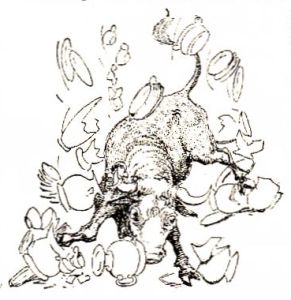
There's another interesting place you pass on the way out to Versailles and that is Sevres where they make bric-a-brac. They make great big vases there that weigh so little you feel as if you ought to put a brick inside 'em to make 'em stay down. Jules was stationed here during the war, and he says it was fine. He could see all the big fires, and all the skirmishes that took place, and everybody had a sort of a notion that sooner or later there'd be a big crash in the bric-a-brac shop and Jules is just a human being like the rest of us. He hated to have the bric-a-brac smashed but if it had to be smashed he wanted to be on hand to see it go. That's me all over again. If I had my choice between seeing a King or a President of the United States, and a bull in a china shop, I think I'd choose the bull. When you think of how he'd toss tea-cups around and lash his tail around pile after pile of dinner plates and soup tureens—well, there's no use trying to describe a sight like that, but it's what Jules was waiting for at Sevres and it never happened. War is full of disappointments anyhow. Pop's uncle went to war once and he says it isn't a bit like the pictures. He says these parlor tableau generals with spick and span clothes on and horses rearing on their hind legs with their ears cocked aren't so, which I don't like to hear and I didn't believe it but Jules says it's true. He says making mud pies is clean alongside of war. I have had more ideas busted since I came over here than I ever thought one person could have. Dukes are plain, Kings are human, and war is not all bands and flags and glory but just grimy scrapping. I'm sure I don't know what to believe in any more.
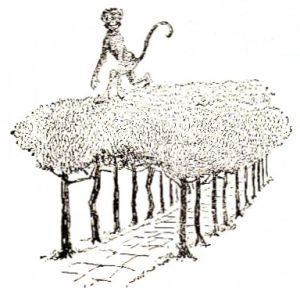
After a while, after we'd driven through lots of pretty country we entered the town of Versailles, where the great palace is, and I tell you it was magnificent. Most of the Avenues have great trees arching over them, and when I say arching I mean arching because they are all trimmed and not allowed to grow foliaginous—that's one of Aunt Sarah's words—the way we let our trees grow at home. If a giant came walking by he'd think the trees formed a hedge, they grow so thickly together and are kept square cut on the top and arched underneath. They look as if an army of barbers had tended 'em all their lives. I don't think I'd like it always but once in a while it's interesting to see trees growing that way, and if I were a monkey there's nothing I'd like better than it because I could walk mile after mile from tree to tree without having to come down once.
As for the Palace of Versailles the best way to describe it is what Aunt Sarah said. "It baffles description" was what she said and that's what it does. It's so big in the first place that you can't take it in without looking eight or ten times, and when you try to go through it and see all there is to be seen you wish you had a year to spare to do it in. Such pictures, such sculptuary, such bric-a-brac you never saw before unless you'd been there before.
They had 36,000 men working on the Palace grounds at one time. When Pop heard that he nearly fainted. He gave me a sum in mental arithmetic to do. If our hired man can loaf three hours a day, how many hours a minute, can 36,000 hired men loaf. That's a dandy. Eh? Some time when I haven't anything else to do I'm going to work it out.
Once a lady wanted to go sleigh-riding in July out here, and she told the King, and he said all right go ahead, "Where'll I get the snow?" she said. "That's easy," said the King. "You get ready and it'll be all right." Pop says the King thought it would take her until winter to get her hat on straight, but it didn't. She was ready next morning, and he took her sleigh-riding over a road he'd had covered with salt. That's the way Kings did things, and that's why they discharged 'em.
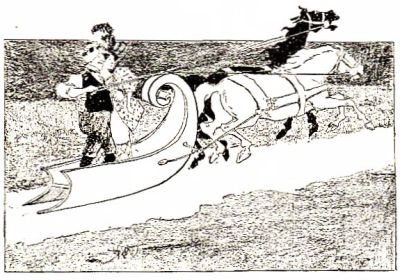
We saw the royal carriages too, and they were royal. Gold all over even the wheels—just like the band-wagons at the circus. Some of 'em looked like show-cases, and Aunt Sarah says that's what they were and she's glad that day is gone when people liked that sort of thing and that's where she's wrong because that day hasn't gone. "People like it yet but they hate to pay for it," Pop says, and I guess that's it. That's what's the matter in France. They've got lots of beautiful things, but they've had to pay too much for 'em. This one palace cost a thousand million francs to build it which is two hundred million dollars, and after that they had to furnish it and keep it up, which made taxes so high that nobody had anything left, and when people haven't got anything left they're apt to get a little cross, which is what they did here, only they got cross with the wrong man, cut off the head of a King that didn't have anything to do with it, which strikes me as a poor way to get revenged on his great-grandfather.
It is long past bed-time and I must quit. I've made this letter pretty long because I've sort of hated to go to bed. Jules told me about the guillotine to-day, which is a sort of spile-driver with a knife in it to cut people's heads off, and I'm afraid I'm going to dream about it. Still I can't sit up forever and so good-night.
Bob.
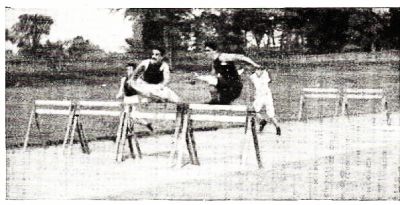
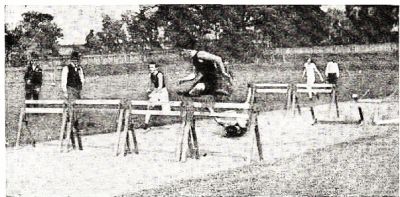
N.Y.I.S.A.A. GAMES: THE 120-YARD HURDLE RACE, FINAL HEAT—SHOWING (1) BIEN AND BEERS EVEN AT THE THIRD OBSTACLE, AND (2) BEERS FALLING AFTER STRIKING THE SEVENTH, BIEN WINNING.
1.
2.
N.Y.I.S.A.A. GAMES: THE START AND FINISH OF THE FINAL HEAT IN THE 100-YARD DASH.
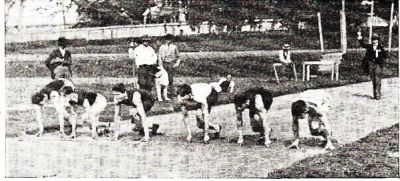
Harris. Patterson. Moore.
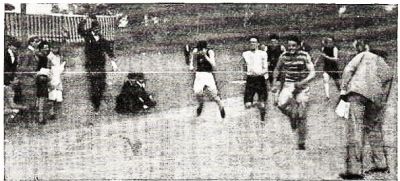

The field-meetings of the New York and Brooklyn Interscholastic leagues were held a week ago Saturday, the former on the Berkeley Oval and the latter at Eastern Park. In many respects the Brooklyn athletes' performances surpassed those of the New-Yorkers, and in point of record-smashing the Long-Islanders were far ahead. Only three New York Interscholastic figures were lowered, whereas in Brooklyn nine out of fourteen were upset.
There was a number of surprises at the New York meeting. The first was Irwin-Martin's defeat by Washburn in the quarter-mile run. Martin started off badly, setting too hot a pace, and took the lead for the first quarter of a lap. Then Hipple and Washburn broke away from the bunch, and when three-quarters of the distance had been covered Washburn forged ahead of the Berkeley man, with Hipple close behind him, leaving Martin in third place. In this way the three raced down the stretch, and crossed the line in that order. This hard race took a good deal of the starch out of Hipple, so that when it came to the half-mile he was not fresh enough to do any record-breaking. He ran well, however, and came close to the mark; Draper of Cutler's ran a beautiful race in this event, leading most of the way, and took second, beating Bedford.
C. W. YOUNG PUTTING THE SHOT.
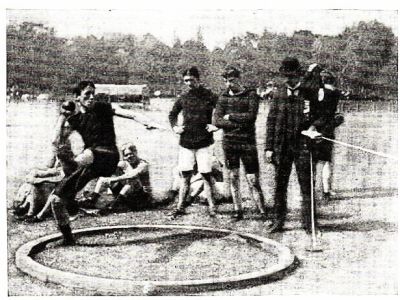
The half-mile tired Bedford for the mile, and Hipple had very little speed and endurance left in him after the gallant work he had already done. Nevertheless, both of these Barnard runners toed the scratch with a large field, and started off pluckily. They staid behind from the start, and it was soon evident that Bedford could do nothing. Turner of Cutler's and Clark of Condon's took the lead, and ran beautifully. Hipple, after trying to urge his schoolmate on for a couple of laps, left Bedford, and worked his way slowly and laboriously to the front. But he could not do anything against the fresh leaders, and deserves great credit for taking the place he did, especially as Turner broke the interscholastic record for the distance. In spite of being the last man, Bedford ran pluckily, and did not leave the cinder path until he had crossed the finish and covered the distance. The quality which led him to do this is called "sand," and if every athlete would follow Bedford's example in the many hopeless races that they are forced to run, and "stick to their colors," it would raise the standard of performance in a great many cases.
Both of the senior sprints went to Moore of Barnard, and both of the junior sprints went to Leech of Cutler's. These two men are very fast. If they had not had to face an unfavorable wind, they would doubtless have made better time; as it is, the performances are not to be ashamed of. Both Moore and Leech had an easy time of it in their heats, outclassing all their opponents. They seemed to be aware of their superiority—too much aware of it, I am afraid, because Moore especially lost a fraction of his speed by continually looking back. This is a very bad habit to get into, and no matter how slow the other men are, there is no excuse for the leading sprinter to look back.
NEW YORK AND LONG ISLAND INTERSCHOLASTIC GAMES.
Records Previous to May 16, 1896.
Event.
100-yard dash10-3/8sec.
100-yard dash (Jun.)11"
220-yard dash22-4/5"
220-yard dash (Jun.)23-4/5"
440-yard run52-2/5"
880-yard run2m.4-1/5"
Mile run4"52"
Mile walk7"30-2/5"
Mile bicycle2"34-2/5"
120-yard hurdle15-3/5"
220-yard hurdle26-3/5"
High jump5ft.11in.
Broad jump21"5"
Putting 12-lb. shot40"¾"
Throwing 12-lb. hammer117"5½"
Pole vault10"3/8"
N. Y. I. S. A. A. Games, Berkeley Oval, May 16, 1896.
Event.Winner.
100-yard dashR. W. Moore, Barnard.10-3/5sec.
100-yard dash (Jun.)D. C. Leech, Cutler's.11-1/5"
220-yard dashR. W. Moore, Barnard.23-1/5"
220-yard dash (Jun.)D. C. Leech, Cutler's.25-1/5"
440-yard runH. L. Washburn, Barnard.52-2/5"
880-yard runW. S. Hipple, Barnard.2m.5-4/5"
Mile run*W. S. Turner, Cutler's.4"49-3/5"
Mile walkJ. R. Walker, Berkeley.7"56-1/5"
Mile bicycleH. M. Ridabock, Barnard.2"48-3/5"
120-yard hurdleF. Bein, Jun., Berkeley.15-4/5"
220-yard hurdleD. G. Harris, Cutler's.27"
High jumpT. R. Pell, Berkeley.5ft.6in.
Broad jumpT. R. Pell, Berkeley.20"5"
Putting 12-lb. shotC. W. Young, Berkeley.39"9½"
Throwing 12-lb. hammer*C. R. Irwin-Martin, Berkeley.123"5"
Pole vaultJ. L. Hurlburt, Jun., Berkeley.10"7¾"
Long Island I. S. A. A. Games, Eastern Park, Brooklyn, May 16, 1896.
Event.Winner.
100-yard dash*A. W. Robinson, St. Paul's.10-2/5sec.
100-yard dash (Jun.)*A. W. Robinson, St. Paul's.10-2/5"
220-yard dashIra Richards, Poly. Prep.23-4/5"
220-yard dash (Jun.)——-
440-yard run*W. L. Van Wagenen, St. Paul's.53-3/5"
880-yard run*C. M. Hall, St. Paul's.2m.6"
Mile run*P. Christensen, B'klyn High.4"54-4/5"
Mile walk——-
Mile bicycleO. L. Roehr, Poly. Prep.2"40-3/5"
120-yard hurdleL. S. Herrick, B'klyn H.-S.16-3/5"
220-yard hurdle*L. S. Herrick, B'klyn H.-S.29-2/5"
High jump*C. L. Duval, B. L. S.5ft.7in.
Broad jumpW. Girrash, B'klyn H.-S.18"3"
Putting 12-lb. shotB. P. Kinney, St. Paul's.41"9"
Throwing 12-lb. hammer*H. J. Brown, St. Paul's.123"11"
Pole vault*J. A. Forney, Adelphi.9"6"
* Record broken.
Walker of Berkeley, as had been anticipated, had it all his own way in the walk, and won easily in excellent form. The real race was for second and third. These places were taken by McCracken of Berkeley and Coffin of Cutler's.
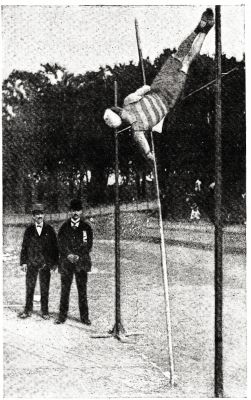
J. L. HURLBURT, JUN., VAULTING 10 FT. 7¾ IN.
The hurdles furnished some exciting heats. Bien of Berkeley took his trial, and Beers got first in the second heat. Beers ran in faultless style on this occasion, but when he met Bien in the finals he seemed to lose his nerve and to go all to pieces. He scraped most of the obstacles, and after Bien had passed him he stumbled even more clumsily, and took an ugly header on the track. Beers is a very clever man over the high hurdles, but if, as it seems, he becomes affected by the prowess of an opponent, he should strive mightily to overcome this weakness. He has frequently covered the distance in better than Bien's winning time. In the low hurdles Beers met Bien in the trials, and ran second; but in the finals he seemed to go to pieces again, although he managed to keep his feet until the last hurdle, where he fell again, and allowed Harris to win. He recovered himself in time, however, to keep Bien in third place.
Berkeley took every field event, winning all the points in the hammer. Here Irwin-Martin made up for his loss of the quarter by breaking the interscholastic record. Young, who took second, also broke the record, and Galloway, who took third, came within three feet of the mark. Young scored again for his school by taking the shot, and T. R. Pell earned a double win in the jumps.
One of the best performances of the day was Hurlburt's pole-vaulting. He fulfilled every one's expectations, and broke the interscholastic record of 10 ft. 3/8 in. by clearing 10 ft. 7¾ in., and his work was performed in faultless style. His nearest opponent, Brown of Drisler, reached no greater height than 8 ft. 9 in.
No better argument in favor of the abolishment of the bicycle-race from the interscholastic programme could be offered than Saturday's performance. It was not a race in the final heat, and it is not certain that the best man won. It was simply luck that kept Ridabock out of the mix-up which ruined the chances of every other competitor, twisted one or more wheels, and caused any number of bruises and scratches. The bunch was going around the lower turn, at the end of the second lap, when Ridabock spurted and got clear of the field. No sooner had he done so than Harbeck of Cutler's tried to follow him. Harbeck fell, and every other racer piled on top of him. By the time the tangle had been straightened out Ridabock was three-quarters of a lap in the lead, riding easily, and looking back complacently. This was a big piece of luck for Barnard, and enabled her team to tie Cutler's score. If it had not been for this, the latter would probably have gotten at least five points, if not more, out of the event, and would have been a closer second than she was to Berkeley.
J. R. WALKER,—AND THE FIELD.
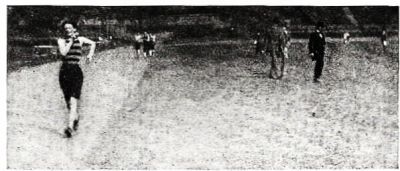
The Interscholastic Cup now becomes the permanent property of the Berkeley School, her winning score at Saturday's games being 48 points. Barnard and Cutler tied for second place with 36, and Trinity came next highest with only 7.
In the Long Island games St. Paul's School of Garden City led all the way, and made the excellent record of 51 points, taking six firsts, six seconds, and three thirds. St. Paul's has a fine lot of sprinters, but the leader of them all is A. W. Robinson, the very swift young man who took both the senior and the junior hundred yards in 10-2/5 sec., breaking the record in both cases. He ought to take the event at the National games, or, at any rate, give Moore a very hard race. In the 220, Goetting of Brooklyn High was a little nervous at the scratch, and was penalized. This put him at a disadvantage, and he failed even of a place, the race going to Richards of Poly. Prep.
In the quarter, Van Wagenen of St. Paul's took the lead from the start, set a hot pace, and won easily, breaking the record. His schoolmate Hall followed his example in the half, and broke another record. Christensen of Brooklyn High did good work in this race, but showed himself to be better at the longer distance. Here, too, he had a race with Hall, but in this case he defeated the St. Paul's man.
Both the hurdles went to Herrick of Brooklyn High. In the longer distance he was penalized by two yards, but in spite of this he reached the tape first, and broke the Long Island interscholastic record.
In the field events the Long-Islanders averaged better than the New-Yorkers, Duval jumping 5 ft. 7 in., one inch better than Pell; Kinney putting the shot 41 ft. 9 in. to Young's 39 ft. 9½ in.; and Brown throwing the hammer six inches further than Irwin-Martin, and also breaking his League's record. Forney of Adelphi did not do so well as Hurlburt in the pole vault, but this was hardly to be expected. Nevertheless, he bettered the previous record of the Long Island Association.
The papers on track athletics that have appeared from time to time in this Department are published to-day in book form under the title of Track Athletics in Detail. The aim of the book is to give clearly, accurately, and concisely the best available information concerning the methods of training for track and field events as practised by college and school athletes. The idea has been to furnish to the aspiring athlete the knowledge which he could otherwise obtain only from a professional trainer, and, where professional trainers are unavailable, this book should prove of especial value.
The events treated are limited to those recognized as standards by the Intercollegiate and Interscholastic Associations. Each one is treated as briefly as is consistent with thoroughness, and each article is illustrated with instantaneous photographs taken of the best exponent in each particular event. The illustrations are arranged in series, as they were when they first appeared in these columns, and show the attitude of the athlete at every important point in the performance of his specialty. The book should be especially valuable as being up to date in every particular, even to the table of records in the Appendix.
The Graduate.
An Evening with Battle Heroes.
Now that the summer gayeties will soon be on us in full force, and entertainments of every conceivable character, old and new, are in demand, worthy Knights and Ladies of Chapters far and near are doubtless ready to arrange an evening for charity or pleasure, and I can safely recommend "An Evening with Battles and Battle Heroes" as a very acceptable entertainment.
Some explanation of the last number is necessary. The scene is enacted by a quartet of young men in Zouave uniform. An artificial camp-fire is constructed with the aid of handsome logs, crimson paper, and, if possible, electric light, though kerosene or candles will serve. It is needless to go into particulars; a member with mechanical ability will find no difficulty in making a very realistic camp-fire. The room is darkened while the logs are being set. The quartet recline about the fire, and two of them tell short, pithy war-stories. Then follow some war-songs; Root's "Tenting on the Old Camp Ground" is a beautiful selection.
Programme.
1. Piano Solo.—"Le Trot du Cavalier," Spindler.
2. The Death of Hamlet and Laertes; "Hamlet": Act V., Scene II., (all but these two parts may be omitted if preferable.)
3. Cornet Solo.—"La Marseillaise," Rouget de Lisle.
4. Discussion.—"Who was the Greater General, Hannibal or Cæsar?" (Delivered by two members.)
5. A Recollection of '63.
This programme will not occupy so much time that there will not be a half-hour or so of conversation, with opportunity for serving refreshments. Plenty of ideas concerning decoration, costuming, etc., will come to the members once they are given this outline.
Vincent V. M. Beede, R.T.F.