CATCHING SHAD FOR MARKET.
Reading edition
BY J. PARMLY PARET.
Hooks and lines are about as useless in shad-fishing as nets would be if eels were wanted. Not one of those long rows of shad you see in the markets was caught with a hook. They were all foolish enough to swim straight into nets spread out to trap them, and they hadn't sense enough to swim out again. So when you see Mr. Shaddie served up before you for your breakfast, you may remember that it is because he has more bones than brains that you have a chance to eat him. Mr. Shaddie inherits two fatal features—his lack of brains and the breadth of his shoulders. One gets him tangled up in fish-nets, and the other prevents his getting out again. Were it not for this, shad would be as scarce in the market as terrapin.
Just as soon as the last ice has left the rivers the shad-fishermen begin to prepare for the fishing season. They must make the most of the few weeks while it lasts, so they never fail to have all their nets ready as soon as the shad begin to "run"—as they call it when the fish commence to swim up the rivers.
There are two ways of catching shad—by small nets set on poles, and with "seine" nets. Most of the fish we see in the markets are taken in the small nets, as the poles are always used in the rivers where the current runs too fast for the "seines." These poles are simply long saplings, like telegraph poles, with their lower ends sharpened so as to stick up in the muddy bottom. The fishermen pick out some part of the river where their nets are not likely to be torn and broken up by passing boats, and then drive down their poles in long rows.
DRIVING A STAKE.
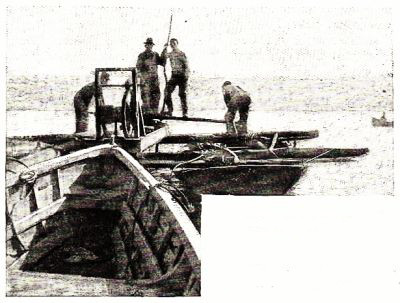
These poles are generally "planted" in water forty or fifty feet deep, so it is not easy to drive them into the bottom so far under the water. Pontoon boats, built by joining two scows or row-boats together, are anchored at the place selected for the row, and the sharpened ends of the long saplings are pushed into the ground. A crossbar is fastened to one of the poles, high out of water, and the fishermen jump up and down on this until the sapling is driven down firmly into the mud. There are anywhere from twenty to forty of these poles in a row, and they are placed about thirty feet from each other.
At the first sign of the fish the nets are set out on these poles. These shad-nets are like enormous fly-traps, open at one end. The meshes are large enough to let the shad put their foolish heads in the nooses, but not big enough to let their shoulders through. The top and bottom of each net are fastened to two long ropes, and the ends of these ropes are tied to wooden rings like barrel hoops, slid over the poles, and sunk down under the surface of the water by weights. So the open end of each net is stretched between two poles, and the meshes belly out with the swift current like a big bag. All along the row these nets are fixed by the fishermen soon after the tide has turned, and then they go ashore to wait for the next tide.
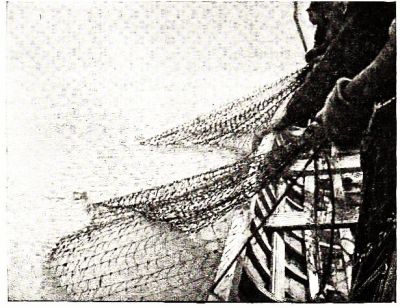
DRAGGING THE NETS.
Along comes Mr. Stupid Shaddie, swimming rapidly with the current. Suddenly he runs against the net, and before he knows what has happened his head is thrust through one of the openings in its meshes. Mr. Shaddie foolishly tries to push through the barrier, and soon finds his gills tangled up with the thin cords that hold him. He has not sense enough to turn around when he first finds himself in the net and swim out again the way he came in. The door is still open, but he hates to swim against the tide, so he goes on trying to push ahead until he is hopelessly caught in the net, and the more he struggles the tighter he is held. Mr. Shaddie's brothers, too, are equally stupid. They follow his silly example, and soon there are a number of them struggling in each net.
The fishermen in the mean time have waited patiently on shore. Just before the tide turns again they row out to their nets and haul them up. If they waited too long, Mr. Shaddie and his foolish friends would get out, for the turn of the tide would swing the net in the opposite direction and soon release the struggling fish. The long fishing-boat is manned by four men, and they row out to the nets. The boat is tied at each end to one of the poles, and the "haul" begins. Long notched sticks or boat-hooks are thrust down under the water beside the poles, and the net-ropes pulled up to the surface.
THE FIRST CATCH OF THE SEASON.
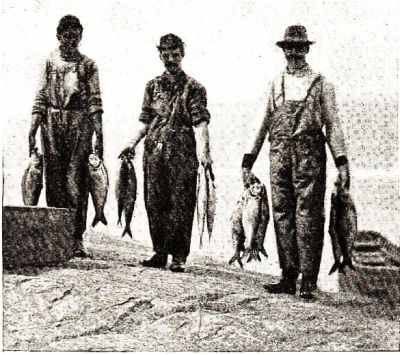
Slowly and cautiously the fishermen, two at each end, pull in the ropes that hold the net. They soon reach the mouth of the bag, and pulling this over the edge of the boat, they quickly haul up the rest of the meshes; for it is then too late for any of the fish to get away. As the net comes up to the surface, Mr. Shaddie and his companions seem too stupid or too much dazed to struggle. When they are jerked out of the water, however, and into the boat, they hop around excitedly for a few minutes, but it is then too late to escape. The fishermen throw their catch into the bottom of the boat, and cast the net back into the water. Then they push along to the next poles, and repeat the same work with the next net.
Down the long row they go, the boat's bottom gradually filling up with the big shad. Sometimes a net will have only one or two in it, while fifteen or twenty are occasionally caught in a single net when the season is at its height. A good haul will often yield three hundred shad, and the fishermen hurry ashore to pack them off to the markets. But shad are not the only fish they get in the nets. Catfish are often pulled up with shad, as well as many other varieties. Some of them are taken ashore and cooked, and others are thrown back into the water.
Then, too, there are the "blackfish," as the fishermen jokingly call the pieces of drift-wood that get tangled up in the meshes. Sometimes these are so heavy as to tear open the nets, and then the shad escape with the "blackfish." Careless captains of passing boats often tear them, too, and occasionally pull down the poles in steering through the fishermen's rows. Extra nets are always carried in the fishing-boats, and when a torn one is found it is taken ashore to be mended, and a whole net is put in its place.
The shad-fisherman's life is not an easy one. During the short season when his trade is profitable he works both night and day. He must live close by the water, and sleep only between the tides. When the boat first comes in after hauling the nets, the men must take out their fish and pack them for the market. Then there are the torn nets to be mended; and when all this is finished, and the meals are cooked and eaten, the fishermen may get a few hours' sleep, perhaps; but they never lie down without first setting an alarm-clock for an hour before the tide turns again. For, rain or shine, by night and by day, those nets must be hauled up at every turn of the tide, and the tide turns every six hours. "Time and tide wait for no man."