Postage Stamps, &c.
Reading edition
$117.50 WORTH OF STAMPS FREE
to agents selling stamps from my 50% approval sheets. Send at once for circular and price-list giving full information.
C. W. Grevning, Morristown, N. J.

100 all dif. Venezuela, Bolivia, etc., only 10c., 200 all dif. Hayti, Hawaii, etc., only 50c. Ag'ts w't'd at 50% com. List FREE! C. A. Stegmann, 5941 Cote Brilliante Ave., St. Louis, Mo
1000 Mixed Foreign Stamps, San Marino, etc., 25c.; 101 all dif., China, etc., 10c.; 10 U.S. Revenues, 10c.; 20 U.S. Revenues, 25c. Ag'ts w'td at 50% com. Monthly Bulletin free. Shaw Stamp & Coin Co., Jackson, Mich.
STAMPS! 100 all dif. Bermuda, etc. Only 10c. Ag'ts w'td at 50% com. List free. L. DOVER & Co., 1469 Hodiamont, St. Louis, Mo.

Cryptography Again.
Members with musical tastes will enjoy corresponding by means of a musical cryptogram. Though this is more difficult of construction than the Dial or Stencil cryptogram, it will be a novel and interesting variation of the "Model Letter-writer," and such helps. If, perchance, a member becomes involved in State politics, and desires to inform his friend in office of an important plan, he can send a few bars of music and no one will be the wiser.
On a 10-inch square of card-board draw a circle divided into 30 parts. These should be separated by lines into three rows or sets. In each of the outer spaces place a figure of musical time, in each of the next row the capital letters of the alphabet, and in each of the inner spaces a note or group of notes on ruled lines. The blank space within is to be filled by a movable disk. On the edge of the disk, at regular intervals, place the three musical signatures, and through the centre drive a pin. Your correspondent must be supplied with a similar dial. Provide yourself with the regulation ruled music paper. Turn the disk so that one of the signatures will correspond with a note on the square, with a letter and figure of time above it. This will give the clew to your correspondent. You are now prepared to write your message by using the various notes which correspond to the letters above.
Vincent V. M. Beede.
South African Fruits and Facts.
Perhaps your scientific readers can make an astronomical puzzle plain to me. A gentleman with whom I am well acquainted, has often said he could always tell whether we would have rain by the appearance of the new moon. If on her first appearance she was "on her point" we would have rain, if she lay on her back we would have dry weather. I confess I was rather sceptical when I first heard this, but it has been proved to me so often that I am fain to believe it.
During our recent severe drought this gentleman used to look at the new moon every month. "No rain this month." At last, "The moon is on her point! we'll have rain!" and we did have rain. Can you explain this? His predictions concerning the weather have never been known to fail. An old Kafir used to say, "The moon's dam is open; we'll have rain." It was no use explaining to him that there was no water in the moon. The question is, Does the moon really affect the atmosphere? That is to say, "Why is it that in rainy seasons the moon is on her point?" I should be much obliged if some of your clever readers would kindly solve this problem for me.
I like Brenda Neville's suggestion of a temperance club. I am a teetotaler, and would like to correspond with Lady Brenda. One has only to live among the Kafirs to see what an awful power brandy has over men. In one of our newspapers I saw that total abstinence is steadily on the increase in Cape Colony. I am glad of it. I hope the Founders of our splendid Order will take up this idea of a temperance club. Our object—as far as I understand it—is to do as much good as we can in the world, and to make the best and most of our lives.
In the Park at East London (South Africa) grows a rather peculiar plant. It bears a fruit which so exactly resembles a hen's egg that many people have been deceived by it. In fact, one lady took several to an old Dutch woman, and asked her if she would kindly set them under one of her fowls. The simple old woman was delighted, being under the impression that these were a particularly precious setting of eggs. It was not until some time after that the lady explained her practical joke.
The wild coffee grows about the mountains and kopjes here. It is an exceedingly pretty shrub, the leaves being of a bright glossy green, and the flowers of a waxy cream-color. It bears berries which, after a while, turn red. After they are dry, if you open one, you will find two seeds very much resembling bought coffee. One of my uncles had a number of these seeds gathered, burnt, and ground. Then he had it prepared in the ordinary way, and said it tasted very good indeed.
The wild-tobacco-tree grows about here too, but it is not of much use. It is said to be poisonous, but I am told that this is incorrect. We used to make chains out of the flowers years ago.
In the kloofs we have several varieties of the wild geranium. My favorite is the "Ivy." It looks so pretty growing over the rocks or around some old stumps. The aloes grow all up the sides of the mountain. When it is time for them to flower, a tall stalk shoots up from the middle of the aloe which, in course of time, becomes covered with red blossoms. There is another aloe which is extensively used for making fences. I do not know whether it grows wild. When it flowers it sends up a stalk to a very great height, the top of which is crowned with yellow flowers. It has long tapering leaves, the sides of which are covered with thorns. It makes an excellent hedge.
At the agricultural show, which was held on the 26th and 27th February, in Queenstown, I saw a pair of snow-white ferrets. I thought at first they were white mice. Among the rocks we often see dassies sunning themselves. These are said to be the conies of the Bible. The spring hare, or jerboa, is a great nuisance to the farmers. Its front feet are used for making burrows. Its hind legs are four times the length of the front ones, and it is with these that it makes its prodigious leaps. It is said that the jerboa uses its tail as a lever. It comes out at night-time and works great havoc among the farmers' crops. By the time this reaches you autumn will have set in properly. At present there seems no abating of the summer heat. If anything it is worse.
Isma Fincham, R.T.L. Roydon, Queenstown, Cape Colony, South Africa, March 2, 1896.
Any questions in regard to photograph matters will be willingly answered by the Editor of this column, and we should be glad to hear from any of our club who can make helpful suggestions.
HOW TO MAKE A NEGATIVE FROM A PRINT.
It sometimes happens that one is so unfortunate as to break a valuable negative. If the glass is broken, but the film uninjured, the film may be removed, and transferred to another glass with very little trouble. (Directions for this process were given in No. 856 of the Round Table.) If the film as well as the glass is broken, there is no way of restoring the negative, but a new negative may be made from an unmounted print.
The printing-frame must be fitted with a plain glass, free from defects. Lay the print on the glass face up, and place over it a slow plate—a plate about the sensitomer of the Carbutt "B" gives the best results. If the print is of average density, expose to an ordinary gas-flame or lamp-light for five seconds. A little longer time must be given to a strong print, and a little less to a weak print. Develop the same as any negative properly timed, starting with a slow developer.
In case one has only mounted prints, remove the print from the card by soaking in warm water till it can be easily stripped off from the mount. Lay the print face down on a sheet of glass, and sponge carefully to remove all particles of paste. Sometimes the print requires soaking after it has been removed from the mount if the paste used was very adhesive. After the print is cleaned, dry on a ferrotype plate free from scratches. Old albumen prints make fine negatives, as the paper gives deeper prints. It is always a good plan to make a paper negative from fine plates, so that if a negative is accidentally destroyed one has still a good substitute.
Sir Knight Russell Senior, who is much interested in the formulas for tinted papers and transparencies, sends the following process for changing blue prints to brown:
"After washing and drying as usual, immerse the print in a solution made of strong ammonia water, 1 oz., water, 8 oz. Leave the print in this solution till it has lost its blue color, which will take from three to five minutes; then rinse and place in a solution of water, 6 oz., tannic acid, 1 dram. (This must be filtered before using.) The print must remain in this solution till the required sharpness and tone are obtained, which will take from ten to fifteen minutes. If the color is not dark enough at the end of fifteen minutes, add a few drops of ammonia; leave in two minutes longer, and wash."
Our members will probably like to try this formula, and very soft tones of brown may be obtained if the directions are carefully followed.
Sir Knight Frank F. Smith, P.O. Box 236, Cumberland, Md., one of the prize-winners in our recent contest, says that any of the other prize-winners who wish a copy of his prize picture may have it by sending a copy of his or her own picture that also took a prize, and that any members of the Camera Club who would like a photo-etching of the picture may have it by sending two-cent stamp for postage. Sir Knight Frank would like to exchange photographs with each of the prize winners.
Sir Knight J. M. Corey asks how to transfer the film on a photograph to glass, and how a drop-shutter is made. The best way of transferring film to glass is to use the transferrotype paper for prints, and then transfer according to directions given in No. 840 of the Round Table. Directions for a drop-shutter could not be given without illustrating with diagrams, and our space does not allow of illustrations.
"New Patron," Nova Scotia, asks for a formula for a flash-light powder. Why not use the pure magnesia? It makes a strong actinic light, and if burned on metal is comparatively harmless, but when combined with other compounds is sometimes dangerously explosive, and requires great care in handling. In regard to mixing the solutions without hydrometer, the simplest way would be to use the rule for ten-per-cent. solutions—one ounce of the chemical and nine ounces of water. A twenty-per-cent. solution would be two ounces, Troy measure, and eight ounces of water. A thirty-per-cent. solution would be three ounces, Troy measure, and seven ounces of water.
Sir Knight F. T. Watson asks how to make solio and aristo paper; what is litmus paper, filtering paper, and distilled water; how many sheets 4 by 5 blue prints can be made with formula given in No. 797; if the formula given for glycin developer is good for pocket Kodak; wishes a formula for combined toning and fixing bath; and what is a ferrotype plate, and for what it is used. Do not attempt to make either solio or aristo paper; it is much more expensive than to buy the ready-prepared paper. Formulas for toning both in one and two solutions are enclosed in each package. Litmus paper is unsized white paper steeped in a solution of litmus and dried in the air. It is used to test solutions, the red litmus paper for alkalies, and blue litmus paper for acids. Filtering paper is unsized porous paper, and is used to filter or strain solutions to remove any impurities which they may hold. Distilled water is water evaporated by boiling, and again collected and condensed by means of a still. In making up solutions where one cannot get distilled water, water which has been filtered will often serve as well as distilled water. A ferrotype plate is a thin iron plate highly varnished. It is used by amateurs to dry aristo prints. The prints are squeegeed to the plate, and when dry have a high polish. The glycin developer works well for films, but is rather slow. Metol-quinol is better, and more easily managed. Three or four dozen sheets of paper may be sensitized with the blue-print formula.
This Department is conducted in the interest of Girls and Young Women, and the Editor will be pleased to answer any question on the subject so far as possible. Correspondents should address Editor.
How to make a cup of tea? Is that what Agnes and Amy wish me to tell them? Nothing is easier. The odd thing is that so many girls fancy tea-making a difficult art, when it is really a very simple process, which needs only attention and care to produce excellent results.
One thing you must if possible have, and that is a good brand of tea. English breakfast, if excellent, is a very satisfactory kind, and there are blends of Oolong, Souchong, and just a dash of orange pekoe which any good grocer will put up for you, and which are very satisfactory. By this I mean that the taste is refined and agreeable, and the tea rests and refreshes the one who drinks it. I myself prefer a sort of tea which comes from Ceylon, and has a fragrance like flowers, and is so clean and sweet and smooth that no tea compares with it in the opinion of those who have given it a trial. Whatever tea you use, it should be bought in small quantities, unless you have an air-tight box, lined with tin-foil, in which to keep it from the air. Tea loses its flavor if carelessly kept in a loosely fastened caddy.
Having good tea to begin with, next be sure that you have freshly drawn pure and filtered water of which to make the beverage. The water must not have been standing for hours exposed to the weather nor simmering on the range, and growing flat. It must be fresh, and then if you have a brisk fire, or the hot flame of an alcohol-lamp, bring it quickly to the boil. A flat-bottomed kettle is to be preferred, as it has a broad surface to expose to the heat, and the boiling is soon accomplished. Water is boiling when it bubbles and jumps merrily about, and the steam comes in white puffs from the spout of the kettle. It does not boil when it begins to simmer and to sing. That is only the sign that it is near to boiling. You must make your tea when the water has just boiled, not when it has been boiling a long time. A kettle which has been standing on the back of a stove all day, filled up now and then by a dipper or two more of water added when some has been taken out, will not make good tea. You must boil the water on purpose.
An earthen pot is better for tea than a metal one. Pour a little boiling water in the pot to heat it, and after a minute or two pour it out. Now put a teaspoonful of tea for every cup of hot water—an even, not a heaping spoonful—and add an extra one for the pot. Pour on as much water as will fill the number of cups you wish to make. Let it stand two minutes, then with a long-handled spoon stir the leaves once through the water, and instantly cover the pot again. Three minutes more and your tea is done. Never let tea steep or boil, or stand a long time. It is a quick, neat, nice process from beginning to end.
Margaret E. Sangster.
Physicians lay the greatest stress, On perfect, spotless cleanliness; And where this law is recognized, There Ivory is most highly prized.
Copyrighted, 1896, by The Procter & Gamble Co., Cin'ti.
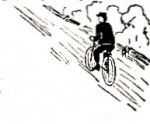
Over the hills and far away, The whizzing wheels speed on to-day. As they fly along the glad shouts ring "Ride MONARCH, the wheel that's best and king."