PRACTICAL GOLF.
Reading edition
BY W. G. van TASSEL SUTPHEN.
(In Five Papers.)
V.—STYLE AND FAULTS.
he question of style is a ghost that will not down. There are those who say that form is the all-important point, and that if you get the swing right all the rest will follow. And there are others who as stoutly affirm that the only thing to do is to thump away at the ball, and trust to nature and the laws of mechanics. Now it is certainly true that style by itself will never drive a ball, and it may be laid down as an axiom that whenever the mind is intent upon some point of how to strike rather than upon the actual business of hitting, a miss more or less palpable is sure to follow. But it is just as true that hands or feet or body may be in such a position that a fair stroke is utterly impossible, and this is surely not golf. Evidently truth lies between the two extremes.
There can be no question but that in all games the right way is easier and productive of better results than the wrong way, and golf cannot claim to be entirely independent of this general principle. Therefore it is wise to begin our practice on the general lines laid down by the wisdom of the ages, subject of course to the necessary modifications due to age, sex, or previous conditions of servitude to tennis, baseball, and other obsolete forms of amusement. Undoubtedly the most satisfactory method is instruction from a competent coach. The beginner may think that he is following faithfully the instructions given him in these papers, and yet be unconsciously going wrong in a dozen ways, imperceptible perhaps except to an expert eye. By all means seek the counsel and instruction of a professional golfer or expert amateur, if there be one within reach, for he can certainly save you many false steps.
BEGINNING OF FULL SWING—INCORRECT.
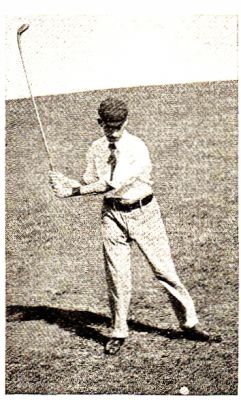
But supposing that there is no way of obtaining this practical assistance, must we give up golf as unattainable and book knowledge as untrustworthy? Not at all. Study and digest the instructions and hints given in these papers as thoroughly as you can, and do your best to put them into practice. There is only one thing to guard against, and that is the tendency of exaggeration in any or all points. For instance, I tell you that the left wrist must be kept taut, and this is indeed necessary. But if you go to work with the idea that in a stiff wrist lies the secret of all golf, you are turning a caution into a fetich, and the result must be unsatisfactory. Even the italicized injunction at the end of each article, about the necessity of keeping the eye upon the ball, is not the whole of golf, and, important as it is, it must not absorb the whole of your attention. All these things work together for golf, and the moment that you exalt any one of them above the others you destroy both your mental and your physical balance, and the result is no game. Finally, let the forming of style be reserved for practice play. Once engaged in a tournament (and, by-the-way, you should enter as many regular competitions as possible), you must let your style take care of itself, and devote the whole of your attention and energy to hitting the ball clean. If you begin to think how you are going to hit it, or how far you will drive it, or anything about it except the simple duty of hitting it, you will fail altogether. In practice let your aim be style; in a match let it be the hitting of the ball.
The detection and cure of specific faults are difficult tasks on paper, for very often different causes may produce what is apparently the same effect, and it is obvious that the particular remedy depends upon the specific disease.
For example, the ball has a great tendency to go off to the right of the line instead of straight. Now the reason may be that the player is putting a cut on the ball by drawing in his arms ("slicing" proper), or he may have the face of the club turned back (wrong grip), or he may be hitting off the heel of the club ("heeling") and at the same time putting a "slice" on the ball. Evidently the same corrective will not answer in every case. For "slicing" proper it will be well to attend to the precept of "slow back," so that the body muscles may be used, and the arms allowed to go freely out both in the up swing and in the "follow on." Perhaps the right foot is too far advanced, and a change in position (not distance) may encourage the loins and shoulders to get in the work. Try drawing the right foot back in proportion to the amount of "skid." Laying the face back is the result of a wrong grip. The left hand may be too far under, and the right hand may be holding too loosely. Look up the instructions for the proper grip. "Heeling," or hitting off the heel, is due to poor aim. Stand up and hit more carefully.
END OF FULL SWING—INCORRECT.
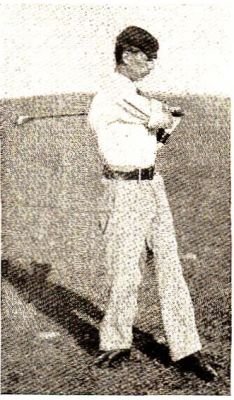
"Pulling" or "hooking," which sends the ball off to the left of the proper line, is not so common a fault. Generally it is the result of having the club face turned in, and this in turn comes of "pressing," or trying to strike too hard and without the proper swing. Give up the idea that you are hitting at a baseball, and guard against stooping forward.
When a ball is "topped" or hit above the centre it is nearly always due to carelessness, or overdue concentration on some point of style. If your swing is too straight up and down, and you are drawing in your arms across the line of fire, a "top" is pretty sure to follow. Let your arms go out so that the curve of your swing may be longer, or rather flatter, and try to look at the side of your ball, and not straight down upon it. If you are looking persistently at the top of your ball, and your "eye is in," the club head must perforce obey its instructions. It is not only the ball but the side of the ball that you want to hit. Another reason why players "top" is because they are afraid of the ground and of breaking their clubs. Now, as a matter of fact, an honest "sclaff" or scrape does no harm either to the club or to the flight of the ball, except perhaps when the ground is frozen, and the game cannot properly be played at all. Therefore get down to the ball always.
In the approach stroke "slicing" is the most troublesome fault to mend. It is a great help in the shorter shots to keep the right arm rubbing lightly against the body, for the sake of its support, and, indeed, without some such aid steadiness is impossible. And keep the left wrist taut.
INCORRECT "STANCE."
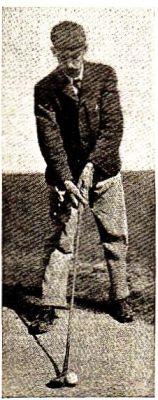
When a player goes off in his putting, the case is pretty sure to be mental, i.e., lack of patience and concentration. And this is particularly true of the short holing-out puts of thirty inches or so. Still, the sin may be one of commission: the player is playing with a jerk, or he is looking at the hole instead of at the ball, or both of his arms are hanging clear of his body, and consequently deprived of its support, or, finally, his putter may be badly balanced. Once the cause is discovered, the remedy is easy of application.
The beginner will do well to study carefully the illustrations that have appeared in the preceding articles. The professional Willie Dunn, who appears in most of them, is not only a fine player himself, but his form is especially good, and a safe model upon which to pattern. The incorrect positions illustrate faults in stand and swing into which the beginner is particularly liable to fall, and a study of them may save him from many misconceptions.
It is to be noted that no distinction has been made in these articles between the girl's game and that of her brother's, and, indeed, none is necessary. The same instructions apply, and virtually the same results should follow. The girl may not be able to drive so far, but there is no reason why she should not hold her own in approaching and putting, and a sensible costume will obviously be of advantage.
Left-handed players must of course make the necessary correction in the instructions, but if possible they should try to play in the ordinary style. It is a curious fact that, unlike tennis, billiards, or baseball, first-class golf is seldom acquired by left-handers.
Finally, don't think the game too easy, and so play carelessly, and, on the other hand, don't get discouraged and give it up as too difficult. In the words of an old-time hero of the green, "It's dogged as does it."