CRETE, AND HER STRUGGLE FOR FREEDOM.
Reading edition
BY CYRUS C. ADAMS.
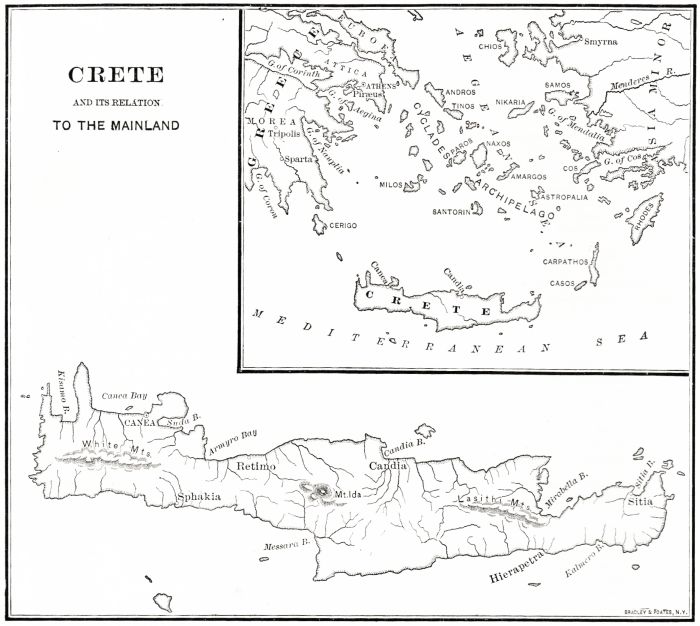
glance at the map on the next page shows a chain of islands stretching like a bent bow from the southern shore of Greece to the coast of Asia Minor. These island stepping-stones, bridging more than one-half the way across the sea, are nothing more nor less than the tops of mountain ranges with shallow valleys in between, their bases resting on the sea-floor. The largest of these islands is Crete. It is almost exactly twice as large as our Long Island, and if we were to stand on the south coast of Greece on a clear day, we should see the mountains of Crete looming above the sea. We might call it a Greek island, for nature made it a part of Greece, just as Long Island is naturally a part of America, and the people and development of Crete are Grecian to this day. The limestone mountains that stretch east and west through Crete are a part of the very ranges that extend through southern Greece and jut out into the sea as promontories, just as our Aleutian chain of islands is geologically a part of the Alaskan mountain range. Why is it, then, that Crete, geographically a part of Greece, and peopled, as it is, by Greeks, is politically severed from the mother-country? It is simply because ever since human history was recorded the nations, by their treaties and wars, have disposed of whole peoples without consulting them at all. This is the reason why Crete is a Turkish island. This is why the whole civilized world sympathizes with the Cretans in their aspirations for good government and their long struggle for freedom.
Numerous revolts against Turkish misrule have made Crete a battle-field from end to end; and perhaps Crete is the only region in the whole world where one may stand at a single point, and see spread before him practically every spot made memorable by the most momentous events in the nation's history. Snow-crowned Mount Ida is the culminating point of the island, 8060 feet above the sea. It stands in the centre of Crete, and tourists, well bundled in woollens even on a summer day, conducted by a guide to the top of the mountain, find it well worth the labor, for Europe has no finer view. If the day is clear, the whole of Crete is in plain view, save some areas of lowland hidden by hills. All the towns fringing the seaboard are in the panorama. The eye may range far over the Ægean Sea, resting on one and another of the beautiful islands of the Cyclades; and then turning from nature's grand and varied aspects, the guide willingly points out the scenes that human struggle has made memorable, just as Waterloo is fought over again every day for visitors who are led to a height overlooking the historic field.
"In that pass," the guide will say, "the Cretans ambushed the Turks, and killed them to a man. On the west side of that hill yonder are some ancient quarries, dug deep into the hill, with passages so intricate that it is called the Labyrinth; and there 500 of our Christian families took refuge, in the revolt of 1820, and the Turks never found them. Those women and children went peaceably back to their homes after quiet came again. Do you see that big oak-tree right down this slope? That marks the entrance to the cave in which the Turks suffocated 300 of our women and children and old men in 1822. In that valley yonder the Cretans made their last bloody stand in 1859; and down that wide slope, far to the west, the Sfakiotes poured, in 1866, to attack the Turks near the coast." So he goes on pointing out the battle-fields where Cretan blood has been given like water in the cause of independence. All parts of the island have witnessed their sufferings, and particularly that lying between Mount Ida and the White Mountains. The Cretans are brave fighters, and they have failed to win simply because, after they were stripped of resources and nearly dead of exhaustion, the Turks could still pour fresh troops and munitions into their mountains and plains.
Aristotle said, twenty-two centuries ago, that Crete would become a great centre of commercial exchange, because it lay midway between Europe, Asia, and Africa. This is the reason why it has been the prey of so many nations all through the Christian era. The Greeks who colonized it, no one knows how long before the dawn of history, were supreme till Crete was absorbed in the Roman empire. Then Byzantine emperors ruled it, and later it was captured by the Saracens, recaptured by a Byzantine general, sold to the Venetian Republic, and while Venice was its master the island had 400 years of greater prosperity than it has ever known since. Then the Venetians and the Turks waged a long war in Crete for possession, a feature of which was the longest siege on record. It was twenty years after the Turks invested the city of Candia before their army made its way inside the walls. Then the whole island submitted, and Crete has been a Turkish province ever since.
Under all her masters Crete has remained Greek. No other people in eastern Europe use the expression "Motherland," a term the Cretans apply to Greece. There are about 300,000 Cretans, and nearly all of them are of Greek descent. Most of the Mohammedans, who number over a quarter of the population, are of the same blood. Their Cretan forefathers, to save their lives, embraced Islam, reared their children in that faith, and to this day the Koran is expounded to them in the Greek language, for very few understand Turkish. The universal language is Greek—not pure modern Greek, but a dialect that has often suggested humorous criticism in Athens; nevertheless, it is as good Greek as Yorkshirese is good English.
Into this land came the alien Turk, 250 years ago, with his tax-gatherers, janizaries, and priests. He has done nothing for the island except to oppress it. His sole purpose was to wring from the wretched people all the taxes they could pay. Only a few thousand Turks, besides the officials, soldiers, and priests have ever lived in Crete. The Turkish outrages in Bulgaria, which caused the Russo-Turkish war of 1877, were long equalled and surpassed in Crete. Travellers and historians say that up to 1830 Crete was the worst-governed province of the Turkish empire. At that time, when the Cretans had been at war for nine years against their oppressors, the intervention of the powers secured some betterment of their condition, and further privileges were conferred upon them in 1878 through pressure exerted by the Berlin Congress. Crete has since been better governed than most Turkish provinces, but the Sultan's yoke was galling none the less.
Nine revolutions, some lasting for years, have cost the blood of many thousands of Cretan patriots; and what has Crete gained by the promises extorted from the Sultan? With a genial sky, a rich soil, and a commanding commercial position, the Cretans are very poor. They have no internal improvements, no cheap means of sending their products to the sea, little commerce, few schools or other advantages of civilization, and too few farm laborers to gather large crops if they raised them. Crete is supposed to have now about one-third the population it supported when the Christian era dawned.
In April last the people revolted again, and the clamors of the powers made the Sultan promise that definite reforms would be carried out at once. His pledges were empty words. When a fresh revolt began, a few weeks ago, the Cretans had no police, nor any other machinery for preventing or punishing crime. One cause of last year's revolt was that the Christians could not get justice in the law courts. The Sultan promised that the judiciary should be reorganized, but three months ago he decreed that the old courts should be continued.
Crete cannot forgive the Turks for their enormities. The list is very long, but here is a specimen: In 1822, 300 women, children, and decrepit old people took refuge in the cave of Melidoni. The Turkish soldiers who were pursuing them, built a great fire before the narrow opening, and the wind blew all the smoke into the cavern. The wretched fugitives retreated to the depths of the cave, but all in vain. They perished of suffocation, and their bodies were unburied, until drippings from the roof covered them at last with a calcareous winding-sheet.
Typical mountaineers live in the White Mountains of the west, in whose veins there is scarcely any admixture of foreign blood. They have guarded their valleys with jealous care, to prevent any intimate contact with foreigners, and whether Romans, Arabs, Venetians, or Turks have ruled the island, they have preserved the purity of their clans. The Sfakiotes, as they are called, have always been foremost in the uprisings against the Sultan.
The Cretans prefer union with Greece to autonomy, and this choice is probably wise. If left to themselves they and their Mohammedan relations might find it difficult to allay their long and deep-seated antagonism. If the island becomes a part of Greece, King George's government will keep the peace in Crete, and time will heal the wounds that have been kept open so many years. When the Turkish flag leaves the island forever a great many of the Mussulmans will doubtless return to the faith of their Christian fathers. Long ago the powers made the Sultan promise that persecution on religious grounds should cease in Crete. This promise has been partly fulfilled, and many Mohammedan families of Greek origin have returned to the Greek faith.
Why is Greece so eager to help these islanders throw off the Turkish yoke? It is easy to see the reason, when we think of the ties that bind these peoples together. When the Greeks won their independence from Turkey, early in this century, the Cretans fought side by side with them, and bore as glorious a part in that great struggle as any soldiers of the Greek mainland. In all the revolts in Crete that have occurred in nearly every decade of this century tens of thousands of Cretans have fled to Greece, saving nothing but their lives, and have been supported, at enormous cost, by the Greek people. We may find Cretans to-day all over Greece prominent and influential in her army, navy, civil service, and social life; and it is impossible to draw between the Greeks of the island and those of the mainland a greater distinction than that between Englishmen and Scotchmen. Who can wonder, therefore, that bound together as they are by race, history, and common interests, Greece yearns to rescue her brethren from further pillage and misery, and at the same time save herself hereafter from the agitation, unrest, and great expense which each recurring revolt, at her very doors, inflicts upon her own people?
These Cretans, among the most patriotic people in the world, have perhaps atoned in bitterness for the sins of their unpatriotic fathers. In ancient times it was the reproach of the Cretans that they had no love for the motherland, and that in the civil wars in Greece their mercenary troops were sent to support the cause that paid them the most money. They were themselves divided into petty little states, which made it all the easier for foreigners to conquer them. The dream of their sons is to become a part of united and progressive Greece: and if the shadow of the Orient may be removed from Crete, and she may share Greece's growing strength, we may expect to hear better things of the island which nature has so highly favored, and man alone has cursed.

St. Paul's School, Concord, probably has as great a variety of winter sports as any school in the country, and, as at Lawrenceville, every student is expected to take his part in some athletic exercise. A few years ago tobogganing was one of the most popular winter sports, but of late hockey has rather usurped its prominence.
LOOKING ACROSS THE LOWER POND TOWARDS THE CHAPEL, ST. PAUL'S SCHOOL.
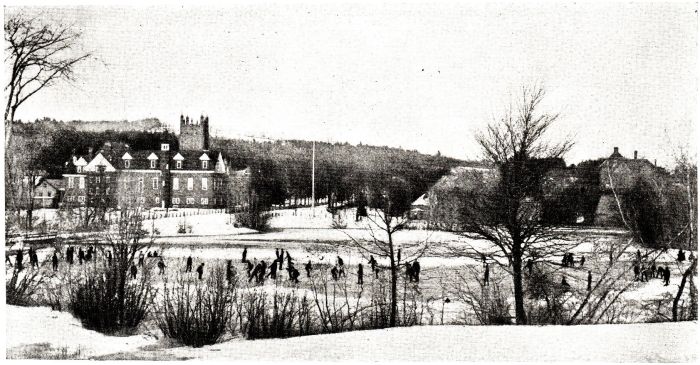
St. Paul's has a toboggan slide nearly 1000 feet long, with a fall of 250 feet. Four years ago, before the Canadian game came in vogue, every boy had a toboggan, or a share in one; now not fifty care for it. Snow-shoeing and winter trapping, on the other hand, are rapidly growing in popularity. There are many opportunities for the pursuit of both these sports, and probably one out of every ten boys in the school has trophies of his traps upon his walls.
THE UPPER POND, ST. PAUL'S SCHOOL.
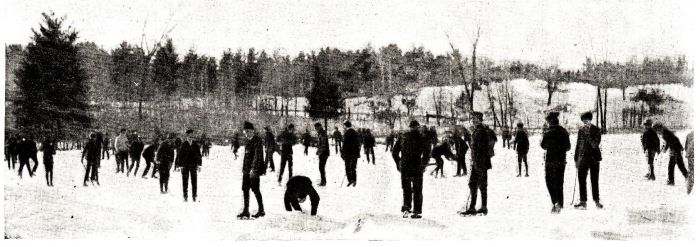
Skating is indulged in by the great majority of the students. There are two ponds by the school—the Upper and the Lower ponds. These, with the connecting "strait" and the adjacent "gulfs" (actually large puddles)—"Mexico" and "Guinea"—offer a skating surface large enough to accommodate 5000 people.
Every one plays hockey. Each building has a team, each "form" (i.e., class), and often scrub teams representing the various tables play for the championship of the dining-room. All this is more or less "scrub." The greater interest centres in the club games. In this sport, as in every other, except rowing, the school is divided into three clubs—Old Hundred, Isthmian, and Delphian. Every boy joins some club. In hockey alone each club has a first, second, and third team.
There is also a school hockey team. Last Easter they played St. Nicholas at the latter's rink in this city, and were defeated, 10-2. Last Christmas a second game was played, and the school was again defeated, 5-1. A third game is to be played at Easter this year. The great fault has been that the boys have not been able to keep up the faster pace set by their opponents. The first twenty minutes has seen good play; then the New-Yorkers have done as they chose. The school has a large rink, which can be flooded at will. It is much used.
Golf has been tried on the snow, but has few followers. Coasting is fairly popular, and the hills are good, but some serious accidents in the past have forced the school authorities to certain rules which materially restrict the sport.
Members of the school hockey team (and one substitute) are allowed to wear the "S.P.S." sweater, with crossed hockeys behind the letters. These school sweaters are very highly coveted. They go to the school football eleven and five substitutes, to the school cricket eleven and three substitutes, to all who break records on the track, and to the best eight oarsmen—these last chosen from the first two crews by a jury composed of two representatives from each rowing club. Football and cricket and crew sweaters are marked S.P.S. The sweaters given for track performance bear in addition "A.A."
There was a number of events at the in-door meeting of the First Regiment Athletic Club (Chicago) in which high-school athletes entered. In several events they won places. In the 40-yard dash, Powell of Hyde Park (4 yards) took his heat in 4-3/5 secs., and McKinnen of Oak Park, with the same handicap, got first in another heat, 4-4/5 secs., but both were defeated in the semi-finals. The time made in the finals was 4-2/5 secs. In the long runs the track was by far too crowded with contestants for any successful racing, and one or two men were hurt at the turns.
In the half-mile run, Boyne of Hyde Park, with a handicap of 40 yards, took second place. Actually he was only third, for the man who took second was protested for cutting a corner. In the high-school relay race of one mile, with five starters, there were three schools entered—English High, Lake View, and Hyde Park. The event was won by the former with the close margin of six yards only, in the very good time of 3 min. 19 secs. Their relay team consisted of E. A. Fitch, D. W. Kelley, W. A. Boley, G. H. Stillman, and L. S. Wells.
The schools of the Inter-preparatory League held a three-quarter-mile relay race, four men to the team. There were but two contestants in this event, the University School and the Princeton-Yale School. The former won easily in 2 min. 47 secs. Their team was made up of G. Henneberry, Robert Ross, C. W. Popper, and F. Maysenberg. The half-mile walk was a scratch event, but in spite of this, Dowd, who is the best man at that event among the Chicago schools, came in a very close second to the winner, the time for the event being 3 min. 47-3/5 secs.
The University of Chicago in-door meet, which was held February 26, drew a well-filled house, and plenty of interest was shown in all the events. The most interesting numbers on the programme were the various team races, the one for high-schools coming next to last on the programme. Among the many contestants, some were from Northwestern University, Lake Forest University, Knox College, University of Wisconsin, and all the big athletic clubs of the city. The high-school boys showed up remarkably well; many of their best runners won heats in the 50-yard dash, but only one secured a place in the finals. D. W. Kelly, of English High, with a handicap of 10 feet, was beaten by the well-known, C.A.A. man C. A. Klunder (8 feet).
In the 880-yard run, a scratch event, having many of the University of Chicago and other university men in it, another English High-School man brought honor to his school. E. A. Fitch came in second, the time of the event being 2.14-4/5. Englewood did well in the walking events. In the half-mile walk, W. O. Dowd (20 yards) won the event in 3.27, A. D. Brookfield coming in third, having had a 30-yard start. The best amateur walkers of the city were in the event, including C. O. Berg, who took second place from scratch.
In the 440-yard run D. Bell, the fastest man for the distance in the Inter-preparatory League, took second place. In the 1-mile relay race for high-schools, eight to enter, six to start, Hyde Park repeated her performance of a year ago, and took the pennant. Her runners were Frank Linden, Roland Ford, Burt Powell, Paul Chase, Dan Trude, and Ralph Pingree, each going 1/6 made the mile in 4.59-1/5. English High showed up well. Englewood also sent a good team.
All in all, the evening was satisfactory for the high-schools. It brought out some new talent, and showed the schools something of what might be expected of their men in the spring meets.
LAST YEAR'S RECORDS AT THE MADISON SQUARE GARDEN GAMES.
Event.
50-yard dash (Senior)6sec.R. W. Moore, Barnard, N.Y.
50-yard dash (Junior)5-4/5sec.W. A. Robinson, St. Paul's, L.I.
220-yard dash26-1/5sec.W. M. Robinson, Worcester Academy, Mass.
Quarter-mile run57-4/5sec.C. R. Irwin-Martin, Berkeley, N.Y.
Half-mile run2m.12-1/5sec.W. S. Hipple, Barnard, N.Y.
One-mile run4m.56sec.E. W. Mills, Berkeley, Boston.
50-yard hurdle (3 ft.)7-2/5sec.A. F. Beers, De La Salle, N.Y.
One-mile walk7ft.59-2/5sec.A. L. O'Toole, English High-School, Boston.
Running high jump5ft.7½in.F. R. Sturtevant, Hartford High-School.
Running broad jump19ft.2½in.A. F. Beers, De La Salle, N.Y.
Pole vault10ft.R. G. Paulding, Black Hall, Conn.
Putting 12-lb. shot42ft.1in.F. C. Ingalls, Hartford High-School.
Relay race4m.2-1/5sec.St. Paul's School, L.I.
The table at the top of the page gives the figures made at the Knickerbocker A.C. in-door interscholastic games last year. As there was never before an interscholastic in-door meet under the auspices of the New York I.S.A.A., these figures stand therefore as the N.Y.I.S.A.A. in-door records. If space allows, the New York scholastic in-door records will be printed in an early issue, for the sake of comparison.
The handball championship of the Long Island Interscholastic League has been won by Poly. Prep., the record of games being as follows:
School.Won.Lost.
Poly. Prep.153
Adelphi75
Brooklyn High55
Pratt014
The man who developed the best playing qualities during the season was undoubtedly Clark of Poly. Prep., and ranking next to him, I think, are Frothingham and Robinson.
The feature of the Newton High-School's in-door meeting, held on Washington's birthday, was the breaking of the record in the 300-yard run. This was done by H. B. Owens in 40 secs. He also ran from scratch in the 30-yard dash in 3-4/5 sec. If he comes to the Knickerbocker A.C. games he will be a hard man to beat.
It is reported from Philadelphia that an interscholastic association of oarsmen is to be formed, and I believe that active steps toward the organization have already been made. Rowing is rapidly becoming more and more popular as an interscholastic sport, and this is the second rowing association formed by schools this year, the first one being that of the Milwaukee High-Schools.
The new spirit which is invigorating interscholastic sport in the middle West has taken the form of a very good set of regulations that have been adopted by the high-schools of Wisconsin. As I am frequently asked for similar texts, I print these in full:
ADMINISTRATION.
1. A committee of three shall be elected annually at the annual meeting of the State Teachers' Association by the principals subscribing to these rules, whose duty it shall be to have general charge of all interscholastic contests under these rules.
2. The chairman of the Athletic Committee of the University of Wisconsin shall be an arbitrator, whose duty it shall be to decide upon alleged violations of these rules.
3. The principal of the school, or persons authorized by him, shall be the manager or managers of the teams representing the school.
4. No game shall be played with any team without the sanction of the principal.
5. No contests shall be arranged with other than school teams acting under these rules.
6. Non-playing captains and managers shall conform to the same rules as players, unless they be members of school faculty.
7. The principal, or his authorized representatives, shall accompany his team to all contests.
QUALIFICATIONS OF CONTESTANTS.
1. To represent a high-school in any athletic contest a person must be a bona fide student in regular attendance, taking three full studies, and obtaining at least a passing standing in each. He must also have obtained a passing standing in two full studies during the previous term, or must have obtained credits in three full studies during his last term of attendance.
Exception.—It is agreed, however, that if during the above-mentioned term any pupil shall obtain ten per cent. above the passing mark in two full studies, and not lower than ten per cent. below passing mark in the third, he shall not be excluded because of failure to obtain the third passing standing.
By full study is meant a regular study in the curriculum of the school requiring daily class-room work. It is stipulated, however, that not less than two periods daily in freehand drawing shall be called a full study.
Standing in each study must be based upon the entire ground covered by the class, and must be a record complete from the beginning of a term to the time required in Section 6. Any athletic contest is understood to mean a contest with any secondary school.
2. Pupils enrolled for the first time shall not be excluded from any contest because of absence during the previous term. But a student entering from another secondary school shall not be allowed to compete unless he has done the work required in Section 1 as a resident student for at least one term. Or he must show as satisfactory a record as that required in Section 1 for at least two terms' work or their equivalent at some similar school in the preceding year. It is stipulated, however, that all candidates under Section 2 must have been members of the school as regular students, conforming otherwise to Section 1 from the first fifteen days of the term in which said contest takes place.
3. A Senior considered by his faculty as a regular candidate for graduation shall not be excluded from any contest because of absence or failure during his first Senior year, provided he is taking three full studies which he has not before completed. It is understood, however, that a Senior who has completed a part of the Senior work in previous years shall not be excluded from contests, provided he is doing the unfinished work of his course.
4. No person shall be eligible as a contestant for more than the minimum number of years required to complete a four-year course.
5. Before taking part in any contest a pupil must file with his principal the written statement of a parent or guardian that said pupil has permission to engage in athletics.
6. No less than five days before a contest there shall be exchanged between the principals of the contesting schools the following data: Name of each candidate, the date of his first enrolment, time in years he has been a member of a secondary school, his age, and studies, with percentage in each for the preceding term, and to the first of the month in which these certificates are exchanged. It must also be stated over the signature of the principal that the candidates are eligible under these rules.
7. No person shall enter a contest under an assumed name.
8. The principal shall have power and is advised to exclude any contestant who, because of bad habits or improper conduct, would not represent the schools in a becoming manner.
9. Each contestant shall sign a statement that he is an amateur, and that he is eligible under these rules. The definitions of amateur and professional shall be those of the Western Intercollegiate Amateur Athletic Association.
10. These rules may be amended by a vote of a majority of the principals subscribing hereto voting on the subject.
11. These rules shall go into effect on and after January 1, 1897.
These rules have been adopted by twenty-eight high-schools in Wisconsin. Madison H.-S. has adopted all the rules with the exception of No. 5 under the administration heading. They obtained permission to do this in order that they might not be restricted from playing with schools outside the State.
"TRACK ATHLETICS IN DETAIL."—Illustrated.—8vo, Cloth, Ornamental, $1.25.
The Graduate.
NANSEN'S ENDURANCE.
Dr. Nansen seems to have been born and bred for arctic exploration. The strength and hardihood which were his by birth were developed and confirmed by the robust austerity of his early training. One reads of his habit of swimming in the evening in the coldest pools of the Frogner River that ran by the door of his father's house, and is no less astonished at the story of his plunge in the sea in pursuit of his kayaks in the extreme north, and of his endurance of the various cold baths he got in fights with bears and walruses. The man who put his wet and frozen foot-coverings in his bosom to thaw out and dry at night while he slept with his companion in a bag was an extraordinarily tough person, with an astonishing physique hardened by Spartan exercises. In his teens, he says, he used to go off on lonely expeditions in the great Frogner woods, and be gone alone for weeks at a time. "I disliked," he says, "to have any equipment for my expeditions. I managed with a crust of bread, and broiled my fish on the embers. I loved to live like Robinson Crusoe there in the wilderness."
THE WAY HE TOOK IT.
There is a neat bit of property in a town near New York that is owned by an Irishman whose nature embraces most of the characteristics of that nationality. He has for a neighbor a very penurious old gentleman who, for a long time, had cast covetous eyes upon the land, and daily devised schemes and propositions for obtaining it. Knowing that the owner, although reputed to be extravagantly good-natured, was nevertheless not to be fooled by any ill-concocted proposal, he desisted until he succeeded in preparing one which he thought would surely be unobjectionable. Carefully writing it out he delivered it to the owner of the property, requesting him to look it over. In a few days he called, and after being jovially greeted, he asked whether his proposition had been entertained. Much to his astonishment the Irishman broke into hearty laughter, crying out:
"Entertained! Ha! ha! Why, my dear sir, I haven't entertained the absurd thing; it's done nothing but entertain me ever since I read it."
AN OBSERVATION.
"I don't think pop is very strong," said Tommie. "He can't stand loss of sleep at night half as well as the baby does."