A JAPANESE PICTURE-STORY.
Reading edition
BY BARNET PHILLIPS.
he stories that have been written about pictures are to be divided into two general categories—those indicating the skill of the artist, and those relating to the performances of the pictures themselves. Both of these merge, since they attest the ability of the artist. There is a third kind of story, dwelling on the mishaps of painters, which accidents, however, in the long-run, invariably aid the artist.
The supernatural must have been called into play at the dawn of civilization, when the first artist scratched with splinter of flint an animal form on a bone. Pygmalion, who carved a woman so lifelike that he prayed to Venus to give Galatea flesh, blood, and a soul, must in an earlier form have been a story of the most remote antiquity. We find traces of this myth in Egyptian worship. To a South Sea Islander carved idols are not stocks nor stones, but living gods. The most acute Hindostanee does not separate his brazen images from the personalities of his deities.
Nothing is older than the stories of the supreme skill of the artist which the old Greek repeated. The common type of this legend is the picture with the figs painted on it, which were so natural that the birds pecked at them. The modern Orientals have embellished this story in many ways. The Persians will tell you that the birds actually carried a pomegranate out of a picture and fought over the fruit. One of the pomegranates slipped from the beak of a bird and tumbled down to a garden below. The over-ripe fruit broke, the seeds were scattered, and where they fell a pomegranate-tree grew, which will be shown you to-day in a court-yard in Ispahan.
We have the very old joke about the slab of stone painted so exactly like a log of wood that it floated. The Japanese have worked up the idea in many ingenious ways. They had a painter of the tenth century who drew a crystal ball so perfectly that when the sun shone on it, it behaved as would a lens, and would light tinder.
The Greeks tell of an artist who was dissatisfied with the flecks of foam in the mouth of the dog he was painting, and in anger threw a sponge at his picture, and, lo! where the sponge had struck the painting there was the froth required.
THE BRONZE WAS HURLED TO THE GROUND.
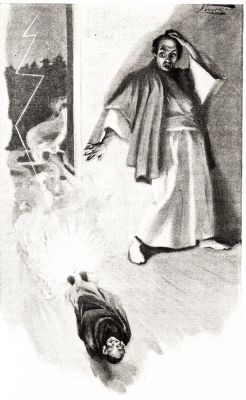
This is told of a bronze artificer who never could be satisfied with the ocean he was making up, into which his hero was wading. He set his work on a window. A storm arose, there was a blinding flash of lightning, and the bronze was hurled to the ground. When the artist picked up the bronze a portion of the metal representing the water had been fused, and there was the rolling, undulating sea, such as no mortal hand could ever have produced.
Another story is about a second bronze-worker, who was a great artist, but an intemperate one, for he drank too much saki. The man had fashioned a deity in bronze which did not satisfy him, though he had worked on it for ten years. Do what he would, the figure showed traces of the long toil he had lavished on it. Though given to his cups, he was apparently a conscientious artist. Putting his bronze in his pocket or up his sleeve, the artist determined to commit suicide, and so plunged into a great tub of fermenting rice, from which saki is distilled. When the saki-maker emptied his tubs there was the artist dead, and his bronze, but the work had been perfected. The fermenting rice had smoothed down the hard lines. The bronze was admirable, and so the artist's death conferred on him a certain amount of heroism—that is, according to Japanese ideas of heroism.
The neatest story of artistic performance and of higher criticism is Japanese, and for the lesson it conveys has its value. There was a Shogun of the fourteenth century who was the art critic of his time, because he never saw a screen or a bronze or a china decoration without finding some fault. In his court all his retainers followed the Shogun in deprecating whatsoever was shown to them.
In the court of the great man was a painter, the most distinguished of his time, and this artist became very tired of the adverse criticisms passed on his work. The Shogun ordered a screen, leaving the choice of the subject to the artist.
"As you are very slow," said the Shogun, "you may take a year to paint your screen. Time enough, I think, to assure us that there will be nothing careless in your work."
The artist accepted the commission, and asked for leave of absence, which was granted to him. He was away for eleven months, and it was within three days of the end of the year when he paid his respects to the Shogun.
"Exhibit at once your so-called work of art," said the Shogun.
"I have not yet commenced it, may it please your Dignity," answered the artist.
"And in three days do you expect to show me a picture worth my looking at?" inquired the Shogun.
"I have travelled all over the country for that work which it has pleased you to commit to my care, and it will be ready on time," replied the artist, humbly.
When the last day had come the artist said his screen was ready, and that it was hanging in a particular room in the Shogun's palace. The high dignitary and his court were present, and examined the picture.
What was painted was simplicity itself. There was a river, and in the stream a boat was moored, with a furled sail. The banks of the river were lined with rushes. There were a few trees, with a bird here and there perched on the boughs. A rabbit was nibbling the grass. In the distance was a high mountain.
"That is supposably water, if I am not mistaken," said the Shogun.
"It's very sluggish," remarked the pipe-bearer.
"Those rushes—ahem!" interposed a courtier—"are they not absurdly stiff?"
"And, dear me," chimed in the secretary, "what birds! Stuffed birds on boughs are too preposterous!"
"The boat—such a boat as that never could float! Is it meant for a boat or a rock?" inquired the master of the robes.
"The fact is," said the Shogun, "it is an idiotic performance. It wants life, go, dash, imagination. It is dulness personified. It is nothing but 'prentice work, and entirely unfitted to grace our elegant abode. Treasurer, pay this man for his trouble. A full year's wages, such as you would give to a weeder of rice."
"Your Highness always was a liberal patron of the arts," said the treasurer.
"And though generous, most discriminating, for really the picture is overpaid," said the courtiers.
THE ARTIST PLUNGED HEAD FOREMOST INTO HIS WORK.
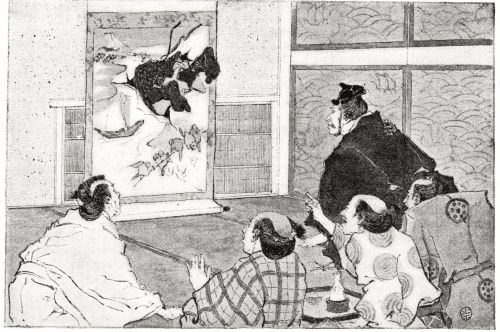
The painter smiled, slowly walked to where the screen was hung, and plunged head foremost into his work. Then, to the great amazement of the Shogun and his court, a splash was heard. Now the water rippled and the boat began to rock. The rushes on the bank of the stream nodded and bent and swayed, as if with a passing breeze. The birds flew from bough to bough. The rabbit scampered away. There was a figure in the boat, and presently the anchor was hauled up and the sail was set, and the little craft, heeling over with the wind, sped up the stream, and now a landing was made at the foot of the mountain.
Next a little man was seen slowly climbing up the mountain, and when the mountain-top was reached the figure bowed respectfully to the Shogun and the court and disappeared, as if descending on the other side of the mountain.
Then a loon came to the immediate foreground of the screen, and flapped his wings, and said, in very courtly Japanese, these words, which may be rather carelessly translated into English in this way:
"You are all a set of ninnies, for you don't know a good thing when you see it. Ta, ta!"
The courtiers were so enraged that they drew their two swords and wanted to hack the loon and the screen to pieces. But when they looked at the screen, they saw a big tear in it, with falling flaps of silk, on which the work had been painted. It was where the artist had made his exit. This is the Japanese fable for critics.