Chapter VI
Reading edition
TODD'S FAILURE AS A HUNTER AND A FIRE-MAKER.
"If this wretched corn was only hard enough to pound into meal," reflected Todd, "I might mix it with water and make a sort of chicken feed that would at least keep me alive until I could find something better. As it is, I believe I am using up more strength in eating it than it will ever pay back. Oh, if I only had a fire in which to roast it, what a difference it would make!
"Hello! what's that? A rabbit, sure's I'm sitting here. And there's another! Why, the woods are full of them! I don't wonder the natives have to protect their fields with tight fences. If I could catch one, what a fine stew he'd make! I wonder how other fellows catch rabbits? They are all the time doing it in books. Seems to me trapping is one of the things that ought to be taught in school. My! how saucy these chaps are!"
One of the rabbits had indeed ventured to within a dozen feet of where the boy stood, attracted by the bits of green squash that he had thrown from the door a few minutes earlier. Instinctively Todd picked up a stone, while the rabbit, alarmed by the movement, ran off a short distance and looked at him inquiringly. As no further movement was made he presently returned to the bits of squash, where he was quickly joined by a companion.
Trembling with eagerness, Todd let drive his missile. To his astonishment it reached its destined mark, and one of the little creatures rolled over with a sharp squeak, kicked convulsively, and then lay quiet, while its companion scampered to a place of hiding.
"I hit him!" cried the young stone-thrower in a tone of mingled amazement and delight, as he hastened to pick up his prize. "Who would have thought that killing rabbits was so easy!"
No hunter of big game was ever prouder or more excited over his first trophy than was our city-bred lad over this proof of his skill. "I certainly can't starve," he said to himself, "so long as the supply of rabbits and rocks holds out, and there seems to be plenty of both. Isn't he fat, though!"
He had already carried his rabbit to the hut, stroking and admiring it as he went. From the job of skinning and cleaning it he shrank with repugnance, nor had he an idea of how to set to work. Still he knew these things must be done, and drawing his hunting-knife from its sheath he prepared to make a beginning. With the very first touch of the knife the rabbit drew a gasping breath, and began to struggle so violently that Todd dropped it in horror. In another moment the little creature, which had only been stunned, had darted away and vanished, leaving one of the most amazed boys in the world to gaze after it with an air of utter bewilderment.
"If that don't beat anything I ever heard of!" he muttered. "I wonder if they always have to be killed twice? That fellow would have jumped out of his skin if I'd only held on tight enough. Never mind; it's a lesson I won't forget in a hurry, and the next time I'll make sure that my game is dead before I begin to skin it."
It did not seem, however, that there was to be any next time; for though Todd filled his pockets with stones and hunted for more than an hour, he did not see another rabbit until he again returned to the hut, and was nearly tripped up by one that darted from the open doorway. It had been attracted by a portion of the squash left on the floor, and noting this, the lad threw out what remained, with the hope that it might cause others to come within range of his missiles. Several were thus tempted during the afternoon, but though the hungry lad threw stones at them until he was weary, he did not succeed in hitting another. Finally, pretty well convinced that the success of his first shot was an accident not likely to be repeated, he gave up this method of obtaining rabbits, and began to think of traps. As he had never made nor even seen one, the only thing in the shape of a trap that suggested itself was a box, one edge of which should rest on a short stick. He would use green squash for bait, fasten one end of a long string to the stick, hold the other in his hand, and when a rabbit was safely under the box jerk away the support.
"It wouldn't do me any good if I did catch them," he reflected, "since I have no fire with which to cook them. At the same time I don't see that I am going to do much with raw vegetables, either, and so a fire does appear to be one of the most necessary things. Seems to me I ought to make one with a cartridge, the same as Phil Ryder did, even if I haven't a rifle."
As a result of much thinking on this subject, Todd finally spread his pocket-handkerchief on the table, laid one of the brass cartridges that still filled his belt on it, and after a while succeeded in cutting it in two close to its rear end. Emptying out the black powder, he threw away the shell with its bullet still attached, and kept only that portion containing the percussion-powder. The next thing was to lay the handkerchief on the stone doorstep, spread the powder over it, and place the firing portion of the shell in the middle. Then he hunted up a stone that came to a point, and holding this firmly in his hand, struck the percussion-shell a violent blow.
The result was instantaneous, and in a certain sense satisfactory. There were a sharp explosion and a quick flash of flame that burned Todd's right hand so severely that he ran to plunge it in the cooling waters of the stream. When he returned to the hut, some five minutes later, ruefully nursing his wounded hand, the only trace remaining of his handkerchief was a film of ashes on the doorstep.
"I don't care," he remarked, stoutly. "I did make a fire, anyhow, and I would do it again if I only had another handkerchief. As I haven't, I suppose I must give up the idea for the present, and live on that beastly raw corn until I can find some other kind of tinder. If I only had some cotton, that would be the very thing. I might as well wish for matches, though, and done with it, as to hope for cotton in a place like this. It was a good scheme, all the same; every bit as good as Serge Belcofsky's brimstone and feathers, and I would have had an elegant fire by this time if I only hadn't burned my hand."
After Todd had again visited the field and brought back two more ears of the much-despised corn, from which he expected to make a frugal supper that night, and an equally unsatisfactory breakfast on the following morning, the sun was so low in the western sky that the shadows of the cliffs on that side extended clear across the valley. Night was close at hand, and the lad dreaded its loneliness in that strange place, without fire, or means of defence against its unknown dangers. For all that he knew, both wild men and wild beasts might only be awaiting the coming of darkness to attack him.
"I wonder if I hadn't better climb a tree," he reflected, "or shut myself up in that hen-house? It at least has a stout door, which is more than this hut possesses."
While he sat on the doorstep thinking of these things, and watching the shadows pursue the waning sunlight up the face of the eastern cliffs, his eye fell on something that caused him to start to his feet with an exclamation. From some unseen source high up on the rocky wall a slender column of blue smoke, curling gracefully towards the summit of the mesa, was plainly visible. Nor was that all; for even as the lad gazed wonderingly at it, a human figure clad in white appeared near the place from which the smoke ascended, and after standing for a moment as though looking expectantly down the valley, again moved out of sight.
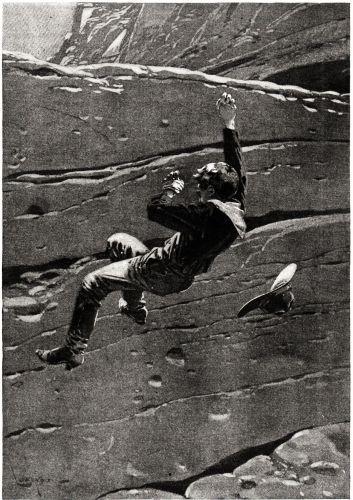
HE MADE A MISSTEP AND FELL HEAVILY.
"That explains everything," cried Todd. "The natives are cliff-dwellers, and live somewhere up there among the rocks. From all accounts of such people, although they are filthy and degraded, they are not half a bad lot. So I'm going to hunt them out before it grows dark. Of course they won't be able to understand a word I say, but I'll make that all right somehow."
The excited boy had already set off in the direction indicated by the smoke, and before long he came across a plainly marked trail leading among the trees directly toward the cliffs. As it reached them it bent sharply upward, becoming steeper and more rugged with every step.
Until now Todd had not realized how very weak he had grown through long fasting and from his recent terrible experience on the desert. Every few steps he was obliged to pause for breath, and several times he was so overcome by giddiness that he was compelled to sit down. Thus his upward progress was very slow, and the sun had set before he reached a point at which the trail ended. Above him was a sheer face of rock some fifteen feet high, in which were cut rude steps and handholds. It was like a perpendicular rock ladder, and in his weakness Todd regarded it with dismay. He was afraid, too, of his wounded hand, and wondered if he could hold on by it.
"It's got to be tried, though," he said, resolutely, "for it would never do to spend the night here, and I hate the thought of that lonely hut; so here goes."
With this the boy began to climb slowly and unsteadily. If he had had two sound hands and his normal strength, it would have been easy enough; but weak, giddy, and wounded as he was, it seemed very doubtful if he could gain the top. Now, too, he began to fear concerning the reception that he might meet even if he succeeded. Suppose the natives should take him for an enemy, how easy it would be for them to push him from his precarious footing?
Filled with such thoughts, he had only ascended a few feet when suddenly there came a loud shout from close behind him. So startling was it that he made a misstep, clutched vainly at the smooth rock to save himself, and with a despairing cry, fell heavily to the steep pathway, where he lay stunned and motionless.
[to be continued.]
"Times bein' so hard, I can't see my way clear to keep that little Portergee through the winter," said Cap'n 'Siah Doane, with a solemn shake of his gray head.
And three hearts seemed to stand still; they were sixteen-year-old Caddy's, who was the Hausmutter, and had knit the little "Portergee's" winter supply of stockings and mittens as carefully as she had knit her own boys', and young Josiah's and little Israel's, who had only truly enjoyed life since they had had a companion who knew as much of the great world as the geography and a fairy-book put together. For the little "Portergee," Manuel Silva, had been tossed upon the Cape Cod sands by a wreck, after cruising about in all the seas, and picking up sixteen years' worth of knowledge in many lands.
It was almost into the door-yard of Cap'n 'Siah Doane's weather-beaten cottage at the Point that he had been carried by a discriminating wave; and with a dislocated shoulder, and a wound on the head which, as Cap'n 'Siah declared, would have killed anything but a "pesky little Portergee," he staid.
There were summer visitors to Tooraloo, and he had done errands for them, and shared young Josiah's jobs of fishing and clamming for the boarding-houses, and generally been "worth his keep," as Cap'n 'Siah carefully figured out, being a thrifty and prudent soul. In fact, Tooraloo people generally thought that Cap'n 'Siah would have been better off if he had been less prudent and cautious. He wouldn't take the least risk for fear of losing; he would scarcely go fishing with a fair wind lest it should become a foul one before he came back, and he wouldn't raise cranberries lest the market should be over-supplied when he came to sell.
"Now God made things chancy to develop folks, and he made 'em chancier than common on Cape Cod," Uncle Saul Nickerson, of Tooraloo, was always saying as a hint to Cap'n 'Siah. And little Israel had heard so much about his grandfather's bump of caution that he thought it must mean the wen on the top of his bald head.
In the winter there were no jobs in Tooraloo. Manuel had talked of going to Kingstown, where there were many of his race, to try to get a chance to sail with a Portuguese captain; but they had all protested earnestly against his leaving, and little Israel had raised a mighty wail. Manuel said he never had struck a home port before, and it was evident that he longed with all his heart to stay. But with a hard winter before them Cap'n 'Siah's bump of caution had got into working order, and he had made the dreadful announcement with which this story begins.
They all looked at each other in consternation; and even Caddy, who had grown very sensible by having to look out for them all, felt a rush of tears to her eyes.
At that very moment the little "Portergee" was digging his heels into the sand—which he did when he had on his thinking-cap as naturally as a Yankee boy whistles—and saying to himself that he should immediately go away, it was so dull, if he didn't feel as if he must stay and take care of these people who had been so kind to him. He meditatively tapped the top of his own thickly thatched head where the wen was on the Cap'n's, and shook his head with sad significance. He, like little Israel, thought that wen was the bump of caution which kept Cap'n 'Siah from everything that was enterprising.
"If I do not stay and take care of them they are los'!" said the little "Portergee" to himself.
But how? For a brave and enterprising spirit what opportunities had Tooraloo? There was a shadow of discouragement upon even Manuel's stout heart; but just then Hiram Tinker called to him from the dory in which he was putting in to shore.
"Seen the herrin'? Kingstown Harbor is chockfull of 'em! Greatest sight anybody ever see! All the traps and seines and nets are full a'ready, and they're gettin' the cold-storage plants ready to take 'em in. Seems as if all the herrin' in creation had drifted into Kingstown Harbor!"
Manuel didn't hear the last words; he was running around to the cove where Michael Fretas lived. Michael was Portuguese. He owned a small fishing-boat, and Manuel had helped him to paint and letter her in the summer. Manuel could paint straight letters—that is, nearly straight. Michael's daughter, who taught school farther up the cape, had wished to name the vessel the Daylight; but Manuel's spelling of English was a little uncertain, and he made her the Delight instead. And Michael said he would not have it changed because Manuel was his friend and countryman.
Michael was an old man, and his daughters sent him money, and he now never used his fishing-boat in the winter, but no one had ever been able to hire it, and Manuel's eager face was clouded with doubt as he ran around to Michael's house in the Cove.
They were still talking about sending him away, Cap'n 'Siah insisting, and Caddy and the others remonstrating with tears, when Manuel burst into the living-room and poured out the story of the great catch of herring in Kingstown Harbor. The doubt was all gone from his face now, and the eagerness was like a flame.
"You don't say! Seems as if we'd ought to get a couple of barrels to salt; or, if they're so plenty as you say, some to manure the garden. But there! we hain't got anything but a row-boat, and we can't. Such chances ain't for poor folks," and Cap'n 'Siah sighed heavily.
"I am going—in the Delight. We want barrels, empty barrels, and all must go—all!" cried Manuel, breathlessly.
"The Delight! How come he to let you have her?" demanded Cap'n 'Siah; but Manuel and young Josiah were already rolling empty barrels down to the slip, and Caddy was putting up a basket of provisions, and essaying at the same time the difficult task of buttoning little Israel into his thick jacket while he turned a somersault.
They were on board the Delight, with nets and barrels, and Jo Fretas, Michael's nephew, slightly infirm of wit but strong of body, to help, and the sails were spread to a favoring breeze, when Cap'n 'Siah was discovered, hurrying as fast as he could, and shouting to them to wait.
"I expect it won't cost me nothin' to see what's goin' on. Anyhow, I sha'n't pay for the boat!" he said, as he came on board. "How come he to let you have her?"
But now Manuel was running back to the house. When he returned he offered no explanation, but Caddy caught sight of the rough little checker-board that he had made tucked under his pea-jacket, and heard the rattle of the wooden checker-men in his pocket.
Cap'n 'Siah was extremely fond of a game of checkers; but it was only a short sail to Kingstown, and there was no danger of being becalmed, and on a trip that promised so much excitement who would think of checkers?
Caddy even remembered the blow on the head which it had once been feared would injure Manuel's reasoning faculties. If Manuel should prove to be foolish, her grandfather must not send him away! They would take care of him always! So thought Caddy, with a dry sob in her throat.
THE HARBOR HAD NEVER BEEN PACKED WITH FISH LIKE THIS.
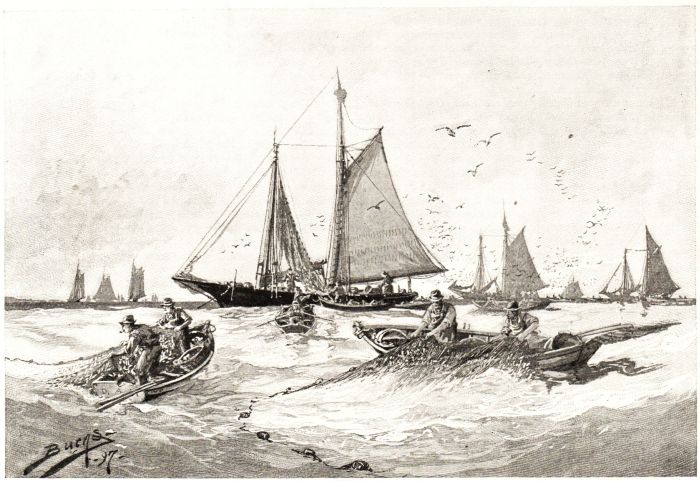
Not the half had been told about the herring. Since the world began Kingstown had never seen her harbor packed with fish like this. The waves tossed them upon the wharves into the baskets and barrels of those who had no nets, at the very feet of the vagrant Kingstown cats, who, for lack of rod and line, had been forced to haunt the fish-houses.
The herring had only just appeared, but it was estimated that when all appliances were ready a thousand barrels a day could be taken.
They worked with a will, all the little party from Tooraloo Point, even Cap'n 'Siah, although he grumbled that herring wouldn't be worth nothing, there were so many, and that the Delight would surely sink if they loaded her so heavily, and that they could never get salt enough to salt so many herring, and if they ate so many they should be like pin-cushions before spring.
There had been a fair wind to carry them down to Kingstown, and in returning they were forced to beat.
"But there's going to be a change," said Manuel, surveying the heavens with a sailor's practised eye, "and after we get round the Point 'twill be all right."
That was when they were making their way out of Kingstown Harbor, and little Israel was shouting with wonder at the herring, which sometimes seemed like a great wall, through which the Delight pushed her bow slowly.
"Round the Point?" echoed young Josiah and Caddy, wonderingly; and Caddy thought again of the blow on the head that had been enough to kill anything but a "Portergee."
And Manuel, growing suddenly pale, and showing new, strong lines in his sharp little sixteen-year-old face, beckoned them impressively aft—yet not so far aft as to be overheard by Jo Fretas, who was at the helm. Cap'n 'Siah was watching the herring with little Israel, and saying, "I wum! I never see so much of anything in my life, without 'twas sand."
Manuel had to use persuasion when he divulged his plan, chiefly with Caddy, who had inherited some of her grandfather's caution, and who had never been to Boston, fifty miles away, in her life.
Young Josiah had demurred but little, and that only—as in a candid moment he afterwards confessed to Manuel—because he hadn't planned it. As for young Josiah's being afraid, like Caddy—catch him!
Caddy was afraid little Israel would be seasick, and was sure that her grandfather would jump overboard, but Manuel tapped the top of his head significantly, and upon second thoughts Caddy decided that his bump of caution would be likely to prevent that.
And at last, when the Point was already in sight, Caddy, with her chin looking pretty square, as young Josiah said, called her grandfather to come down into the Delight's very small cabin and play checkers.
Cap'n Josiah came with alacrity, for he could never get checker-playing enough; moreover, the wind was growing fresh, and it was chilly on deck. He said maybe there would be time for a game before they got home, and Manuel was a good little "Portergee" to think of the board.
"Let him beat! Make him beat! Play like fox!" whispered Manuel to Caddy, as she followed her grandfather into the cabin.
And the Delight rounded the Point and found a more favoring wind, as Manuel had predicted, and the little weather-beaten house on the shore was left desolate and alone, with the early shadows of the November afternoon closing in upon it; while Cap'n 'Siah hilariously beat Caddy at checkers, and quite forgot that it was time they should be at home. When Caddy was forced to light a lamp in the little cabin, he sprang to his feet, and demanded, in great excitement, where that "pesky little Portergee" was letting the vessel drift to.
Manuel appeared in the doorway to explain, with young Josiah looking over his shoulder—although young Josiah was but thirteen, he was taller than Manuel—and with little Israel's beaming face thrust forward between his knees.
"It is not Portuguese like Jo Fretas and me who let the vessel drift. To navigate is in our blood, like the great Colombo!" Manuel drew his spiderlike little figure up as tall as he possibly could. "We carry the first herring to Boston; the very first, because the others have wait to load more. There is fair wind, and the moon will shine bright; before morning we shall be there. To carry you off was disrespect, and I lament him." Manuel removed his small cap and bowed profoundly. "But you are known there in Boston as great ship-master; you have license to sell these many years."
Cap'n 'Siah sat down and mopped his brow—and his wen.
"I was consid'able well known up there before things went wrong, and I got so kind of discouraged," he admitted. "But you—you're a terrible resky little Portergee!"
Manuel drew a breath that made his small chest heave; it was going to be all right with Cap'n 'Siah, whom he did not fear, but loved.
"The disrespect I lament him," he repeated, anxiously, "but the wind so fair, and to be the first in with the herring, and the Delight so comfortable, with bunks for every one except Jo and me, who have known life, and are content with coils of rope!"
"How come he to let you have the vessel?" asked Cap'n 'Siah, abruptly.
"Michael Fretas he is my friend and countryman," answered Manuel, evasively.
There was all the moonlight that Manuel had promised, and the wind held instead of going down at night-fall, as it so often does; in fact, it made the waves so rough that as they drew near Boston Light little Israel was very seasick, and even Caddy had a qualm. But who remembered that when the Delight thrust her sharp little nose between the larger vessels that lay at T wharf, in the murky morning light? Little Israel felt that life had suddenly turned into a fairy-story, and young Josiah, and even Caddy, had little doubt that the family fortunes were made.
Alas and alas! T wharf was piled with barrels of herring! On an adjoining wharf was a small mountain of the fish, as they had been shovelled from a schooner! The great catch had begun to reach the Boston market in the steamer that got in the night before, and in two or three large schooners that could take all the wind out of the little Delight's sails!
"Why hadn't you listened to me and kept from such foolhardy pranks!" cried Cap'n 'Siah, in angry despair. "Here we be, likely to be becalmed, and not get home for a week, with a cargo that's good for nothing but to heave overboard, and no victuals to eat!"
Little Israel gave way to despair at this dreadful prospect and set up a mighty roar. Caddy thought it was better, after all, to have a bump of caution; and young Josiah, with red rims appearing around his eyes, as they always did when he was frightened, looked inquiringly at the leader of the enterprise.
"It is so—as I have hardly thought it possible—the market is glut!" said the leader, calmly, but with a sharp line between his tensely drawn brows.
"Little mites of herring, too! Look how big them are!" Cap'n 'Siah pointed to the barrels nearest them on the wharf.
"He told me to pick 'em out small!" said young Josiah, in an aggrieved tone, for his faith in the leader had begun to waver.
The color leaped suddenly into Manuel's sharp, thin little face.
"It is true they are small; one must provide a little for the evil day, even when one shall not think the market will be glut! I go, but I will be back again by-and-by!"
He made his way swiftly through the crowd of clamoring fish-dealers, with which the wharf was already alive, and in the long avenue that led to the street he disappeared from their sight.
"That's the last we shall ever see of that tarnal little Portergee!" said Cap'n 'Siah.
But after the Cap'n had threatened to throw the herring overboard, to sell them for enough to buy a breakfast, and never to pay for the boat, Caddy had given way to tears in company with little Israel, and young Josiah had permitted himself to express a preference for Yankees, Manuel came walking across the plank to the Delight, his small brown face aglow.
A man came with him, well dressed and with a business-like air, but dark-skinned and with ear-rings. Manuel introduced him proudly as his friend and countryman, José Macés, foreman of the great canning factory in —— Street. He would buy the little herring; it was of them that sardines were made in his factory.
"It is why I have choose the small ones," Manuel explained, serenely.
But it was not until Cap'n 'Siah saw the barrels loaded upon a great dray, with the name of José Macés's firm upon it, that he could believe the good fortune.
They all had to count the money over twice; it seemed too much to be true; and little Israel bit and rung the silver pieces. Then Manuel made them go to a restaurant on Atlantic Avenue to breakfast, and although Cap'n 'Siah thought it was reckless extravagance, he murmured all the way that Manuel was a "dreadful cute little Portergee." At the restaurant he met two sea-captains who were old friends, and had so good a time that he forgot how reckless it all was.
But when the Delight had set sail for her homeward voyage he grew silent and dejected. He wished he had a vessel he owned; the old captains had told him that he ought to go sandin'; that there was money in it.
"But the Delight! She will be so good a vessel for that," said Manuel, calmly. "It is true that I have contracts with the canning factory to deliver many herring—and mackerel too, in their season; but there will be times—oh, plenty, until we buy another boat, to use her for the sanding too!"
"What in nater are you talking about? Don't you know that Michael Fretas won't lend his boat?" growled Cap'n 'Siah.
"The Delight she begin to-day to be mine. I agree to pay the first instalment from the herring money; after that it will be easy, and—the disrespect I lament him—but if you would share in the business—and afterwards young Josiah—and with Mees Caddy to keep the home port snug—" Manuel took off his old cap, with one of his beautiful bows.
"And I thought of letting you go away," said Cap'n 'Siah, with something between a growl and a sob in his throat.
"Oh, but I should not—nevair!" cried Manuel, his little peaked face alight. "You that have been so good and make true home for me, should I leave you to take care of yourself?"
Cap'n 'Siah's great grizzly chin actually quivered; he threw back his head and laughed to hide it. "If you ain't the all-tiredest little Portergee!" he said.