THE VOYAGE OF HIRAM AND DAVE.
Reading edition
BY A. J. ENSIGN.
George Whittingham was staring at a Billingsgate fish-woman. She was glaring at George, and treating him to some of that wonderfully abusive language known to all Englishmen as "Billingsgate." George was just about to repeat the expedient of a noted English wit, and call her a "miserable isosceles triangle, a beastly rectangular parallelopipedon," when some one pulled his coat sleeve and said,
"Mr. George, let 'er alone; she can beat you at that every time."
George whirled around at the sound of a familiar voice, and exclaimed: "Hiram Wardell! Well, what on earth are you doing in London?"
"Tryin' to find out how to get home, Mr. George. Me and Dave Hulick here ain't in London on a tour, I can tell you, and we don't want to stay here either."
"Then it's lucky for you that my father is in the consular service here. I guess he can help you two boys. But, say, this is a funny case, isn't it? Only a year ago you fellows were taking me out fishing off Joppa, and now—How did you get here, anyhow?"
"Well, Mr. George, this ain't a very good place for story-telling. Can't we go where it's quiet?"
"You two boys come to my father's office with me," said George, "and then you can tell him and me the story at the same time. I think that will be the best way to manage it."
So the well-dressed young gentleman, accompanied by the two rude-looking New Jersey "beach-combers," set off through the jostling, bustling London crowds toward Mr. Whittingham's office in Cheapside. George's father was at his desk, and expressed his readiness to listen to the story of the two boys, whom he was surprised to see in London. Hiram Wardell, when bidden to go on with his narrative, hung his head and twisted his cap nervously in his long red fingers.
"Go on, Hi," said his companion; "ye got to tell it, an' ye might as well start an' git through."
Hiram straightened himself up with a jerk, ran the red fingers through his shock of dust-brown hair, and began: "Well, sir, I s'pose we two boys is a pair o' fools, an' that's the truth. But we'll know better nex' time. You see, it ain't very much of a country down there on the Jersey coast, except in the summer, when the city people is there, an' then what is it? Only drivin' a hack, or takin' a gentleman out fishin', or somethin' o' that sort. So Dave an' I this spring got mighty tired o' the whole business, an' we made up our minds that we'd got to git out. So one day we was a-settin' on the beach talkin' about it, an' Dave he says to me to look at a schooner wot was goin' down to the south'ard. An' he says to me, wot was the matter with goin' to New York an' shippin' on one o' them schooners an' goin' to the West Injies, or Savannah, or Halifax, or some sich place? Right off it seemed to me that was about the finest scheme I'd ever heard of. But we didn't have much money betwixt—only sixty-four cents—an' the question were how to git to New York. First off, Dave thought it would be the best way for him to take the money an' go to York, an' when he'd earned enough to send for me. But I was mistrustful o' bein' left behind an' seein' Dave wave his hat at me some day from the deck o' one o' them schooners goin' South."
Mr. Whittingham lay back in his chair and shook with laughter, while Dave Hulick looked at Hiram with a countenance full of solemn reproach.
"Well, you know you'd 'a' done it, Dave," said Hiram, as he continued with his story. "After talkin' the thing over for a good while, I proposed that we pervision Dave's father's smallest fishin' skiff with them sixty-four cents an' sail for York. Dave he said it weren't fair for him to furnish twenty-eight cents an' the boat, an' me only thirty-six cents. But I told him the boat didn't cost him nothin', an' he had to allow that I was tellin' the truth; so he agreed to my plan. I ain't a-goin' to stop to tell you all the botheration we had a-gettin' them pervisions an' gettin' 'em stored ready for shippin'. Land sakes! Folks was so mighty curious that I 'most lost my wits inventin' answers for all their questions."
"All about sixty-four cents' worth of provisions?" inquired Mr. Whittingham, who could not conceal his amusement.
"Jest that, sir, an' nothin' else," replied Hiram, gravely. "Well, at last everything was all ready, an' bright an' 'arly one fine mornin' we slipped out an' down to the beach. Of course it wasn't no great shakes of a matter for us two boys to launch the boat an' get out through the surf. Mr. George he knows that, 'cause he's often gone out with us. Well, when we got out there wasn't enough wind to sail, the ocean bein' as smooth as one o' the plate-glass winders in Bill Smock's drug-store. So we had to get to work an' row. There was other boats goin' out, an' my sakes alive! what a lot of questions we had to answer! Seems to me there wasn't any reason for 'em, either, 'cause we boys often went out fishin'. But anyhow we pulled along till we got well to the north'ard o' Joppa an' out o' reach o' questions, an' then Dave he struck work. 'Blowed if I'm goin' to row all the way to York,' says he. Didn't you, Dave?"
"That's wot I said," was Dave's laconic answer.
"We set the mast an' sail, an' let her drift. It was a putty middlin' hot day, an' along in the early afternoon, when we hadn't got more'n five or six miles to the north'ard, I reckon both of us fell asleep. I don't know how long we was asleep, but I know what woke us up. The blamed boat turned turtle."
"What—upset?" exclaimed Mr. Whittingham.
"THEN I GOT OUT MY BIG RED HANDKERCHER AND WAVED IT."
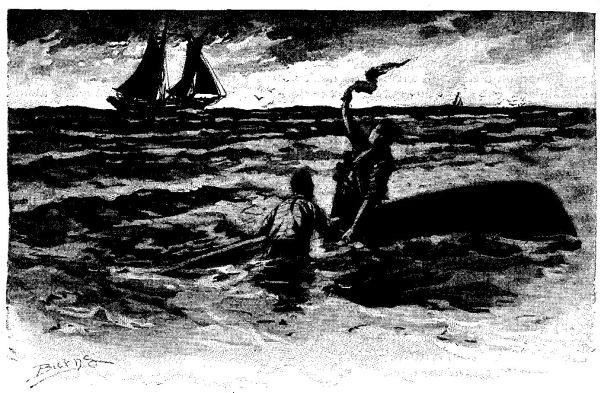
"Yes, sir, upset. You see, there was a kind of a squall, an' we, bein' asleep, didn't get no notice of't till we was in the water. Well, I climbed up on to the bottom o' the boat, an' Dave he hung on to me an' grumbled. 'Nice sort o' doin's,' says Dave; 'there's that sixty-four cents' worth o' good grub gone to feed the fish.' An' then I says to Dave to shut up his all-fired nonsense, and be glad that we wasn't gone along with the grub. Then I got out my big red handkercher an' waved it. There was a small coastin' schooner ratchin' along not more'n a mile away. The squall had died down to a good breeze, an' she was a hustlin'. She didn't see us, though. Well, sir, we hung on to the bottom o' that there boat till putty nigh sundown, an' all the time we was a-driftin' further an' further out to sea. About then this here Dave he woke up an' says, 'Here comes a big wessel right at us.' Sure enough, there was a full-rigged ship what had just cast off her tug an' was a-makin' sail. She was a-headin' so's to come within a hundred yards of us. So I got the handkercher out again an' waved it, and when she got putty near we both yelled. The ship hove to an' lowered a boat, an' in a few minutes we was aboard o' her. We told the skipper our story an' he laffed. He wasn't putty when he laffed, either, because his teeth was all out in front an' his nose was broke. 'So you was bound to New York, was you?' says he. 'Well, now you're bound to London.' I didn't want to go to London, but this here Dave—he don't know much, sir—he said he'd jest as leave go to London on a ship as the West Injies on a schooner. So to make the story short, sir, we two lunatics—'cause that's ezackly what we was—shipped on to that there wessel as green hands."
Hiram paused a moment, overcome by the flood of his melancholy recollections.
"I hope, sir," he continued, gravely, "that you was never a green hand on a ship. A green hand don't know how to do nothin', an' one o' the mates tells him to do it, an' then yells, 'I'll l'arn ye, ye slob!' An' he allus teaches him with his fist or his foot or a belayin'-pin. I bin punched, kicked, an' knocked down all the way from off Long Beach to the North Foreland. I was taught to furl a royal off Davis South Shoal with a kick in the ribs. I had a long splice, a short splice, an eye splice, an' a black eye punched into me off George's Bank. I got the science o' heavin' to in a gale o' wind kicked clean through me off Cape Race. I learned how to heave the log off Sable Island by bein' hove down the forehatch head fust,'cause I didn't know how to do 't. I got a fust-class chart o' the North Atlantic Ocean hammered on to my body in black an' blue, an' ef ever I git lost out there again, it'll be because the Jersey coast has lost its anchor an' gone adrift. An' now, sir, here's Dave an' me; we don't want to go South on to a schooner no more. All we wants to do is to git back to Joppa, let our fathers lick us, an' then settle down to cod-fishin' an' peace an' quiet for the rest of our lives."
Mr. Whittingham laughed heartily over this account of the two boys, but said their final decision was a very wise one, and that he thought they had paid in full all they owed for having run away from home. He sent them home in the steerage of a swift ocean liner that landed them in Joppa a week later.
THE SCIENTIST AND THE FARMER.
A distinguished scientific writer was once on a shooting excursion in an English shire. Coming across a bluff, hale farmer, he entered into conversation with him. As they walked along, they reached a heap of stones. Pointing to them, the scientific man asked the farmer if he knew how they were made. The farmer grinned and replied, "Why, they bean't made, sir; they grows."
"Grow? Why, nonsense, man! What do you mean by grow?"
"Why, same as 'taters grows."
"Dear me! Why, those stones can never grow!" said the scientific man. "They have been that way for years and years, and if you were to look at them years hence, they would be just the same size."
At this the farmer actually laughed, and looked at the man of science as though he pitied his ignorance as he exclaimed, "Why, in course they'd be, 'cause they've been taken out o' the earth, and they stops growin' then same as 'taters would."