A BOY OF 1775.
Reading edition
BY MOLLY ELLIOT SEAWELL.
Can you not see the boy of 1775 now—his sturdy legs encased in stout black stockings, german-silver buckles to his knee-breeches, his hair plaited and tied with a smart black ribbon, and all this magnificence topped by three real silver buttons with which his hat is rakishly cocked? But the boy himself is better worth looking at than all his finery—so thought Captain Moore, of his Majesty's ship Margaretta, lying at anchor in the harbor of Machias. Jack Leverett was the boy's name—a handsome stripling of sixteen, with a quiet manner but a fearless eye.
The two were sitting opposite each other at the cabin table, and through the open port they could see the village and the harbor, bathed in the bright white light of a day in May. The Captain was conscious that this young guest was decidedly in a hurry to leave. A whole hour had they sat at the dinner table, Captain Moore, with the utmost art, trying to find out Jack's errand to Machias—for those were the stirring days when every American had to take his stand for or against King George—and Captain Moore particularly desired to know how Squire Leverett, Jack's father, stood toward the King. But Jack, with native mother-wit, had managed to baffle the Captain. He had readily admitted that he was the bearer of a letter from his father to Jerry O'Brien, master of Squire Leverett's sloop Priscilla, in regard to heaving down the sloop. But the Captain, with a seaman's eye, had noted that the Priscilla was in perfect order and did not need to be hove down, and he more than suspected that Jack was the bearer of other and more important news. Through the cabin windows they could see the sloop, a beautiful craft, being warped into her dock, while across the blue water was wafted sweetly the voices of the men, led by the shanty man,[1] singing the old shanty song:
"Haul the bowline, our jolly ship's a-rolling, Haul the bowline, the bowline haul! Haul the bowline, our jolly mate's a-growling, Haul the bowline, the bowline haul!"
As soon as Jack decently could, he started to rise from the table. Captain Moore had observed that the glass of wine at Jack's plate remained untasted, and it suggested a means of finding out whether the Leveretts meant to go with the King or not.
"Do not go," he said, "until you have joined me in drinking the health of his Majesty King George."
Jack had no notion whatever of drinking the King's health, but he was at his wits' end how to avoid it. Just then, though, the Captain turned to speak to his orderly, and Jack took the opportunity of gulping down his wine with more haste than elegance. Captain Moore, seeing it, was surprised and disgusted at the boy's apparent greediness for wine, but raising his glass, said, "To the King."
"Excuse me, sir," answered Jack, coolly, "but my father never allows me to drink but one glass of wine, and that I have already had."
"Then I will drink the toast alone," said Captain Moore, with a stern look at the boy. "Here is to his Majesty King George. Health and long life to him! God save the King!"
As Captain Moore uttered this sentiment Jack rose and promptly put on his hat. The Captain was quite sure that the boy's action, like his gulping down the wine, meant a distaste for the King, and not a want of breeding. But he thought it best not to notice the incident, and said, civilly, to his young guest:
"Present my compliments to your honored father, and tell him that his Majesty's officers have the kindest feelings toward these misguided people; and while if attacked we will certainly defend ourselves, we have strict orders to avoid a conflict if possible, and not to fire until fired upon."
"I will remember your message, sir," was Jack's answer; and the Captain, having no further excuse for detaining his young guest, allowed him to depart.
He was soon alongside of the Priscilla, and there, standing at the gangway, was the sloop's master, Jerry O'Brien. Jerry, by an accident of fate, had inherited an Irish name, but he was as arrant a Yankee as ever stepped. He was a handsome fellow withal, and in his natty blue suit much more resembled the Captain of an armed cruiser than the master of a smart merchant vessel. The Priscilla, too, was a wonderful contrast to the slovenly merchantmen around her. She was as clean as hands could make her, and her beautiful lines were brought out by the shining coat of black paint upon her hull. Her men were smart and seamanlike. Jerry O'Brien was the most exacting ship-master on that coast, but he never had any trouble in shipping men, for, while making them do their work with the quickness and steadiness of man-o'-war's men, he used neither blows nor curses. A natural leader of men, he made himself respected first, and after that it is always easy to command obedience.
As soon as Jack Leverett came over the side Jerry took him to the cabin. Jack produced a letter, and by the heat from a ship's lantern some writing in lemon juice was deciphered. It contained a full account of the affairs at Lexington and Concord, of which only vague rumors had reached Machias. At every sentence descriptive of American valor Jerry would give a half-suppressed whoop, and at the end he could not forbear letting out a huzza that made the little cabin ring.
"Suppose," said Jack, who had hard work to keep from hurrahing wildly, "instead of making a noise, we should invent a scheme to capture the Margaretta. If the farmers around Boston could, with hay-forks and blunderbusses, beat off the British regulars, the sailors and fishermen about here ought to be able to get alongside the Margaretta and take her."
Jerry's mouth was large, and it came open like a rat-trap at this bold proposition. After a pause he spoke. "Boy," said he, "the enterprise shall be tried; and if we succeed, you shall be prize-master of the Margaretta."
Jack's heart leaped at these words. He was an admirable sailor, like most of the hardy youngsters on the coast, and had more than once taken the Priscilla on short trips. But his mother and the Squire meant him to be something else than a merchant Captain, and kept him under a tutor when he would much rather have been sailing blue water. For hours Jack and Jerry sat in the cabin talking over their scheme. Jerry knew that the people of Machias were heart and soul with the cause of freedom, and could be depended upon in any desperate adventure. The Margaretta carried four brass guns and a number of swivels; but, as Jerry shrewdly said, if once the Priscilla could grapple with her, it would be a battle of men and musketry, not of guns. At nightfall Jack and Jerry went ashore. A great vivid moon hung in the sky, and they could see the Margaretta almost as well as in daylight. She was a handsome vessel, schooner rigged, and in a state of preparation that showed Captain Moore did not mean to be caught napping. All her boats were hoisted in, her anchors had springs on them, and her sails were merely clewed up, instead of being furled.
"There you are, my beauty," said Jerry. "It's a shame, so it is, that King George's ensign should fly from your peak. You deserve an American flag, and we'll try and give it you."
All that night they spent going from house to house of the men who had the patriotism to enlist with them, and by daylight they had the promise of twenty-five resolute men who, at a signal of three cheers given from the Priscilla, would at once board her and put themselves under Jerry O'Brien's command.
All this commotion on shore had not escaped Captain Moore's lookouts during the night, and although the Captain would much have preferred staying and fighting it out, his orders compelled him to cut and run if signs of an outbreak were visible. The British government then earnestly wished to conciliate the colonists, and by no means to come to blows.
The next morning was Sunday, and as beautifully clear and bright as the day before. In order to avoid the appearance of fear, Captain Moore determined, with his officers, to go to church as usual. As the Captain's gig landed the officers, Jerry O'Brien and Jack Leverett, with the six men who composed the Priscilla's crew, were all on deck, keeping a sharp eye on the Margaretta and her boat.
"What say you, men," suddenly asked Jerry, "to bagging those officers in church?"
"We say yes," answered every man at once. In a few minutes, with Jerry and Jack in the lead, and all well armed, they took the road toward the church. As they neared it they heard the faint sweet echo of a hymn that floated out on the spring air—the only sound that broke the heavenly stillness.
Jerry silently posted his men at the entrance, and then opening the door softly, raised his horse-pistol and levelled it straight at Captain Moore, who sat in the last pew.
The British Captain happened to turn his head at that instant. The congregation was too absorbed in the singing to notice what was going on. Jerry nodded at the Captain, as much as to say, "You are my prisoner." The Captain coolly shook his head, as if to answer, "Not quite, my fine fellow," and the next moment he made a sudden dash for the open window, followed by all of his officers, and before Jerry could realize that the birds had flown, they had run half-way to the shore. In vain Jerry and Jack and their followers pursued. The officers had too long a lead, and by the time the Americans reached the shore the Captain's gig was being pulled rapidly to the ship. As soon as the boat reached it the anchors were picked up, every sail that would draw was shaken out, and the cruiser made for the offing. As soon as she was well under way she sent a shot of defiance screaming over the town, and was answered by three thundering American cheers from the Priscilla. As if by magic the sloop's deck was alive with armed men, and with a quickness equal to the cruiser's, her mainsail was up, and she was winging her way in pursuit of her enemy.
Well had the Priscilla been called the fastest sloop in all that region. The wind was dead ahead, and both vessels had to get out of the river on "a long leg and a short one." The Margaretta was handled in a seamanlike manner, but on every tack the Priscilla gained, and showed that she was a better sailer both on and off the wind. In an hour they were within hailing distance, and the men on the Margaretta were called to quarters by the tap of the drum. Her guns were run out, their tompions withdrawn, and the cruiser showed herself to be an ugly customer to tackle. But this did not intimidate the Americans, who were closing on her fast.
A hail came from the Margaretta, "What are you following us for?"
"To learn how to tack ship!" responded Jerry O'Brien, who had taken the wheel himself. This reply caused a roar of laughter from the Americans, as the Priscilla could come about in half the time of the Margaretta.
"Keep off or I'll fire!" was the next hail.
"Fire away, gentlemen," bawled Jerry, "and light your matches with your orders not to fire first!"
At this the gallant British tars groaned loudly, and Captain Moore, drawing his sword and shaking it at the rapidly advancing sloop, shouted:
"Orders or no orders, I will fire one round if I lose my commission for it. Blow your matches, boys!"
The guns were already manned, and at the word there was a flash of light, a puff of smoke, and a round shot came hissing and shrieking across the water and struck the Priscilla's mainmast fairly in the middle, splintering it. The sloop staggered under the blow, and in a minute or two the mast went by the board with a crash.
A great cheer broke from the Margaretta's men at that.
"Never mind," cried Jerry. "This is not the first mast that was ever carried away, and we have spare spars and carpenters too. Wait for us in Holmes Bay, and we will fight it out yard-arm to yard-arm before sundown."
The Margaretta, with her men cheering and jeering, sailed away toward the open sea. The Priscilla being the best-found sloop in New England, in a little while the stump of the mast was cleared away, a lighter spar, but still good enough, was fitted, and she made sail on it.
As she neared the ocean the wind freshened every moment, and although the sun shone brilliantly, a heavy sea was kicked up. Soon they sighted the Margaretta, with her topsail backed, and gallantly waiting for her enemy.
In all this time Jack Leverett showed a steadiness and coolness beyond his years. Once Jerry O'Brien said to him,
"Youngster, if you flinch, depend upon it, your father shall know it."
"All right," answered Jack; "and if I don't flinch I want my mother to know it."
The two vessels now neared each other on opposite tacks. Captain Moore manœuvred to get into a raking position before delivering his fire, but the Priscilla, by skilful yawing and by the roughness of the sea, proved to be as difficult to hit as if she had been a cork bobbing up and down. In vain they played their two starboard guns and all their swivels on her; their shot rarely struck, and when it struck, did small damage.
Not so with the Americans. Without a single cannon, they poured forth a musketry fire at close quarters that did fearful work and made hot the Margaretta's decks. The brave British sailors stood manfully to their guns, but the Americans were gradually edging up, and their fire grew more deadly every moment. The Margaretta tried to sheer off, but the Priscilla, closing up, got her jibboom entangled in her adversary's main rigging, and a dozen Americans sprang forward to make the two ships fast.
As the vessels came grinding together Jerry O'Brien, leaping on the taffrail, shouted, "I will be the first man to board—and follow me!"
But Jerry was mistaken. He was suddenly seized by the coat tails, jerked backwards, and fell sprawling upon the deck, and the next instant Jack Leverett sprang over him, and was first upon the Margaretta's deck.
"Drat the boy!" was Jerry's involuntary exclamation as he scrambled to his feet.
The Americans poured over the side, and met with a warm reception. Captain Moore, surrounded by his officers, retreated to the fo'c's'le, fighting every step of the way. At last Jerry O'Brien came face to face with him. The Captain defended himself with his sword, but it was knocked out of his hand by Jerry with a pistol butt. They clinched and fell to the deck fighting. The struggle was sharp but short, and in fifteen minutes from the time the Americans had lashed the ships together the Captain was overpowered, nearly every officer had been cut down, and the cruiser was in the hands of the Americans. There had been much cheering on the Priscilla that day, but when the British ensign was hauled down, and Jerry, in default of a national flag, hoisted his own jacket at the mast-head, there were three cheers given that could almost be heard at Machias.
The prisoners were quickly transferred to the Priscilla, and as Jerry O'Brien required all of his best men on board, he could only spare a few landsmen for a prize crew on the Margaretta.
"But I will give her a prize master who, although not very old, can sail a schooner or any other craft—John Leverett, there," said Jerry. "And he will take her in, you may be sure."
Oh, how Jack's heart beat with delight at these words!
Soon they were heading up the river, and when, under a fair wind, they made a quick run to Machias, the May moon made the heavens glorious. Jack Leverett thought the happiest moment of his life had come when they cast anchor amid the thunder of cheers from the people assembled along the shores.
But there was a happier moment yet in store for him. A week afterward Jack and Jerry O'Brien entered Squire Leverett's study, where sat the Squire and Madam Leverett. The mother uttered a cry of joy and clasped her boy in her arms. Then Jerry O'Brien, taking him by the hand, led him to the Squire.
"Sir," he said, "here is your brave boy. You have reason to be proud of him. I have been promised two things when the navy of the Colonies is formed. One is a Captain's commission for myself, and the other is a midshipman's commission for this lad. He is born for the sea, and to make a landsman of him would be like putting a mackerel in a barnyard to scratch for his living."
The Squire, too moved to speak, silently took one of Jack's hands in both of his, and Madam Leverett, falling on her boy's neck, cried, "How happy am I to have such a boy to give to my country!"
GRANT'S TROUBLESOME SOLDIER.
General Grant used to tell a story of a soldier in a certain regiment during the war who was continually bothering him by asking favors. Grant one day said to him, "Look here; I believe you are the most troublesome man in the Union army."
The man quickly replied, "Why, that's funny, sir!"
"Funny; how do you make it out funny?"
"Because it is just what the enemy says about you."
BY GASTON V. DRAKE.
VII.—FROM BOB TO JACK.
London.
DEAR JACK,—When I left off my letter to you last night it was nearly ten o'clock, but almost broad daylight. What do you think of that? It's the queerest thing you ever saw. The clock and the sun don't seem to gee over here at all. You can read after nine o'clock without any gas-light at all. Pop says it's a special British arrangement, because London is such an interesting place and so many people can only stay a few days that they like to keep it lit up as long as they can. I'd heard before that the sun never sat on the British Empire but I never knew it was so long about setting in England. The hall-porter on our floor says it makes up for it in winter though by rising about midday and setting ten minutes later. If that's so how it must whiz across the sky. I'd rather like to see it then. He says too that last winter they had a fog so thick that people had to dig their way through it with spades, and he told another boy that it was a regular business in winter for boys and men who couldn't get other work to do to go about the city and shovel the fog off the front door steps and walks just as snow-shovellers do in New York. It must be fun living here then.
We didn't get into London until about seven o'clock Wednesday night, but it was fine travelling coming up from Southampton. You'd have thought the cars had rubber bicycle tyres on their wheels—see that word tyres?—that's English for tires—I saw it on a sign. They rode along just as smoothly as a bicycle would on a tar pavement, and go—Jerusalem how they did go! That little toy engine I told you about once she got started just leaped over the ground. You'd almost think you were travelling on a streak of lightning and in a packing box. That's all the cars are, just little packing boxes petitioned off into stalls running from side to side. You get into one of these stalls and the guard—they call brakemen guards over here—the guard locks you in and off you go. It isn't a bit like travelling in America, and I don't know as I like it quite as much as the American cars with Isles down the middle of 'em because the broken mixed candy and banana boys can't walk through and sell you things! haven't seen a broken mixed candy and banana boy over here and it's all because their cars haven't any Isles. There aren't any comic paper boys either but I guess that's a good thing. Pop bought a copy of one of the English comic papers and he nearly ruined his eyes trying to see the jokes, their points were so awful fine.
It took us about four hours to get here and two to find our baggage after we got here because the porters had put some of it with the B baggage and Aunt Sarah's trunk had wandered off among the C's. The station was crowded with hacks and omnibuses and people and almost every hack was engaged. Finally Pop managed to get a cab they called a four-wheeler. It looked scarcely big enough for two but as we got into it it sort of stretched and by the time the driver had us packed in we had seven people in it, Pop, Mamma, Aunt Sarah, the two children, the nurse and me. How we ever managed it I don't know, but we did, and then instead of sending the baggage to the hotel by an express-wagon the cabman put it all on top of the cab, two Saratoga trunks, three steamer trunks, a bath-tub, four bundles of rugs, two hat-boxes, three dress-suit cases and the hamper—and all for one horse! I didn't believe the horse could move us, but the minute the driver chirruped to him off he started like a regular race-horse and I tell you it was exciting. There we seven people were, cooped up inside with all those trunks piled up on the little bit of a roof right over our heads being galloped around corners as if we were playing snap-the-whip, darting in and out between policemen, lamp-posts and omnibuses. Mamma and Aunt Sarah were scared to death. They weren't afraid we'd tip over but they had half a notion that the roof might cave in and let all that baggage down on us; and I think Pop felt uneasy too because he tried several times to tell the driver to go slow, but he couldn't because he was wedged in so tight.
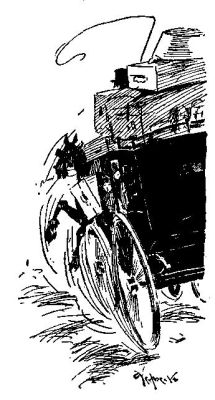
It wasn't possible to see much, we went so fast, but we did catch a glimpse of a fearfully dirty river as we crossed it and Pop said he guessed it was the Thames and it turned out to be so later on, and the bridge we were on led right up to the houses of Pollyment, I think they're called and I tell you they're beautiful. They look good enough to put on a mantel piece. Two minutes later we got here and Pop managed to pull us out of the carriage and get the baggage taken into a hotel by a man who was dressed up as gorgissly as a drum major, and all that cab cost was three dollars! Pop says he couldn't have got off for less than ten in New York and the driver cheated him into the bargain!
When he paid the cabby Pop told him he'd driven too fast and the man said he hadn't at all. "Aren't you afraid you'll run into somebody?" asked Pop. "No," said the man, "I'm afraid somebody'll run into me." Which is why he tore so to keep out of the way of the cabs behind him.
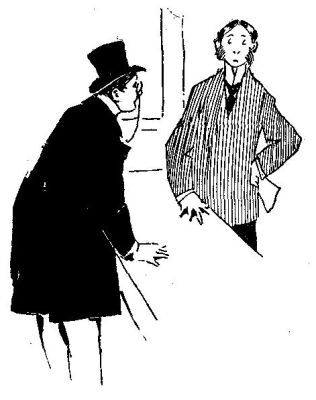
I can't say I think much of the hotels here. They're very handsome to look at, but its hard work getting anything at 'em. The people here behaved so that Pop thought we'd been landed at Buckingham Palace by mistake, and asked if he might see the Queen and apologize for intruding, but the man never laughed a bit; just turned away tired. We got our rooms finally though and there isn't a bed in one of 'em without a canopy over it and all the wash-stands have bottles of patent tooth-powders on 'em with signs saying if you open this bottle it'll cost you a shilling. I opened two of 'em before I saw the sign and Pop says I'm out fifty cents for my curiosity, but I don't mind. It'll go on the bill and he'll pay it.
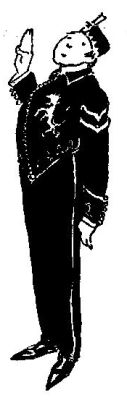
We're off now to see the Tower of London. The next time I write I'll tell you all about it. I wish Sandboys was here. It would do these English hall-boys good to see how Sandboys does his work. It would take one of them English boys a year to carry up as much ice-water as Sandboys does in a night, but then they've got as much work as they can do looking after their buttons. I should think it would be a day's work buttoning up a hall-boy's coat over here. Ours has sixty between his chin and his waist.
Yours ever Bob.