WHAT IS A MILLION?
Reading edition
BY BARNET PHILLIPS.
I must own up I never could wrestle much with figures; they generally threw me. I am afraid I was born without the power of appreciating what is called proportion in figures. I do not take that for an excuse. I ought to have practised more, and it is probable that I should have improved on an imperfect sense.
How my breath was taken away when I saw with my own eyes and heard with my own ears a young Irishman, in a great New York dry-goods house, rattle out marvellous results which had stiff calculations in multiplication and addition, and he did it all in his head, and had no slate to figure on! His ability was of use in a practical way. A salesman would say to this Irishman something like this: "Fourteen cases of prints, 22 pieces per case, 38 yards to the piece, at 6-7/8 cents per yard." The salesman had no sooner stopped calling it all out than the lightning calculator had given him the result. The advantage to the house was that before the purchaser of the goods had left the building his bill was handed to him. All day long that living calculating-machine kept on figuring just in this way, and his work never seemed to tire him.
I had a friend who possessed this marvellous mental power. He was a bookkeeper in a large Southern house dealing in cotton, and sometimes when great lots of thousands of bales of cotton were sold he figured up the results.
To come back, however, to the conception of figures and the difficulty in understanding proportions. I know what is meant by 1, or 10, or 100, or 1000, or 100,000, or 1,000,000, but when I get into a billion, and try to encompass that, my ideas are vague. When I read that the Secretary of the Treasury gave, some time ago, this figure as the money in circulation in the United States, $1,606,139,735, I got lost with that figure 1 which stood before the other nine figures.
Now who does exactly appreciate what is a million? A young friend of mine asked me to show him "a million of anything." I might have taken the grains of sand on the sea-beach, and counted and weighed out an ounce of them, but that would have been troublesome work. Had I done so, however, I could have shown him a million of grains of sand. I had, however, some No. 9 shot, just such shot as are used for snipe-shooting, and then, as luck would have it, a No. 9 shot is just about the size of the letter "o" in Harper's Round Table. The manufacturers of shot, who know exactly what are the diameters of their leaden pellets, tell me that a No. 9 drop-shot has a diameter of 8/100 of an inch, and that 568 of such shot weigh one ounce. Therefore 1,000,000 of such shot would weigh 110 pounds, and a trifle of an ounce over.
I wanted, however, to get some idea of bulk. I had a box made one inch high, one inch deep—in fact, a cubic inch. This I filled with No. 9 shot, and it held just about 2000 pellets. Now a million of these shot would be, of course, 500 times 2000 pellets, or 500 little boxes would hold the million. If, then, I had a big box made to contain the million, this receptacle would have to be about eight inches on all sides. I can get of this some idea as to the bulk of these small shot by the million.
The more ways I could look at a million, the better I thought I would understand it. I wrote to the Treasury Department in Washington, and I put two questions, which one of the leading authorities answered in the most obliging manner. All I have to do, then, is to copy this gentleman's letter.
Treasury Department, Office of the Treasurer, Washington, D. C., March 16, 1893.
Sir,—You ask me the following questions: 1st. How long does it take, under the most advantageous circumstances, for an expert to count 100,000 silver dollars? 2d. How long does it take, under the most advantageous circumstances, for an expert to count one hundred thousand notes?
In reply to the first inquiry, permit me to state that for a continuous count of an expert it will require twenty hours to handle 100,000 standard silver dollars. Under ordinary conditions, and observing the rules and regulations of the office for count as to correctness, and at the same time keep a careful eye for the detection of counterfeits, 4500 per hour, or 27,000 per six working hours each day is about the limit of capacity of our experts in that line.
To the second inquiry I may say that it will take an expert 16-2/3 hours to count 100,000 new notes, and for a current or ordinary day's work 40,000 notes is about all that can be done.
Respectfully yours, E. H. Nebeker, Treasurer U. S.
Take, then, a million of silver dollars, and set an expert counting it. If he worked night and day over it, lost no time in eating, drinking, or sleeping, he would finish a fairly tough job of counting a million of silver dollars in precisely 8-1/3 days.
I asked the Washington authority to give me some general idea as to the weight of 100,000 standard silver dollars, and the Acting Assistant Treasurer wrote me, "that 100,000 standard silver dollars will weigh 7161.5 pounds troy, and will occupy a space of 10.49 cubic feet." Then a million of silver dollars would weigh 71,615 pounds troy. The silver brick takes up less room than coin in some respects, but a vault made to hold a million of dollars worth of silver bullion must have more size than an ordinary coal cellar.
If you want to get swamped with figures, supposing at least you have the conception of what is a million of dollars, the total stock of money in the world is $3,656,935,000 in gold, and $3,944,700,000 in silver, making a grand total of $7,601,635,000. Say that the population of the United States is 65,000,000, then about this amount of money, $10.47 in gold, $8.55 in silver, $6.51 in paper notes, or $25.62, suffices for each one's use. If there was not as much money as that per head—little boys and little girls and babies included—the fathers, who hold the purse-strings, would complain that money was tight or hard to get, and exchange of goods for coin would be difficult.
Certainly the Secretaries of the Treasury must understand what are the vast amounts they have charge of. Only try and appreciate how much money was taken in by the United States in 1883 for gross revenue. It was $954,230,146. But the United States wanted a great deal of money that year, and so it paid out in 1883 $885,491,968.
This is one of the big counts of the United States Treasury. On the 29th of August of 1893 the cash alone on hand was $174,770,422.97 in coin. Sixty experts began work on it, and it took three months to finish the job. The weight of mixed coin was nearly 5000 tons.
When you come to figures in their application to time most of us get quite lost. We call this year 1896—that is 1896 years since the birth of Christ. In the history of the world that is only an instant, and yet it seems so far distant as to be somewhat out of our comprehension. But what is the mental process which can span the period between to-day and the time when the pyramids were built—say 3000 years before the birth of Christ. Perhaps one way of comprehending it is to divide every 100 years by three, because 33-1/3 years may about present a generation.
Suppose we take the conquest of England by William of Normandy, and his coronation at Westminster, in 1066. That was 830 years ago. In the eight centuries there would be about three generations for each 100 years, and that would make twenty-five generations and twenty-nine years over. Let us say the event took place twenty-five generations ago—it is curious dividing time in that way—how much nearer William the Conqueror seems to be to us. There is only one trouble about this method; it is the sense of humiliation it causes, because twenty-five or thirty generations ago our forefathers must have been rather savage people. At the same time we have the consolation of knowing that we have improved since then. Why, Christopher Columbus found America only twelve generations back—and there are many people alive who have seen five generations, counting themselves. It does not do, however, to go too far back, say to the forefather who was alive when the pyramid was reared. I do not understand 1964 generations ago.
BY GASTON V. DRAKE.
VIII.—FROM BOB TO JACK.
London July — 189-.

MY DEAR JACK,—I tell you this London's a great place, and the more you see of it the more you want to see. There's only one thing that's disappointed me about it and that's Dukes and things like that. I thought Dukes went around in funny clothes with coroners on their heads and red velvet robes stirring up the dust on the sidewalks behind 'em but it ain't so. I've only seen one feller that looked real noble and he was standing on the back of a carriage on the place where American hackmen put trunks. I thought I'd spotted an Earl anyhow, but Pop said you could tell from his stockin's that he was only a Flunkey, and when I asked him if Flunkies were greater than Barons he said he guessed they were—anyhow they made other people sort of dwindle in their presence which Barons couldn't generally do. He wore red plush knee breeches, and to make him look older they'd put plaster all over his head. It's queer having a man like that getting a hitch behind on carriages and I asked Pop what they did it for and he said the Coachmen were always dropping their aitches and the Flunkey was put there so's he could get off easily and pick 'em up.
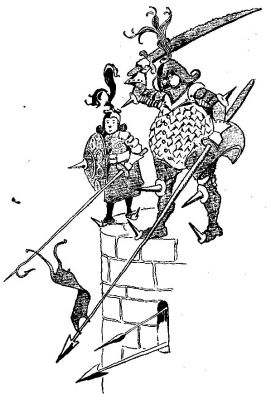
Yesterday we took a hansom and went out to see the Tower and it's a terrible place. It has motes running all around it that they fill up with water when enemies come. Pop says enemies always hates water and it gives people inside more chances of beating 'em. If they managed to get over it and scale the walls those inside could shove their ladders over backwards so that all those that fell on the land would get their backs broken and those that fell in the water would get drowned. It sort of all makes me wish that I'd lived in the old times. I'd like to have seen those old warriors trying to climb ladders in their cast-iron clothes and trying to swim ashore with tin trousers on.
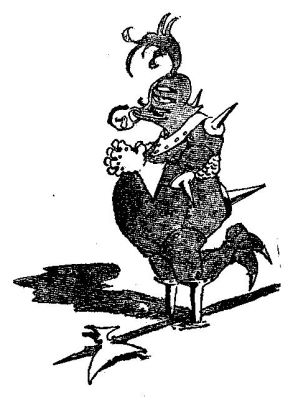
Up in the Armory of this tower they've got nearly a million of these old suits and lances bigger than telegraph poles. It seems to me that when two armies dressed up in sheet-iron the way they used to be ran at each other with all their force it must have been worse than a railway collision when they met. I'd have thought they'd have telescoped like two Pullman cars, but Pop says they didn't. They just dented each other and fell back. I don't believe even our seventh regiment could have carried uniforms like that, because I don't think they weigh less than a ton, but it must have been safe. When a feller met an enemy he'd have to take an axe and crack him open like a nut before you could get at him. Maybe that's where the soldier's title of Kernel comes from. I asked Pop if it was and he got laughing so the man who was taking us around got mad and acted as if he'd put us out for ten cents. Pop told him what I'd said and he said what an extrordnery question.
Some of the iron uniforms had great spikes in the knees which must have been great when it came to shoving an enemy. Pop says that once a poor warrior with spiked-knee pants was so afraid he was going to get killed that he got down on his knees to pray before going into battle and got stuck so fast he couldn't go and his life was saved.
There's lots of other things in the tower too. They've got a block that people's heads used to be chopped off on. It has a nice comfortable little place for your neck scooped out of the middle of it, which shows that they tried to make death easy for the victims. I don't think I'd have liked it much just the same and I'm glad people can die other ways. There are screws there too to put on people's thumbs when they wouldn't confess that they'd done things. When a man said he was innocent they'd put these screws on his thumbs and give 'em a twist and ask him to guess again, and they'd keep him guessing till he remembered he was guilty after all. Then they'd take him out and chop his head off and begin on somebody else.
All the Queen's jewelry is kept in the tower in a cage like monkies. I spent about a half an hour looking at it. The diamonds are so big you'd think they were glass and somehow or other they don't dazzle you as much as you'd think. I think maybe they're not real and the Queen's just making a great big bluff with 'em, though they do say that once a man broke in here and got away with more than half of them, but couldn't get far because they shined so in the night that the police saw them through his clothes and arrested him before he'd gone a mile. The crown is kind of nice to look at. It reminds you of one of those small hall gas fixtures with lots of colored lights in 'em, and I've a notion that if it was lit up it would beat one of those colliderscope pictures all holler.
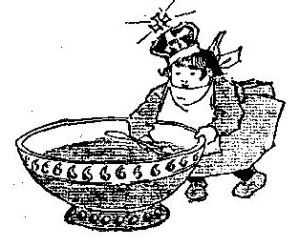
Then there were maces and great big solid gold porridge bowls for royal babies to eat their oat meal out of, till you really got tired of it all and felt as if you wouldn't mind looking at a tin cup or a pile of rusty iron tracks near a railroad for a little while. The Queen must be awful rich to own all these things, but after all I don't see what good it does her to have 'em if they've got to be locked up all the time. It's like owning a gold watch your Pop won't let you carry for fear you'll break it. I guess you've been there. I have—in fact, I am there. It's a stem-winder and came last Christmas.
Pop says that supper is ready, so I'll have to quit writing. If I have time to-morrow I'll tell you more about the tower and what I saw.
Yours affectionately Bob.
The annual interscholastic indoor games of the Boston Athletic Association were held last Saturday—too late in the week to afford opportunity for detailed comment in this issue of the Department, which is consequently postponed until next week. These games practically close the indoor athletic season in and around Boston. This year that season has proved most interesting and profitable, and the standard of performance developed at school games has been considerably above the average.
Chauncy Hall School started the ball rolling early in February with an enthusiastic closed meeting. The best performances were done by Abrams, who won the 30-yard dash and the 35-yard hurdles; and Porter, who won the half-mile. This is Porter's particular distance, and he is not so strong in either the 600 or the 1000. Some good pole-vaulting was done, but only the younger boys were entered for it.
English High followed suit the next week with a closed meet. Unfortunately, spiked shoes were not allowed, as the games were held in the school armory, but nevertheless the feats were very creditable, especially the high jump, which was won by Converse, who cleared 5 feet 4 inches with little difficulty. It was evident that he can do much better than that. Dow at 1000, Purtell at 600, and Emery at 300, were the best distance-runners. Dow runs with a very graceful stride, and is a clever racer, as witness his deed in the Cambridge Latin open games, when running practically from scratch, he finished second only to Blakemore, the Harvard crack, who had five yards handicap over him. Purtell can do 600 yards in excellent form, but seems to need more experience in hard races. Emery showed his mettle by winning the open scratch 300 in the Cambridge games from a big field of starters. In the dash O'Brien and Duffy are the best men, but neither is a star. O'Brien, however, is a sure man in the shot-put, throwing it 38 feet 2 inches in the English High games.
Roxbury Latin's games were not so interesting to interscholastic enthusiasts, since most of the events were crowded with college men. Brewer and Hallowell of Hopkinson's, however, did good work in the dash and hurdles, respectively, and Warren of Cambridge put the shot 34 feet 8 inches.
The Newton High games were the most successful of the school meets. Cotting was the star of the day, winning the closed high jump, shot-put, and 300. Sever of Cambridge Latin was the best interscholastic man in the open 30, as was Martin of Hopkinson's in the 600. Martin won his heat by the cleverest kind of racing, but was unable to get through the big field of starters in the final. Carleton, Captain of Hopkinson's team, won the open 440 after a hard race. A relay race was run off between Brookline High and Newton High. Brookline led all the way, until Cotting, who ran last for Newton, pulled out the race in the last ten yards.
Boston Latin held a closed meet in the school armory, and, as in the English High games, no spikes were allowed. Maguire was the star of the day, winning the dash and hurdles as well as the 300-yard run. Lincoln did well in the 1000. The shot-put and high jump were not extraordinary performances, but the 300 brought out a good field.
Cambridge High and Latin held an open meet February 29th. Only one closed event was run—the dash. Garrett and Sever divided honors in this, both running in excellent form. In the open dash, which was crowded with college men, Brewer of Hopkinson's reached the final heat, and but for the handicap he received for a couple of false starts, would probably have made a place. Seaver of Brookline won the open hurdle race. Hallowell of Hopkinson's takes the hurdles with a much better step, but seems to lack the necessary speed. The 300, which was a scratch event, was won by Emery, E.H.-S. Abrams of Chauncy Hall, and Thompson of Cambridge Manual, won their heats in flashy style, but both were unfortunate in meeting with accidents in the final. Young of C.M.T.S. was the only school-boy to get a place in the 600. As noted above, Dow, E.H.-S., got second in the 1000. No interscholastic men got placed in the high jump or pole-vault; and the performances in the shot-put were not up to the average.
Of these men, Dow of English High, and Mills of Chauncy Hall, are coming to New York to compete in the N.M.A.C. games at the Madison Square Garden next Saturday. Dow has made a good record for himself in the New England League. He made his début on the track in the summer of 1894, getting placed in five of the first six races he ran in. During 1895 and 1896 he won numerous other places in open competition, and has so far in his career of not quite two years captured three first, eight second, and six third places. Mills has achieved quite a local reputation as a long-distance and cross-country runner, his last performance being at the B.A.A. games last February, where he made a brilliant showing in the two-mile invitation run. He competes in interscholastic circles this year for the first time. He is best in the long-distance runs ranging from one to ten miles. Both Mills and Dow are but nineteen years of age.
Two Connecticut Leagues will be represented at the big indoor games. In addition to the men who are coming from the Hartford High-School and from the Hillhouse High-School of New Haven as representatives of the C.H.-S.A.A., there will be a strong team from the Black Hall School to represent the Southern Connecticut I.S.A.A., and there seems little doubt that this last aggregation will carry off the pole-vault event with ease. Paulding, who is entered for this, did 10 ft. 3 in. at the Yale games a week ago Saturday, and has done 10 ft. 7 in. out-of-doors. The N.Y.I.S.A.A. record is only 9 ft. 4 in., and that was made by Simpson of Barnard last year. The other men who are coming down from Black Hall are Cleveland in the 50 yards, who has no record for that distance, but has a record of 10-4/5 sec. in the 100 yards; Aborn in the mile, who can run in about 5 min.; Coolidge in the high jump, who has a record of 5 ft. 3½ in.; and Green in the 440, who has no record as yet, but is a promising man, and may enter also in the 50 yards.
The order of track events at the N.M.A.C. games Saturday night will be as follows: 50-yard dash, Senior, trial heats; 50-yard dash, Junior, trial heats; 440-yard run, trial heats; 50-yard hurdles, trial heats; one-mile walk; 50-yard dash, Senior, final heat; 50-yard dash, Junior, final heat; 50-yard hurdles, final heat; one-mile run; 440-yard run, final heat; 220-yard dash, trial heats; half-mile run; 220-yard dash, final heat; school relay race; college team race. The 50-yard trials will be called at 7 o'clock sharp, and will probably take up an hour's time to run off. The walk will be started promptly at 8 o'clock.
The field events will also be started at 8 o'clock, and all four of them, the jumps, the shot, and the vault, will be carried on at the same time. If any competitor is entered for two field events, he will have to take his turn at each when his name is called, or forfeit his chance. This plan has been adopted, after careful consideration, in order to avoid the long delays usually attendant upon field events. The school race will be a relay race—each man of the four entered by each school to run a quarter of a mile. The college race, however, is to be a team race, all the contestants to start together, and every man to run a mile.
The track will be of clay and loam, six inches deep and twenty feet wide, rolled hard. Consequently spike shoes will be allowed, and, as a result, there ought to be considerable record-smashing. Spike shoes will also be allowed in the jumps.
Most of the New York schools will send strong teams to the Garden. Berkeley and Barnard will be represented by their full strength, and each school will have to exert its utmost efforts to gain more points than its rivals, for several events that both might count on will no doubt go to out-of-town competitors. Drisler's team will probably be made up of Wolff, Pinkus, Curran, and Ingersoll in the sprints; Wolff, Hildburgh, and Howe in the middle distances; Ballin, Wenman, and Eakin in the shot; Katzenbach, Wenman, and Agate in the high jump; Howe and Marlin in the walk; and Katzenbach and Ingersoll in the pole vault.
Trinity will be represented by A. W. Taves and M. Page in the shot, the former with a record of 39 ft. 7 in.; C. A. O'Rourke, Jun., and E. Moran in the hurdles; L. S. Jackson in the mile run; G. McGuire in the mile walk; L. W. Maltby in the high jump; Scott Kidder, pole vault; G. R. Lemcke and W. E. Mitchell in the Junior run; Dudley Fanning, W. M. Van Zandt, and F. C. Simons in the sprint.
Pingry's School, of Newark, will send its best men; and a team made up of the following men will represent Stevens Prep, of Hoboken: R. Shippen, W. Sharkey, N. Stewart, S. McClave, N. McClave, and C. A. Colwell.
The accompanying table of indoor scholastic records of the N.Y.I.S.A.A. includes only those events that are to be contested at the N.M.A.C. games, and has been corrected to date. There is some uncertainty about the accuracy of the shot figures. Berkeley claims that T. A. Ball did 40 ft. 5 in. in 1894. On the other hand, E. Bigelow, of Wilson and Kellogg's, claims that he holds the record with a put of 39 ft. 7 in. The secretary of the N.Y.I.S.A.A. says that his books give the record to Bigelow, but for a put of 37 ft. 7 in. only, and he states that he has no record whatever of Ball's 40 ft. 5 in. put. In the constitution and by-laws of the N.Y.I.S.A.A. recently issued there is given a table of indoor scholastic records, and I have adopted the shot figures given there, 39 ft. ¾ in. for the present purposes.
N.Y.I.S.A.A. INDOOR RECORDS FOR EVENTS TO BE CONTESTED AT N.M.A.C. GAMES.
Event.Record.Holder.
50-yard dashNo record.
220-yard run25-2/5 sec.C. R. Irwin-Martin, Berkeley, 1896.
440-yard run54 sec.C. R. Irwin-Martin, Berkeley, 1896.
Half-mile run2 min. 5 sec.W. S. Hipple, Barnard, 1896.
Mile run4 min. 54-2/5 sec.E. W. Bedford, Barnard, 1896.
Mile walk7 min. 37-4/5 sec.T. L. Bogart, Berkeley, 1892.
50-yard hurdles (3 ft.)No record.
Running high jump5 ft. 8½ in.W. Baltazzi, Harvard, 1895.
Running broad jumpNo record.
Pole vault9 ft. 4 in.E. W. Simpson, Barnard, 1895.
Putting 12-lb. shot39 ft. ¾ in.R. Bigelow, W. and K., 1895.
At the last meeting of the Long Island I.S.A.A. the date for the annual field meeting was set for Saturday, May 23d. The events will doubtless be the same as usual, and will be run off at Eastern Park. There was some objection to the date made by the delegates from St. Paul's, whose nine was scheduled to play against Pratt Institute on that day, but this difficulty was easily adjusted by a rearrangement of the baseball committee's schedule.
The revised schedule, therefore, will go into effect as follows—the arrangement as given in this Department in the issue of January 28th being superseded:
April 18—Latin School vs. St. Paul.
April 22—High-School vs. Adelphi Academy.
April 25—Pratt vs. Poly. Prep.
April 29—High-School vs. Latin School.
May 2—Pratt vs. Latin School.
May 6—High-School vs. St. Paul.
May 6—Poly. Prep. vs. Latin School.
May 9—Pratt vs. Adelphi.
May 16—Pratt vs. High-School.
May 16—Adelphi vs. Latin School.
May 16—Poly. Prep. vs. St. Paul.
June 6—Pratt vs. St. Paul.
June 8—Adelphi vs. Poly. Prep.
The amendment offered at the previous meeting, providing that any team forfeiting a scheduled game within two weeks of the date of the contest shall pay a fine of $5, was adopted. This is a step in the right direction.
On account of the withdrawal of Woodbridge and Drisler's from the N.Y.I.S. Baseball League, the N.Y.I.S.A.A. baseball committee has likewise been obliged to revise its schedule, and the following will consequently supersede that given in this Department in the issue of February 25th:
FIRST SECTION.
April 24—De la Salle Institute vs. Cutler.
April 29—Barnard vs. Condon.
May 11—Cutler vs. Condon.
May 15—Barnard vs. De la Salle.
May 20—Barnard vs. Cutler.
May 25—De la Salle vs. Condon.
SECOND SECTION.
April 22—Columbia Grammar vs. Hamilton Institute.
April 27—Berkeley vs. Trinity.
May 1—Hamilton Institute vs. Berkeley.
May 13—Columbia Grammar vs. Trinity.
May 18—Hamilton Institute vs. Trinity.
May 22—Columbia Grammar vs. Berkeley.
The Inter-High-School Athletic Association of Washington, D. C., has set aside June 6th for its field day. I hope the National I.S.A.A. committee will call their attention to the fact that this is a late date for associations who wish to enter teams at the National meet, and urge them to hold an earlier field day so as to send representatives to the general meeting. Every effort should be made to have as wide a representation as possible on this occasion, for much will depend upon the success of the first National affair. The Washingtonians have placed the hop, step, and jump, and throwing the baseball on their card. Neither of these can be properly considered an athletic event, and the managers of the Inter-High-School A.A. will be making a stride forward if they discard them.
It is to be regretted that the Inter-Academic League of Philadelphia found it inadvisable to hold a joint athletic meeting with the new High-School League. Such a meeting would doubtless have furnished good sport, as both aggregations have strong athletes, and the extra incentive of association rivalry would certainly have developed a higher standard of performance.
At the recent meeting of the Maine I.S.A.A. the dispute between Portland and Bangor High Schools over the possession of the championship cup was referred to a special committee consisting of one representative from Bangor High-School and Bangor Y.M.C.A., one from Portland High-School and the Portland Athletic Club, these four to choose a fifth. The dispute arose last June through a misunderstanding in the scoring of the hammer-throw at the spring meet. This trouble should have been settled long before, but the inability to get a special meeting of the association has prevented.
The prospects for a good meeting of the association this spring are excellent, in spite of the fact that the Portland High-School and the Bangor High-School, the strongest contestants at last year's field day, have lost many first-class athletes by graduation. Thus it seems probable that some of the smaller schools will make a better showing this year than ever before.
Thornton Academy, of Saco, has for two years held third place in these contests, with many points to spare. This year Thornton ought to make a strong bid for the leading position. Much good material is in the school, and only needs development. Among the expected point-winners are Hodgdon, the half-miler, who will try to lower his last year's mark of 2 min. 11-4/5 sec.; Wakefield, the all-around athlete of the school, who throws the 12-pound hammer over 100 feet, puts the shot about 34 feet, pole-vaults over 9 feet, goes 5 feet 2 inches, and 20 feet in the high and broad jumps respectively, and runs the 100 in 11 seconds and a fraction.
Preble, who has a record in pole vault close to 9 feet, is also expected to do well in the hurdles and the hammer. Cole is a new acquisition, but he is not new to athletics; he throws the hammer in the vicinity of 95 feet, puts the shot a few inches over 35 feet, and runs the mile under 4 min. 50 sec. J. Dow, who got pocketed last year in the 440-yard dash, has improved and can run near to 55 seconds. In addition to these men there are a number of others of more or less experience, who are all in training, and who help to make Thornton's outlook for success a bright one.
The Graduate.