THE AMERICAN NIGHTS' ENTERTAINMENTS.
Reading edition
BY EMMA J. GRAY.
EASTER FROLIC.
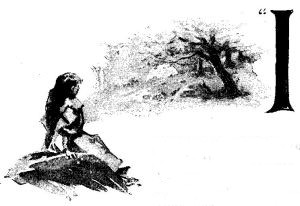
s it true that the sun dances Easter morning, and that all the stones turn upside down, and that if I will climb to the top of that hill"—pointing to a high hill that was in the immediate neighborhood—"I can see it all?"
"Sure an' ye can, miss. It's meself that has seen 'em many's the time, only ye must be up airly, for the sun niver dances after five in the mornin'."
The getting up was indeed a difficult task, for I was a regular "lie-a-bed"; but I had never seen the sun dance or stones turn over, and, being a credulous child, I resolved to try. The only question was, "How was I to waken?" for my head, once on the pillow, lay there generally, without even turning over, for a stretch of twelve hours. Bridget suggested that I tie my hand to the bedpost, but not thinking this a very safe precaution, I settled the matter by giving her an order to wake me at half after four o'clock. This she consented to do, provided I would "niver tell me mither." And I did not until breakfast-time, which was my very first opportunity, and at the moment I was so annoyed at the dolt this Irish cook had made of me, that I would have told a dozen mothers, had I only had the chance. Instead of waking me at half past four, she woke me at four o'clock. Oh, how sleepy I was! I remember dreaming of a short red-faced fairy shaking me and saying, "Hurry, child! stones turning, sun dancing! Hurry-scurry, or you'll be too late!" And on opening my eyes there stood our old red-faced Bridget.
I dressed as fast as I could, begging her to button my shoes. I was all in a quiver of excitement for fear of being late, and as soon as it was light enough to see my way, without waiting for hat or jacket, I rushed wildly along and up the lane, unto the hill and so on, never pausing until reaching the very top.
There I sat down on a big stone, so making sure of that one at least, and with an occasional turning of my head to watch all the other stones lying around, and especially one big rock over which the apple boughs swayed, I awaited the sun's rising.
It finally rose, much after the fashion, I suppose, of any other spring morning. I thought maybe it danced, but my mother didn't agree with me; she said I was faint and dizzy because I was unaccustomed to rise so early and go out without breakfast. But the stones never turned, not even the smallest one; of that I was assured. And so at a quarter before eight o'clock a very disappointed, tired child wandered down the hill and along the lane, so reaching home.
That the Irish serving-maid had been making fun of me I did not dream until I heard a loud, hard laugh, accompanying the words, "What a fool that child is!" Therefore it was no strange thing I was angry enough to make full confession.
And now that I have older grown, I have learned how fraught with superstitions the beautiful Easter day is. Not alone in Ireland, but in almost every country some qualities of the miraculous or uncanny may be discovered.
The time for Easter amusement is during the week which follows Easter day, and it would be a pretty idea at such a season to give a short tableau entertainment in connection with music and games, the tableaux indicating the superstitions of various countries.
When the tableau is shown, announce what it is intended to represent; for example, in Russia the Easter festival might almost be termed the "kissing festival," for beginning with the Emperor, who on Easter day kisses various generals and even privates in his army, the singular contagion spreads throughout the empire, apparently affecting both aristocrat and plebeian.
Tableau.—A boy representing the Russian Emperor kissing a member of the army.
In the olden days of France it was the custom for a Christian to give a Jew an Easter box.
Tableau.—Two boys, one representing the Christian, the other the Jew. The Christian must be in the act of boxing the Jew's ear.
Follow this with the France of to-day.
Tableau.—An interior of a church, extravagantly trimmed with flowers, and brilliant with lighted candles. It should be crowded with boys and girls, mothers and fathers, all in brand-new clothes.
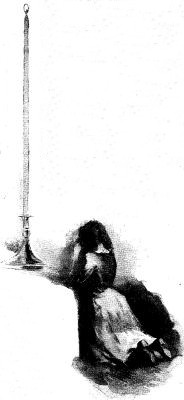
Show Spain as a dark-haired girl, with a mantilla over her head, kneeling in a church before a mammoth candle—the Paschal candle, nine feet long. In order to make it seem taller, stand it on a marble pedestal.
Rome, with a procession of gayly attired children, and a boy representing the Pope, in the most elegant of robes, carried in a crimson chair, over which is a canopy. This chair must be preceded by two other boys, each carrying white ostrich-feather fans.
Germany, with a group of dancing girls and boys, the girls wearing small close-fitting white caps, full white aprons over dark gold-braided skirts and white sleeves; the boys with knee-breeches, white stockings, showy vests, and gold buttons. Or show a hare running from a nest filled with colored eggs, before which two little children kneel. The nest should be placed under a bush, and one of the children should wear a laughing face, for she holds up an egg.
England, with a crowd of boys and girls returning from Hampton Court, Kew Garden, or Stoke Pogis, with their arms literally filled with willow-boughs and branches of blossoms—yellow, pink, and white—with which they will decorate the church for Easter Sunday. Switzerland, with a band of musicians carrying guitars, and going from house to house singing some sweet carol, their hats and caps wreathed with flowers.
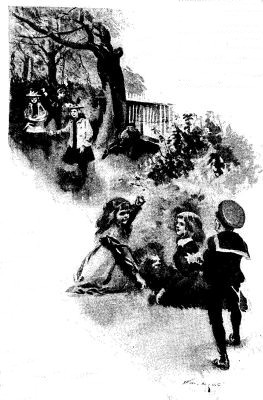
A very pretty way to amuse children of all ages is to hide eggs in the grass or under bushes, and then have an egg-hunt. All eggs found may, of course, be carried home. Give five minutes for the hunt, and it will prove great sport for lookers-on also.
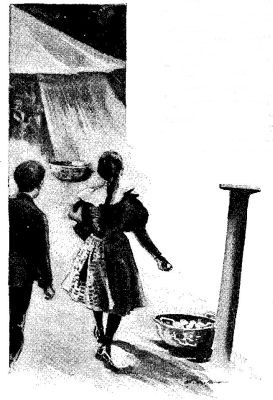
For another game, raise a tent decorated with flags, cheese-cloth streamers, or ribbons. Opposite the tent in which the guests are to be seated, and ten feet distant, is a post or tree on which to put the prize. At the base of the post put a basket of thin glass balls, and also one at the tent door, only fill this basket with excelsior. The game is to find the person that will throw the largest number of eggs from one of the baskets into the other and not break them. Whoever wins is rewarded by the prize.
For little children, form a ring, and pitch to the centre of the ring a hard-boiled egg, and let them scramble for it. For larger children, let them pair off, a boy and girl; thus alternating, they form a ring. Then start thirteen china or glass eggs, one after the other, from hand to hand, taking the egg in the right hand, passing it to the left, and so on around the ring. If an egg drops it must stay where it falls until the other eggs have gone around the ring three times. It may chance by that time that all the eggs have dropped. When the third time around is complete, immediately a grand chain is formed, and the children dance, and go back to position, picking up the eggs as they dance. If the egg is not picked up, keeping time to the music, which is being played throughout the game, that person cannot retain it, but must give it to the one following. Sometimes no eggs fall, then the game is kept up until all the eggs have passed rapidly around three times. But when dropped and picked up, they must then go around once, and after this final circuit the game is concluded.
Boil a dozen or more eggs in logwood of different strengths of dye; they will then be colored violet or purple. Give these eggs, with a large pin or pen-knife, to young people to decorate. Offer a prize for the best decoration within fifteen minutes.
Still another game is to knock eggs. Hold an egg so that the small end is shown between the forefinger and the thumb. Sit or stand opposite to the person with whom you are playing. Then knock each other's eggs. The knock should be swift and hard, and whosesoever egg is the first to crack must now be given to the opponent. When starting, each should have equal number. Whoever has the most eggs after playing ten minutes has won.
The Game of Cluck.—Perhaps this is the jolliest game of all, and it is essentially for boys. Whoever gives the party should ask each of his friends to bring a chicken—a real live chicken—and if he is sure he would not recognize her when with a barnyard of others, he must tie a ribbon around her neck; he must also bring some hard-boiled eggs. The court used should be surrounded with a high netting, and the centre of the court marked with a cross.
At a signal all the players, each with his fowl in his arms, must enter the court, and the host, going to the centre, now becomes auctioneer, and taking each offered fowl in turn, he loudly calls, "How many eggs am I bid for this chicken?"—two eggs, three, or whatever the number may be; no one must bid what he cannot pay, and the chicken is given to the boy offering the largest number, and the eggs are given to the previous owner of the chicken. He may put them wherever he pleases, only they must be somewhere within the netting.
The sale being over, the "cluck" commences, for it is now each one's aim to recover his chicken, which can only be done by finding the requisite number of eggs given for her. This is much easier said than done, for the boys will have hidden them in their pockets and other peculiar places. Meanwhile, the chickens, running in every direction, are very apt to "cluck" loudly.
The Bird's Nest.—Put a bird's nest in a room; hunt for it as you "Hunt the Slipper," only instead of saying "warm, warmer," and so on, you cluck, cluck, cluck soft or loud as the party goes toward or from the nest. Only one person hunts at a time; everybody else clucks.
Never rob a bird's nest, no matter how much the pretty eggs may tempt you. Think of the sorrow of the mother bird when she returns and sees it empty. Think, too, of the time when these little shells would break, and a blue or yellow bird, or maybe an oriole, would rise out and sing sweetest song to you.
Have you ever seen among the variety of confectioners' eggs those trimmed with roses—the kind that seems near of kin to the Æolian-harp?—for blow on the roses ever so softly, listen, and you'll hear a bird.