THE BATTLE OF EASTER MONDAY.
Reading edition
BY W. G. van TASSEL SUTPHEN.
Fred March had an idea. It was even a brilliant idea, and the longer he pondered over it, the more certain he was that it was a practical one. "And that, after all, is the important point," as Jack Howard had sagely observed, after being taken into Fred's confidence. Here it is as it finally resolved itself into tangible form.
"The Twelfth Regiment of the Transylvania State National Guard are to hold a sham fight on Easter Monday. There has been a great deal of talk about the use of the bicycle in war, and here is a chance to test the theories. Let us organize the boys into a bicycle corps, and offer our services to your father, Colonel Howard, who commands the regiment."
Jack reflected, soberly, "How could we be of any use?"
"We could be organized as a body of mounted riflemen, and also do scout and staff service. The fight is going to be somewhere on the Quantico golf course, and the grass on the links is short and smooth enough for riding. Easter comes so late this year that the frost is out of the ground already, and it isn't likely to rain before Monday. And then there are the roads in all directions."
"How many fellows can we muster?"
"Well, you know that all the boys from boarding-school are at home for the Easter holidays, and I've counted up sixty-five single wheels and three tandems; then we have the motor cycle, the 'Happy Thought,' and the people at the Driving Park have promised to lend me the 'quad' that they have there for pacing the circuit riders—an available force altogether of seventy machines and seventy-seven men."
Jack became enthusiastic. "Let's go down to the armory and propose it to my father," he said, briefly.
Colonel Howard was mildly amused when the proposition was first broached to him, but as the boys proceeded to explain the practical details of the plan he grew interested.
"There may be something in it," he said, finally, "and I'll think it over."
Two days later Colonel Howard sent for Fred and Jack, and informed them that their idea had been favorably considered, and that the services of the bicycle corps would be accepted.
"I have arranged," said Colonel Howard, "that the boys on the single wheels and two of the tandems shall be armed with short repeating carbines, and shall act as mounted riflemen, under command of Fred March. I have a friend in the gun-factory at Decatur, and he has promised to lend me two rapid-fire guns, which I will have mounted on the third tandem and on the 'Happy Thought.' Jack will take command of the 'quad,' and will act as a member of my personal staff. You will report with your men at the armory Monday morning at nine o'clock sharp."
The idea had actually materialized, and Fred was naturally pleased to think that his suggestion was to be taken up in earnest. But he was even more anxious that the experiment should be a success and that the military value of the bicycle should be demonstrated.
Now sham fights are generally carried on after a carefully prepared plan, every movement being carefully thought out beforehand, even to the strategy. But on this occasion it had been proposed that an actual problem should be placed before the two commanders, and that they should be allowed to work it out in their own way. Here, then, was a chance for real strategy, and, other things being equal, brains must win. Of course, as only blank cartridges are used, umpires must be appointed to determine the practical results of the various movements, and to finally award the victory to the side which in their judgment has fairly won it.
The field of operations had been decided upon, and Saturday afternoon Fred and Jack jumped on the "Happy Thought" and went down to have a look at it.
The map on the opposite page gives a good idea of the military features of the battle-ground, and if you study it carefully, you will easily understand the conditions of the problem.
PLAN OF THE BATTLE-FIELD.
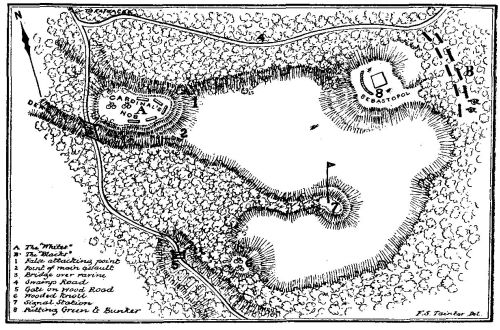
It is supposed that Colonel Howard with a force of two hundred and fifty men, together with an auxiliary bicycle corps of mounted riflemen, including two machine-guns, are intrenched upon the wooded ridge at the left and locally known as the "Cardinal's Nob." This ridge is the key to the country lying behind it, and must consequently be defended at all hazards. The position is naturally strong, as its steep sides are inaccessible except at the three points marked by the numerals 1, 2, and 3. The open space in front is part of the Quantico golf course, and a putting-green occupies the little knoll at 8. The green is defended by an earth bunker, and from its military appearance it is known to the golfers as "Sebastopol." In the woods immediately behind "Sebastopol" the forces of the enemy, under command of Lieutenant-Colonel Camp, are supposed to be concealed. They number four hundred and fifty, with a battery of two field-pieces, and their object is to obtain possession of the "Cardinal's Nob." It is to be understood that the ground south of the "Cardinal's Nob" and separated from it by "Deadman's Hollow," is practically unfitted for military occupation, and consequently of no strategic importance to either side. The other features of the map explain themselves.
It is furthermore arranged that the two parties shall leave the armory at Fairacre at ten o'clock precisely, and proceed by separate routes to their respective positions. The battle will begin theoretically at eleven o'clock, and will continue until three in the afternoon unless decided earlier.
With these points carefully fixed in mind the two boys made a careful survey of the ground. The "Happy Thought" moved swiftly and easily over the short, firm grass of the golf course, and it was evident that the bicycles would have no difficulty in operating in the open. But how would they ever have a chance to do so with the enemy under cover in the woods? Exposure would mean destruction, and, moreover, they could expect no support from the main body under Colonel Howard. At all risks the "Cardinal's Nob" must be held, and, it was clear that Colonel Howard would act strictly on the defensive. The bicycle corps, it is true, could assist in the defence as an unmounted body, but that was not what Fred wanted. Could not the wheelmen be used as an independent force without materially weakening the defence? Of course the "Cardinal's Nob" must be held, but might it not be strategy to both repel the assault and destroy the attacking force?
"And I think it is possible," thought Fred to himself as the "Happy Thought" rolled slowly back to Fairacre.
Easter Monday dawned clear and warm. The armory was a busy place at nine o'clock, and every effective man was present to answer to his name. Fred's force was complete just as he had counted it up, and the machine-guns, mounted on the "Happy Thought" and Alec Jordan's tandem, looked particularly wicked and fit for work. The ammunition was served out, the general orders read, and at ten o'clock the two forces took up the march. Fred on the front seat of the "Happy Thought," and with forty wheelmen armed with repeating carbines, headed the line, and the rest of the bicycle corps, under command of Acting-Lieutenant Alec Jordan, formed the rear-guard.
The "Cardinal's Nob" was reached at half past ten, and Colonel Howard summoned a council of war. There was still half an hour before hostilities would commence, and it was necessary to consider carefully Colonel Camp's probable line of attack, and to devise an effective checkmate.
Colonel Howard briefly outlined the situation as follows:
1. The "Blacks," or Colonel Camp's force, will occupy "Sebastopol" with their artillery, and a false demonstration will be made against the point 1.
2. A strong flanking force will be sent around by way of the Swamp Road (4) to make an attack in the rear of "White" at the bridge (3).
3. At the moment that the attack on "White's" rear begins, "Black's" main force, under cover of the artillery, will abandon the demonstration against 1, and endeavor to carry the "Cardinal's Nob" by a charge across the open and a general assault at 2, the most practicable scaling-point.
"We may therefore expect, gentlemen," concluded Colonel Howard, "a pretty hot corner at the point 2, and a simultaneous attack at the bridge (3), which, if successful, will place us between two fires. Obviously we must, above all things, protect our rear. Captain Jones will therefore take one hundred men and occupy a position near the bridge (3), to meet and, if possible, ambuscade the expected flanking force. As for the bicycle corps—"
It was Fred's chance, and he improved it. Colonel Howard listened attentively to what he had to say, and turned to his staff for their opinion. The suggestion was a daring one, for it involved a separation of forces in the face of an enemy numerically superior, but it looked feasible, and if there was no hitch it meant defeat to the "Blacks." There was not much time for deliberation, and Colonel Howard acted quickly.
"Your suggestion is accepted, Captain March," said Colonel Howard, "and you will therefore take your corps, including the machine-guns, and occupy the wooded knoll shown on the map at 6. Corporal Wood, with two men, is detailed as signal officer, and will take up a position at the point marked 7. It is expected that Captain Jones will be able to hold 'Black's' flanking force at the bridge (3) in check, but to draw the enemy into the open it will be necessary that we should make a false demonstration in our own rear. If 'Black' takes the bait the bicycle corps will be brought up by signal to the point 7, and finally ordered forward at the proper moment to take 'Black' in the rear, and, if possible, capture the battery. Captain March will remain in strict concealment at 6, and will not advance under any consideration until the signal is given from 7 by the waving of a white flag. Is that clear, gentlemen? It is just eleven o'clock," concluded Colonel Howard, shutting his watch with a snap, "and the game of war is on. Lieutenant Mason, you will determine at once the exact whereabouts and disposition of the enemy's force. Gentlemen, to your posts."
Ten minutes later Fred, at the head of the bicycle corps, was spinning rapidly along the wood road in the direction of the wooded knoll at 6. It was all important that the movement should not be discovered by the enemy, and the greatest care had to be taken in transporting the bicycles down the hill and out upon the road. As Fred glanced back at the shining silent line bowling swiftly along in column of twos, he felt sure that they had been unobserved, and that success was certain.
But he had not reckoned upon the fact that Lieutenant Young of the "Blacks" was a smart young officer who owned a particularly fine pair of binocular glasses. Colonel Camp smiled grimly when Lieutenant Young reported that the bicycle corps had left the "Cardinal's Nob," and were proceeding southward, and that the point 7 had been occupied as a signal station. It had been his original intention to carry out the very plan of operations that Colonel Howard had outlined; but it was now necessary to modify it. Colonel Camp decided upon the following plan:
As before, the artillery would occupy "Sebastopol," and a false demonstration would be made against the point 1. But instead of a large, a very small flanking force would be sent to the bridge (3), and they would be instructed to deceive "White" as long as possible in regard to their real number. In this manner forty "Blacks" might occupy the attention of the hundred "Whites" detailed at 3, and therefore sixty of the defenders would virtually be kept out of the main action.
Secondly, a squad of men under Lieutenant Young would be sent around back of 6 with instructions to capture "White's" signal station at 7, and another squad to ambuscade the wood road at the gate (5).
As Colonel Camp figured it out, it would then be impossible for Colonel Howard to communicate with the bicycle corps either by signal or by a messenger along the road, and with the bicyclers also out of the action, the "Blacks" should be able with their main body of 400 men to carry the "Cardinal's Nob" at 2, the defending force being now reduced to 150 men. It would take just about an hour to capture the signal post and guard the gate on the road, and the same length of time for the small flanking force to engage the attention of "White's" rear guard. The instant that the firing in "White's" rear announced that the skirmish at the bridge (3) had commenced, the main assault at 2 would be made, and, if everything went as Colonel Camp expected, it could not fail. It was indeed a good plan, and reflected much credit upon the strategic ability of the commander of the "Black" forces.
It was twelve o'clock, and nothing in particular had happened to change the situation of affairs. "Black's" artillery had occupied "Sebastopol," and had opened a hot fire on the "Cardinal's Nob," but the "Whites," protected by their intrenchments, had suffered but little. The mythical bullets from the "Black" sharpshooters in the edge of the woods were, according to the plan, directed against 1, and one or two false sorties had been made in that direction without result. Both commanders were waiting for the real development of the struggle.
At ten minutes after twelve the signal officer on the "Nob" reported to Colonel Howard that communication with the signal-station (7) had suddenly been broken off. Colonel Howard looked grave, for he realized at once that with the bicycle corps out of the action he could hardly hope to defend the "Nob" against an attack at 2. There was but one thing to be done, and that was to send a messenger by the wood road to order up the bicycles to the signal-station at 7, with instructions to use their own discretion in making any further advance.
A moment later Jack and his crew of three were pedalling down the wood road on the "quad." Another message was despatched to Captain Jones at the bridge (3), ordering him to send back every man whom he could possibly spare to assist in repelling the expected assault. And then Colonel Howard lit a fresh cigar and waited.
In the mean time Fred and his force had occupied the wooded knoll (6), taking care to keep well under cover. The trees cut off their view of the battle-field, but the signal-station at 7 was plainly visible, and all they had to do was to wait for the waving of the white flag. But would the signal ever come? Fred could hear the booming of Colonel Camp's artillery and the sharp crackle of the rifle-firing. Could it be possible that Colonel Howard had forgotten about them, and that the real fight was already in progress? He was half inclined to steal forward under cover of the woods and see what was going on. And then he remembered that he was a soldier, whose first duty is to obey.
Nearly an hour had gone by, and the boys were beginning to feel the nervous strain. They had examined the breech mechanism of their carbines and counted over the cartridges in their belts a score of times, and they were anxious for active service. A half-suppressed murmur arose.
"Silence in the ranks!" commanded Fred, sternly, as he gazed eagerly over at the signal-station. It was odd, but certainly some kind of a struggle was going on there. Could anything have gone wrong? "Steady!" he said to himself. "Your business, Fred March, is to wait for that white flag, and then we'll see who holds the trumps."
Ten, fifteen, twenty minutes more, and then—surely there was something waving, and it was white. The signal! It was a queer kind of motion, too; the signal-man was acting as though he had suddenly been afflicted with St. Vitus's dance. But it must be the signal. What else could it be?
"By column of fours!" shouted Fred, as he sprang to his saddle. "Attention! Charge!" and as one man the bicycle corps swept down the little hill and out upon the short grass of the golf course.
Fred remembered that his instructions were to regulate his advance by the signal-flag; but surely that frantic waving could mean but one thing, and that was to go on. A moment later and they had swept around the point, and the battle-field was before them. And just in the nick of time, for the "Blacks" were charging across the open, and were already within fifty yards of the "Nob."
"Fire!" shrieked Captain Fred, and a destructive volley was poured in upon the astonished "Blacks," while a cheer went up from the gallant defenders on the "Nob."
The boys could all ride without their hands, and again and again the rifles spoke as the line dashed on. Fred with a squad of twenty of the fastest riders had already made good his position in the rear of "Sebastopol," and before the bewildered artillerymen could turn to meet them the battery had been captured and the guns silenced. The rest of the corps, under command of Alec Jordan, had dismounted, and were firing over their wheels into the broken masses of the "Blacks." In another instant Fred had brought the machine-gun mounted on the "Happy Thought" into action, and the "Blacks," huddled together at the entrance to "Deadman's Hollow," were under three destructive fires.
It was only a question of five minutes, and Colonel Camp's force had been pronounced annihilated by the umpires. The battle was over, and the honors of war rested with Colonel Howard and his gallant "Whites."
Of course they fought the battle all over again at the armory that night, and Lieutenant-Colonel Camp demanded an explanation.
"My dear fellow," said Colonel Howard, soothingly, "it was very clever of you to capture my signal-station; but you forgot that it was possible for me to send a messenger by the wood road."
"But I did think of that," retorted the defeated warrior. "The road was ambuscaded by my men, and the 'quad' was stopped and captured at the gate."
It was Colonel Howard's turn to look mystified. "How, then—" he began, looking at Fred.
"But, indeed Colonel," said that young gentleman, eagerly, "I only obeyed orders. I did get my signal."
"Lieutenant Young," said Colonel Camp, "you captured the signal-station by my orders, and held it to the end. Have you any explanation to offer of this extraordinary affair. And, by-the-way, what is the matter with your face?"
Lieutenant Young blushed and stammered.
"Well, Colonel, if you must know—it—it was the hornets."
"Hornets!"
"You see, while we were waiting, one of the men undertook to explore an old hornets' nest, and, the weather having been rather warm for the last week, why—er—they—er—proceeded to resume business."
"Exactly," said Colonel Camp, grimly. "And I suppose you used your handkerchief to protect yourself, and the boys mistook it for the signal."
"Well, it was something white," said Fred, apologetically, "and it was waving as though it meant business. I thought I'd better go on."
"You did exactly right," said Colonel Howard; "it was the turning-point of the whole affair."
"That fellow Young ought to be court-martialled," growled the irate Camp.
"Never mind, Camp," laughed Colonel Howard; "you out-generalled me fairly enough, and the rest was simply the fortune of war. By-the-way, what became of Jack and the 'quad'?"
Now it happened that there was an interesting answer to Colonel Howard's query about this "quad"; but that is another story.