THE INCANTATIONS OF ALI BEN MESROUR.
Reading edition
BY W. A. CURTIS.
The fame of Ducardanoy and Bouchardy spread through Algeria. Tho methods by which they had deceived and despoiled the Arab tribes gradually became known, and threats of vengeance coming to their ears, they decided that it was no longer safe to dwell so near the Sahara and its wild tribes, and they removed to the northern side of the Atlas. But even in their new home they were destined to encounter the power of the Shiekh of the Mountain of Singing Sauds, though not in a way that menaced their personal safety.
It was at the close of the Mohammedan fasting season of Ramadan that the great Arabian magician Ali Ben Mesrour came to town. Bouchardy, who attended all of his performances, declared his feats to be easy of execution, and their mechanism readily detected by the most unobserving. Ducardanoy was inclined to attribute this to professional jealousy; but when the magician began to cure the halt and lame among the Arabs of grievous corns and bunions, he too denounced Ben Mesrour as a bungler and a charlatan. Hearing of the criticisms of the two experts, the Arab sage gravely sent them a challenge. He announced that if they dared to give him a trial he would appear at their house, and by a certain magical process change the one into a dromedary and the other into a mule, and he agreed that in case of failure there should be forfeited two five-franc pieces of silver, which he would deposit with the commandant of the garrison previous to the trial. Two five-franc pieces were nothing to the chiropodist and the prestidigitator, grown exceedingly wealthy with the prudent investment of the results of their late encounters with the Arabs, but they hailed with pleasure the prospect of amusing themselves at the expense of the magician.
The lamps had been lighted an hour when Ali Ben Mesrour was ushered in to begin the process of transforming Ducardanoy into a camel and Bouchardy into a mule. He was attired in a robe of dark red silk, and upon his head was the green turban that indicates descent from the Prophet. Upon the side of the turban a white aigrette was fastened by a single emerald, and about his neck was hung a long gold chain. Ducardanoy and Bouchardy received him with great courtesy, and profoundly salaaming, conducted him to a divan resting against a heavy portière. The magician sat down, and the divan instantly flattened out beneath him. He leaped to his feet, whereupon the divan promptly resumed its former shape.
"I beg pardon for the conduct of the divan," said Ducardanoy. "Sit down in this chair," and Ben Mesrour sank down in a huge arm-chair, which rose beneath him and dropped him to the floor.
"Why, what's that on your turban?" exclaimed Bouchardy, and he reached forward and took from Ben Mesrour's head a white rabbit and a pair of doves. Bang! and the turban flew up in the air, and then settled back again, and Bouchardy further relieved it of a frog and a large carrot.
"What a number of things you carry around with you!" said Bouchardy. "Have a smoke?" and he handed him an amber mouth-piece holding a cigarette, which, being lighted, began to lengthen out and curl and twist into the semblance of a long and writhing snake.
"Bismillah!" grunted Ben Mesrour.
"What a man you are! Your breath changes a cigarette into a snake. But if you can't smoke, have something else. Try this sherbet," said Bouchardy, bringing out a long goblet of silver gilt. The magician raised the goblet to his lips, when there was a sudden whir, and a bright blue flame leaped up into his face.
"Mashallah!" he cried, dropping the goblet, which instantly exploded with a loud report.
"All our little attempts at hospitality seem to fail," said Bouchardy, with mock chagrin. "Have something to eat. Try this peach."
"No," said Ben Mesrour, waving a remonstrance; "it is time to make a mule of you. The five-franc pieces have been deposited with the Commandant. Let us begin. Stand upon this hassock, if you please, and I will turn you into a mule."
"The first thing I shall do when I become a mule will be to kick you good," said Bouchardy.
"We'll see about that," said the magician, and starting at Bouchardy's ankles, he began to knead his legs, and proceeded over his entire body, kneading, patting, and thumping him, all the while crooning a low chant in Arabic. Having finished Bouchardy, he left him standing on the hassock, and turned to Ducardanoy and repeated the process. An attendant then handed him a chafing-dish in which a few coals were burning, and withdrawing to the middle of the room, he threw a powder upon the coals. A great opaque white cloud, stifling and acrid, arose and filled the room, and from the midst of the cloud came the voice of Ali Ben Mesrour, shouting: "Accursed, the Shiekh of the Mountain of Singing Sands is avenged. I have made beasts of you."
In a moment the cloud drifted away, and the magician and his attendant had vanished.
"Made beasts of us?" said Bouchardy. "Well, he didn't make a mule of me. Look at that," and he held up the emerald from Ben Mesrour's turban and the gold chain from his neck. "When I saw that spiteful old fellow trying to turn me into a beast, and evidently thinking he was doing it, I decided to punish him by taking his jewelry."
"If it is not too late, let us have in a few friends to celebrate the successful outcome of our third encounter with Arabs striving to injure us," said Ducardanoy.
"It is not too late," said Bouchardy, reaching for his watch. A look of surprise swept over his face. The watch was not there. And his trousers pocket was empty of the purse it contained a few hours before, and a diamond stud was gone from his shirt front, and as for the emerald and chain, which he now scrutinized in attempting to console himself, both were cheap imitations worth only a few sous at most. Gone was Ducardanoy's watch, too, and a roll of bank-notes, and a gold match-safe. They ran into the hallway for their hats to start in pursuit of Ben Mesrour. Gone were their hats. Gone were the rugs from the floor, the divans, the pictures, the ormulu clock, the onyx tables, the silver and china ware, the books—everything in the house that was easily movable. They rushed into the streets, and in a moment were seeking Ben Mesrour with a squad of soldiers. Ali Ben Mesrour? His caravan had left the town two hours ago, on the way to Morocco. But Ben Mesrour himself had not gone an hour ago, Ducardanoy and Bouchardy declared. The people knew naught of that. The magician's caravan had gone, and the people thought he had gone with it. Away went the pursuing party, riding out on the road toward Morocco, and in a short time they overtook a man riding upon a mule, accompanied by a closely veiled woman riding upon a camel.
"There he is," cried Ducardanoy. "That woman is Ben Mesrour disguised. Drag him down."
"Hold," said the French sergeant, glancing around at his troopers, all native Algerians. "Do you propose to strip the veil from the face of a woman?" he continued, in a whisper. "Such an outrage of Mohammedan customs would cause these men to fall on us at once, and the town would rise to-night. We must let them proceed without interference."
Reluctantly Ducardanoy and Bouchardy turned back toward town with the soldiers. The man on the mule shouted something after them in Arabic.
"What did he say?" asked Bouchardy.
"He said," replied the soldier, "that he and his wife were riding on a mule and a camel presented to him by the magician Ali Ben Mesrour, which same were formerly the Messieurs Ducardanoy and Bouchardy, transformed into their present shape by his magic arts."
"That is not true," said Bouchardy, "for the magician Ali Ben Mesrour made mules of both of them."
HURDLE-RACING.
From instantaneous Photographs of Ernest H. Cady.
2.
1.
4.
3.
6.
5.
8.
7.
ERNEST H. CADY.
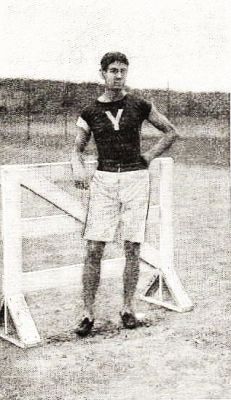
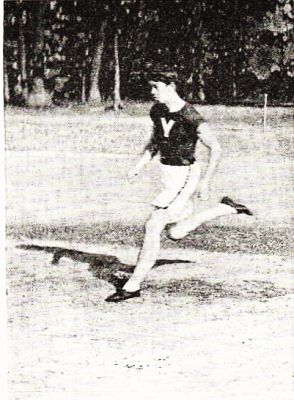
There are two distances for hurdle races which have become recognized by the Intercollegiate Associations and the larger athletic clubs as the standards for this event. The shorter distance is 120 yards, the race being run over ten hurdles, 3 feet 6 inches high, placed ten yards apart, the first and last obstacles being respectively fifteen yards from the starting and the finishing lines. The longer distance is 220 yards, the ten hurdles in this case being 2 feet 6 inches high, twenty yards apart, and the first and last respectively twenty yards distant from the start and finish. These two events are usually spoken of as the "high hurdles" and the "low hurdles," the distances being invariably understood as given above.
Hurdling requires skill, strength, spring, nerve, and a cool head; and to become a fast hurdler you must devote several years of hard and faithful practice in this particular event. The training for a beginner should be begun in the gymnasium in the winter, with light calisthenics, rising on the toes, rising on the heels, raising the legs, and practising the double jump on the toes. This double jump is a peculiar exercise, and consists of raising one leg, bent at the knee, forward, and the other leg, bent at the knee, backward, alternating the legs at each jump; this serves to limber the muscles that are used in hurdling, and also helps to lengthen the stride. An occasional short jog out of doors on fair days, and light all-round work in the gymnasium, for general physical development, should be made a part of this preliminary training. One of the best exercises that a hurdler can possibly indulge in is to dance up and down on the spring-board for ten or fifteen minutes every day. This develops that very necessary quality of spring and suppleness.
When the out-door training season begins, the first two or three days should be spent in jogging up and down the track. After that take occasional sprints of thirty or forty yards, without practising the start. On the third day practise the start two or three times, and try clearing one hurdle about three times. On the fourth day do the same thing. On the fifth day place two hurdles on the track at their proper distances, and negotiate them two or three times. On the sixth day repeat this performance with three hurdles. After this first week of out-door practice, whenever the hurdles are being jumped, the athlete should rush at them with his utmost speed from the proper distances, so as to become accustomed to them. The general training for a hurdler should be about the same as that undertaken for the 100 and 220 yard dashes, as described in this Department on February 25th.
After three weeks of this kind of preliminary work, the high hurdles may be placed in position, and the hurdler may try going over the whole distance on time; but he should never attempt this move than once or twice a week, doing his daily work over not more than three hurdles. There are two things of vital importance for the hurdler to work at in order to acquire speed; he should drive himself as fast as he can go from the crack of the pistol until he stops running, and each hurdle should be rushed at as if it were the last.
Fig. 1.

Speed between the hurdles is of the utmost importance. The secret of obtaining this lies in starting the foot, which has crossed last over the hurdle, forward for the first step before the forward foot has reached the ground, thus making the first step after the jump a very short one, yet a very quick one. This is a difficult movement to learn, but the athlete will find that it will lower his time perceptibly if he can master it. The instinctive act upon landing after the leap is to take a long stride forward with the view of covering distance. But the athlete must restrain this inclination and force himself to take a short step, even if he has to work over it for months, or he will never be able to acquire skill or speed as a hurdler. That first short step after clearing the hurdle gives the runner his impetus, and the other two steps easily follow. The third step is shorter than the second in order that the runner may gather himself slightly for the spring over the next hurdle.
Fig. 2.
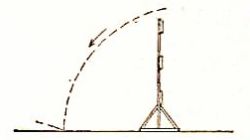
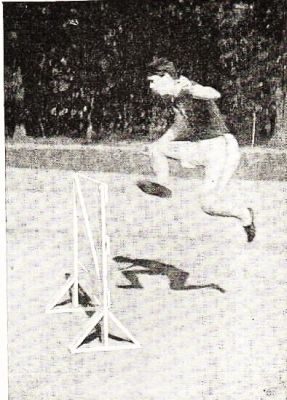
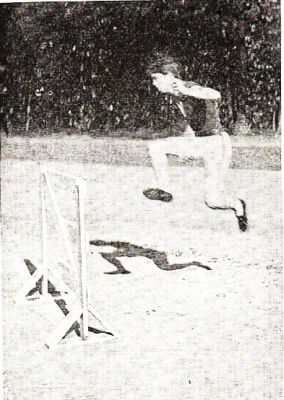
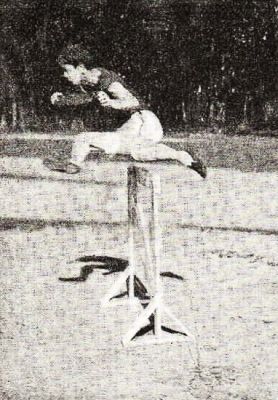
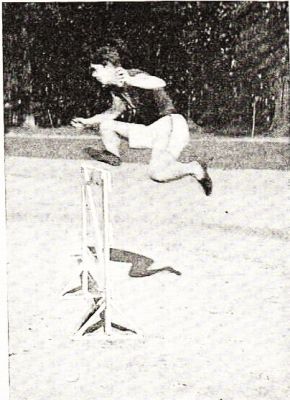
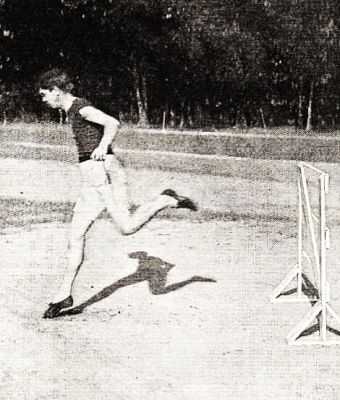
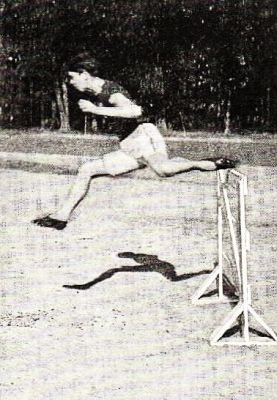
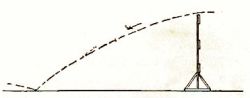
The ideal distance between steps in a high-hurdle race is shown in the accompanying diagram (Fig. 1). The runner alights about 7 feet 6 inches from the obstacle, and then takes the short quick step already mentioned (4 feet 10 inches); then he makes a long step (5 feet 10 inches), and then another short step (4 feet 4 inches), which brings him within 7 feet 6 inches of his next hurdle, and he makes that spot his take-off. A fatal fault of many hurdlers is to bring the forward foot down in such a way as to cut off the length of the jump, as shown in Fig. 2. The first foot should be made to shoot as far forward as possible along an imaginary line, as shown in Fig. 3.
Fig. 3.
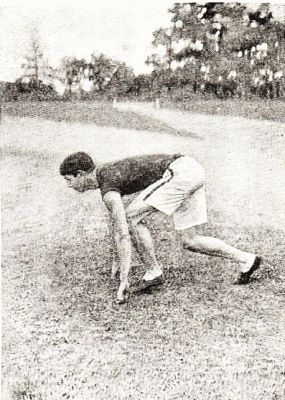
As the last hurdle is cleared, the head should be thrust forward as the athlete lands on the ground, and so held, for this will greatly aid in the sprint for the tape. There is a difference of opinion among the best men in this event as to whether the standing start or the crouching start is the better. Those who take the upright start assert that they can get off quicker and are in a better condition to take the first hurdle, which is only fifteen yards away, and say that it is difficult to rise to the proper jumping position in such a short run. Those who favor the crouching start deny this. This is a case where each individual must decide for himself which method he prefers. Another vital point that must be observed is to rush for the first hurdle with the utmost speed, for the way in which the first obstacle is reached and cleared often decides the race. A hurdle race is a constant drive from start to finish.
The hurdles should be cleared by as narrow a margin as possible. From the standpoint of speed it is better to strike the top bar lightly rather than to clear it by several inches, for this margin makes a loss of time. The athlete shown in the illustrations is E. H. Cady, and these photographs give a very good idea of the position a man should train himself to assume when clearing the sticks. The eighth illustration gives a very good idea of the distance of the landing-spot from the hurdle, as shown also in the diagram. The single thing which requires probably the greatest practice is to get the exact length of stride for the various steps between hurdles. A good way to get this is to mark these spots on the ground, and then go over the hurdles, lighting on these spots, until the stride has become absolutely natural.
The first annual in-door games of the Long Island Interscholastic Athletic Association brought out a good crowd of athletes from the two cities, and although no records were broken, the sport was good, and each event was well contested. Everything went off promptly and sharply except the pole-vault, which was not started until after five o'clock, and dallied along for almost two hours. Even so, it resulted in a tie that had to be settled by the toss of a coin. Forney, Hurlburt, and Eddy kept abreast until the bar reached 9 feet, and there Eddy dropped out. The other two then struggled for first place, breaking every bar the committee could furnish. Two broken ends were spliced to keep up the contest, but the imperfect bar sagged so deeply at the centre that it was impossible to tell how high (or low) the mark was, and finally Forney and Hurlburt split the points, and tossed for the medal, luck favoring the former.
Berkeley won the banner offered to the school taking the greatest number of points, the scores of the contesting teams being as follows: Berkeley, 21; Barnard, 18; St. Paul's, 12; Brooklyn High, 8; Pratt Institute, 6; Pingry's, 5; Adelphi, 4; Drisler's, 4; Cutler's, 3: Oxford, 3; Alling Art, 1; Brooklyn Latin, 1; De La Salle, 1; Poly. Prep., 1; Stevens Prep., 1; Hamilton Institute, 1. The struggle for points was reduced to a duel between Barnard and Berkeley very early in the afternoon, St. Paul's being the only other team that made any kind of a showing.
Irwin-Martin, of Berkeley, had an easy thing of it in the quarter-mile, taking the lead from the start; Hipple of Barnard likewise had his own way in the half-mile, although he misjudged his pace, and failed to make as good time as was expected of him. Moore, of course, made a double win in the dashes, for there is probably no better sprinter in the New York and Brooklyn schools than he. Berkeley depended on Armstead for five points in the Junior 75-yards, but although he won his heat, he met a better man in the finals. This was Robinson of St. Paul's, who proved so far superior in speed to any of his rivals that we may well count on hearing from him as a first-class man in the near future.
The hurdles furnished a surprise in the defeat of Beers by Bien. The latter was a little awkward in his trial heat, but when he started in the finals he showed much better form. Beers, on the other hand, was all out of shape, bungled over the first obstacle, and took a cropper at the second. Beers always has been a better man out-of-doors than in, but he will have to look to his laurels at the Interscholastics this spring.
The mile run took five points off Barnard's forecast. Bedford had been counted a pretty sure winner, in spite of the fact that Manvel of Pingry was on hand. The two ran pretty evenly for half the distance, but toward the end the Jerseyman displayed more wind and staying power, and spurted for the finish, crossing the line well ahead of Bedford.
There have been a number of scholastic in-door games in and about Boston the past month, and about the most interesting feature of each has been the team race. I was sorry not to see a team race at the Long Island games a week ago. Such races are always exciting, and create a great amount of enthusiasm, the interest being shown for the school rather than for the individual athlete.
The enthusiasm of some of the English High-School team's supporters at the E.H.-S. games recently was so reckless that one young man thrust a hurdle across the path of a rival racer. The E.H.-S. men won the team race easily by about forty yards, but some one in the crowd upset a hurdle in front of Lincoln, the second Boston Latin runner, and of course the race had to be awarded to the Latin School on the foul. Fouls seem to be frequently the result of the enthusiasm that breaks loose over a team race—especially in Boston. On this same occasion there was a race between teams representing the right and left wings of the school regiment, and it proved exceedingly close. There was not three yards of floor between any two of the runners, and finally Ober, the fourth man for the right wing, won by only a few inches. But a foul gave the prize to the left-wing team. I only mention these incidents to show how very exciting team races are; for fouls are very infrequent at interscholastic contests; yet when it comes to a relay race, enthusiasm seems to get the better of both competitors and spectators, and frequently the referee has to step in and assert his authority.
The Cambridge High and Latin School games followed some days later, and as there were a number of open events, several Harvard men, old interscholastic athletes, entered and kept the younger men up to their best efforts. There were so many entries that the 20-yard dash had to be run off in twelve heats, with a second round of four heats and a final.
The Boston Latin School's games had no open events, the contest being entirely among the classes. McGuire of last year's football team made a record for himself by winning the 30-yard dash in 4-1/5 sec.; the 35-yard hurdles in 5-1/5 sec.; the 300-yard run in 46-2/5 sec.; the pole vault with a leap of 8 ft. 4 in.; and by captaining the winning team in the relay race. McGuire is a good all-round man.
The entries for the big games at the Madison Square Garden on the 28th will have a most cosmopolitan character. I spoke recently of the Connecticut athletes who intended to compete, and I have heard that several Bostonians are in training for the occasion. The Central High-School of Philadelphia also expects to send representatives. It is likely that the team will be composed of Frazier, Mekenson, and Hunt in the sprints; Thomas, Hunt, Frazier, and Freeland in the relay race; Thomas, Freeland, and Hunt in the half-mile; Thomas and Rutschman in the mile; the Gillender brothers in the walk; F. Gillender, Halderman, and Bay in the shot, and Buckley and Eyre in the high jump.
It is reported that St. Paul's School, of Garden City, is making arrangements to withdraw from the Long Island Interscholastic A. A., and join the new organization recently formed by Lawrenceville, the Hill School, and a number of other large institutions, which from their situation may properly be called "country schools." It seems to me that St. Paul's is doing the right thing in joining the new league, for at present it is competing with institutions not at all of its own class in many respects. St. Paul's will doubtless at first be the weakest member of the new league, but that should not be a reason for discouragement.
In the revised constitution of the New York Interscholastic A.A. a penalty of $5 has been fixed for the forfeiting of any league contest. This law should be strictly enforced, for there has been too much forfeiting of games by teams that thought they stood no chance of winning, and had not sufficient sporting spirit to appear upon the field and do their best. If the five had been made double the amount, this would not have been too severe a punishment. As it is, the treasury of the N.Y.I.S.A.A. will doubtless reap considerable benefit during the coming baseball season, if matters go as they went in the past. The difficulty may now come in collecting the fines. It may be found advisable to insert a by-law which shall make the fine for forfeiture payable within a certain very limited period—say, before the date of the next game scheduled for that team to play—on penalty of suspension. Such suspension should be made to apply to the members of the offending team, not to the school. The players who then found themselves debarred from participating in other sports—track athletics, for instance—would soon see that the fine was paid, and after one such experience they would probably abstain from forfeiting.
Albert George, Jun., New York.—The Round Table will offer no All-round Sports Medal this year.
Percy Holdsworth, Rockville Center, L.I.—An approximately accurate table of interscholastic records was published in the Round Table of July 9, 1895. Since then several of these records have been broken, and another table will not be prepared until later in the spring.
J. M. Allen, Marinette, Wis.—Hints on training for the 100 and 220 yard dashes were published in Harper's Round Table of February 25, 1896; for the half-mile run, in Harper's Round Table of March 3, 1896; for the high jump, in Harper's Round Table of July 30, 1895.
The Graduate.
Any questions in regard to photograph matters will be willingly answered by the Editor of this column, and we should be glad to hear from any of our club who can make helpful suggestions.
Among the pictures sent to our recent photographic competition were some not eligible for entry in any of the classes for which prizes were given, but which were such fine specimens of amateur work that they deserve more than a mere mention of subject and artist. There were several excellent animal studies, a class of pictures which requires special skill in order to be successful. Mr. Louis H. Flanders, of Chicago, Ill., with other examples of good work, sent two—one was the head of a Jersey cow, evidently without a flaw in the negative; the other, to which no name was given, might appropriately be called "Waiting for the Master." A large shepherd dog is sitting on his haunches, holding in his mouth the bridle of a horse, which stands, like the one in the nursery rhyme, "All saddled, all bridled, all fit for a ride." The surroundings—a drive leading to a barn in the background—are in keeping with the picture. This is one of the most natural animal studies which it has ever been the good fortune of the editor to examine.
Another good animal study, which is called "Friends," was made by Mr. Orville Bassett, of New Bedford, Mass. The friends were a shepherd dog and a handsome cat lying side by side on the grass. Mr. Huber Hoge, of Brooklyn, N.Y., sent an animal study entitled "Fallen Majesty"—a picture of an enormous lion in a cage; an unusual subject, and well taken. Miss Bertha Lothrop, of Riverton, N.J., sent a picture of a pug dog and a good natured looking cat playing together—"Playmates." Franklin M. Conant, Providence, R.I., and W. Yost, of Cumberland, Md., both sent good studies of cats, and Mrs. Claud Gatch, Salem, Or., sent a picture of a dog family, entitled "A Good Square Meal." A characteristic Southern picture was sent by Lieut. W. C. Davis, Fortress Monroe, Va. While this picture was not as sharp in detail as might be desirable, the subject was very amusing. A ragged colored boy was holding by a rope halter the framework of a horse—it could be called nothing more—and "De Price is Fifteen Dollahs, Sah," was the appropriate title to the picture.
Some fine photographs of unusual subjects were received, among which was one sent by Mr. C. H. Voorhees, of New York city, of a flash of lightning. It is one of the best pictures of lightning that could be made, the effect in the picture being exactly what one sees on a summer night when a flash of what is called "chain lightning" crinkles across the sky, the landscape being faintly outlined instead of illuminated as in the broad flashes. Photographs of lightning have revealed one mistake of the artist, and that is that lightning never assumes the jagged streaks with sharp angles which one sees in drawings of lightning. The electric fluid runs in curved lines, and looks something like outlines of rivers in map-drawings.
Two beautiful cloud effects were submitted. "Day is dying in the West," is the title of one taken by Mr. Newell B. Edson, of Portland, Me. The clouds are very artistically shaded, and show no halation, as is apt to be the case in most cloud pictures. This picture would make a fine bromide enlargement. The other cloud effect was sent by Warfield T. Longcope, Baltimore, Md., and is entitled "Moonlight." It is a harbor scene, and the outlines of the wharves and shipping show dimly, while the moonlight, breaking through the clouds, shines across the water. Mrs. George Conn, of Black Diamond, Wash., sent a picture of a snow scene, the snow looking like the real article and not like chalk, as is often the case with photographs of snow.
FEED THEM PROPERLY
and carefully; reduce the painfully large percentage of infant mortality. Take no chances and make no experiments in this very important matter. The Gail Borden Eagle Brand Condensed Milk has saved thousands of little lives.—[Adv.]