310
Reading edition
foreign Bolivia, etc., 10c.; 100 different China, etc., 10c. Finest approval sheet, at 50%. Agents wanted. Large price-list, free.
Shaw Stamp Co., Jackson, Mich.
125 dif. Gold Coast, Costa Rica, etc., 25c.; 40 U. S., 25c. Liberal com. to agents. Large bargain list free.
F. W. Miller, 904 Olive St., St. Louis, Mo.
STAMPS! 100 all dif. Barbados, etc. Only 10c. Ag'ts w't'd at 50% com. List free. L. DOVER & CO., 1469 Hodiamont, St. Louis, Mo.
Stamps. Approval sheets. Agents wanted; 50% com.
G. D. Holt & Co., 155 Pulaski St., Brooklyn, N. Y.

For an Afternoon.
Mrs. Mary B. Miller writes to you: "We originated the following for entertaining a few young ladies invited to spend an afternoon. A phrase describes some character noted in history, literature, or art. The initial letters of words in each phrase are also initial letters of the character's name. Given the phrase, guess the name. Here are a few that were used; others may be thought of by you: Able Leader—Abraham Lincoln; Can Draw Girls—C. D. Gibson; Uncle Sam's Guardian—U. S. Grant; Wrote Many Tales—W. M. Thackeray; Somebody Famous By Messages—S. F. B. Morse; Crossed Courageously—Christopher Columbus; Great Philanthropist—George Peabody; The Big Republican—Thomas B. Reed; Wise Cultured Bard—W. C. Bryant; Great Warrior—George Washington; Favors Water—Frances Willard; Betrayed Americans—Benedict Arnold; Prone To "Blow"—P. T. Barnum; and Was Scotch—Walter Scott."
The Antiquary Puzzle.
Some members enjoy knotty kinks. There are not a few in the following story. See how many you can unravel. No prizes are offered, and you are not to send answers to us. We will publish the answers in a week or two. The story was written by a member of our Order. Here it is:
In the early fall of the year (1) in which Captain Cook died I set sail in the White Lady of Berlin (2) from the Modern Athens (3) for a three years' trip abroad. The brother of the historian (4) whose name signifies the long-armed ape had handed me an object the night before, attached to which was a card reading as follows:
My name is short—it's in my head. Behead me, and consider only My threefold nature, and you'll find That I'm in yours. Yours truly.
I followed the directions, and found a roll of paper containing these lines:
I once in hour of wicked wrath Slew one fourth of this great earth's race. I fled o'er plain and mountain path, But ne'er could that crime efface. In any clime may I be seen, Of rustic form or city made. I oft conceal a weapon keen; Am found in many a street parade. To arctic regions cold and drear I once did journey years ago. My faith was strong, nor was there fear Of floating berg or deadly floe (5).
I read the verses to a group of passengers, and one gentleman, a friend of the musician (6) who never could compose without his diamond ring, laughed so immoderately that he tripped over a spare mineral (7) that can box, and broke his leg. The physician (8) who first made use of chloroform was summoned, and in short order had the tonic plant (9) used in chills.
I reached Cairo in the month (10) of the gate, and spent five days in studying the Great Sphinx and its near-by temple. While exploring the latter I found a secret passage to the Sphinx itself, and there, in a square excavation, on a massive altar of the stone (11) that is dainty lay a huge black stone carved to represent the insect (12) worshipped by the ancient Egyptians. On it was this inscription, which, deciphered, reads thus:
"I am older than the Earth. I was born in Space. Once I was Fire. Now I am Stone. Yet no man ever quarried me. I have journeyed to the Sun, yet the Earth is now my tomb" (13).
After much difficulty I secured the stone for the museum (14) which contains the Elgin marbles, together with treasures from the Petrified City (15) and the City of Zenobia (16). I then sailed for England, reaching Cockagne (17) in March. One day, as I was passing the Old Lady (18) of Threadneedle Street, I saw a strange bronze-green sign-board which read, "ANTIQUES." Being interested in antiques I crossed the street and entered the shop.
An enormous claymore (19) hung by the door, and at a black-oak desk which had once belonged to Old Noll (20) sat a little weazened man of kindly look. As I entered he laid down a copy of the Vinegar Bible (31) which he had been reading, and rose to greet me.
"As I live!" he exclaimed. "You remind me of the Man (22) of Blood. Where do you hail from?"
"O, I have been visiting old worlds and new," I replied.
"Here are two busts," he went on. "They are of the Laughing Philosopher (23) and the Weeping Philosopher (24), and the contents of these cases are worth having. If you can answer my descriptions, they are yours. Others have tried—and have failed."
He handed me the following rhymes:
My first was used in Shakespeare's time To exorcise the evil one. My second's life is spent in toil; Reward it never yet has won. The wondrous beauty of my whole May well be praised in poets' verse. To purchase it would much reduce The contents of the longest purse (25). My first is a large reflector, Old, but as good as new. My second's the bone and sinew Of lands that we travel through. My whole is little, and lucky, and white; Much like my first, but not so bright (26).
I gave up.
"Here is an easy one," he said. "It describes an every-day object, and is no quiz (27), I assure you, but an honest riddle."
I was born in the sun, but I lived in the earth. I died where I lived, and was buried from sight. I rose from the tomb that had long been my home To curse or to comfort, destroy or delight (28).
To my surprise my answer was correct.
An image of the Egyptian Mercury (29) brought to mind my recent solution of the Riddle of the Great Sphinx. The old Antiquary was surely the man to whom I should open my heart.
"Are you interested in Egypt?" I began. "I have just arrived from Cairo, and, to be plain, have made a stupendous discovery—I have solved the Riddle of the Great Sphinx!" And I gave him an account of my discovery in detail.
The Antiquary seemed to drink in my last words, and in another moment had dragged me to the back of the shop.
"Man!" he gasped, "do you know what you have done? By this solution you have the chance of solving another and greater mystery!"
Leading me to a dark corner, the Antiquary lighted a taper and showed me a narrow door of oak strengthened with iron.
"What is this?" I asked. The Antiquary slipped a roll of parchment into my hand. I found on it this verse, engrossed in old English characters:
JVGUVAGUVFANEEBJCBEGNYQVZ VAWRJRYYRQPNFXRGOEBHTUGSEBZSNE UNFYNVASBEGUVEGRREPRAGHEVRF XVATNEGUHEFFJBEQRFPNYVONE (30)
Though I carried the cryptogram back to America with me, it has to this day remained unsolved—and the Antiquary is dead!
A Ute Indian Legend.
Long years ago the forefathers of the Utes lived near a vast warm lake northeast of the Big River (Colorado). Snakes as long as a hundred lodge poles were plenteous in this lake. The country was full of big trees, big deer, and big oxen with white horns. One day all the big oxen began to roar together, and they raised such a steam from their nostrils that the earth tottered and trembled and the sun was hidden. Then suddenly the warm lake fell and continued falling for the space of three moons, and then became so low that the Indians saw it not again.
The big lake of warm water had been drained away. It had gone out through the mountains by the present cañon of Green River, and of the Big River. The old bed in the Toom-pin-to-weep is where the warm lake waters were drained. Next, all the big deer and the big oxen with white horns wandered eastward and perished from cold or by the arrows of the Ute hunters. Soon after a big flood formed Grand River Cañon. After this came a race of small people who brought seed corn of a small kind, called Chiquito maize. They also brought skin canoes. They had silver and gold in abundance, and iron tools which they had gathered in the mountains to the northeast.
These little people were almost white. They built stone houses in the cliffs, and cultivated corn, beans, and pumpkins. They taught the Utes how to make spears and bows. Soon big red Indians came over from the northeast and drove off the little people, who went south. The big red men also went away. These were the Apaches, Navajos, Kiowas. Down among these tribes were found the big oxen with white horns, and the grande lagarios (alligators). By-and-by the country became dry and cold, and only the Utes were left on the Big River and its branches. Then melted rocks were poured out and the country was left desolate.
Sybel Newell Stone. Selak, Colo.
Questions and Answers.
Claude G. Smith, William F. Tillson, Hubbard Marsh, Lawrence Fraley, Albert R. Bullman, Frances De Berard, Rolfe McCollom, G. Du Bois, and a score or more others are reminded that the Table has no exchange column, and cannot publish notices of trades, as of stamps, pictures, addresses, printing-presses, and the like. We should be happy to oblige members in this respect, but space does not permit. We do not give the addresses because improper uses are often made of them by unscrupulous persons. The only exceptions we make—and these we do not make often—are in publishing the names of members in far-away countries, since advertisers rarely use such, and cases where requests are purely educational, as in getting seeds to plant and study, gathering mosses for a natural history collection, etc. We repeat that we much regret that we cannot oblige you in these respects. Charles W. Anderson and Charles Cohen apply for Patents and give no addresses.
James D. Waite: The National Guard of the State of New York is not a part of the regular army of the United States. It is under the State control, but may be mustered into the United States service through the action of the President, who calls upon the States, if need be, to furnish troops. If your father does not wish you to join the N. G. S. N. Y., do not do so. Hubbard Marsh, Groton, N. Y., wants to belong to some literary or similar society having corresponding members. Write him. Claude G. Smith: There are, just now, no prize offers open. New ones, when ready, will be announced on this page. The only contest awards in which have not yet been announced is the Illustration. In that about 300 young artists are trying to make a picture for a story, a proof of which has been mailed to them. This contest closes March 21st, but applications for proofs with permission to enter the contest have already closed. D. Blondheim: We fear it is a bit late for descriptions of Christmas entertainments. Better tell us about oysters and the oyster trade. E. M. Wallace, Monmouth, Ill., and Jay F. Hammond, Harford, N. Y., want to receive samples of amateur papers.
Daniel W. May: We should think old skates could well be made use of in constructing an ice-boat. Coils in use in the relay and sounder of telegraph instruments are two in number. The cores are soft iron bars, and around them there is wound, for the relay, very fine wire that is covered with silk thread, to perfectly insulate it. The finer the wire, the more its resistance. The large wire that you see on the poles connects directly with this fine relay wire. When the electric circuit is complete, the soft iron bars are magnets; when it is broken, they are not. Thus is produced a backward and a forward movement of the armature which opens and closes a second or local circuit, in which is placed the sounder, having two similar coils, but wound with comparatively coarse wire. The Century Dictionary describes an induction coil as being essentially in two parts, one wound over the other. The first, of coarse wire, is wound about the soft iron bar, and connected with a key for breaking and closing the circuit. Above it, on the same coil, is wound very fine wire, carefully insulated from the first, which becomes magnetic by induction every time the electric circuit is closed. We advise, for a first attempt, a single coil of fine wire. All wire used in making coils should be insulated.

This Department is conducted in the interest of stamp and coin collectors, and the Editor will be pleased to answer any question on these subjects as far as possible. Correspondents should address Editor Stamp Department.
In the Round Table for January 21, 1895, I mentioned the fact that Ecuador had cancelled the contract for "Seebeck" stamps, as unworthy the dignity of a great nation, etc. It seems that the only change that has been made is one of name only. Another decree announces the issue of a commemorative set, for use ten days only, "part of the sum accruing from the sale to be devoted to the assistance of the families of soldiers fallen in defence of their country." No collectors of any importance will touch these stamps, nor will they be catalogued, or space reserved in any of the albums.
The Post-Office Department will not sell the Periodical stamps either used or unused, and yet they seem to be easy to get. One dealer in New York offers a complete set of all the stamps from 1c. to $100, unused, for $250, and offers to give the source from which he obtained the stamps. Probably these sets are the complimentary copies sent by the U.S. government to the P.O. Dept. of the various countries in the Postal Union throughout the world. There are 175 countries in the Postal Union, and each of these is entitled to five complete sets of all stamps issued by each country.
The auction season is in full blast, not only in New York, but also in Boston, Philadelphia, Baltimore, Chicago, etc. Hardly a day without an auction somewhere. And as auctions multiply, the quality of the stamps offered improves. Cheap and common stamps are worth as little to-day as they were ten or twenty years ago, and it does not pay to sell these in the auction-rooms. But scarce or rare stamps continue to increase in value, as demonstrated at each sale. At one sale last week every lot sold consisted of one stamp only. At another sale two evenings were given up to the sale of U. S. stamps only. They brought nearly $7000, and probably had not cost their owner, an old collector, one-third of the amount.
R. A. Hunt.—With a few exceptions (Russia, etc.), the way dealers take off stamps is simply to soak them in cold water a short time.
A. T. D.—An "error" is a stamp made by mistake in the color of another stamp of the same issue. Any daily newspaper is printed on "wove" paper. Most fine writing paper is "laid."
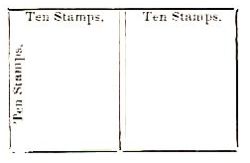
Kersky G. Williams.—The 3c. 1851 U.S., with extra lines on the right or left hand side of the stamps, are those from the tenth and eleventh vertical rows of the entire sheet. The stamps were printed in sheets of 200. These sheets were cut apart into half-sheets of 100. As a guide to the cutter, the division between the halves was made prominent by two extra lines. The 1870-3 varieties of the U.S. stamps were illustrated in the Round Table, September 10, 1895.
Philatus.

"A cold bath is a good tonic and nerve bracer." If Ivory Soap is used, it is a beautifier as well.
The Procter & Gamble Co., Cin'ti.
THE CHANCE OF
A LIFETIME.
All Lovers of Art, who would like to learn Landscape Painting, should get THE ONLY SELF-INSTRUCTOR IN ART. Just out. It contains more plain, practical instruction than you will receive in ten lessons from a teacher. For particulars write to