THE COURAGE AND ENDURANCE OF ARCTIC ANIMALS.
Reading edition
BY THE CHIEF OF THE GREELY EXPEDITION.
The animals we have spoken of live on grass or other vegetation, and their ability to exist depends primarily on their ability to cover enough pasture ground to ensure sufficient food. Their dinner always awaits their coming. With the fox and wolf the question is more serious, for they live on flesh, either of animals or of fish. The long silky hair makes the arctic fox beautiful in winter, and, indeed, quite the whole year, for in the farthest north his color remains quite unchanged from a snowy whiteness. They are much smaller than the common fox, the total length, including the bushy tail, varying from two to three feet, and their weight is from eight to twenty pounds; in late winter, however, some do not weigh over five pounds. As the arctic ptarmigan has feet quite clothed with fine feathers as a protection against cold, so the arctic fox needs for the soles of his feet the thick covering of hair that earns for him the designation of lagopus (hairy).
After fifteen years' experience in South Greenland, Dr. Rink, fully recognizing the craftiness of the fox, but also knowing the great difficulty of obtaining animal food, says: "How these little fellows are able to find food necessary to support life during eight months of the year at the northern fiords remains somewhat of a mystery. Hares and partridges are scarce, and seem unable to yield sufficient food for the foxes. In summer the fox seeks the water's edge for mussels or other food there exposed at low tide. He follows the seal-hunter, whether he be man or bear, for the drops of blood or bits of skin and meat yielded by the chase."
In Boothia Felix, Captain Ross found that he burrows and accumulates supplies. He says: "One of their burrows was discovered on the sandy margin of a lake; it had several passages, each opening into a common cell, beyond which was an inner cell, where the young, six in number, were taken. In the outer cell, and in the several passages leading to it, we found a great number of the two species of lemmings, several ermines, and the bones of hares, fish, and ducks in great quantities."
In the extreme north the difficulties of life for the fox greatly increase. Shell-fish disappear, seal as a rule migrate for the winter, and the hunting season shortens wofully with the lengthening winter. Moreover, in Grinnell Land the fox cannot burrow, for the earth never thaws more than a foot or two. However, the cunning animal utilizes nooks and crevices as dens and store-houses. The theory advanced by Professor Newton that the foxes of Spitsbergen lay up in summer a store of food for winter use has been confirmed as to the foxes of North Grinnell Land and Greenland.
THE ARCTIC FOX CATCHING HIS DINNER.
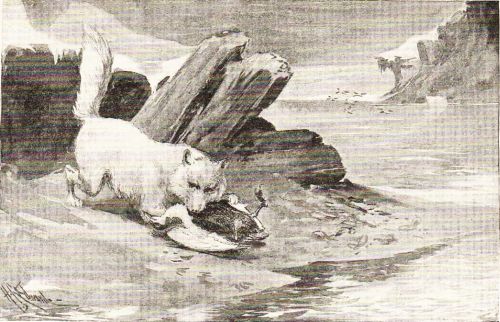
In 1876, near the 83d degree of north latitude, Colonel Feilden shot a fox who, with his mate, occupied a lair in a hillock of broken rocks. "While resting," says Feilden, "we noticed that numerous dead lemmings were scattered around. In every case they had been killed in the same manner—the sharp canine teeth of the foxes had penetrated the brain. Presently we came upon two ermines killed in the same manner. Then, to our surprise, we discovered numerous deposits of dead lemmings; in one hidden nook under a rock we pulled out a heap of over fifty. We disturbed numerous caches of twenty and thirty, and the ground was honeycombed with holes, each of which contained several bodies of these little animals, a small quantity of earth being placed over them. In one hole we found the greater part of a hare hidden away. The wings of young brent-geese were also lying about, and as these birds were at that date only just hatching, it showed that they must have been the results of successful forays of prior seasons, and that consequently the foxes occupy the same abode from year to year."
It appears evident that the hoarding of supplies is peculiar to the fox of North Grinnell Land, for two we held in captivity regularly hid such portion of their food as was not needed for immediate consumption, and it was also noted that the fox was an unusually frugal eater. Curiously enough, our captive foxes would not hide anything while being watched, and a piece of meat has been allowed to lie on the snow undisturbed for half an hour or more while persons were around; but leaving the fox for only four or five minutes, it would be found, upon returning, that the piece of meat had been carried to a corner, a hole dug in the snow, and the surface so carefully restored that it was difficult to notice any change.
One of the foxes, under gentle treatment, became quite tame, and permitted us to handle him, although he always caught the advancing hand and gently applied his teeth, as if to give warning that he was not to be trifled with. When stroked he seemed pleased, and gave forth a purring noise very like that uttered by a contented cat. He would not tolerate the bringing of the face near to, nor blowing at him, invariably jumping at the person so offending.
The other fox, an old female, proved vicious and intractable. Despite kind treatment, every effort to handle her resulted in serious bites. She was kept chained, but made such frequent and violent shows of anger, at times bordering on madness, as compelled us to kill her. She never showed any signs of fear, and neglected no effort to free herself. She was confined in a lean-to, at the door of which the Eskimo dogs gathered for their daily food. Whenever a dog was in sight, Miss Fox put on a bold front, showed her teeth threateningly, and emitted a series of low growls, somewhat of a modification of the shrill barks the fox usually indulges in. Several of the half-grown dogs rushed in on her, one at a time and on different occasions, but the fox met the attacks with such courage that the puppies retreated, one of them howling dismally at his wounded muzzle, in which the fox had deeply inserted her sharp teeth. The tame fox broke his chain and made a burrow in the snow wall that surrounded the house. As daylight was then continuous, and there were about thirty dogs around the quarters, it was thought that the fox would fear to attempt an escape. After ten days, however, he took the chances, and successfully ran the gauntlet of Eskimo dogs.
Doubtless the female fox has the hardest life, her energies being severely taxed in caring for her young. She is always in poorer flesh than the male, and as a rule she is much more vicious, and less amenable to kindly treatment.
An instance of the endurance and possibly the craft of the arctic fox may be cited in the experience of Biederbick, one of our expedition, who put a bullet through a fox and apparently killed him. Failing to reload his gun, the expectant hunter went forward to pick up his prey. To his great astonishment and chagrin, as he neared the wounded animal the fox, lamed and bleeding, sprang up and ran off at such a pace that he escaped.
It may be added that the arctic fox, while noted for his courage and endurance, is not skilled against traps or pitfalls, but shows a proneness to be caught that borders at times on stupidity.
THE ARCTIC WOLF.
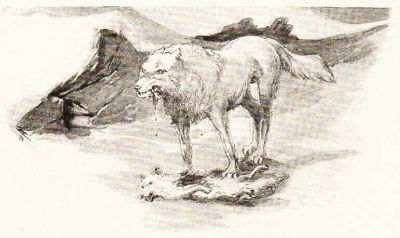
The white-skinned, large-limbed wolf is the most ravenous, untiring, and dangerous of all arctic animals. Its tireless gallop, sharp teeth, snappish bites, and powers of a concerted action with its own kind make it possible for this predacious animal to live wherever game of any considerable size is to be found. In Grinnell Land he subsists almost entirely on the musk-oxen, who find their only safety by travelling in bands. When attacked they form a circle, and placing their calves and feeble members in the centre, by opposing horns and desperate bellowings stand off the encircling wolves. Woe, however, to the straggling ox who falls in with wolves, for he never escapes.
In his widely read narrative, Kane most unjustly disparages the strength and prowess of the arctic wolf. He says: "The Eskimo dogs of Smith Sound encounter the wolf fearlessly and with success." There is absolutely no foundation for this statement. Kane never saw a wolf either in southern Greenland or in the Smith Sound region, for this animal is unknown in Greenland, save one drifted from the American coast and killed at Omenak in the winter of 1868-9.
In truth the arctic wolf is relatively the strongest, as he is in fact the most courageous and enduring of arctic animals, and these qualities are supplemented by unusual craft and caution. They average some twenty pounds greater weight than the dog, which animal views their appearance with terror, realizing his small chance of safety in an encounter. The single wolf tempers his desperate courage with caution, and so rarely attacks man. Indeed, he uses such good judgment that there are not half a dozen instances in the annals of arctic expeditions where the hunter, matching his wits and efforts against those of the beast, has succeeded in shooting a wolf. When wolves assemble in packs they seem to act without any fear of consequences whenever the community interests of the pack demand it. They seem to realize that by concerted action the pack is bound to prevail, and they accept the chances of death very much the same as a soldier does when sharing the dangers of a victorious charge.
The British expedition of 1875 to Grinnell Land saw several wolves following a herd of musk-oxen, on which the wolves of that region subsist. Despite repeated efforts the sportsmen could not get within three or four hundred yards of these very wary animals. Later a single wolf followed Colonel Feilden's sledge for several days, but such was the cunning displayed by the beast that all efforts to get a shot at him failed. Very greatly to our surprise, in September, 1881, a large band of wolves appeared on the harbor floe near our house at Lady Franklin Bay. They were eighteen in number, and while they showed no signs of timidity, yet their discretion was such that none of our many expert hunters were able to get within gunshot. While this wariness is in keeping with the general habits of the arctic wolf, which has been rarely killed by sportsmen, yet it seems surprising when we reflect that these wolves could never have been hunted, and doubtless had never seen any animal, save the polar bear, which could injure them.
The tenacity with which arctic animals hold to life was frequently instanced in our experience, and the thought occurred that it arose from the survival of the strongest and hardiest individuals in a clime where nature ever seems at strife with nature's life. A few days later two of our hunters ran across a pack of wolves, of which two were shot, but both escaped. A rifle-ball went completely through the body of one animal, which bled profusely. The wolf was followed for several hours by its trail of blood on the snow, but it finally escaped. Later, a single wolf came within one hundred yards of our house, and in the early twilight was for a time mistaken for one of the dogs, who were much disturbed. He was eventually pursued by several hunters, and was shot through the body by Lieutenant Kislingbury. Knocked down by the ball, the wolf lost in a few minutes at least a cupful of blood. He was chased for some time, his blood marking his path, but no one got within gunshot. He was let alone for several hours in hopes that he would die, but, pursued by the hunters later, he travelled on, stopping and waiting as did his pursuers. Leaving drops of blood in the snow, he kept walking out of gunshot, until he fell down dead with his body substantially bloodless.
As the repeated efforts of our best huntsmen failed to further diminish the number of the pack, it became necessary to resort to other means of offence, for our interests were too important to be neglected. The terror and dismay of our dogs promised their destruction, and with their loss was involved our future sledging trips. Again, the health of the party depended largely on the herds of musk-oxen, which the wolves were running down. Acknowledging ourselves beaten as man against beast, we resorted to poison. Here we were surprised at their craft and caution. Different poisons skilfully arranged in meat were visited and left untasted by the animals. Eventually, by mixing good and bad meat together, we succeeded in killing four wolves; but on more than one occasion the animals ate all the good meat and left the poisoned. While the remaining wolves gave anxiety to us, yet this was not unmixed with a certain feeling of satisfaction that a brute of such courage, endurance, and craft had been able to hold his own against man, as he had against nature in her sternest mood.
A. W. Greely.