A FLASH IN THE DARK.
Reading edition
BY R. M. FULLER.
The Whitonville Camera Club was to meet at Will Vaughan's house Wednesday evening. Whitonville is a town of some size in the western part of New York. Mr. Vaughan, Will's father, one of its earliest residents, lives in a large old-fashioned house on the main street, opposite the Whitonville Bank, of which he is president. All day the overcast sky had given promise of a downpour, and the sultry atmosphere, charged with electricity, presaged plenty of thunder and lightning before midnight.
"It's too bad!" exclaimed Will Vaughan to his friend and visitor Tom Wetherby, as they stood on the front porch looking at the angry sky. "If the storm breaks before the fellows get here the meeting falls through; but here comes Frank Wentworth."
The young men exchanged cordial greetings, and followed Will to the library, where the meeting was to be held. One after another the members arrived, until the whole club was seated around the table. Tom Wetherby belonged to a large club in the city, and was recognized as an authority by the members of this small country organization. He was a bright young fellow of nineteen, always on the lookout for some novel subject for his camera, which accompanied him on all his wanderings. He listened to the debate, offering a word now and then as his opinion was requested, until his ear caught the swish of rain hurled violently against the window-panes by the wind. Presently this was followed by heavy peals of thunder, and flash after flash of lightning.
"If you don't mind, Will, I will try to catch a flash or two of the lightning; I have been waiting for a chance like this for a long time," said Tom.
"All right, old fellow; we'll excuse you. Look out your camera isn't blown away."
Tom was soon busy setting up his camera on the front porch, with the lens pointed at the sky at an angle which just cleared the tops of the opposite houses. The rain poured down, while crash upon crash of thunder followed each successive flash of lightning. Nearer and nearer came the force and violence of the storm, until the centre of electrical activity was directly over the village. Tom exposed several plates, and had put the last plate-holder in position when his foot struck one leg of the tripod, almost capsizing the camera. A quick grab at the instrument prevented the catastrophe; but before he could get the camera in position, again, a blinding flash came, followed simultaneously by a crash which shook the building to its very foundation. For a moment Tom was dazed with the vivid light. Every object was illuminated with a brightness exceeding daylight, and then all became intensely dark. Tom capped his lens, seized his camera, and re-entered the house, where he found the club still discussing the topic of the evening.
"Well, what luck?" they exclaimed.
Tom shook the water from his clothes, wiped the moisture carefully from the camera, and replied: "Oh, so so! the last plate must be a dead failure, though. I knocked the camera half over just before that terrible crash."
The following morning the Vaughans were at breakfast when a quick ring at the door-bell was heard, and Mr. Vaughan recognized the voice of one of his clerks, saying, "I must see Mr. Vaughan without delay, if you please."
Mr. Vaughan surmised from the tones of the speaker that something had happened, and hastened to the door.
"Mr. Vaughan," exclaimed the excited clerk, "please come over to the bank at once. We have been robbed, sir."
"Robbed?"
"Yes, sir; everything is in confusion. The vault is open, and papers and securities litter the floor."
It took but a moment to recognize the truth of the clerk's statement. The vault door was wide open, but the lock had not been injured. The robbery had been committed by some person who knew the combination of the lock, or the vault had not been fastened the night before.
Mr. Vaughan discarded the latter idea, for he had tried the vault door before leaving the bank, and knew that it was locked. There were three besides himself in the employ of the bank—James Hendrix, the cashier; Frank Wentworth, bookkeeper and assistant cashier; and John Salters, general utility clerk, the man who had notified him of the robbery.
Neither Hendrix nor Wentworth had arrived, and Mr. Vaughan requested the clerk to gather up the papers which were still lying scattered over the floor, while he endeavored to find a clew to the robbery.
While they were thus engaged the cashier entered, and appeared surprised to find the president already there.
Mr. Vaughan immediately informed him of the robbery, and noted the look of indignation and astonishment with which the news was received.
"Hendrix, what was your cash balance last evening?"
The cashier, after consulting the books, replied, "Twenty-eight thousand five hundred and twenty dollars, fifty-eight cents, of which six thousand four hundred was in bills, twenty thousand in government bonds, and the balance in securities and currency."
Mr. Vaughan stepped to the cashier's desk, glanced over the book, verifying the figures, and was about turning away, when his eye caught the edge of a paper protruding from the right-hand drawer of Wentworth's desk, which adjoined that of the cashier.
Without saying a word or attracting attention to his movements, the president quietly drew the paper from the drawer and gave it a glance as he put it in his coat pocket.
It was a thousand-dollar government bond.
At this moment Frank Wentworth entered the bank with a pleasant "Good-morning." As he passed behind the rail which separated the customers' side from the working office he noticed the eyes of the president fixed upon him with a stern expression entirely new to him.
"Wentworth, I would like to see you in my office immediately," said the president.
When they had entered the little room, Mr. Vaughan closed the door, and, looking Wentworth in the eye, said:
"Frank, the bank has been robbed of a large sum of money, exactly how much we do not know until these securities have been examined and counted."
Wentworth's face became crimson, for the president's manner implied more than the mere words conveyed.
"You were the last one to leave, were you not?"
"Yes, sir; but everything was safe and sound when I left. I tried the vault door after putting on my hat and coat, and I am positive it was securely locked."
"Are you equally positive in regard to the front door after you had passed out?"
"Yes, sir; I turned the knob repeatedly; the door was closed and locked."
"You have no theory to offer as to how the robbery was accomplished?"
"Why, Mr. Vaughan! how should I know anything more about it than yourself? Was the vault door open?"
Without replying, the president said, "Step to the door and call Mr. Hendrix and Mr. Salters."
Frank did as he was bidden.
"Each of you has a private drawer in your desk of which you retain the key. The bank has lost a large sum of money, and we must be willing to clear ourselves of the suspicion which might attach, in view of the fact that the vault combination is unknown to any person outside this room. You will hand me your keys, and come with me to the outer office while I perform a most unpleasant duty."
Hendrix's desk was first inspected; then Salters's; but nothing found to implicate them.
Mr. Vaughan next opened Frank's private drawer, and there, directly in front, lay two of the government bonds and a number of bills of different denominations.
Wentworth's face became ashen, his knees trembled, and he gasped for breath. Presently, however, he looked Mr. Vaughan squarely in the eye, and exclaimed, "Mr. Vaughan, in spite of what we see, and what you doubtless think, I do not know how the bonds came there."
The president did not reply. He tried the keys of the others' desks in Wentworth's lock, and neither would fit.
"Mr. Hendrix, you will call an officer; my duty is plain; I cannot evade it."
As the cashier went out of the door, Mr. Vaughan turned to Wentworth, who had sunk into a chair, covering his face with his hands, and said:
"Frank, I could not feel much worse if this had been against my own boy Will. Your father was a director of this bank, and my friend for years. It is a mercy that he did not live to see this day."
Wentworth made no answer; the power of speech appeared to have forsaken him. He did not lift his head nor utter a sound until Hendrix appeared with an officer.
Mr. Vaughan explained the situation, and Frank was led away in custody.
Consternation fell upon Frank's friends and acquaintances, for the evidence was so overwhelming that his simple denial of any knowledge of the matter had no weight with the majority. His mother and sister, together with the members of the camera club, formed a small minority who believed him innocent.
Will Vaughan was untiring in his efforts to console Mrs. Wentworth and her daughter Alice, and did his best to keep Frank's spirits up. What could he do, however, to stem the tide of public opinion? Again and again he besought Frank to discover some tangible clew to the robbery. Frank had racked his brain in the effort to do so, without avail.
Tom Wetherby returned to his home in New York early on the morning of the day following the storm. He knew nothing of the robbery until weeks afterwards, when a long letter from Will Vaughan arrived, detailing the terrible plight of Wentworth, and rehearsing all the circumstances.
"Too bad! too bad!" muttered Tom, as he finished the letter. "I don't believe Wentworth guilty any more than Will does. His face is as honest and open as the day."
Will's letter called the lightning plates taken at Whitonville to mind, and he determined to do so now; accordingly he went up to his dark-room and was soon as busy as a bee. One after another the plates were developed, fixed, and washed, until plate-holder No. 7 was reached. Tom hesitated as he drew the slide and removed the plate from the holder.
"Oh, pshaw!" he exclaimed, "what's the use of bothering with this one?" for he remembered with a smile the wild grab for the camera and the dazzling flash that came before he could straighten the tripod.
"I don't suppose there's anything on it—but here goes, for fun, anyway!"
He popped it into the tray, poured the developer over it, and awaited results. After a while the image began to show, and little by little the detail came out.
"Hello! what's that?" Tom's eyes fastened on the negative with astonishment. His face assumed an expression of intense interest, for moment by moment the image grew stronger and stronger. With the utmost care he completed the process, and then, opening the dark-room door, flew down the stairs two steps at a time, tore into his bedroom, grabbed Will's letter from the desk, and read the concluding paragraph as follows:
"My heart aches for Frank and his mother and Alice. I don't believe one word of the charge against him; but, like all the rest of his friends, am powerless to help him. The trial comes off on the 18th."
"The 18th, and to-day is the 17th! It's a close call, but it's got to be done, and I'll do it," cried Tom, in a whirl of excitement.
He hurried to the telephone in the library, called up his father's office in the lower part of the city, and while waiting for the connection looked at his watch. It was quarter of three o'clock. Then the customary "Hello!" came over the wire.
"Please tell Mr. Wetherby to come to the 'phone."
"Who are you?"
"His son Tom; I want to speak to father."
Presently Mr. Wetherby called back, "Well, Tom, what is it? Hurry up; I'm busy!"
"Father," shouted Tom, his voice betraying the excitement he was under. "I must go to Whitonville to-night. I think I've got something which will help Will Vaughan's friend who is accused of robbing the bank."
"My son, hadn't you better wait until I get home and talk the matter over with you?"
"Can't wait, father; to-day is the 17th; Wentworth's trial takes place to-morrow. The only train which would get me there by noon to-morrow leaves at four o'clock this afternoon—about an hour from now."
Buzz-z-z went the 'phone.
Mr. Wetherby was probably thinking about it. He knew Tom was a pretty level headed young man, and felt convinced that his son had something of material importance to the case.
The break seemed an age to Tom, and he called over the 'phone impatiently,
"Well, father, can I go?"
"Yes, Tom. I think I can rely on your judgment. If you haven't money enough for the journey, explain matters to your mother, who will supply you. Be sure and write me full particulars, and come home as soon as practical."
When the four-o'clock express rolled out of the Grand Central Depot that afternoon, Tom Wetherby was aboard, and in his grip was the plate that came out of holder No. 7, and a bromide print therefrom.
The court-room at Whitonville was crowded to suffocation. Never before had such widespread interest been manifested in a criminal case in that town.
Frank Wentworth was known and liked by everybody, and the astonishment and grief at his predicament were universal.
Hendrix testified to quitting the bank about five o'clock in the afternoon, leaving the president and Wentworth still there.
Mr. Vaughan testified to his departure a few minutes after the cashier, and that Wentworth was still at his desk.
Frank, in his own defence, accounted for every moment from the time he left the bank until he entered it next morning; but the fact that he was the last to leave the building after remaining there alone half an hour weighed heavily against him.
No one but the Almighty and Frank himself could know what took place in the interim, and the lawyers sought in vain to bridge over the fatal half-hour which succeeded Mr. Vaughan's departure.
The case finally went to the jury, and a verdict of guilty was reluctantly rendered in accordance with the facts.
The District Attorney moved for sentence, and Frank was directed to take his place before the bar, when a commotion occurred at the door of the court-room.
Some one was evidently trying to force his way through the crowd.
For a moment all was confusion, and the judge rapped savagely for order.
All this time a young man was making the best of his way towards the bench. It was Tom Wetherby. Without looking to the right or left he kept his eye fixed upon the judge, and raised his hand in token of a desire to be heard.
Judge Dalton, recognizing that something of import must be responsible for this unprecedented proceeding, calmly awaited Tom's approach.
At length he reached Wentworth's side before the bar, and speaking earnestly, said: "I believe, your honor, I have in my possession evidence which will clearly establish the innocence of the prisoner. I have travelled all the way from New York to bring it to you, and reached Whitonville less than half an hour ago. If you will let me give the evidence to the prisoner's counsel before you take further action, I think you will be satisfied with the truth of my statement."
The required permission was given, and every eye in the room was fixed on Tom while he hurriedly told his story to the lawyer and produced his negative and print.
A consultation followed between Frank's lawyer, the District Attorney, and Judge Dalton.
Presently the judge turned to the jury and said, "In view of the fact that new evidence of importance has been presented to me, the District Attorney recommends the reopening of the case; I therefore set aside the verdict rendered, and ask your further consideration of the matter."
The excitement of the spectators was intense. Frank's lawyer promptly called Tom to the stand.
Tom testified to the facts we already know, and took his seat.
"Mr. Hendrix," said the lawyer, turning to the cashier, who occupied a seat among the witnesses for the people, "will you take the witness chair for a few moments?"
Hendrix started as though he had been shot, but rose and made his way to the stand.
"Will you tell us, Mr. Hendrix, where you were between the hours of nine and ten o'clock on the night of the robbery?"
"I was at home."
"Did you not leave the house at all that evening?"
"No, sir; it was a very stormy night, and I did not go out."
"You are perfectly sure of this?"
"Certainly. I did not leave my house."
"Mr. Hendrix, will you look at this picture and tell me if you recognize the person it represents?"
Hendrix took the bromide print from the lawyer's hand, and saw—the entrance of the Whitonville Bank; a man was just issuing from the door; one hand was on the knob in the act of closing the door, while the other hand was holding his hat firmly on his head to prevent its being blown away; the man's face was clearly distinguishable; it was himself!
THE EFFECT UPON THE GUILTY MAN WAS PITIFUL.
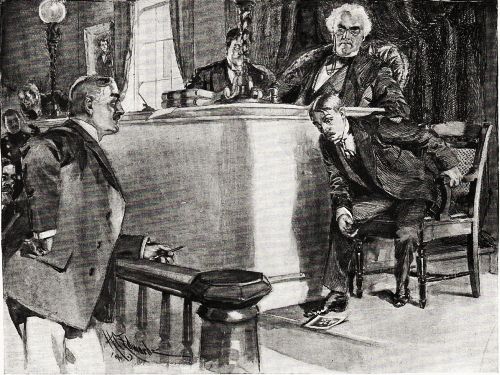
The effect upon the guilty man was pitiful. He shook with fear; his head dropped upon his breast, and the picture fell from his nerveless grasp to the floor.
The lawyer quickly handed the print to the jury, and then turning to the judge, said: "Your honor, our side of the case has been presented. We have finished."
The jury promptly acquitted Frank, who was surrounded by friends eager to congratulate him on his wonderful escape.
Tom was the hero of the hour, and received compliments enough to turn the head of any fellow less modest and unassuming.
Hendrix's story is quickly told. Speculation, losses, peculation in small sums to make good the losses, and finally robbery to cover the petty thievings. He made a full confession—told how he put the bonds in Frank's drawer to avert suspicion from himself, using a duplicate key to open the drawer. He is now undergoing a long term of imprisonment in Auburn.
Frank Wentworth is the new cashier of the Whitonville Bank, and enjoys the friendship and regard of the entire community.