Part 2 — THE RIVER.
Reading edition
Down through the fields, by the poplars and birches, Into the towns past the houses and churches, On through the night while the curfew is tolling The river goes bubbling and foaming and rolling Under the bridges and over the stones, Winding through swampland that nobody owns, Spraying, and splashing, and murmuring free— Onward it speeds from the hills to the sea!
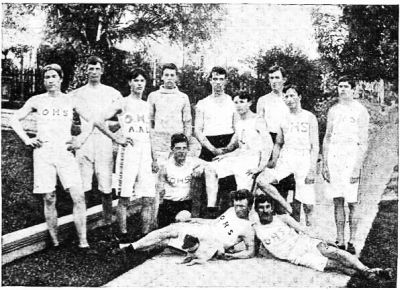
Lynch. Hoffman. Cooley. Cheek. Bell. Jenks. Whitman. Edwards. Dawson, (Capt.). Smith. Steele. Morrel. OAKLAND HIGH-SCHOOL ATHLETIC TEAM. Interscholastic Champions of the Pacific Coast.
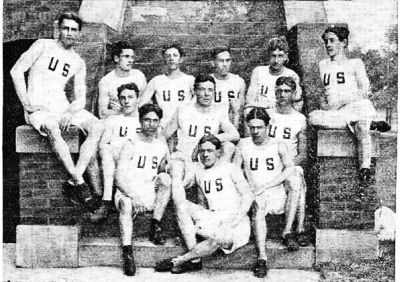
Striebinger. Raby. Hord. Deming. McBride. Perkins. Shechan. Alexander (Capt.). Cross. Burke. Sullivan. Ruttle. UNIVERSITY SCHOOL (CLEVELAND, OHIO) TRACK-ATHLETIC TEAM.
The superior value of team-work over individual brilliancy was effectively demonstrated at the New York State Interscholastic games at Tonawanda, New York, June 6. The honors of the occasion were carried off by the Buffalo High-School team with 38 points, Syracuse H.-S. coming second with 36, and Ithaca H.-S third with 27.
Ithaca boasted the most brilliant performer of the day—A. B. Miller—who took four firsts, thereby earning twenty out of the twenty-seven points to Ithaca's credit. Miller is a sprinter, and a sprinter of the first class. He took the 100 in 10-3/5 sec., the 220 in 25-4/5 sec., the quarter in 52-2/5 sec., and the half in 2 min. 13 sec.—and all this in one afternoon against lively competition. The other seven points for Ithaca were earned by F. E. Gibbons, who threw the hammer 97 ft. 7 in., winning first place, and took third in the shot with a put of 36 ft. 7 in., and third in the broad jump with 18 ft. 9½ in.
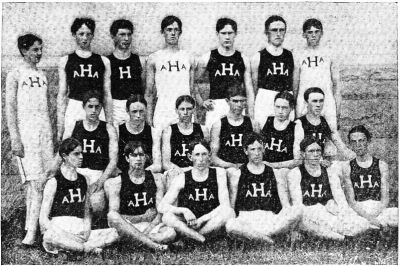
Stone. Eells. Rixon. Brown. McCormick. Parker. Cook. Stetson. Bardeen. Cheney (Capt.). Goodwin. Harper. Ellsworth. Twichall. Tiffany. Lyman. Spencer. Pendleton. Fox. THE HOTCHKISS SCHOOL TRACK-ATHLETIC TEAM.
Miller and Gibbons were the stars, and no other member of the Ithaca team scored a single point. But these two giants, single-handed, could not overcome the work of the little seconds and thirds that Buffalo and Syracuse kept piling up against them. Buffalo took only three firsts; Syracuse got four; but the Buffalo team grabbed almost every second and third there was in sight, and thus, by general efficiency, easily overcame the brilliant individual work of Ithaca's two star athletes. Brilliant performers are much to be desired if they can be backed up by other athletes of average capability; but they are almost useless, so far as a victory is concerned, when all the work falls upon them, for their achievements then practically count for nothing.
In many respects the performances made at the New York State meeting were better than those recorded at the N. Y. Interscholastics on the Berkeley Oval a few weeks ago, notably the high jump and the broad jump—although these figures do not, of course, surpass the New York city records. It is very probable, too, that Miller would have made better time in his sprints if he could have had the advantage of a better track and more favorable conditions. The Driving Park track at Tonawanda on the day of these games was very heavy, and in none of the running events were the records broken. In addition a strong wind blew across the path and interfered with the speed of the sprinters. Besides the unfavorable weather conditions, the meet was very badly managed; there were no programmes, and no apparatus for the field events; the jumping posts, etc, had to be obtained at the last moment, and this occasioned considerable delay.
When there were but three events left to be decided, Ithaca was ahead with her final score, and Buffalo and Syracuse were tied for second place with 26 points. The broad jump was then called, and Prinstein of Syracuse took first place, making the score 31 for his team, while Purdy of Buffalo took second, and brought the Buffalo score one ahead of Ithaca. The pole vault followed, and Jackson settled matters for Buffalo H.-S. by adding five points to the score. Purdy won the high jump at 5 ft. 8 in., and afterwards, in trying for a record, cleared 5 ft. 10 in. This comes very close to Baltazzi's Interscholastic record.
New York State I.S.A.A. Games, Tonawanda, New York, June 5, 1896.
Event.Winner.
100-yard dashMiller, Ithaca H.-S.10-3/5sec.
220-yard dashMiller, Ithaca H.-S.25-4/5"
Quarter-mile runMiller, Ithaca H.-S.52-2/5"
Half-mile runMiller, Ithaca H.-S.2m.13"
One-mile runBrown, Roch. H.-S.4"56-3/5"
120-yard hurdlesTaylor, Syr. H.-S.19"
220-yard hurdlesTaylor, Syr. H.-S.31-4/5"
One-mile walk—————
One-mile bicycleMiller, Buff. H.-S.3"15-1/5"
Running high jumpPurdy, Buff. H.-S.5ft.8in.
Running broad jumpPrinstein, Syr. H.-S.20"9½"
Pole vaultJackson, Buff. H.-S.9"10"
Throwing 16-lb. hammerGibbons, Ithaca H.-S.97"7"
Throwing 12-lb. hammer—————
Putting 16-lb. shotHall, Syr. H.-S.37"9"
Putting 12-lb. shot—————
Wisconsin I.S.A.A. Games, Madison, Wisconsin, May 30, 1896.
Event.Winner.
100-yard dashMcGowan, Eau Claire.11sec.
220-yard dashMcGowan, Eau Claire.23¼"
Quarter-mile runAthearn, Oshkosh.57½"
Half-mile runDisch, Mil. S.S.2m.21"
One-mile runDodman, Mil. E.S.5"3"
120-yard hurdlesLyle, Madison.20"
220-yard hurdlesLyle, Madison.29"
One-mile walkShepherd, Madison.8"26"
One-mile bicycleComstock, Oshkosh.3"30"
Running high jumpGill, Whitewater.5ft.4in.
Running broad jumpSchroeder, Mauston.18"10"
Pole vaultWard, Oshkosh.9"3½"
Throwing 16-lb. hammer—————
Throwing 12-lb. hammerSmith, Evansville.101"10"
Putting 16-lb. shot—————
Putting 12-lb. shotPatterson, Evansville.42"5½"
Pittsburg I.S.A.A. Games, Pittsburg, Pennsylvania, June 5, 1896.
Event.Winner.
100-yard dashJarvis, E.L.A.11sec.
220-yard dashJarvis, E.L.A.24-3/5"
Quarter-mile runJarvis, E.L.A.53-1/5"
Half-mile runBell, S.S.A.2m.11-2/5"
One-mile runBell, S.S.A.5"15"
120-yard hurdles—————
220-yard hurdlesJarvis, E.L.A.34"
One-mile walk—————
One-mile bicycleHeinz, S.S.A.3"55"
Running high jumpKallock, P.H.S.5ft.3in.
Running broad jumpBaird, E.L.A.19"4"
Pole vaultBaird, E.L.A.8"10"
Throwing 16-lb. hammerBell, S.S.A.74"4"
Throwing 12-lb. hammer—————
Putting 16-lb. shotBell, S.S.A.33"2"
Putting 12-lb. shot—————
Abbreviations.—Roch. H.-S., Rochester (New York) High-School; Syr. H.S., Syracuse (New York) High-School; Buff. H.-S., Buffalo (New York) High-School; Mil. S.S., Milwaukee South Side High-School; Mil. E.S., Milwaukee East Side High-School; E.L.A., East Liberty Academy, Pittsburg, Pennsylvania; S.S.A., Shady Side Academy, Pittsburg, Pennsylvania; P.H.S., Pittsburg High-School.
The Wisconsin School held their athletic meet at Madison, Wisconsin, on May 30, and although the performances as a whole were below the average of the records attained on the Atlantic and Pacific coasts, they will stand comparison with almost any school figures in the middle West. Nineteen schools sent teams to the meeting, and the points were distributed as follows: Milwaukee East Side, 28; Milwaukee South Side, 19; Madison, 17; Eau Claire, 14; Oshkosh, 10; Janesville, 4; Fond du Lac, 1; Whitewater, 7; Evansville, 14; Ripon, 5; Mauston, 7; Edgerton, 3; Wayland Academy, 4; Darlington, Dodgeville, Milwaukee West Side, Lake Mills, and Beloit failed to score any points. In addition to the events shown in the accompanying table, there was a relay race, which was won by the Milwaukee East Side High-School. For some unexplained reason no points were allowed to the winner of the one-mile bicycle-race, which was apparently thrown in as a sort of extra event.
The Pittsburg Interscholastic Association held its second annual field meeting on June 5, the victory going to East Liberty Academy with 23 points out of 64. Pittsburg H.-S. was a close second with 20 points, and Shady Side Academy ran third with 17 points. The other schools followed far in the rear, Park Institute getting only 3, and Allegheny High 1 point. Jarvis of East Liberty Academy stood head and shoulders above any other contestant in the quality of his performances, and won four firsts. He took the 100, the 220, and the quarter, and also finished first in the low hurdles. He could not have been very hard pressed, however, for the time was very slow.
In addition to the one-mile bicycle-race, which was a loaf for three-quarters, there were three other bicycle events. These are not shown on the accompanying table, because it has seemed more advisable, for the purpose of comparison of performances, to record there only the standard events. The quarter-mile bicycle-race was taken by McCready of Pittsburg H.-S. in 35 sec.; he had no easy time of it, however, for Heinz, S.S.A., who took the mile event, pressed him so closely that there were but a few inches between the two as they reached the tape. The two-mile bicycle-race was another uninteresting loaf, the contestants crawling around the track for five laps. A pace-maker was then put in and a spurt followed. Orr, P.H.S., won in 8 min. 3/5 sec., with McCready, his schoolmate, second. When it came to the half-mile race, the officials decided to put in a tandem pace-maker in order to prevent a third loaf, and a good race resulted. Orr again took first, time, 1 min. 9-2/5 sec., with McCready second.
The list of events at the games this year was changed considerably from last spring's schedule, but the house-cleaning did not go quite far enough, for the hop-step-and-jump still remains on the card. Let us hope it will be lost in the shuffle next year. Twelve of this season's events were the same as those of a year ago, and eight of the 1895 records were broken. It is probable that if Jarvis had been pushed he could have lowered the figures in the 100 and the 220; as it was, he established a record in the 440—53-1/5 sec.—which is better than the Pittsburg collegiate performance done by Miller and Edwards at the recent local meeting—54-3/5. Jarvis expects to enter Princeton next year, and will be a valuable acquisition to the New Jersey college's track team, which has never yet been a strong one. Bell, the long-distance runner and weight man, who won four firsts at these games, and Heinz, the bicycle-rider, both go to Yale.
The Oakland High-School athletes have every reason to feel proud of the record they have made on track and field this year. The track team won both the autumn and the spring field days of the Academic Athletic League, and took eight points in the recent Pacific Coast Championships. They have showed themselves to be so strong an aggregation that they can only secure meetings with university teams. A set of dual games had been arranged between the O.H.-S. and the Berkeley High-School, but this fell through after Berkeley had been defeated by the Oakland athletes at the recent A.A.L. field meeting. Challenges have been sent to many high-schools and athletic clubs, but none of these have felt that they were strong enough to stand any chance for success against the Oaklanders, and all have adopted discretion as the better part of their valor.
This year's High-School team, however, is much stronger than any this school has ever turned out before, and it will probably be some time before any such a collection of athletes will be gathered again under the O.H.-S. colors. Three of the best men, Cheek, Jenks, and Dawson, go to college in the fall, and they will add materially to the strength of the University of California team. These three scored 24 out of the 42 points which O.H.-S. secured at the last field day. Cheek is by far the most versatile of the trio, and will undoubtedly be heard from in the near future. At present he holds four of his school's records—the running broad jump, 22 ft.; the running high jump, 5 ft. 8 in.; the 16-lb. shot, 41 ft. 8½ in.; and the pole vault, 10 ft. 5½ in. In addition to these events, he is a strong performer over the hurdles, and throws the hammer beyond the hundred-foot mark.
Jenks is Oakland's sprinter, and holds the school record in both the dashes. His figures are 10-4/5 sec. for the 100, and 24-3/5 sec. in the 220. He is a good quarter-miler besides, his best performance in that line being the winning of the handicap a year ago last April from the 20-yard mark in 52-3/5 sec., coming in ahead of some of the best quarter-milers on the Pacific coast. Dawson's specialty is hurdling. He holds the school record of 29 sec. for the low hurdles, and his best time for the high is 17-4/5 sec. He would doubtless have improved these figures this spring if he had not had the responsibility of captaining the team. It is much to be regretted that such scholastic athletic talent as this could not be present at the National games last Saturday; if they had, the results in many of the events would doubtless have been different; for I feel confident that with better tracks and a more eager competition they would be able to improve on their home figures.
In baseball the Oaklanders have as good a record as in track athletics. Their nine this year won every game played, and the contests were not only with academic teams, but also with some of the strongest nines in that section. Two years ago the O.H.-S. had the reputation of possessing the best team of amateur baseball-players on the Pacific coast. So great is the interest in athletics there that the Grammar and Primary schools of Oakland got up a field day on May 23. There was a great deal of enthusiasm displayed by the colts, and their best performances were in the high jump, 5 ft. 3 in.; and the quarter-mile run, 59 sec. The season, however, is now pretty well closed, and not until next fall will there be any great activity in any kind of sport among the schools of California.
The activity in sport of the Californiana has acted as an incentive to many schools in the middle West. I know this to be true from correspondence I have had with many captains of teams in that section of the country. Foremost among those who have been drawn into emulation of the Oaklanders are the athletes of the University School of Cleveland, Ohio. Comparatively little had been done in athletics there until about a year ago, but since that time a great improvement has been noticeable, and at the University School's field day a week or so ago some very good figures were made. Alexander threw the hammer 123 ft. 6 in.; Hord vaulted 9 ft. 9½ in.; McBride jumped 5 ft. 5½ in.; and Alexander put the shot 36 ft. 6 in. It will not be long before the records in the middle West will equal those of any of the scholastic associations of the country.
Iowa H.-S.A.A. Games, Cedar Rapids, May 22, 1896.
Event.Winner.
100-yard dashJackson, Cedar Rapids.10-3/5sec.
220-yard dashJackson, Cedar Rapids.23"
Quarter-mile runCarmichael, Clinton.51-1/5"
Half-mile runBrown, Sioux City.2m.6"
One-mile runBrown, Sioux City.5"8-3/5"
120-yard hurdlesHorton, Muscatine.
No time taken.
220-yard hurdlesConger, Clinton.29-1/5"
One-mile walkDavis, Clinton.8"6-3/5"
Running high jumpFlournoy, Clinton.5ft.8in.
Running broad jumpJackson, Cedar Rapids.20"¼"
Pole vaultWalsh, Clinton.9"2"
Throwing 16-lb. hammerLeo, Cedar Rapids.89"5"
Putting 16-lb. shotHartung, Des Moines.32"11¾"
Two-mile bicycleCherry, Cedar Rapids.5m.59sec.
Half-mile bicycleCherry, Cedar Rapids.1"14-2/5"
When the Iowa State H.-S.A.A. held its first field meeting last year this Department criticised the schedule of events, which contained a number of acrobatic feats not usually recognized as track or field events. It is with great pleasure, therefore, that I notice a change this year. The Iowans are certainly a progressive set of athletes, as has certainly been proved by their sending a team to the National games of last Saturday.
Clinton High-School is the leading institution in athletics there at present. Clinton won the championship among the Iowa schools, and also, in a dual meet, defeated Rockford H.-S., whose team won the Illinois championship.
The Clinton High-School team also challenged the Milwaukee team, but their invitation for a dual contest was not accepted. The Iowa Association is the only one, I believe, of the Western interscholastic leagues that has joined the National I.S.A.A., and for this they deserve great credit. Their action and enterprise will no doubt be of the greatest benefit to sport in that region, and will serve to place the Iowa schools in the front rank of scholastic athletics.
The Graduate.
AN OUNCE OF PREVENTION
is cheaper than any quantity of cure. Don't give children narcotics or sedatives. They are unnecessary when the infant is properly nourished, as it will be if brought up on the Gail Borden Eagle Brand Condensed Milk.—[Adv.]
AS TO FRUIT SHORT-CAKES.
Now is the season of the fruit short-cake, and from this, on the household journal and the domestic departments of the dailies that do not contain several receipts for mailing the different varieties of this delicious dessert will be deficient in their make-up. As a matter of particular information it should be stated that whenever a cooking receipt calls for a baking powder the "Royal" should be used. The receipt will be found to work better and surer, and the biscuit, rolls, cakes, short-cakes, dumplings, crusts, puddings, crullers, or whatever made, will be produced sweeter, lighter, finer flavored, more dainty, palatable, and wholesome. Besides, the "Royal" will go further or has greater leavening power, and is therefore more economical than any other powder. The greater consideration, however, is the added delicacy of flavor, the uniform fineness of the article that are always insured.
Many receipts as published still call for cream of tartar and soda, the old-fashioned way of raising. Modern cooking and expert cooks do not sanction this old way. In all such receipts the Royal Baking Powder should be substituted without fail.
The greatest adepts in the culinary art are particular to use the Royal only, and the authors of the most popular cook-books and the teachers of the successful cooking-schools, with whom the best results are imperative, are careful to impress their readers and pupils with the importance of its exclusive employment.
The Royal Baking Powder is the greatest help of modern times to perfect cooking, and every receipt requiring a quick-raising ingredient should embody it.—The Caterer.