HOW MAGIC IS MADE.
Reading edition
BY HENRY HATTON.
V.
About the year 1864 Carl Herrmann introduced at the old Academy of Music, New York, a trick never seen here before, which he called "The Miser." It has since become common, and, under the more prosaic title of "Catching Money in the Air," is exhibited more or less skilfully by many of the present-day conjurers. None, however, has presented it so artistically as the originator, for in his hands it was a very clever bit of melodramatic acting.
Borrowing a hat from the audience, he crept about the dimly lighted stage to the accompaniment of weird music, and with eager eyes and avaricious clutch seemingly plucked from the air half-dollars innumerable, which he deposited in the hat, until he had accumulated twenty-five or thirty.
FIG. 1.
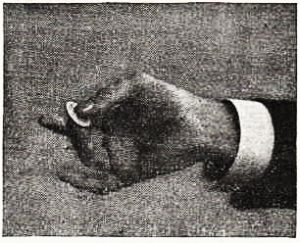
More modern conjurers have tried to improve on Herrmann's method by using apparatus of one kind or another in the trick, but he relied exclusively on his ability to palm a coin.
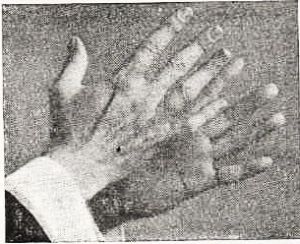
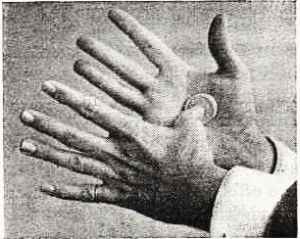
As it will be necessary for my readers first to master this important element of conjuring, I shall try to teach it before explaining the other details of the trick. To palm a coin, hold it lightly between the tips of the second and third fingers and the thumb of either hand, as shown in Fig. 1. Balancing it on the finger-tips, let the thumb resume its normal position, and at the same moment let the two fingers press the coin into the hollow of the palm. See Fig. 2. Now contract the thumb so that the coin will be held by the ball on one side, and on the other by the opposite fleshy part of the hand, as in Fig. 3. Though at first it may be difficult to press the coin into the exact position, practice will soon make it easy.
FIG. 2.
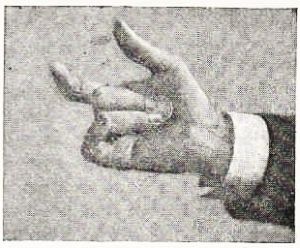
The beginner is apt to try to have his hand appear perfectly flat when seen from the back; but let him notice the open hand of a friend as it hangs in a normal condition, and he will find that it is slightly arched. Supposing that my reader is now an adept at palming, let us proceed with "The Miser" as Herrmann did it.
When he came on the stage he held twenty-five or thirty coins in his left hand and one coin in his right. As an excuse for keeping the left hand closed it grasped the lower part of the lapel of his coat. In the right hand he carried his wand, or badge of office, a round ebony stick about eighteen inches long, fitted at the ends with ivory ferrules.
FIG. 3.
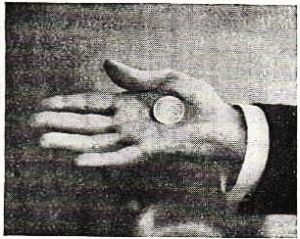
Approaching some man in the audience, he asked for a high hat, and as it was handed to him he thrust the left hand inside of it, the thumb only remaining outside to grasp the rim. Extending his arms, he struck the left arm with his wand and the closed right hand, asking the nearest person to feel his arms and body so as to assure himself that nothing was concealed there. This examination over, he turned to go back to the stage, throwing his wand ahead of him, and letting the coin in the right hand slip into his sleeve.
Now began his search for the money. As he moved about the stage the audience was allowed to see that the right hand was empty. Suddenly he grasped at the air, and then peering into his hand, he struck his forehead as if in despair at finding nothing. Then as the right hand fell to his side the sleeved half-dollar slipped into it.
Now began the money hunt in earnest. With his right side toward the audience, he again clutched at the air, and this time, letting the coin drop to his finger-tips, showed it. Then he tossed it visibly, so that all might see it, into the hat, where it was heard to fall. The next moment, as if with the instinct of the miser, he took it out again and pressed it to his lips, and once more threw it into the hat. This time, however, he only apparently did so, for as the hand went inside the hat he palmed the coin, and let drop one of the coins from the left hand instead.
Round and round the stage he went, catching the coin, palming it, and apparently adding it to the store in the hat, which was each time supplied from the left hand.
When only four or five coins were left in the hand, he actually threw the coin which he "caught" into the hat, turned the empty hand toward the audience—without speaking, however, for the whole trick was carried out in pantomime—and then placing it inside the hat, as if to hold it, took the remaining coins from the left hand. Withdrawing that hand, he turned it, palm outward, toward the audience, and then took the hat with it again, this time keeping the fingers outside. In the mean time he had palmed the four or five remaining coins, for it is as easy for the practised conjurer to palm six as one. These coins he proceeded to "catch," one at a time—which requires considerable practice—and threw each visibly into the hat. This last move set at rest any suspicions which might exist that he had been using one coin throughout the trick.
During the course of the trick, Herrmann at times pretended to pass the coin through the bottom or side of the hat. To do this he merely showed the coin, which he palmed as his hand approached the hat, and let the tips of his fingers touch the plush, as if pushing the coin through. At the same time he dropped a coin from the left hand, and the chink as it came in contact with the others heightened the illusion.
Herrmann played to very large audiences, and this trick proved so popular that Robert Heller decided to reproduce it; but he varied it as follows: Besides the lot of half-dollars in his left hand, he had six or eight in his right. Making a grab at the air, he thus "caught" a number of coins, which he appeared to throw into the hat. In fact, he merely closed his hand over the captured coins without any palming, and let six or eight drop from his left hand. Of course his stock was soon exhausted; but when that happened he threw the coins from his right hand bodily into the hat. Then for the next two or three times when he grabbed at the air he kept the right hand closed, and putting the empty hand over the hat, shook up the coins already in, thus giving the impression that he had thrown a number of coins in. Finally he went among his audience, and taking a heaping handful of coins out of the hat, poured them back, retaining six or seven in his hand. These latter he then shook from a lady's handkerchief or her muff, or pretended to take them from the long whiskers of some man.
FIG. 4.
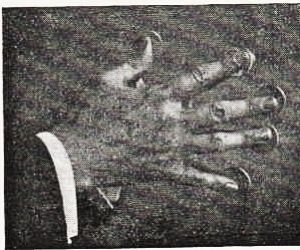
Two or three years later Hartz did the trick, and as he could not palm a coin, he used a flat tin tube which held about six coins. This tube hung by a hook inside the right breast of his vest; the lower end just reached the bottom of the vest. By putting the tips of the fingers under the vest and pressing a lever, a coin dropped into the hand, and the performer was thus enabled, from time to time, to show a half-dollar and throw it into the hat. The other times he merely pretended to catch a coin, and put his closed empty hand over the mouth of the hat, and "made believe," as the children say, to drop the money in.
Another mechanical arrangement that is used by some performers is strapped just above the wrist, inside the sleeve, and is so constructed that by extending the arm suddenly a coin is shot out by means of a spring to about the tips of the fingers, and the performer really catches it. Still another coin-holder is used, but the pump-handle movement necessary to release the coins is inartistic. There is one little wrinkle, however, in connection with this trick which is worth describing and worth using. It is a coin with a tiny hole drilled through it near its edge. A human hair or a bit of fine sewing silk is run through this hole and formed into a loop. In this way the coin is hung from the thumb. When the performer wishes to "catch" it, a slight jerk brings it to the front of the hand, where he seizes it; and as he puts it into the hat he lets it swing to the back of the hand, which can then be shown empty.
FIG. 5.
A very good trick, somewhat akin to palming, is done with five half-dollars. In palming proper, a new coin with a sharp, milled edge is the best to use, as the milling helps to hold it in place, but for this trick well-worn pieces of money which have become quite smooth are necessary.
FIG. 6.
Begin by rolling up the sleeves so that the arms are bared. Hold the left-hand extended, palm upwards, and on the tip of each finger and thumb balance a coin. Place the right hand on top of the left, so that the money is held between the tips of the fingers of the two hands. Now turn the hands until the back of the right hand is towards the audience, as in Fig. 4. Fix your eyes on the ceiling, as if that had something to do with the trick; move the hands rapidly upward and downward twice, and while doing so bring the tips of the fingers together, causing the coins to lap one over another. Then surround them, as it were, with the tips of the left hand fingers and thumb, and quickly slide them down into the right palm, where they are to be held by pressing on them with the tip of the left thumb; finally, at almost the same moment make a third upward move, keeping the hands together and the eyes fixed above; the hands will appear to be empty and the coins to have vanished. Figs. 5 and 6 show the fronts and backs of the hands. During the applause which always follows this trick, quietly withdraw your thumb, close the right hand over the money, and put it noiselessly away, either in your pocket or other receptacle.
The mere learning of a move like palming is hardly interesting unless it avails for some trick. As "The Miser" is not suitable for all occasions, here is a little trick which will answer to show my amateur friend's proficiency:
Place two half-dollar's on a table. Pick up one with the right hand, palm it, and pretend to place it in the left hand. To do this naturally let the tips of the right-hand fingers touch the left hand, and at the same time close that hand and draw the other away. To the general spectator it will appear as if the coin really remained in the left hand. Turn the left wrist, so that the back of the hand will be toward your audience.
Now pick up the second coin with the tips of the right-hand fingers and thumb, cry, "Pass!" Clink the two coins together, and it will seem as if the left-hand coin had at that moment passed to the right.
Besides the method of palming described, which may be called the orthodox, there are several other methods, one of which I will briefly describe.
FIG. 7.
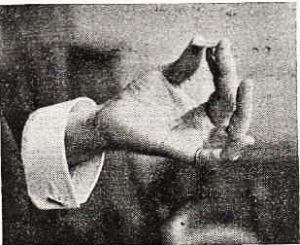
FIG. 8.
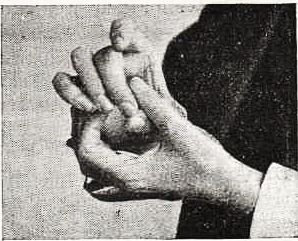
With the palm upward, hold the coin between the thumb and second finger of the left hand, the tip of the forefinger touching it from below, as in Fig. 7. Let the right thumb go under and the other fingers over it, as if taking it. If at the same time you withdraw the right forefinger and release the grasp of the thumb and second finger, the coin will fall into the left palm, as in Fig. 8. Close the right hand and hold it aloft, letting the left hand drop to the side or rest on the hip. The effect is exactly as if the coin had been taken away by the right hand.
The coin may be made to appear as if taken from the leg by merely dropping it to the tips of the left-hand fingers, which must then be laid on the spot it is desired to have it appear.
If, instead of a coin, a small ball is used, a very laughable effect may be produced by appearing to swallow it. To do this show the ball, throw it into the air once or twice, and at last palm it. Place the gathered-up tips of the fingers and thumb to the lips, and at that moment thrust the tongue into the left cheek, which will give it the appearance of having the ball there. Point to the cheek with the right forefinger; then let the right hand drop to the side, holding the ball palmed. To reproduce it lift the lower front of the vest with the left hand, and thrusting the right hand under, let the ball find its way to the finger-tips; leave it under the vest a second, and then withdraw it slowly.