THE HIDDEN TREASURE OF KING OBANI.
Reading edition
BY RICHARD BARRY.
This is the story of an American boy in far-off Africa. He was sixteen years of age—very near seventeen, in fact—at the time of this tale; but he had led such a strange life and had been in so many places that he had probably seen more of the world than many grown men who consider themselves great travellers.
The boy's name did not have an American sound; it was Malcolm McFee, and that is Scotch, as any one can tell at half a glance, and the only reason he was an American was because he happened to be born in the United States, on the slopes of the Sierra Nevada.
In his early youth Malcolm's father had been a sailor, and after that a soldier of the Queen in India, where, after serving bravely, and being wounded in one of the campaigns against the mountain tribes, he had taken it into his head to leave before his time was up, and start on the peculiar crusade which filled the next thirty years or so of his life, and which, at the end of that time found him in the far-away diamond and gold country of the dark continent.
One day Malcolm McFee was sitting in front of the little sheet-iron house in which he and his father lived off in the interior of one of the British Colonies in South Africa, when he saw the latter coming rapidly towards him with his arms swinging. Mr. McFee was a small wiry man, all thews and sinews. He had never abused himself in any way, and he could strike a trot and hold it open-mouthed all day like a dog. He was loping along through the dust, and Malcolm saw that he was evidently laboring under some excitement. Now his father was never despondent or cast down, but he was sometimes more enthusiastic than at others, that was all, and never had the boy seen his father so wrought up as at this very moment. He entered the house and closed the door behind him. Then, not even breathing hard from his running, he put both hands on Malcolm's shoulders, and exclaimed, "Laddie, laddie, but we are going to strike it rich!"
Now Malcolm had heard this before, so he waited for further developments. But the strange tale that was told him succeeded at last in arousing even his calmer nature.
A year previously the British government had conducted a campaign way to the northwest of the South African Dutch republic. They had humbled the little black native King and made him pay tribute, but the loot and treasure that they expected to find (for he had been reputed to be wealthy) were not forth-coming. This is the key to this story, and there is no use of going into the details of the conversation between Malcolm and his father. It is what they did that is interesting—and what took place afterwards.
That night an Englishman named Gifford, a tall, gaunt, fanatical-looking being, entered their hut. He was accompanied by a gray-headed, wizened negro, whose ribs and joints showed plainly beneath his shrivelled, dusty skin. A rather remarkable council was held—the Englishman translating as the negro talked.
"He says he knows exactly the place," Gifford said. "He saw them burying it, and after they had walked away from the spot old Obani had every one of the men who digged for him killed—heads chopped off, you know. That's the reason Tommy Atkins didn't find anything up there, eh? Listen, man! We can get it—gold and sparklers! old Grumpah here says—handfuls of them. Are you game, man, to try it? I tell you frankly why I come to you," Gifford continued. "I know you can be trusted, and we will need some money for the outfit. I say, old Juggins, come, are you with me?"
"How did you get such a hold over the old boy?" asked Mr. McFee, nodding towards the squatting black figure.
"That's a short story," answered the Englishman, laughing. "I have had my eye on him for a long time. He let something slip once, and I tell you, man, I worked with my hands to keep that old nig in idleness—for three years I've worked for him. I arranged it so that he thinks I saved his life, too; and that was easy. And now the point—will you join me?"
This question was superfluous, as any one who had known Malcolm's father would have testified.
Three weeks later two large ox-carts, with four blacks to drive them, and three white men—at least two white men and a boy—were treaking across the flat plains, equipped apparently for a hunting excursion into the game-abounding country where beasts with strange horns and names are found in plenty, and where the lion's roar often breaks the stillness of the night.
Privation and hardship, death and disease they faced, and at last, a month later, with only one wagon left, and the loss of one of the negro drivers (by drowning at a river ford) they arrived at the great fertile border-land that edges the deep forest of the outermost possessions of King Obani, chief of the Bangwalis. Here they rested for a week, regaining strength, for they had made the trip in the unhealthy season of the year. They had traded their way peaceably, so far, with what natives they had met, and had encountered no hostile resistance. But the hardest work was yet to come.
Leaving the cattle in charge of one of the natives in a little hidden valley, the four men and Malcolm entered the shadows of the forest. For ten days they struggled on, cutting their way slowly through the massive undergrowth. Each one was laden down with a heavy pack, pickaxes, and long-handled shovels, not forgetting a few coils of rope, and iron bolts which came in handy afterwards. Besides, the three white men (I can speak of Malcolm as a man) carried rifles and well-filled cartridge-boxes.
On the tenth day old Grumpah, who was leading, stopped and made a strange clucking sound, the sound that the African used universally to attract attention. He pointed with his long bony arm. Half hidden by the vines and weeds lay a white rain-washed skeleton, and only a few feet away lay another. They counted thirty of them in all. It was here that the sharers of King Obani's secret had been put past the revealing of it. Grumpah was talking excitedly now, using long words, but Malcolm had picked up a little of the language, and he caught the gist of it even before Gifford turned and spoke.
"Old 'Grumpah' says it is only five miles further on," he whispered.
For some time they had been following quite a distinct path, and now it was better going. In a little over an hour, Gifford, who had forged ahead, uttered a shout that startled some great billed birds squawking out of the tree-tops.
"By George," the Englishman exclaimed, "the old fellow has not lied! Here is the place."
It was evident that a clearing had been made, and at the foot of a great white-trunked tree a mound could be seen covered and grown with underbrush, but hanging from the branch of a tall bush was a strange object. It was an ordinary gin bottle with a label blown into the glass, and on another branch hung a dinner-bell with the clapper removed. Gifford struck the bell with the point of his rifle—it tinkled musically in the silence, and he said, "Come in," jocosely. Mr. McFee's eyes, however, were shining like coals; he removed his coat and laid about him with an axe, cutting away the shrubbery and clearing up the ground. Evidently the mound had been made by hands—no mistaking that.
"Ask him how deep it is," Mr. McFee said, eagerly, driving the point of a pickaxe into the earth.
"The depth of four men!" returned Gifford—"less than thirty feet. How long will it take us?"
McFee looked about him.
"Four days at the most," he said, "if it is easy digging. But now let us go at it right and dig it well fashion. We must make a windlass."
Even before dark—and it grows dark very suddenly in the African forest—a rough winch had been constructed from the trunk of a tree; with the aid of the iron bolts it was strongly held together, and handles were placed on each end, so they could be worked the way a bucket is lowered and raised in a mine shaft. By noon the next day all this was completed and the digging fairly commenced. When they had gone down some ten feet or more, and it became difficult to throw up the spadefuls of the black rich earth, the windlass was placed in position, a basket constructed with the aid of twigs and vines, and the two negroes were set to work hauling the earth to the surface as the white men below filled the improvised carrier. Malcolm's back ached from the constant bending and lifting, but his father labored as might a fireman in a burning house, and Gifford, stripped to the waist and dripping with perspiration like a stoker, delved with the strength of two men. Twenty feet, twenty-five feet, thirty feet were reached, and the only encouraging thing about it was that there were signs that the earth had been disturbed before them.
At noon of the third day they had all gone to the surface except Sandy McFee, when the latter gave utterance to a shout from the shaft,
"Here's something," he called; "look out!"
A shining object thrown from his hand sailed up from out the shaft. It was another gin bottle. (Alas! the mark of on-sweeping civilization.)
It struck against the handle of the windlass and shivered into a hundred sparkling bits. One of them fell at Malcolm's feet.
"Look out, McFee, you idiot!" cried Gifford, springing up. "You came near braining us."
"I have struck a layer of tree trunks," came the answer from below. "The treasure must be underneath."
But Malcolm was sitting there gazing at something that he held between his thumb and forefinger.
"What's the matter, lad?" asked Gifford, turning.
Malcolm handed the shining thing up to him.
"Diamonds!" exclaimed the older man, with a gasp; "the bottle was filled with 'em!"
Most of its contents had fallen back into the shaft. Gifford slipped the stone into his mouth and made a spring for the rope. He slid down it sailor fashion, and one of the blacks followed him. Malcolm hastened to the edge. There they were, on their hands and knees, searching the loose earth, beneath which showed clearly the heavy beams that protected the rest of King Obani's treasure.
They were picking things up, objects to right and left, as children do scattered sugar-plums.
Malcolm had about made up his mind to go down also, when suddenly he heard a weird call off in the woods. It reminded him of the "coo-ee" of the Australian bushmen. It was evidently the sound of a human voice. Another answered it. The black man who had staid on the surface with old Grumpah and himself gave a startled look around, and without a word put off into the woods.
"Some one is coming," shouted Malcolm down the shaft.
Again the call was heard. This time those below heard it also.
"Hurry up! get us out!" shouted Gifford. "It's the Bangwalis. I know the cry."
Hurriedly he emptied the earth out of the basket, and, with Mr. McFee, stepped inside, holding fast to the rope. Malcolm took one handle and Grumpah the other. Slowly they turned the windlass that was supporting more than its usual weight. They had raised it perhaps ten feet or so when there was a sharp crack, and old Grumpah gave a groan. The handle on his side had broken. The old man, who had been straining forward with all his strength, slipped his footing and plunged headlong into the pit.
The weight now was more than Malcolm's arms could stand, and do his best he could not help the windlass slipping from his grasp. Down went the basket.
"Are you hurt?" he shouted.
"Steady, Mal, my boy," came his father's voice in reply. "Keep cool. Now try again. One at a time!"
Malcolm put forth all the might of his strong young back, and slowly the bucket came to the surface, this time with his father alone.
"The old nig broke his neck," were the first words he said. "Come, get the others out."
McFEE AND MALCOLM GRASPED THE WINCH HANDLE.
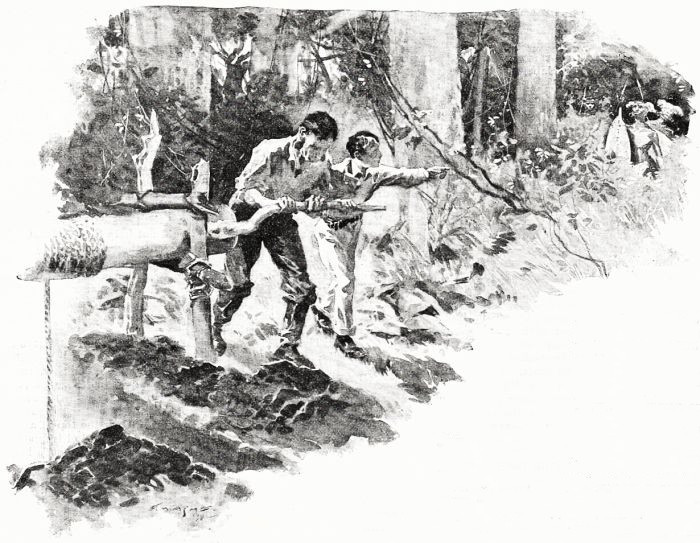
At this moment, nearer than before, sounded the strange cry. McFee grasped the winch handle with his son, and they had wound Gifford nearly to the top, when Malcolm heard a noise and looked up. Not thirty feet away, parting the bushes, stood a strange figure. Over the top of a long shield peered an excited black face, and behind it another. The gleam of a broad spear-head and the tossing of a headdress farther back showed that there were more to come.
So paralyzed were the natives by astonishment at what they saw that they stood there for a moment like ebony statues. McFee saw his opportunity.
"Pull hard, boy," he said. "This affair has gone past treating;" and he stooped quickly and picked up the Martini rifle from the ground. The shot rang out at once, and the nearest two figures lunged forward, for the ball had passed through both of them.
Gifford was now swarming up the rope faster than Malcolm could raise the bucket. A wild cry rang through the woods, but dismayed by the death of the foremost two, the rest of the Bangwalis had taken to their heels.
"Get your guns," cried Gifford. "We must make for the high ground down the path."
The black man down at the bottom of the pit set up a piteous howl.
"We can't leave him," cried Malcolm, letting the bucket go by the run.
The negro seized the rope and came up it like a monkey, leaving the body of poor old Grumpah where he fell. All four now struck off through the woods to the northward. The cries and the pounding of a tomtom were heard from the south, and then a wild scream, as it was evident the blacks had determined on a charge across the open.
"They'll be on us in about five minutes," panted Gifford, looking back over his shoulder. "What in the world are we to do? We must leave the path."
They crushed their way through the thickets a dozen yards or so, each man fighting as if the leaves would drown him, when Malcolm pointed with his finger. There, towering straight up to the sky, was the trunk of a huge tree. At the roots was a small opening, large enough to all appearances for a man to squeeze his way in. No sooner had he seen it than the black darted toward it on hands and knees like a rabbit, and before the others could tell what he was going to do, nothing but his heels were to be seen. Gifford turned and reached up overhead. With the stroke of his knife he clipped off the top of one of the overhanging bushes.
"In with you!" he cried—"in with you! That tree trunk is nothing but a chimney. It will hold us all."
Malcolm and his father and lastly the lanky Englishman crawled into the damp-smelling interior, and Gifford pulled the ends of the branch in after him, so that the spreading leaves would hide the opening. Now the cries sounded all about. On the path not forty feet away a crowd of natives went by on the rush, the ornaments on their knees jingling as they ran. Crouching in the crowded space the fugitives waited breathlessly. They heard more cries, and once some one had passed through the bushes so close to them that they could hear the swishing of the leaves. It had grown so dark that perhaps their footprints could not be seen; their hiding-place was not discovered.
Now a consultation was held.
"I wish old Grumpah was here," said Clifford. "He knows the country."
The black whose teeth were chattering was mumbling something.
"What's that?" asked Gifford, turning to him.
"Ribber not far off," the man replied.
Gifford spoke to him in his own language, and then he addressed the others in a whisper.
"This boy was a slave to the Bangwalis," he said. "He tells me there is a stream to the northward. We might make it and find a canoe at the banks. It's our only chance for life."
"Will we have to leave the treasure behind?" asked Mr. McFee, hoarsely.
"Confound the treasure!" responded Gifford. "It may be the death of us yet. We have enough white stones to make us rich."
It was midnight, judging as well as they could, when they crawled from their hiding-place, and there was nothing for it but to take the path again and go cautiously, as it was impossible in the darkness to travel through the forest. But after following the path for half an hour it lightened suddenly, and they perceived that it was only the thick foliage that had kept the moonlight from reaching them. A few rods further on they went, and a broad stream lay spread before them. On the opposite shore lights could be seen, and the sound of wailing voices and the beating of drums proclaimed the fact that some negro rite was there in progress. The black man pointed with his finger, and Gifford held up his hand as an order to halt.
"King Obani, he home," said the negro boy, nodding across the river. "Three year ago English too 'm. No find gold."
"I know where I am now," whispered Gifford, excitedly. "This river is the Mmymbi; that is Obani's chief town. Willoughby and the rangers took it three years ago, and were fooled in getting the loot, don't you remember. Eh? the idiots!"
"Well, what are we to do?" asked Mr. McFee.
"Thirty-five miles below is an English trading-station," Gifford said, eagerly. "We must get a boat of some kind."
Tho black had waded knee-deep into the stream. He bent over with his face close to the water, and then struck out silently.
"Come back here, you black rascal," hissed Gifford, raising his rifle.
But the boy's reply caused him to lower it.
"He says there's a boat tied to the branches of yonder tree," he murmured.
Now by bending over all could see it plainly. The negro slid over the side, and soon came back paddling it silently along the shore; the others crawled in, and now, keeping well in the deep shadow of the trees, they drifted down the stream; the cries and lights of the Bangwali village grew fainter and fainter in the distance. When around the bend of the river Gifford picked up a paddle, and they struck out at full speed. Three hours' paddling and they were beyond King Obani's jurisdiction, and by daylight they saw the clearing of the English trader.
For some reason they chose not to tell their story, and the next morning as they sat at breakfast a canoe shot down the stream. Some natives landed.
"Hullo, here's news," said the trader's clerk as he approached the house after meeting the native boat. "King Obani is dead."
"Then the mystery of his treasure dies with him," said the trader, for the story was well known.
"Humph," observed Gifford, lighting his pipe.
"Mal, my boy, we'll return for the rest of it some day," whispered Mr. McFee.
But he never did. Adventure seemed to be killed within him, and he and Malcolm composed the firm McFee & Son, general merchants, at K——. And here is where the story comes from.