BLIND-MAN'S-BUFF AT SEA.
Reading edition
PROBLEMS OF NAVIGATING IN THICK WEATHER.
BY W. J. HENDERSON.
"What do you think about the weather?"
That was the question which Captain Jason Argo asked his first officer as they stood on the bridge together. The great black hull of the steamer Golden Fleece, driven by the powerful quadruple-expansion engines, was cleaving its way westward at a flying gait of nineteen knots an hour. There was a thundering hill of foam under her bows, and a massive cloud of oily brown smoke went rushing sternward from her two big funnels. She had encountered only one bit of fresh weather since leaving Queenstown, for it was hardly time yet for heavy gales. But now the sky had become overcast with a thin haze of clouds, which obscured the sun completely.
"I'm afraid," answered the first officer, "that we're in for a settled spell of cloudy weather and fog."
"And I'm morally certain that you're right," said the Captain, with a serious face, as he thought of what was before him.
When the celestial bodies—the sun, moon, and stars—cannot be seen, then begins grave trouble for the navigator. As long as these are visible, by observing their altitudes above the horizon with the sextant—an instrument designed for that purpose—and by some simple astronomical calculations, he can ascertain the latitude and longitude of his ship, and thus know just where he is and which way to steer in order to reach his port. But the moment he loses the heavenly bodies he must feel his way into port by "dead reckoning," which consists of measuring the actual distance sailed by means of the log-line, and of ascertaining the direction by the compass. It is a method subject to errors of many kinds, caused by incorrect registering of the log, by deviation of the compass, and by currents. It is like trying to walk through a room in the dark by counting the number of your steps. So it was not remarkable that Captain Jason Argo looked grave.
"At noon to-day we made our position 47° west longitude and 46° 30' north latitude," said the Captain, reflectively.
"Yes, sir," answered the first officer.
"As we are steering, that should have made us seventy-five miles from the easterly edge of the Newfoundland Banks."
"To a dot, sir."
"And it is now three o'clock. What does the patent log show?"
"It is registering nineteen and three-quarter knots an hour."
The patent log is an instrument for recording the distance sailed by the ship. It consists of a dial on the outside of a case, inside of which are wheels to turn the hands. Attached to the machinery is a long line, at the end of which is a rotator shaped somewhat like a ship's propeller. This rotator drags through the sea, and makes a certain number of revolutions every mile, twisting the line, and thus turning the hands on the dial, where the number of knots is marked.
"It's a new log, isn't it?"
"Yes, sir; I received it at Queenstown."
"Good. What is its percentage of error?"
"Two per cent."
Patent logs usually overrate the distance run, and the percentage of error has to be ascertained.
"It's running fully two per cent. now, I fancy," said the Captain, stepping to the speaking-tube that ran to the engine-room and calling for the chief engineer.
"Hello, Mr. Bargot! How many revolutions are you making a minute?"
A jumble of figures returned through the tube.
"And that's nineteen knots, isn't it?" said the Captain. "Good."
The speed of vessels can be tolerably well calculated from the number of revolutions of the screw.
"Now," said the Captain, turning to the third officer, who was also on the bridge, "what was the last record of the chip log?"
"Twenty knots, sir."
"Common log is not much good at high speeds," commented the Captain.
The common log consists of a triangular wooden float, a line marked with knots at equal distances apart, and a reel. The float is thrown overboard, and the line allowed to run off the reel for a certain number of seconds. The proportions of the distances between knots are such that the number of them run off in the given time is the number of miles an hour which the vessel is making.
"We shall be safe in saying that we are doing an even nineteen knots," said the Captain. "We ought to strike the easterly edge of the Newfoundland Banks a little before four o'clock, in longitude 48° 30' west and latitude 45° 40' north, and we ought to get a sounding there of fifty-four to fifty-eight fathoms. Mr. Parker, you will get the sounding-machine ready to take a cast at five minutes of four o'clock."
"Ay, ay, sir," answered the third officer.
The sounding-machine consists of a heavy lead on the end of a very long piano-wire wound round a cylinder. With this a sounding can be taken while a vessel is going ahead at the rate of twelve or fifteen knots, while with an old-fashioned deep-sea lead line it is necessary to stop. An indicator on the side of the sounding-machine shows how many fathoms of wire are out, and there is a crank for winding it in.
At five minutes of four the third officer took the sounding, and reported a depth of fifty-five fathoms.
"Good," said the Captain, who was now in his room consulting the chart. "So far we know exactly where we are. We shall keep our present course. You will take another sounding at seven o'clock, when we should be fifty-seven miles west sou'west of this, and you should get thirty-three fathoms. How's the weather?"
"Looks like fog before morning, sir."
"Hum!" muttered Captain Jason Argo, through his clinched teeth, "I shall hold our present course at least till we clear the Banks. It's 150 miles across, as we are going, and I wish soundings taken every two hours till we are across, which will be in eight hours. You will pass the word to call me when the last sounding is to be taken."
The third officer returned to the deck. At seven o'clock he made the sounding, as directed, and got a depth of thirty-two fathoms, which tallied closely enough with the Captain's calculations to show that they were correct. Steadily the Golden Fleece ploughed her way westward across the comparatively shallow waters of the Grand Banks, and at midnight, the Captain having been called, the last cast of the lead showed eighty fathoms.
"Good," said the Captain, turning his face against the damp rush of the heavy mist; "we shall run into 1500 fathoms now, and into the northerly limit of the Gulf Stream. On the whole, I think we'd better give our course an eighth more southing, and hold it at that till noon. Keep a bright lookout ahead, and keep your weather eye on the sky. If it breaks away, look sharp, and get the deviation from the first star that shows. I think we're in for a lot of thick weather."
The Captain went below and turned in, "all standing." All through the dreary night his sleep was broken by the hoarse blasts of the fog-siren and the half-hourly cries of the lookouts. He wondered whether the current of the Gulf Stream was setting true, or had perhaps been deflected by some now dead wind of which he could not possibly know anything. He had a sailor's dread of an unknown current. If he had been on soundings the trusty lead would have told him where he was, but no machine could plumb the depths now under the Golden Fleece's keel. At six o'clock the Captain went on the bridge again. The fog had disappeared, but the sky was still overcast.
"Hum!" he muttered; "it's enough to make a man give up the sea and go to farming."
Toward half past nine there were signs that the clouds were about to break, and the officers on the bridge made ready to "shoot the sun," as taking an observation is called, at the first opportunity. Presently there was a rift of blue sky, and in a few minutes the gorgeous sun broke through. The officers made their observation, but as they were still uncertain of their latitude, they could do nothing with it. At noon they were able to ascertain the latitude, and then they figured out the ship's position.
"How does our dead reckoning compare with our position by observation?" asked Captain Jason Argo.
"By dead reckoning we have made a run of 456 miles in the twenty-four hours," answered the first officer, "and our noon position was latitude 43° 34' north, longitude 54° west. By observation our position is latitude 43° 30' north, longitude 53° 54' west."
"Excellent," exclaimed the Captain; "that's close work, and shows that my current allowance was about as near right as possible. Now I wish to hit the easterly edge of George's Bank, which is in longitude 66° west, in latitude 41° 20' north. When we make that point, I'll show you my reason for doing that."
The Captain now gave out the course as south 76° west, true, and the distance to the point indicated as 540 miles. The course had to be corrected for variation and deviation of the compass before it could be given to the man at the wheel, and the greatest care was exercised in making the calculations.
"If we keep going at nineteen knots," said the Captain, "we'll strike that eastern edge in twenty-eight hours and three-quarters, or at a quarter of five to-morrow afternoon. Whether the weather is clear or thick, at that hour I want a sounding. We ought to get about fifty-five fathoms."
IT BEGAN TO BLOW BRISKLY FROM THE NORTHEAST.
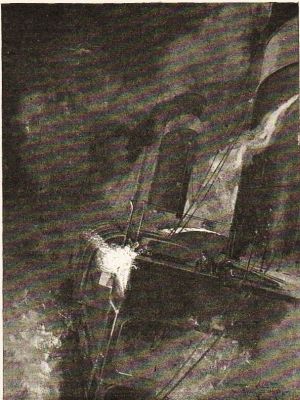
The Golden Fleece continued her westerly flight, but the weather did not remain clear. Before noon the following day it had clouded over, and had begun to blow briskly from the northeast.
"Now," said the Captain to himself, "I shall have that much discussed southerly and westerly current to look out for."
But among the passengers the Captain appeared to be so easy in his mind that they thought he had very little to think about. Yet he ordered the sounding to be made at 4.30, and had the ship slowed down to half speed. No bottom was got at 300 fathoms; but fifteen minutes later the lead struck at fifty-eight fathoms. The course was now altered two degrees more to the westward.
"I steer now," said the Captain, "for longitude 68° west, latitude 41° north. That is the westerly edge of the southern extremity of this bank, and there we should get thirty fathoms. The distance is 240 miles, and as we are now doing about twenty knots an hour, we ought to be there in twelve hours, or at 4.45 in the morning."
Not a star peeped out in the course of the night, and the Captain, running wholly by dead reckoning, was an anxious man. Toward morning he had the lead hove every half-hour, and his wisdom was shown by the result of the soundings, which proved that the Golden Fleece had over-run her reckoning by eight miles—quite enough to cause disaster if near land, or dangerous shoals. The latter was the case, for the Nautucket Shoals were not far away. The weather continued to be thick and "dirty," and Captain Jason Argo was constantly on the alert. There were dangerous shallows ahead of him and uncertain currents under him, and he knew that it was his duty to get the Golden Fleece to port as quickly as possible. But no amount of speed would atone for running the vessel on the Long Island or New Jersey shore, now hourly drawing nearer behind the impenetrable mist. Speed was reduced to fifteen knots, and the lead was hove every hour.
"I am steering now," said the Captain, "to cross the meridian of 70° west in latitude 40° 40' north. But to do that I must pass about six miles south of the South Shoal Light-ship, which is in latitude 40° 46' north, and longitude 69° 56' west. I don't need to see that vessel or hear her fog signal, because the soundings south of her will give me my latitude to a minute, and my longitude almost as well."
"Yes, sir," said the first officer, who had heard something like this before.
"All the same," said the Captain, "I'm not in love with this business of running in with the land in thick weather, and when we are half a dozen miles this side of that light-ship I want the lead down every fifteen minutes."
"Ay, ay, sir."
The navigation of the ship now became a business requiring the utmost caution. Owing to the invisibility of the heavenly bodies it was impossible to ascertain the precise amount of error in the compass. The treacherous Nantucket Shoals, with their changeful currents, were close at hand. The Captain had his chart spread before him, and on it he was tracing the course of the ship as shown by the soundings. She would run twelve miles, and the chart would show that she ought then to be in thirty-four fathoms. The sounding-machine would give the depth. If it was less than thirty-four fathoms, she was north of her apparent course; if more, she was south. She was literally feeling her way. It was nearly 6 p.m., and a fine misty rain narrowed the horizon down to a small circle of two miles in diameter. The Golden Fleece was slowed down to eight knots, and soundings were taken every fifteen minutes. Suddenly the dull blast of a steam-whistle was heard far off the starboard bow. The first officer hastily drew out his watch and counted the seconds. Nearly half a minute passed, and then came another blast, three times as long as the first.
"The light-ship," said the first officer.
"Yes," said the Captain, who had mounted the bridge at the first sound. "We are fully two miles further north than I thought; too much current allowance, I guess. However, I shall now steer to pass eight miles due south of Shinnecock Light, at a point 40° 43' north and 72° 30' west. The course is west, true, and the distance 113 miles; but we must make some allowance for current—not much, though, with this wind. It's ebb-tide, and it will hardly be likely now to set toward the beach, as it often does."
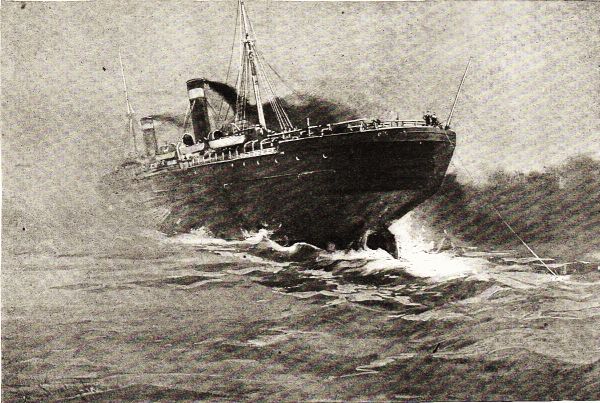
"HARD A PORT! HARD OVER!"
The Captain made some more calculations, and then gave out the compass course. The speed of the ship was increased to twelve knots, and the deep-sea sounding-machine was used once an hour all night. At four o'clock in the morning the rain had ceased, and another dense fog had set in. The soundings indicated that a point about eight or nine miles due south of Shinnecock Light had been reached. The Captain now gave out the course as west, and the distance as sixty-two miles; but he was very uncertain as to the deviation of the compass, so he ordered speed reduced to ten knots, while the lead was to be cast every half-hour. A fresh northeasterly wind sprang up, raising a choppy sea, and transforming the fog into a driving mist. The soundings ran very irregularly, the lead showing 18, 17½, 20, 22, and 19 fathoms without any apparent guidance. The Captain walked the bridge anxiously. The soundings began to run 18, 17½, 17, 17, 16½, 16, 15, 14, 13½, 13, 14, and 13 fathoms.
"Too far to the south, as sure as I live!" muttered the Captain. "How did we do it? But we're sure to make one of the holes." And then he added aloud, "Slow down to six knots."
Suddenly the officer at the sounding-machine away aft sung out, "Twenty-one fathoms, sir!"
"Right slap into the twenty-one-fathom hole, and heading straight for Monmouth Beach, as I live!" growled Captain Jason Argo, and he sharply ordered the helmsman, "Hard a port! Hard over!"
The Golden Fleece swung her black prow northward through the fog, and when it pointed due north by compass the Captain told the helmsman to keep it so.
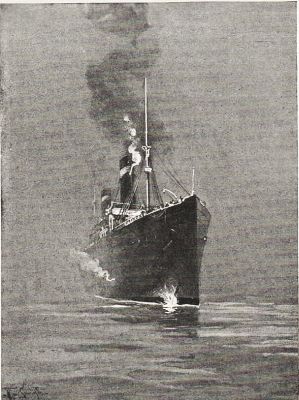
HE ORDERED THE VESSEL STOPPED AND LET GO THE ANCHOR.
"We'll be up with the Sandy Hook Light-ship soon," he said; "we fell about seven miles to the south of it. Keep the lead going. That's my motto—log, lead, and lookout in thick weather. If we hadn't kept up our soundings we'd have gone on the Jersey shore. Get the port anchor ready."
A little over an hour later the lookout forward reported the Sandy Hook Light-ship close to the starboard bow.
"Hard a starboard!" said the Captain; and as the ship swung round and the light-ship faded away into the mist again, he ordered the vessel to be stopped and let go the anchor. The fog-whistle ceased to blow, and the bell took its place as a warning. The Captain went down off the bridge, and made his appearance at the luncheon-table.
"Captain Argo," said an impatient old lady, "I'd like to know why we are anchored here in a fog out in the middle of the ocean. I've paid to be taken to New York, and I don't wish to stop here."
"My dear madam," replied the Captain, "up on the coast of Maine the steamboat captains run in fogs from point to point among the islands by timing their craft and then listening for the echo of the whistle from the rocks. And there was once a schooner captain who went from Cape Ann to Quarantine in New York Bay in a fog without seeing a single thing, steering from one whistling-buoy or fog-horn to another. Now I'm only a plain sea navigator, and having brought my ship safely from the other side of the Grand Banks to this side of Sandy Hook Light-ship with only one observation, feeling my way the rest of the time with the lead, I'm satisfied now to come to anchor, wait till the fog lifts, and then let a pilot see whether he can get me up the Lower Bay in clear weather without running me aground."