THE PROPER USE OF A SHOT-GUN.
Reading edition
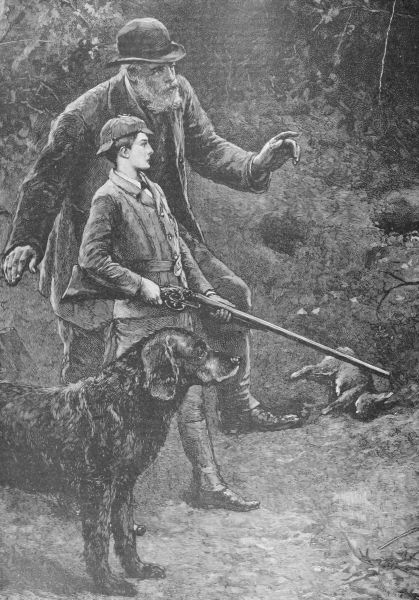
Though shooting, like many other sports, can be a very dangerous amusement for boys—and men, too, for that matter—there is no reason why boys as well as men should not learn how to use a gun, and get much amusement and benefit out of hunting. It is all a question of learning what the dangers of gunning are, and learning how to avoid them. Fire is a dangerous thing in its way, and yet we all have fires. Gunning is no more dangerous, if carefully taken up, and a boy of fifteen or sixteen is quite old enough to learn what the dangers of a shot-gun are, to respect them and avoid them. Naturally any parent, especially one who knows nothing about rifles or shot-guns himself, is very chary about letting his son go off alone with one on his shoulder, and it is quite as natural for his mother to think she has seen the last of her boy as he disappears in the woods on his first sporting expedition. But there is really no other reason for this than that boys are naturally careless, and guns can be dangerous and deadly if treated in a careless manner.
The whole secret of shooting and the use of fire-arms can be stated in a few words: Never, under any circumstances, point a gun at any one, whether loaded or not, whither in pieces or ready for use. If it is never pointed at any one, it cannot very well kill or wound any one. In like manner you can never succeed in shooting yourself unless you have already pointed the muzzle at yourself. I have seen many a crack shot and old-time sportsman shudder as he saw a green hand hold up the detached barrel of a shot-gun while cleaning it, and point it at some one. Of course the two steel barrels could not possibly "go off" by themselves, with no butt and no cartridges, and the sportsman shudders only because he dreads the greenhorn who, even under such circumstances, allows himself to get into the habit of putting up the muzzles in such a position. If he does it at home while cleaning the barrels, he may do it out in the woods some day when the barrel is attached to the stock, and perhaps loaded with cartridges, and then there may really be danger for any one who is near by.
The only accidents that can occur if the muzzle is never pointed at any one are, first, the bursting of the gun itself, which is unlikely, unless the piece is badly made, cheap, or very old; and secondly, the presence of some one in the woods who is not within the cognizance of the sportsman. As I say, the first is uncommon nowadays with the carefully made breech-loading guns. The second never occurs if the sportsman invariably keeps his muzzle pointed toward the earth, about five feet or less in advance of him, and if, when he does fire, he makes sure what he is firing at and where his shot is likely to go after firing.
A good sportsman is familiar with his piece, and brave enough to be afraid of it. From the time he takes it out of the case the muzzle of the barrels is on his mind until he has taken it to pieces, cleaned it, and put it away in his case. When he starts out in the morning, he takes out the barrels, and pointing them towards the earth as he holds them in his left hand, he springs the stock into its place with his right. Then having fixed on the little piece of wood which clinches the two parts together, he passes his right arm around the barrels, so that as he carries it the stock points up and behind him at an angle of about forty-five degrees, and the barrels point down toward the earth at a similar angle in front of him. Around his waist or in his pockets he carries cartridges. No charge goes into his gun until he has not only left the house but actually arrived on the grounds where he expects to find game. If he has to drive to the proper woods or the shooting-stands or blinds, he places the piece in the bottom of the wagon, pointing out towards the rear, never once allowing it to point towards himself or any one else who may be standing by. If he is near enough to the woods or shore to walk he carries the gun as described, unloaded, until he reaches the proper place. When climbing over fences, whether with cartridges in place or not, he places the gun under the fence flat on the ground, climbs over or under, and then picks it up from the other side. Resting a shooting-piece against a fence or wall in an upright position shows the greenhorn or the careless and therefore poor sportsman. The fence may be rickety, or the stones on the wall easily detached. In either case it only takes a little jarring to cause the shot-gun to slide one way or the other and fall to the ground, and in doing so it may very easily go off. If it is unloaded this would, of course, do no harm. But if it is never allowed to get into the position where it may so slide, it certainly can never go off, loaded or unloaded. In other words, form the habit of never giving a gun the chance of sliding or going off, and then you can never have an accident. This is not a sign of timidity, and you would soon realize it if you could see how carefully some famous old sportsman who is a friend of your father's handles his firing-piece.
On arriving finally at the particular woods you have planned to cover, or the "blinds" which you are going to lie in, put in the charges, and then all is ready for the sport.
Most of the danger after this stage of the proceedings has been reached is again only through carelessness or excitement over the sport, which is only another word for carelessness. For example, you are in the woods and a bird flies out among the branches. In your excitement at the sudden flush of the partridge you throw up your gun and "blaze away," forgetting that the other man with you is just ahead. That is rank carelessness. For no two sportsmen ever lose track of each other. If they happen to be out of sight of each other, and within range, they keep up a constant conversation, or call to each other continually, so that from moment to moment each knows where the other is. Again, when two men are standing close beside each other and a covey jumps up under their guns, there has to be a quick swing to right or left. Usually, under these circumstances, the man on the right takes the right-hand shot, and the one on the left takes the left-hand shot. If the right-hand man swings to the left he may very easily bring his friend in the line of his muzzle.
As regards the half and full cock of the hammers, there is one safe rule to follow. When on the actual ground, and following dogs on the scent or pointing, the gun must, of course, be at full cock. But whenever a fence is to be climbed, or a bad bit of close underbrush broken through, the hammers should be dropped carefully to half cock, or, if the gun is hammerless, the half-cock trigger should be sprung.
In all this the important point is that every man or boy, while carrying a shooting-piece, should have his mind on what he is doing, and should never for a moment lose his head. It is far better to lose a shot than to hit a friend or take the slightest chance of hitting him. On the other hand, if a boy thinks the matter over and follows out these rules, there is not the least danger in his owning and using a shot-gun, and the amount of exercise to both brain and body which he can get out of it is astonishing. When you begin you need your father's advice as to the proper way of holding the gun, taking aim, and bringing down the game. But after that nothing is necessary but your own coolness, presence of mind, and care.
The butt should come up quickly and firmly to the shoulder, resting against the shoulder itself rather than the biceps or top of the arm, and you should acquire the habit, which can only come with practice, of getting it up quickly, steadily, and firmly the first time in the right place. Otherwise the "kicking" may be severe and painful. The aim should be taken with both eyes open, though the right eye does the aiming. The objection to sighting with the left eye closed is that the operation of closing the left-eye always half closes the right, and hence makes your sight a little less distinct and somewhat unnatural. This sighting with both eyes open is a little bewildering at first, but it soon becomes natural, and the whole operation then becomes a kind of second nature. For quick wood shots, the left hand should hold the barrels some distance out towards the muzzle, the left arm being almost extended to its full length, while the right arm is bent up short, the right elbow stuck out in a nearly horizontal position to the cheek hugging the stock. At the same time stand firmly on the feet, and do not, as many older and supposedly better sometimes do, bend the knees just as you fire.
WHEN YOU FIRST BEGIN, YOU NEED YOUR FATHER'S ADVICE

The squabble which has disgraced the close of the New York Interscholastic baseball season was as undignified as it was unnecessary, and it has surely brought no credit to the Harvard School or to any of its athletic authorities. Knowing, as it seems they all did, that Ehrich was absolutely and unequivocally disqualified from competing in sports held under the rules of the N.Y.I.S.A.A., he was nevertheless put in to catch in the most important game of the season. Zizinia, the captain of the Harvard team, had been advised to substitute Dillenback if Ehrich was protested on the field, but for some unexplained reason, when De La Salle did protest him, he was nevertheless allowed to play. This was a bit of gross misjudgment, to say the least, and has resulted in Harvard losing the pennant, which might have been won with Dillenback behind the bat. By pursuing this course, Harvard School not only allowed an inferior team to represent the N.Y.I.S.B.B. League at Eastern Park on June 8th, thus doing an injustice to the entire association, but made itself liable to expulsion and disgrace, which will probably only be avoided because of the personal friendship of the League delegates for the Harvard representatives. As for the unsportsmanlike spirit of the whole performance, perhaps the less said about it the better.
The De La Salle nine is, no doubt, inferior both in fielding and batting qualities to the Harvard team, but I do not believe that the latter would have made a much better showing against the strong men from Garden City had they met them. These are baseball-players, and no mistake; and they worked just as hard all through the game with De La Salle as if they were not having a "merry-go-round," as their rooters constantly exclaimed. It certainly was a merry-go-round, and all the mirth was on the St. Paul side of the fence, for a poorer exhibition of baseball-playing has doubtless seldom been seen at Eastern Park than the game put up by the representatives of the New York Association. The out-fielders could not judge the easiest of flies, and dropped almost every ball that they did manage to get their hands on, and the in-fielders were not much better. To any one who saw the game, or who was acquainted with the record of the St. Paul nine, it was not surprising that the Garden City players piled up thirty-five runs to their opponents' one, or that they made twenty-six base hits, with six home runs.
Baker, Howard, Foster, Henderson, Goldsborough Robinson, Hill. 3d b. sub. 2d b. coach. r.f. sub. sub. Hall, p. Lum, l.f. and capt. S. M. Starr, c. E. Starr, 1st b. Mortimer, s.s. Flippen, c.f. ST. PAUL'S, GARDEN CITY, BASEBALL NINE. Winners of the Inter-City Championship, Eastern Park, Brooklyn, June 8, 1895.
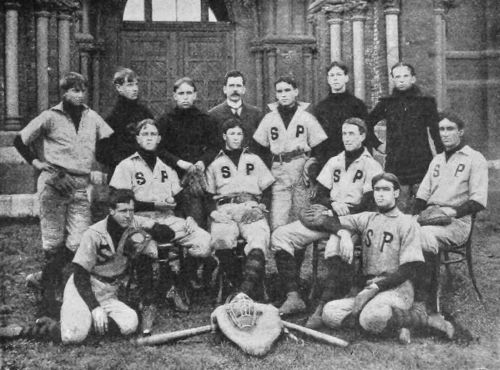
The St. Paul nine have played thirteen games this season, and have not suffered a single defeat. They have scored 179 runs to their opponents' 51; they have made 192 hits to their opponents' 69; and they have committed only 54 errors to their opponents' 84. Their batting and fielding averages reckon up as follows:
Batting.Fielding.
Hall, p..407.915
S. Starr, c..371.937
E. Starr, 1 b..393.948
Foster, 2 b..375.893
Baker, 3 b..375.714
Mortimer, s. s..333.709
Lum, l. f..360.923
Flippen, c. f..339.813
Goldsborough, r. f..378.900
It is evident from the above that St. Paul had a hard-hitting team, and I have no doubt the fielding averages—especially of Baker, Flippen, and Foster—would have been higher if the men had tried to make records rather than to accept every chance that came their way. Hall's pitching throughout the season has been up to a high standard, and his fielding has been excellent. In one game he had thirteen fielding chances, which he accepted without making an error. Foster, too, has done well, and has spoiled many an apparent base hit. Next year the managers of this nine should seek games with stronger teams than can be found in either the New York or the Long Island leagues. I should like to see them play Andover or Lawrenceville. The latter claim they cannot find opponents worthy of them outside the colleges. Perhaps Garden City can give them good practice.
OAKLAND HIGH-SCHOOL ATHLETIC TEAM, Champions of the Academic Athletic League of the Pacific Coast.
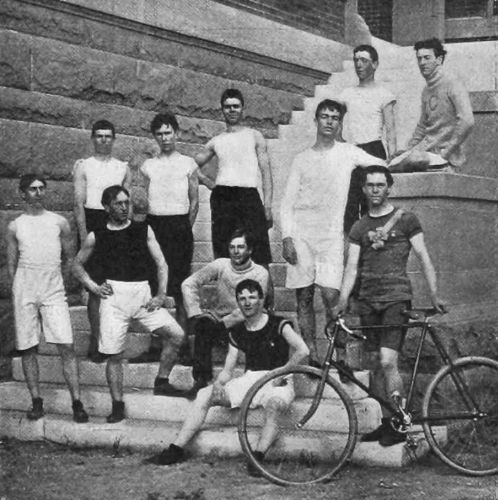
The men shown in the picture of the Oakland High-School Athletic Team are Cheek, Jackson, Jenks, Gooch, Hoffman, Guppy, Russ, McConnell, Hanford, Rosborough, and Dawson. They won the championship of the A.A.L. for the O.H.-S. at the last two field meetings—March 16th and May 4th—and most of them return to school next year. W. B. Jackson, the mile runner, enters the University of California this fall, and if that enterprising college sends a team to Mott Haven next spring, Jackson will be one of its members, and he will push the Eastern cracks in the mile run.
Connecticut H.-S.A.A. Games, Hartford, June 8, 1895.
Event.Winner.
100-yard dashConner, L.10-1/2sec.
220-yard runDyer, L.23-4/5"
440-yard runFoster, B.H.-S.53-1/2"
Half-mile runBassett, N.B.2m.7-1/5"
Mile runBuckingham, B.H.-S.5"8-1/5"
Mile walkButler, H.7"17-3/5"
120-yard hurdleField, H.H.-S.17-4/5"
220-yard hurdleField, H.H.-S.26-1/2"
Two-mile bicycleBaker, L.5"18-2/5"
Running high jumpSturtevant, H.H.-S.5ft.5in.
Running broad jumpConner, L.20"7-1/4"
Pole vaultSturtevant, H.H.-S.9"8-1/2"
Throwing the hammerBeck, H.111"10"[1]
Putting the shotBeck, H.36"8-1/2"[2]
Western Massachusetts I.S.A.A. Games,
Amherst, June 8, 1895.
Event.Winner.
100-yard dashCoit, H.10-4/5sec.
220-yard runCoit, H.24-4/5"
440-yard runPerkins, C.57-2/5"
Half-mile runThayer, H.2m.10-1/5"
Mile runThayer, H.5"55"
Mile walk
120-yard hurdlePhillips, M.16-3/5"
220-yard hurdlePhillips, M.29-4/5"
Two-mile bicycle
Running high jumpChism, M.5ft.4-3/4in.
Running broad jumpGladwin, W.19"3"
Pole vaultScott, W.10"1-1/2"
Throwing the hammerChism, M.94"8"[3]
Putting the shotAustin, M.32"3"[4]
Dual Games between Phillips Andover and
Worcester Academies, Worcester, June 8, 1895.
Event.Winner.
100-yard dashSargent, W.A.11-1/5sec.
220-yard runBarker, W.A.23-2/5"
440-yard runFish, W.A.53-2/5"
Half-mile runLaing, P.A.2m.7"
Mile runLaing, P.A.4"47-4/5"
Mile walkLockwood, W.A.8"3"
120-yard hurdleHolt, P.A.18-3/5"
220-yard hurdleBarker, W.A.28"
Two-mile bicycleCampbell, W.A.5"48-4/5"
Running high jumpEdmonds, W.A.5ft.5in.
Running broad jumpWilliams, P.A.19"2"
Pole vaultJohnson, W.A.10"2-1/2"
Throwing the hammerHolt, P.A.104"3-1/2"[5]
Putting the shotHolt, P.A.33"6"[6]
Abbreviations.—Connecticut H.-S.A.A.: L., Hotchkiss School, Lakeville; H., Hillhouse High-School, New Haven; H.H.-S., Hartford High-School; B.H.-S., Bridgeport High-School; H.C., Hartford Classical School; N.B., New Britain High-School; B.M.T., Boardman Manual Training-School; B., Bulkeley School, New London. Western Massachusetts I.S.A.A.: M., Monson; H., Holyoke; W., Westfield; C., Chicopee; A., Amherst. Dual Games: P.A., Phillip's Academy, Andover; W.A., Worcester Academy.
A mere glance at the reports of the three interscholastic meets held in New England a week ago Saturday will demonstrate that scholastic sports, in spite of their prominence and excellence, are still in a suit of "go-as-you-please" state of perfection. For instance, half the associations use a 16-lb. hammer and a 16-lb. shot, whereas the other half use 12-lb. weights. In some instances, such as at the Worcester-Andover dual games, the contestants put a 16-lb. shot, but threw a 12-lb. hammer. It is impossible to make a comparison of relative efficiency under such conditions. Why is it not just as easy for all the schools to use a 16-lb. hammer, and thus equalize things? Then they could not only compare their own records, but they could see in what relation they stand to college-men. The principal argument in favor of the 12-lb. shot and hammer is that school-boys are not strong enough to use the heavier weights. This does not seem to me to be a good argument, because fully half the associations use the 16-lb. hammer and shot, and there are no reports of resultant evil effects. Besides, a school athlete who goes in for those events is usually a well-built and muscular boy, who, if he is going to college will probably continue to put the shot and throw the hammer. It is pure nonsense, therefore, for him to become accustomed to lighter weights, for it will be like beginning all over again for him when he enters college sports, and his classmate who started with a 16-lb. hammer will have a considerable advantage over him.
For some time I have wanted to speak of this matter and of kindred subjects, but as I have not space enough to go into it fully this week, I shall only say a few more words to start those interested in it to thinking. The kindred subjects are the other events on the scholastic programmes. Why not have the card at school meetings identical with the inter-collegiate programme? We all know that there are too many events, anyhow, on both cards, and I am glad to hear that next year the colleges will eliminate the mile walk and the bicycle race. The schools cannot do better than follow this example, and those leagues which have throwing the baseball, standing high jump, standing broad jump, and other acrobatic feats on their lists will do well to start in on sweeping reforms. There is nothing athletic about throwing the baseball, especially, and it certainly is not a picturesque feature of any meeting.
Uniformity is a great thing in any branch of human endeavor, and the sooner we can attain to it in interscholastic sport the farther advanced we shall be. The formation of a general interscholastic league, such as I spoke of last week, will be of great service in that very direction; for the greater association would adopt a definite programme, and all of the schools holding membership would have to accept it, and would no doubt be delighted to do so. I am glad to say that the suggestion of forming a general league has been favorably received by many enthusiasts in interscholastic sport, and, so far as I know, has been unfavorably commented on by no one. I have received, already, several letters endorsing the scheme, and the only point so far on which my correspondents differ is concerning the best place to hold the annual meeting. Until representatives from all sections are heard from, however, it will be impossible to say what the preponderance of opinion really is. Mr. Evert Wendell is heartily in favor of the formation of a joint league. In his letter he says that such a thing would increase the interest in the subject everywhere, and would prove a great success.
Continuing, he writes: "The only part of it of which I disapprove is the holding of the meeting in a distinctly college town. The interests of so widely representative an interscholastic meeting must be so diverse that it would be unwise, for many reasons, to hold it in a town identified only with one of them. New York would be the most central place for it, and, to my mind, the most advisable choice. The best tracks are here, the best-known officials are here, and the greatest number of spectators would doubtless be gathered here. The Inter-collegiate Association has chosen New York as the most central and representative place in which to hold its annual meeting, and the localities of the various associations which you propose to have constitute members of the new-school athletic body would in general be drawn from about the same parts of the country as the colleges in the other organization. So have the meeting, by all means, but have it in New York."
For the fifth time since 1889 the Hartford Public High-School won the championship of the Connecticut High-School A.A. at the games held in Charter Oak Park, Hartford, June 8th. They scored 38-1/3 points out of a possible 112, their nearest rival, the Hotchkiss School of Lakeville, being just ten points behind them. Some very good performances were made, and eight records were broken, and if it had not been for a strong wind blowing up the track the time in the sprints might in many cases have been better. In spite of the breeze, however, the three trial heats of the 100 were run in 10-4/5 sec., 10-3/5 sec., and 10-3/5 sec., respectively, and the final was made by Conner in 10-1/2 sec. He ran a strong race, finishing a yard ahead of Dyer, his school-mate, with Davenport third. Ingraham, unfortunately, had to be put back a yard at the line for a false start, and could not overcome the handicap. Dyer turned the tables on Conner in the 220, finishing ahead of him. It was a pretty race, all the contestants running in one heat, the track being sixty yards wide. Luce proved a disappointment for the Hartford High-School in the quarter by going to pieces in the last half of the race after earning a good lead at the start. Consequently Foster passed him, and took first easily in 53-1/2 sec. Luce has done better than 52 in practice, and may learn from his experience of last week not to take any chances with his diet on the eve of a race.
The half-mile run was one of the most exciting events of the day. The runners kept bunched at first, but soon Bassett, Kearney, and Lawrence plunged ahead of the field, each one struggling for the lead. Bassett and Lawrence ran almost abreast until within fifty yards of the finish, when the latter was taken with a cramp in the leg, which forced him to third place, behind Kearney, while Bassett crossed the line in 2 m. 7-1/5 sec. This time would certainly have been bettered but for Lawrence's misfortune, for both he and the winner have done better in practice. I was surprised at Chapman's defeat in the mile, for I think he could have won if he had shown more "sand." He led until within sixty yards of the finish, when Buckingham passed him. Then he gave up, and straggled in second. The high hurdles made a pretty race for two Hartford High-School men—Field and Cady. Field is a most graceful runner, and he scraped the sticks in fine form, with Cady snapping along barely a yard behind. The time was comparatively poor, but I dare say this was largely due to Cady's weakness, he having dislocated his shoulder a few weeks before the race. He is a brother of the Yale sprinter, and from present appearances I believe he will do better than his senior when he gets the advantage of college methods and training. The improvement over his last year's style is marked. He came in third in the low hurdles, with Field again in the lead.
F. G. BECK, HILLHOUSE HIGH-SCHOOL, NEW HAVEN.
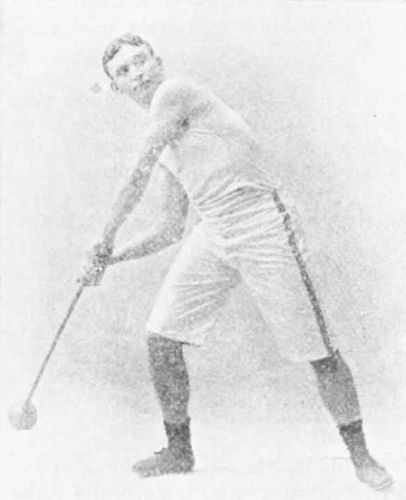
The fifteen starters in the bicycle event kept well bunched until a collision scattered the crowd and spoiled things for four of the riders. The remainder bunched again and pedalled along pretty evenly, until Steele, Rutz, and Baker forged ahead in the stretch and finished in that order. The time, 5 min. 18-2/5 sec., is excellent. Another unusually good performance at the Connecticut games was Butler's winning of the walk in 7 min. 17-3/5 sec. He forged ahead at the start with such a rapid gait that I felt certain he must give out before he could cover half the distance, but he kept it up, and finished strong fully a hundred yards ahead of Tichbourne. Sturtevant and Beck carried off the honors in the field events, the former winning both the pole vault and the high jump, breaking the record in each case. He is only seventeen years old, but he is a promising man. He won the vault at 9 feet 6 inches without ever touching the bar; then he had it raised to 9 feet 8-1/2 inches, and cleared it at the first trial. He could have gone higher, but was reserving his force for the jumps. In the high, he repeated his performance of the vault by winning first at 5 feet 4-1/2 inches, then by having the bar raised to 5 feet 8 inches and clearing it at the first attempt. In taking both the hammer and the shot Beck did excellent work, as our table of records will show. Both weights were 16 pounds, and I feel confident that he can make a better put in the shot when not competing in so many events.
It is to be regretted that the Springfield High-School decided not to enter any team at the Western Massachusetts I.S.A.A. games, held on Pratt Field. Amherst; but the meeting was most successful, and Monson Academy again left the field a victor. The success of the Monson athletes was entirely due to their careful training, and to the systematic way and the earnestness with which the men went into every event. I have heard many plaints to the effect that Monson's annual victory in the shot and hammer was always due to the fact that her representatives in these events were larger men than the other schools could produce. That excuse cannot hold this year, for both O'Connor of Holyoke H.-S., and Clark of Amherst H.-S., were giants alongside of Austin, the Monson shot champion. Considering this was the Chicopee High-School's first year in the association, her representatives did remarkably well in spite of the fact that they finished fourth. Amherst High made the lowest score, with only 6 points to her credit, while Chicopee got 25, and Westfield, next ahead of Chicopee, only scored 27. The winning score of Monson was 53 points.
The Graduate.