Highest of all in Leavening Power.—Latest U. S. Gov't Report.
Reading edition
The Interscholastic Sport Department of Harper's Round Table will be as full of matter interesting to its present readers during the summer months as it is now. Many will go to distant summer resorts where there may be no newsdealer. To insure the prompt receipt of the paper each week, send the accompanying coupon bearing your name and address with 50 cents for 13 weeks, or $2.00 for one year.
HARPER'S ROUND TABLE
Summer Subscription Coupon.
...................1895. Messrs. Harper & Bros., New York City, New York. Please send Harpers Round Table for ..... weeks, for which I inclose $........ Name..................................................... Address.................................................. ..........................................

SEND for Catalogue of the Musical Instrument you think of buying. Violins repaired by the Cremona System. C. Story, 26 Central St., Boston, Mass.
This Department is conducted in the interest of Bicyclers, and the Editor will be pleased to answer any question on the subject. Our maps and tours contain much valuable data kindly supplied from the official maps and road-books of the League of American Wheelmen. Recognizing the value of the work being done by the L. A. W., the Editor will be pleased to furnish subscribers with membership blanks and information so far as possible.
Copyright, 1895, by Harper & Brothers.
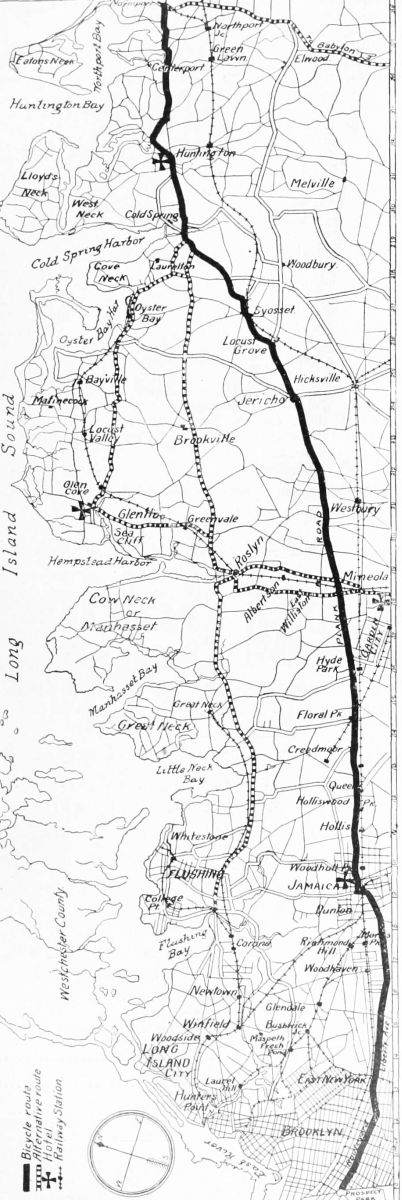
The only other really good ride on Long Island out of Brooklyn, besides the one given in last week's issue to Babylon, is over the same route as already described to Jamaica, and from thence as on the Babylon route, on through Hollis and Holliswood Park. Just beyond Holliswood Park the fork is reached whose right leads to Babylon, and whose left runs out over the plank-road to Jericho, and thence up along the north shore of Long Island. There are almost no hills along the entire route until the rider gets up to the north shore at and beyond Huntington. On taking the left fork, after passing Holliswood Park, the rider gets into Queens, continues on through Floral Park, Hyde Park, and Mineola straight out to Jericho, on a remarkably good road for Long Island, and a creditable road for any country. Jericho is practically the end of this plank-road. After leaving Jamaica and passing by the toll-gate, the rider may to advantage take to the side paths, for these will give him considerable help; but complaints against bicyclists have grown so numerous of late, and there is so much danger that severe legislation will be pushed against bicyclists, that every one is urged never to ride on side paths or sidewalks within the limits of a village or a thickly populated town.
There are several roads which may be taken out of Jericho. One of these is to turn right from Jericho and go on southward to Hicksville (and turn at the bottom of the hill), about a mile beyond, near the edge of the plain. Take the left fork and continue on this until the railroad is crossed. After crossing the railroad turn left and keep to this road until the railroad is again crossed, when a turn to the right should be made at the next fork, and the rider will soon run into Farmingdale. Running through Farmingdale, and turning sharp to the right at the next crossroads, the wheelman crosses the tracks and runs to the Holycross Mission-House, two miles away, turns sharp to the right a little beyond, and runs into Amityville, three miles further on. The road is good, and the side paths may be taken here to advantage also. After leaving Amityville, cross the railroad, and turn to the left to the shore road on the south shore of Long Island. A turn to the left carries the rider into Babylon, and he may here rest, and run back to Brooklyn by the route described last week.
Another run, and the one marked on the map accompanying the Department this week, is to continue on from Jericho until the turning to the right is reached, and then the wheelman can run up to the north shore, through Huntington to Northport. There should be a turn made to the left at Jericho, and, after a short distance, a turn to the right, thence crossing the railroad track after passing Locust Grove and running into Syosset. The road is somewhat hilly there, though not bad. On passing the station the wheelman should turn right and take the next turn to the left. It will bring him into Cold Spring. Turning right from here and taking the main road he runs on three miles into Huntington over a somewhat hilly road; thence the route is direct to Centreport and Northport, a little over five miles further on, and the rider may then keep on along the north shore as far as he likes. Huntington, however, makes thirty three or four miles, which is enough for an ordinary bicyclist, who would naturally return by train, or, if the return route be made in the same day, sixty-five to seventy miles would be covered.
If the return trip be made, it is possible to take a pleasant run out to Glen Cove by keeping to the road after passing (going west) Cold Spring. The run then will be through Laurelton, Oyster Bay, Bayville, Locust Valley, into Glen Cove, and the road can then be followed without difficulty. From Glen Cove it is somewhat hilly. There is a pretty run through Greenville, Roslyn, back to plank road at Mineola. This return detour adds three or four miles, but makes a variety in the road.
Note.—Map of New York city asphalted sheets in No. 809. Map of route from New York to Tarrytown in No. 810. New York to Stamford, Connecticut, in No. 811. New York to Staten Island in No. 812. New Jersey from Hoboken to Pine Brook in No. 813. Brooklyn in No. 814. Brooklyn to Babylon, 815.
Any questions in regard to photograph matters will be willingly answered by the editor of this column, and we should be glad to hear from any of our club who can make helpful suggestions.
PAPERS FOR BEGINNERS, No. 4.
HOME-MADE APPARATUS.
A DARK-ROOM LANTERN.
A wooden starch-box can be made into a good dark-room lantern with very little trouble. Across the cover at each end nail a thin strip of wood an inch wide. In the centre of the cover cut a hole 4 by 6 inches, and over this paste two thicknesses of yellow post-office paper. The strips of wood are to prevent the cover splitting. For the chimney, remove the bottom from a round tin spice-box, and in one end of the box cut slashes an inch in depth and half an inch apart. In one end of the wooden box cut a hole into which this tin shall fit snugly. Slip it into the hole as far as the slashes are cut in the tin, turn the piece of tin back against the wood, and fasten them with small brads or tacks. For the covering of the chimney, to prevent the escape of white light, take an empty tin fruit or vegetable can—the cans used for corn are the best size—cut slashes in the tin the same as in the small can, and above these slashes for about two inches puncture the tin full of holes. Turn back these pieces of tin at right angles, place it over the chimney, and tack it in several places to the box. This arrangement will allow plenty of air to enter for ventilation, but no white light will escape. For a light get a small brass candlestick like those used for camping, and use adamantine candles.
A NEGATIVE WASHING RACK.
If one has an old washboard half the work of making a negative rack is already done. From the washboard cut two strips seven inches long and three inches wide. The strips must be cut so that the corrugations go across, instead of lengthwise, the strips. These two pieces are for the sides of the rack. Now take four pieces of wood six inches long and about an inch square, and nail a piece to the end of each strip so that they project an inch beyond the strip at one edge and two inches the other. Fasten these two side pieces together by nailing pieces of wood from one of the ends of the projecting sticks to the one opposite, allowing just space enough for a 4 by 5 plate to slip between the corrugated zinc as they are turned in toward each other. On the bottom nail a thin piece of board to the four pieces of wood on which the plates may rest when in the rack. You thus have a skeleton box, grooved on the inside, which can be filled with plates; and when necessary to change the water the box can be lifted out of the pail without danger of breaking the plates. A negative-box costs from $1.75 to $5.00, and this negative-box costs but half an hour of time.
A HYPO-TRAY.
A tray for hypo may be made by lining a small wooden box with enamel cloth. Have the cloth a little larger than the inside of the box; fit it smoothly, and fold it at the corners, instead of cutting it; turn the edges over and tack in a few places. The cloth for a box 8 by 10 costs only five cents, and will last a long time if rinsed thoroughly each time after using.
A PLATE-LIFTER.
To make a plate-lifter, take a stiff piece of wire, bend it exactly in the centre, and twist the halves together so as to make a loop. Bend over the ends of the wire a half-inch, bending them far enough to make a sharp angle, and with the ends turned toward each other. The ends of the wire should be a little less than four inches apart, so that when the hooked ends are slipped over a 4 by 5 plate there will be enough tension to hold the plate without slipping. This lifter is as useful as those bought for fifteen or twenty-five cents, and costs nothing.
ILL-TEMPERED BABIES
are not desirable in any home. Insufficient nourishment produces ill temper. Guard against fretful children by feeding nutritious and digestible food. The Gail Borden Eagle Brand Condensed Milk is the most successful of all infant foods.—[Adv.]