KING ARTHUR AND HIS KNIGHTS.
Reading edition
III.—ARTHUR AND THE KNIGHTS.
"Arthur must have been tickled to death," said Jack, when his father told how Sir Ector and Kaye knelt before him and hailed him as King. "Wouldn't it be fine, Mollie, if somebody should ring our front-door bell now, and come in and prove that you and I were King and Queen of somewhere, and that papa was bringing us up for Queen Victoria or Emperor William, for instance?"
"I don't think so at all," said Mollie. "I don't want to be Queen, and I don't think you'd make a good King, either. You slide down the banisters too much to make a very royal King. Kings don't do such things."
"I guess they would if they could," said Jack. "What's the good of being a King if you can't do whatever you wanted to?"
"I'd rather be a President, though," put in Mollie. "Kings have to wear solid gold crowns with prongs on 'em all the time, and it must be dreadfully uncomfortable."
"Very true, my dear," said her father. "A crown is about the most uncomfortable possession a man can have, and Arthur, I fancy, felt very much at first as you do. He felt very badly indeed when he learned that Sir Ector was not his father, and that Kaye was nothing but a chum, instead of a brother, as he had always thought, for he loved them both more than he did any one else in the world. So when Sir Ector knelt before him and said, 'You are the rightful King of England,' Arthur opened his eyes as widely as he could and started back in amazement."
"I guess he thought it was an April-fool," laughed Mollie.
"At first he may have thought that," said the Story-teller, "but when he remembered that great Knights like Sir Ector wouldn't play jokes of that kind he didn't think it any more. He began to grow uneasy and unhappy, for instead of throwing his cap into the air and crying hurrah, as Jack would do if he were elected President of the United States to-morrow, he gave a groan and an exclamation of dismay.
"'Alas!' he cried; 'why do my father and brother kneel before me?'
"'I am not your father, nor is Kaye your brother,' replied Sir Ector.
"'Then who am I?' cried Arthur, in great distress.
"'That I know not,' returned Sir Ector, 'save that you are our King. You were brought to me by Merlin to care for when you were an infant, and from that day to this you have been treated as my son. Whose child you are I do not know, nor have I ever known—nor has any one known except Merlin.'"
"Didn't Sir Ector know who paid his board?" asked Jack. "Who'd he send his bill to?"
The Story-teller smiled. "I don't believe Sir Ector charged anything for his services," he said. "He was a true Knight, and was willing to perform a knightly service for another without charging anything for it or asking too many questions."
"You couldn't get anybody to do that nowadays, I imagine," said Mollie, thoughtfully. "I think very likely they'd ha' sent him to an orphan asylum if he'd lived now."
"I am not at all sure that you are not right about that," said her father; "but whether you are or not, the fact remains that Sir Ector took Arthur in, and without knowing whence he came or who or what he was, was as good to him as he was to Kaye, his own little boy; and when Arthur learned that Ector was not his father, it pained him deeply, and he heartily wished he had never seen the sword in the stone which had made known the secret of his high position to the world."
SIR ECTOR TOOK ARTHUR TO THE ARCHBISHOP AND TOLD HIM ALL.
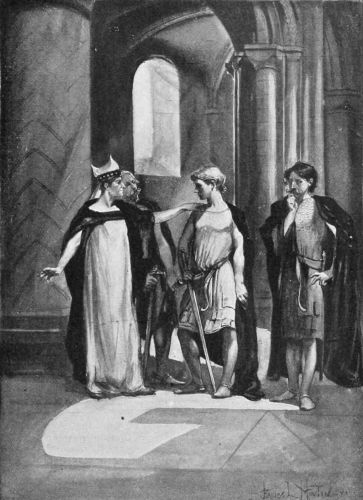
"Then Sir Ector asked Arthur to be his gracious lord when he had become King, and to make Kaye the steward of all his lands. This Arthur promised, for, as he said to Sir Ector, he owed more to him and his wife than he did to all others in the world. The promise made, Sir Ector took Arthur to the Archbishop, and told him all that had occurred, and the Archbishop was as much surprised as Arthur had been, and being a wise man, he foresaw that all others would be surprised as well, and some of them unpleasantly so, so he advised that the matter be kept secret for a little while, when he would summon the Knights for another trial, at which Arthur could do publicly what he had already done unobserved.
"On Twelfth Day the plan was carried out. The Knights again rode to the church-yard and tugged at the sword, but no more successfully than before. Then Arthur came forth to try, and they all laughed at him. Some of them sneeringly asked why a mere boy should be brought forward to try to do what they, the most gallant and the strongest Knights, had been unable to do, but they soon stopped smiling and sneering and began to frown. Arthur, as he had previously done, walked easily up to the stone, and grasping the sword by the hilt, pulled it out with as little effort as if it were a weed in a garden."
"That ain't always easy," said Mollie, who had tried weeding in her own little garden patch.
"No," said her father; "not always, but sometimes they come up with scarcely an effort, and that is the way the sword came out of the stone as soon as Arthur grasped the hilt."
Jack chuckled. "You can bet on a boy to beat a man in a game o' stunts every time," he said, proudly.
"Well, you can in many cases," said his father, with a smile, "but the Knights did not like it any the better for that. They were not used to playing games of stunts with boys, and in this particular instance the prize was so great a one that their anger ran very high, and they asked some very embarrassing questions.
"'Who is this boy?' asked some, and nobody was prepared to answer the question. All Sir Ector knew was that he had brought him up from a baby, and that he had been a very good boy, but this was not enough for the Knights. With the crown at stake, they wanted to be certain that his parents were people of high birth. They didn't want the son of a stable-man to rule over them and to sit on the throne, and they grew so bitter about it that to save trouble the Archbishop ordered another trial to be held at Candlemas."
"I don't think that was fair," said Mollie. "He'd won, and they'd ought to have given him the prize."
"True," said her father. "He certainly had won it, but the Archbishop felt that having won it once, he would do it again, and it was better to wait."
"He was all right," said Jack. "I think it wasn't quite fair as Mollie says, but it was good business."
"Yes," said the Story-teller; "for, as you will soon see, Arthur didn't lose anything by it except time."