Part I.
Reading edition
The other night Reginald was tossing about in his little bed, unable to go to sleep. The dull monotonous ticking of the clock fell upon his ear in a way that drove him almost mad, and the rain pattering upon the window-pane added to his misery, and made him wish for the light of morning as he had never wished for it before. And when the trees moaned in the wind, it filled poor Reginald's mind with dire forebodings, and caused him to bury his curly head deeper in the pillow to deaden the weird refrain that rippled in the blinds with a sort of fiendish playfulness.
And then he heard a soft footfall on the carpet, and, looking up, saw the strangest creature he had ever set eye upon standing grinning by the bedpost. At first Reginald was so frightened that he could say nothing; but when he noticed that the creature didn't move, and that his grin could not hurt him, he found his voice, and said, "Please, Mr. Robber—"
"Did you say robber?" asked the Presence, with angry emphasis.
"I did," replied Reginald, trembling violently; "but it was all your fault, I meant to say Mr. Robertson, but you cut me short before I could pronounce the last syllable."
"I will then pardon you," replied the Presence, which continued quickly, as if to catch Reginald in a lie: "What did you intend to say after robber?"
"I intended to say," replied Reginald, still trembling, "Mr. Robertson, can you tell me what time it is. That clock doesn't strike, and I cannot sleep. If I thought you to be a thief, I would ask you not to take my new locomotive or boxwood tops."
"Very good," replied the Presence, as it took the grin off its face, and holding an end in each hand, proceeded to stretch it this way and that, until it was a yard long.
"Why, what a singularly large smile you have!" said Reginald, who by this time had partially recovered his composure. "I never saw anything like it before."
The Presence evidently felt complimented, and proceeded to entertain Reginald further. It fastened one end of the grin to the bureau, and walked to the opposite side of the room, with the other end in its hand.
"Oh, don't," cried Reginald; "it might break!"
But just then the Presence let go of the end it held in its hand, and the grin flew across the room, and settled down to its size when in repose, on the bureau.
"Oh, please put it on again," pleaded Reginald; "because it is so becoming, and when it is off, you look so sad and homely."
So the Presence readjusted its grin, and looked just as it did when Reginald had first beheld it.
"Will you kindly tell me what you are?" asked Reginald, who was really at a loss for a question.
"With pleasure," replied the Presence; "because I am always ready to show myself in my true colors, which are warranted never to fade or wash out, and I am always ready to submit myself to the strictest critical scrutiny." Then the Presence drew itself up proudly, and sang, to a lively measure:
"In reply to your question, so natural, I Shall be happy to make you a truthful reply, And inform you that I am a-roaming, care free, The sprite of the pudding, the Slambangaree. "Of the pudding of plum, when you've eaten too much, And you drop into sleep as the pillow you touch. Oh, you tumble about, and you snore, and you see Awful things, all produced by the Slambangaree. "But as now you can't sleep, this occasion I take All my antics to play on you while you're awake; And until your plum-pudding's digested, ah, me! You can bill no farewell to the Slambangaree.
"But now, if it is just the same to you, I will drop into plain every-day prose. You see, it is just this way, to put it in a condensed form: Myself and my fellow-Slambangarees are the sprites—or the fiends, if you will—of the canned plum-pudding. From being slammed and banged around so much in our cans we gain our name of Slambangaree. Now, you see, to put it more clearly than I could do in song, after you have eaten too much plum-pudding, against which I exhort you to refrain (for it is better to be temperate in all things), you fall asleep, and have awful nightmares—dream you are falling off houses, and all that sort of thing. It is the mission of the Slambangaree to bring about this condition of things. But as you cannot sleep to-night, I, the Slambangaree representing the plum-pudding you have eaten, have come to give you your nightmare while awake. My brother Slambangarees are taking care of the others who devoured the rest of the plum-pudding, and not until all that pudding is digested shall we be free disembodied spirits."
Here the Slambangaree took off its grin and wiped its mouth, after which the grin was readjusted with great care. Then it said, "I will now see what you have in your pockets, for I am a little curious."
Then, while Reginald felt very anxious about the precious things in his pockets, the Slambangaree's eyes became larger, and shot out of his head and across the room, seeming to be attached to long wands.
"Those are the roots of my eyes," it remarked, playfully, as it shot its eyeballs into the pockets of Reginald's trousers, and sang:
"Two boxwood tops herein I see, A sling-shot and a knife, And a tin horn that unto me, With its uncanny witchery, A burden makes of life. "Here are two soldiers made of lead, And here a little boat, And seven agates, blue and red, Likewise the hind leg and the head Of a green candy goat."
Then the Slambangaree withdrew its eyes, as if satisfied with the result of its investigations, and, as it did so, noticed Reginald's drum lying on the floor. No sooner had it seen it than the roots of its eyes suddenly lengthened, and it began to play a solo on it with its eyeballs. As the rumpy-tum-tum filled the room, Reginald thought the noise would alarm the house and bring some one to his rescue. But in this he was mistaken. The Slambangaree played on until weary of the sport.
"How long is this going to last?" asked Reginald.
"Until the pudding within you is digested; you must have patience—"
"I would rather have some pepsin tablets," said Reginald.
"I suppose so," replied the Slambangaree; "but you must never be upset by yearning for the thing you haven't got, or you never will be happy. I can only leave you, as I said before, when the pudding is digested. I will therefore leave you by degrees. The better your digestion, the sooner you will be rid of me. Now for the fun!"
Here the Slambangaree turned itself upside down and danced gracefully all over the ceiling. While Reginald was looking on in open-mouthed wonder, the Slambangaree reached down from the ceiling and lifted him out of bed in its arms and capered all over the room with him, but never bumped his head, although it floated under the bed with him, and jumped from the mantel-piece to the clock and from the clock to the bureau with great rapidity. When it dropped Reginald back into bed, it said,
"That was only to hurry your digestion."
"I would greatly prefer to let it take its time," replied Reginald.
Here the Slambangaree, not noticing what Reginald had said, took the top-cord from the surprised boy's pocket, and seating itself on the clock, threw one end of it into the water-pitcher. In another instant it pulled out a great fish, which, when released, flew about the room like a bird, for its fins were like wings.
[to be concluded.]
BY GASTON V. DRAKE.
XX.—FROM BOB TO JACK.
Home Again.
DEAR JACK,—Well its all over. We got to Hoboken, yesterday and thinking we'd seen all the foreign lands we cared to for a little while we decided not to stay there and came right through to Yonkers. Yonkers isn't such a bad place after all, but its queer: you can stay there a year and see it all in a day while those foreign cities you can stay in only a day when you couldn't see 'em in a year. Things seem to be arranged very queerly in this world. The kitten has turned into a cat four times too large for any use and my corn in the garden has grown so high it reminds me of the trees at Versailles.
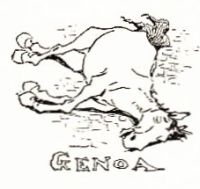
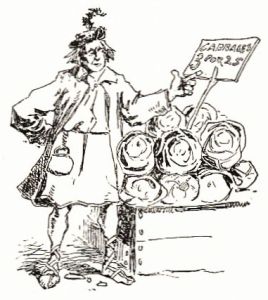
The trip home was pretty fine. We didn't find much to do at Genoa and with all due respect to Columbus's birthplace the only thing I particularly remember seeing there was a dead horse. The hotel was interesting. We had five rooms and one of 'em smelt like macaroni, another smelt like pie, the third smelt like cake, the fourth reminded me of the circus and we didn't keep the fifth. As for the house where Columbus lived we drove out to see it and that was the time I saw the dead horse. Columbus's house was a very poor sight, and between you and me I don't believe he ever lived there, because if he had he'd have gone into the business of selling cabbages the way everybody else in the neighborhood does instead of becoming a great discoverer, though I'll tell you one thing. If I'd had to live a week in that neighborhood I'd have wanted to be on the ocean for the rest of my natural life to get fresh air enough to carry me through. That's a queer thing about Italy. There's less fresh air to the square inch in Italy than there is anywhere else in the world. Pop says Italians most always sleep with their windows open and maybe that's the trouble. It is the closest country I ever was in.
We got on board the Werra Thursday morning and she's a great ship. Aunt Sarah says the only thing against her is the band that plays all through dinner, but Pop doesn't think so. He says the band is a good investment because it keeps people from eating and hasn't been known to blow a ship to pieces, which is a great thing considering the band. I liked the music. Why one night I was feeling pretty mean when the sausages were served, and I wanted to go up on deck and the band began to play the Washington Post March, and it settled my stomick right away. Besides the officers aren't so great but what they can notice kids. I got to know every officer on the boat from the deck steward down to the Captain, and when they weren't on duty they were fine; but on duty—my—you'd have thought the world depended on 'em. I tell you, Jack, I liked Chesterfield, and I liked the officers on the New York, but if a Werra man chose to throw me overboard I wouldn't care because I'd know he'd get me home safe and was looking after me whatever he did, whether the band played or not. You are ten and I'm nine but we can size up fellows just the same, and when it comes to sizing up, give me Captain Pohle and Captain Polack. They can have me for a cabin-boy or anything else. I'll get home safe as long as I'm with them and I won't have to wear rubbers either.
After leaving Genoa we sailed through a sea so blue that you could imagine the red and white and the stars and the stripes. It's called the Mediterranean and it reminds me more of America than any sea I've seen. It's pleasant. It sort of winks at you when the sun shines, but its as independent as if it was an ocean.
After we sailed about two days through this beautiful blue water we came to Gibraltar, and how it does stick up out of the water! A big insurance building is very noble in a city but Gibraltar beats everything I ever saw. It just sticks itself up and says look at me and whether you want to look at it or not you've got to. It's like Pop when he's nervous. You've got to do what he says and not say a word. Every time I've seen anything over here I've had something to say, but when I took in that bit of rock, I wanted to go off and sit in a chair and not move for five minutes. Aunt Sarah was the same way, and that's saying lots.
And if we hadn't gone ashore it would have been all right, but we did go ashore and then it seemed different. Pop took me to see a comic opera once, and Gibraltar reminded me of it. Everybody wore a costume and when we'd meet a man dressed up like an Arab we'd stop to see if maybe he wasn't going to sing a song. Nobody did though and everybody walked along as if they were going to market in Yonkers and didn't know they were at Gibraltar, which I think is awfully queer, but it has made me think that maybe when I think there's nothing to see in Yonkers its because I'm so used to it that I forget it all.
There were lots of boys selling matches and grapes and flowers at Gibraltar and Pop threw away a beautiful coin collection buying everything he could find. They take any kind of money there. But after it was all over and we were back on the Werra again and sailing towards home, I forgot all about everything except the rock and how it just made you hold your breath and wonder how on earth Spain ever let England have it.
And that's all about the trip. We're home and nothings happened. After seeing Gibraltar I'm not going to waste my ink describing Hoboken—but I will tell you one thing; when you've travelled all around the way we have and seen lots of beautiful places and beautiful things, and then come back home you're just as glad after all that you live home instead of abroad. The people on the streets at home look better and happier, and somehow or other the world doesn't seem quite so much in need of an airing as it does abroad.
Good-by for the present. Next time either of us goes anywhere I move we start up a correspondence again, for whether you've enjoyed this one or not I have.
Always yours Bob.
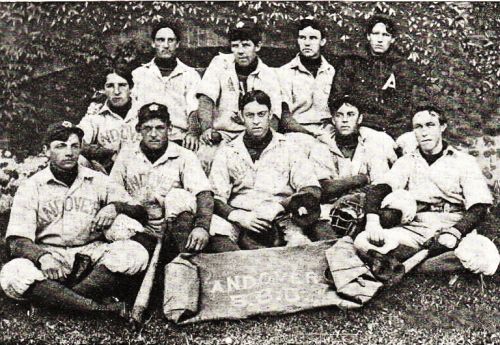
L. D. Waddell, r.f. F. H. Croker, 3.b. R. A. Kinne, c.f. A. R. T. Hillebrand, p. A. Barnwell, Jun., sub. I. J. French, s.s. J. Wentworth, l.f. R. M. Barton, Capt. and 1.b. A. S. Goodwin, c. F. L. Quinby, 2.b. THE PHILLIPS ACADEMY, ANDOVER, BASEBALL TEAM.
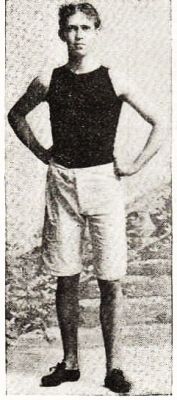
BASCOM JOHNSON, Worcester Academy.
A. N. RICE, Noble's School, Boston.
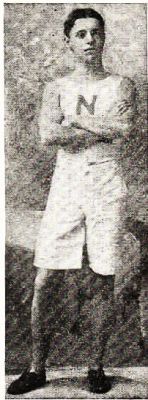
An unusually small crowd turned out to witness the New England Interscholastics on Holmes Field a week ago Friday. The meeting, however, proved an exceptionally good one, and although but few records were broken, the general standard of performance was uniformly excellent. The figures were changed in the mile bicycle, half-mile run, and pole vault, and those equalled were the 120-yard hurdle and the 320-yard flat.
Worcester Academy won the meet, with English High second, and Andover third. Worcester High, last year's champions, landed in eighth place. The day was warm and still, without being sultry; just an ideal day for record-breaking. The track was in excellent condition. The standards set by the Executive Committee of the N.E.I.S.A.A., which must be attained by the athletes who are to be sent to the National Games, Saturday, were equalled or excelled in all but two events—the mile walk and the shot—and as it is well known that the winners of both these events are capable of at least equalling those standards, it was determined by special vote to send them to New York. It will be seen, too, that in every event in which the conditions are similar to those obtaining at the recent New York Interscholastics, with the exceptions of the hammer and the quarter, the New England records are superior. Verily these New England boys will be a hard crowd to beat!
The first event on the programme was the 100-yard dash. Jones of Andover won, in 10-2/5 sec., with Robinson of W. A. second, and Kane of E. H.-S. third. Jones tied the record, 22-2/5 sec., in the 220. Robinson and Kane drew second and third places. The half-mile was the best performance of the day. About fifteen started, and ran in a bunch for a lap. Then Hanson, E.H.-S., let himself out, followed closely by Albertson, W. H., and Gaskill, P. A. A. Hanson's pace proved too much for the others, and when he turned into the homestretch he was leading by twenty yards, and seemed to be adding a little with every stride. He finished in excellent form, having lowered the record from 2 m. 5-1/5 sec. to 2 m. 1-1/5 sec. There was a pretty race for second place. Albertson, last year's champion, finally got it by a narrow margin over Gaskill.
A big field started in the mile run. Mills of Berkeley took the pole and held it throughout. He gave a fine exhibition of running, and won in the fast time of 4 m. 33-4/5 sec.; but he was so far superior to the others that as a race the event was a failure. Sullivan of W. H. was second, and Palmer of Andover a good third. When the time was announced, it was thought that the record had been broken, as Laing's time was down on the score-card as 4 m. 34-2/5 sec., but on investigation it was found that Laing's record was 4 m. 32-2/5 sec.
The best race of the meet was in the final heat of the 440. Bascom Johnson, W. A., took the lead, followed by Warren, C. H. and L., and Whitcomb, P. E. A. They held this order until the turn into the homestretch. Then Johnson let out a little, and won by a scant five yards. Warren was plugging along, trying to save second place from the smaller Whitcomb, but Whitcomb gained surely, step by step, and plunged across the line second.
Hallowell of Hopkinson's won his heat in the high hurdles in 17-2/5 sec., equalling Hoyt's old record, which has stood since 1893. Edmands of W. A., who was booked to win the event, had a streak of his usual hard luck, and got mixed up with a hurdle in his heat. The final was an exciting race. Shirk of W. A. proved equal to the emergency of winning in default of Edmands, although it was only in the short dash for the tape that he managed to slip by Hallowell, who had made an unfortunate stumble. Cady of Andover drew third place. Converse of E. H.-S, won the low hurdles, as was expected. His time was 27 secs. Peters of Andover was a good second, and MacDonald of Chelsea ran third.
New England. I.S.A.A. Games, Holmes Field, Cambridge, June 5, 1896.
Event.Winner.
100-yard dashJones, P.A.10-2/5sec.
220-yard dashJones, P.A.22-3/5"
Quarter-mile runJohnson, W.A.52-3/5"
Half-mile runHanson, E.H.-S.2m.1-1/5"
One-mile runMills, Berk.4"33-4/5"
120-yard hurdlesShirk, P.A.17-2/5"
220-yard hurdlesConverse, E.H.-S.27"
One-mile walkO'Toole, E.H.-S.7"43"
One-mile bicycleBoardman, Noble's.2"35-4/5"
Two-mile bicycle——————-
Running high jumpRice, Noble's.5ft.7¼in.
Running broad jumpHersey, W.A.21"5"
Pole vaultJohnson, W.A.10"9"
Throwing 16-lb. hammer——————-
Throwing 12-lb. hammerBoyce. B.H.-S.122"1"
Putting 16-lb. shotHeath, Hop.36"7"
Putting 12-lb. shot——————-
Connecticut H.-S.A.A. Games, Yale Field, New Haven, June 8, 1896.
Event.Winner.
100-yard dashLuce, H.P.H.-S.10-2/5sec.
220-yard dashMorris, H.P.H.-S.23-3/5"
Quarter-mile runMorris, H.P.H.-S.52-4/5"
Half-mile runBradin, H.P.H.-S.2m.10"
One-mile runTwitchell, H.S.5"13-4/5"
120-yard hurdlesEllsworth, H.S.17-2/5"
220-yard hurdlesEllsworth, H.S.27-2/5"
One-mile walkEelk, H.S.7"11-3/5"
One-mile bicycle——————-
Two-mile bicycleRutz, H.H.-S.5"26-2/5"
Running high jumpSturtevant, H.P.H.-S.5ft.6in.
Running broad jumpBrown, H.S.19"8½"
Pole vaultSturtevant, H.P.H.-S.10"½"
Throwing 16-lb. hammerIngalls, H.P.H.-S.118"2¾"
Throwing 12-lb. hammer——————-
Putting 16-lb. shotIngalls, H.P.H.-S.34"2½"
Putting 12-lb. shot——————-
New Jersey I.S.A.A. Games, Bergen Point, New Jersey, June 6, 1896.
Event.Winner.
100-yard dashSulzer, P.S.10-4/5sec.
220-yard dashSulzer, P.S.24-2/5"
Quarter-mile runManvel, P.S.54-1/5"
Half-mile run——————-
One-mile runAdams, N.A. }5m.27-2/5"
Myers, P.S. }
120-yard hurdles——————-
220-yard hurdlesPlum, N.A.29-4/5"
One-mile walkAdams, N.A.8"20-3/5"
One-mile bicyclePager, M.H.-S.2"58-2/5"
Two-mile bicycle——————-
Running high jumpJones, N.A.5ft.3¾in.
Running broad jumpJones, N.A.19"2½"
Pole vaultSmith, P.H.-S.9"3"
Throwing 16-lb. hammer——————-
Throwing 12-lb. hammerSmith, P.H.-S.96"4½"
Putting 16-lb. shot——————-
Putting 12-lb. shotSmith, P.H.-S.37"2"
Abbreviations:—P.A., Phillips Andover Academy; W.A., Worcester Academy; E.H.-S., Boston English High-School; Berk., Berkeley School, Boston; Noble's, of Boston; B.H.-S., Brookline High-School; H.P.H.-S., Hartford Public High-School; H.S., Hotchkiss School, Lakeville; H.H.-S., Hillhouse High-School, New Haven; P.S., Pingry's School, Elizabeth; N.A., Newark Academy; P.H.-S., Plainfield High-School; M.H.-S., Montclair High-School.
O'Toole of E. H.-S. won the mile walk, with 70 yards to spare, and, as usual, got through without a caution. Mallette, B. L. S., was ruled off, after a hard brush with O'Toole on the third lap. Lockwood of W. A. got second, and Mohan of E. H.-S. third.
The mile bicycle was a genuine race, and, strange to say, proved exciting. Stone of Andover was thrown in his trial heat. Lincoln of B. L. S., who was looked upon as the next best entry, met with an accident in the final. Then a pretty race began among Boardman of Noble's, Warnock of C. H. and L., and Hardy of Hopkinson's. They finished in that order, Warnock breaking away from a bad pocket just in time to spurt for second place.
The field events developed uniformly high performances. Rice of Noble's won the high jump, after a close contest; his height was 5 ft. 7¼ in.; Perry of Andover was second, with 5 ft. 6 in.; Lorrimer (Mechanics Arts), Howe (W.A.), and Phillips (Noble's), tied for third. Hersey of W.A. won the broad jump with a performance of 21 ft. 5½ in.; within half an inch of Brewer's record made in 1890; Theman, W.A., was second with 21 ft. 4 in.; and Prouty, P. E. A., third, 21 ft. 1 in., making this event much more even and creditable than usual. Bascom Johnson, W.A., added two inches to his own record of 10 ft. 7 in. in the pole vault, beating out Clapp of Williston, who vaulted 10 ft. 6 in.; Kendall of W.A. and Prouty were tied for third. Boyce of B. H.-S. won the hammer, throwing it 122 ft. 1 in.; Edmands was second, 117 ft.; and Shaw, Hopkinson's, third, with 105 ft. O'Brien, E. H.-S., failed in the shot, putting it only 36 ft. 2 in.; Heath, Hopkinson's, surprised the crowd by doing 36 ft. 7 in.; Edmands was able to do only 34 ft. 2½ in.
The Hartford High-School track team won first place at the Connecticut High-School games a week ago Saturday for the sixth time in the history of the association. There were only five schools entered, and Hartford took the pennant with 51 points, Hotchkiss School coming second, with 37. Five records were broken—the 100-yard dash, the walk, the high jump, the hammer, and the pole vault.
F. C. INGALLS. Hartford High-School.
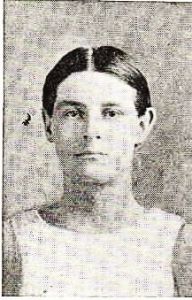
The star performers of the day were Morris, Sturtevant, Ingalls, and Luce of Hartford, and Ellsworth of Hotchkiss. The 100 was taken by Luce in .10-2/5, with Morris and Pendleton behind him. The 220 was a race among these same men, but on this occasion Morris won after a sharp tussle with Luce, who came second, with Pendleton again third, the time being .23-3/5. Morris took another first by winning the quarter. This race had been conceded to Luce beforehand, but his work before he came to the scratch had taken a good deal out of him, and consequently he was not so fresh as Morris. The latter ran a very clever race, and finished strong, with Luce only about four feet behind him, in .52-4/5, Cheney being a good third.
F. R. STURTEVANT. Hartford High-School.
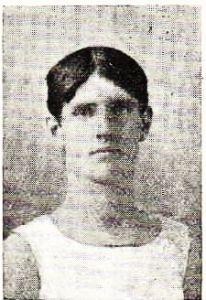
Bradin's winning of the half-mile was somewhat of a surprise, the knowing ones thinking the event would go to Kearney. Bradin took the lead about half-way around the track on the first lap, and kept it to the tape. Kearney hung back with Luce, fearing him, and when the spurt came he was unable to overcome Bradin's long lead. Bradin's time was 2 min. 10 sec., and I am told that in practice he has frequently done 2 min. 5 sec.
The time in the mile was exceedingly slow. Breed of Hartford burst out ahead of the bunch at the beginning of the third lap, and was ahead until within 75 yards of the finish, when the two Hotchkiss men, Twitchell and Fox, dashed ahead, and won in that order. The walk went to Eelk of Hotchkiss, who finished some fifty yards ahead of Blakeslee. The time was 7 min. 11-3/5 sec., which is better than any other interscholastic performance that I know of.
Both the hurdles went to Ellsworth of Hotchkiss, who cleared the obstacles in excellent form, and is undoubtedly one of the cleverest hurdlers in the schools to-day. In his trial heat for the shorter distance his time was 17-1/5 sec.
Both the hammer and the shot went to Ingalls of Hartford, as had been anticipated. He surpassed himself in the first event, throwing 118 ft. 2¾ in., but in the shot his performance was less noteworthy, his best put being 34 ft. 2½ in. He will be a factor in the National Games next Saturday. Sturtevant took the high jump, clearing 5 ft. 6 in., with Goodwin second. He can do much better than this, his record being 5 ft. 9½ in., but he was not pushed on this occasion. Sturtevant also took the pole vault, clearing 10 ft. ½ in., with Hixon second.
The most exciting race of the day was the two-mile bicycle. In the first heat Strong's chain broke and threw him, and three other men ran into him and spilled. Lycett of Hartford was the only man in the heat who was not thrown, and was about half a lap ahead when the first man of the tumblers had mounted again. By the time Strong had secured another wheel Lycett was coming on him a lap to the good, but Strong pushed off, and before the heat was finished he had passed every one but the leader, and finished a close second to Lycett. In the finals, although badly bruised from his fall, he finished second to Ruiz, Hillhouse High, who won in 5 min. 26-2/5 sec.
The New Jersey Interscholastic A.A. is one of the new leagues brought into existence by the formation of the National I.S.A.A., and it is probably one of the strongest, and certainly one of the most promising, of all of them. Its first field meeting was held on the grounds of the New Jersey Athletic Club, at Bergen Point, a week ago Saturday, and some very creditable performances resulted. Hitherto our knowledge as to the capabilities of New Jersey school-boy athletes has been drawn from the performances of individuals in open games given by New York schools. The result of this field meeting shows that there is a high general average of proficiency among the teams of the New Jersey League.
The meet was won by Newark Academy, whose team scored 40½ points; Pingry's School of Elizabeth was a very close second, with 35½ points. Then came Plainfield High, with 27, and Montclair High, with 14; Stevens' Prep, of Hoboken did not score.
The star performers of the day were G. P. Smith, of Plainfield High, who scored a triple win, taking both the weight events and the pole vault, and finished second in the low hurdles; J. P. Adams, of Newark, and C. T. Meyers, of Pingry's, who finished a dead heat in the mile walk; and S. H. Plum, Jun., of Newark, who ran a beautiful race in the hurdles. The firsts and seconds in each event will represent the Association at the National games next Saturday, and there is every reason to expect that New Jersey's name will figure in the point schedule.
Lawrenceville defeated Andover in their annual baseball game, which was played at Lawrenceville on Friday, June 5. The score was 10-2, and Lawrenceville played an almost errorless game. The Andover men did not appear to be in very good condition when they walked on the field, seeming slightly tired from their journey, and their play showed, in addition, that a number of the players had not been as thoroughly coached in their duties as they might have been.
The Lawrenceville batters found the ball in the early part of the game, Hillebrand being ineffective during the first inning, whereas Arrott, who was in the box for the home team, never pitched a better game. He struck out only seven men, however, to Hillebrand's nine, but only four hits were obtained off him to ten off Hillebrand.
The weakest playing for Andover was done by the short-stop and the whole out-field, they being responsible for eight errors, which let in five runs. Fumbles and muffs covered most of the errors, and of course the Lawrenceville players took advantage of every occasion. Goodwin, Andover's catcher, is an excellent player, and allowed only two bases to be stolen off him. The Andover men did not try to steal bases on Kafer, the Lawrenceville catcher, after having failed on the first attempt. The latter played a star game, and captained the team in perfect style. He will be a valuable acquisition to the Princeton nine next year.
Only seven Andover men reached first base. Their two runs were made in the seventh inning, when Barton knocked a home run, which brought in Croker. Lawrenceville's scoring was done in the first, third, fifth, sixth, and seventh innings. Hastie, their right-fielder, who has not made an error this year, knocked out two singles and a home run. Three of Lawrenceville's thus were let in by Wentworth, Andover's left-fielder, who allowed a base hit to be stretched into a home run by letting the ball roll by him. Most of the other points were earned by hard and timely hitting.
Never before this year have the Lawrenceville players shown so much head-work in batting as they did on this occasion. Andover, on the other hand, resorted to bunting, trying in that way to advance men on first base, but they were almost always unsuccessful. Besides the good work of the Lawrenceville battery—Arrott and Kafer—good work was done by Righter at second base, who played a first-rate game, accepting every chance offered, and he had many. The out-field work was almost flawless, and it is very probable that if Hastie had not been playing so close up to the infield, Barton's home run might have been pulled down considerably.
The Graduate.
The Round Table Fund.
The vote in favor of turning over the money in hand to the trustees of Good Will Farm seems to be unanimous. And hence, in accordance with these instructions a formal transfer will be prepared, to be placed in the hands of these trustees. This transfer will set forth, 1, That the money is to be known as the Round Table Fund; 2, That it is to be invested and the proceeds used to help one or more students at Good Will, the application of said income to be left wholly to the trustees. There is to be, we believe, a girl's department at Good Will, and the trustees are to be left free to apply the income of the Fund toward the support and education of a girl, if their judgment at any time approves; 3, The memorials, originally intended to buy stones for the school building foundation, will be indicated in the transfer, the name of each person or Chapter being mentioned.
Details of this plan will be carried out at once, and the formal correspondence and the deed of transfer published here.
DON'T WORRY YOURSELF
and don't worry the baby; avoid both unpleasant conditions by giving the child pure, digestible food. Don't use solid preparations. Infant Health is a valuable pamphlet for mothers. Send your address to the New York Condensed Milk Company, N.Y.—[Adv.]