A NEW WATER ROUTE TO CENTRAL AFRICA.
Reading edition
BY CYRUS C. ADAMS.
ny man who reveals to the world a great river on which steamboats can ply for hundreds of miles is a benefactor, and his name will be recorded among important explorers. Dr. Ludwig Wolf, in 1886, found a new water route to central Africa, and in all the good work he did until his death he never won a greater prize. Dr. Wolf loved the big continent, and he said that in all his life in Africa he never experienced such almost insupportable heat as he endured in Philadelphia during the Centennial Exposition. But he was convinced that women from the temperate zones should not try to live in tropical Africa, and believed that white men who spend their lives there should humanely renounce the idea of taking wives from their own race, and should marry women who were born in tropical countries.
Dr. Wolf's little steamer puffed up the big Sankuru River, threading its way among many islands, and revealing a great new highway and many unaccustomed sights. One day Dr. Wolf was astounded to see, some ways up the river, what appeared to be a raging snow-storm. Of course snow never falls there, but the illusion was perfect. It was caused by myriads of white butterflies zigzagging through the air. Two or three years later a black boy named Pitti, who had been taken from his home on this river to Germany, came rushing to his friends, exclaiming; "Oh, look out of the window! The air is full of butterflies." It was snowing hard. You see, the first impressions both of the learned doctor and of the ignorant little black boy were erroneous, because neither of them was in a country that he knew very well. You will see on your map that the great northern bend of the Congo is like a bent bow, and far below it is the string of the bow—the Sankuru—pieced out at one end by the Kassai River, which unites it with the Congo, while the other end stretches far across, almost to the other end of the bow. Dr. Wolf's discovery added almost 800 miles of navigable waters to the Congo basin, stretching almost due east to central Africa. Many a boy who loves adventure would think it a proud honor to add so important a fact to geographic knowledge, but I wonder how many boys would be willing to pay the great price that Dr. Wolf and all the pioneer explorers have had to pay for the discoveries that made them famous.
How would you like to be among hostile natives, many hundreds of miles from the nearest white settlement, with no means of transportation except a wheezy little steamboat that was likely to blow up or break down beyond repair at any moment? The worn-out En Avant, which carried Dr. Wolf's little party, was tired all the time, and incessantly on the verge of giving up entirely. There was no machinist on board to coax the complaining engine into good humor. The boiler-plates were sprung, and every morning the cracks were plastered over with a fresh layer of clay. Some of the tubing and the furnace grates gave out, and the doctor mournfully sacrificed gun-barrels from his slender stock of fire-arms to replace the worn-out parts. Of course, he would have repaired his rickety little steamer before he started if he had had anything with which to patch it up. With everything right at our hand at home, we have little idea of the countless perplexities that beset the explorer. Some years ago the French carried a steamboat in sections, at great cost, to the bank of a river in the French Congo, where they wished to launch it, and there the vessel lay uselessly on the shore for more than a year, because they had lost one little package that had to be replaced from Europe before a fire could be kindled under the boiler. Dr. Wolf was not able to move up stream as fast as a land party would have travelled; and around sharp bends in the river, under full pressure of steam, he was often two hours in making 700 feet against the rapid current.
Until he had ascended far towards the sources of the river, he found the Sankuru a noble stream, one to two miles in width; and, curiously enough, the natives on the north bank were very hostile, while those living south of the river were perfectly friendly and hospitable. The wide river was a boundary between peoples who differed from each other in many respects. This has often been observed in savage lands. On the middle Congo, where the river for long stretches is from fifteen to twenty miles wide and crowded with islands, there are thousands of natives who, until recently, had never seen the opposite shore nor the people who live there.
"STOP! DON'T SHOOT!"
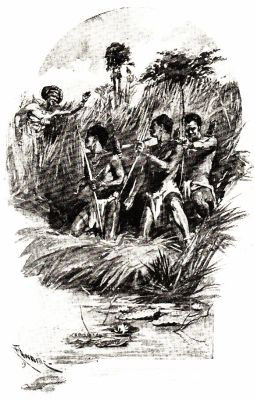
Soon after the explorer entered the Sankuru he had an adventure with the hostile natives of the north shore that a little resembled the fabled story of Pocahontas and Captain John Smith. The doctor was steaming along about twenty feet from the bank, when he saw a girl, wearing ornaments that showed she was the daughter of a chief, leaping through the grass towards the water and shouting:
"Stop, you fools! Don't shoot! Let them go! They will not harm you!"
Dr. Wolf took in the situation in an instant. He saw a party of Bassongo-Mino crouching in the herbage at the water's edge, their bowstrings drawn, all ready to launch the arrows. The girl sprang in among them and knocked the bow and arrow from the hands of the man nearest to her. She cowed the men with her loud upbraidings, and they lowered their weapons as the steamer swept past. There is little doubt that her word of command, spoken in behalf of white strangers, the like of whom she had never seen before, saved the lives of some of Dr. Wolf's party. Perhaps she knew how grateful they were for her humane and friendly act, though they had no opportunity to express their gratitude.
Sometimes the more important women among these barbarous tribes exert great influence. At another place on the Sankuru Dr. Wolf thanked his lucky stars that a woman took his part. He had stopped in front of a large settlement and tried to make friends with the people. They made no answer, but sprang to their weapons and advanced to attack him. Among the foremost suddenly appeared a girl named Pemba, the daughter of the most powerful chief in all that region. With a few words and a wave of her hand she stilled the angry tumult. She had never seen white men before, but she called to them to wait. She ordered some ivory and native grass cloth to be put into a boat, and, perfectly fearless, she went out to the strangers, had a good talk with them through the interpreter, received beads, brass wire, and cotton cloth for her commodities, and when the paddle-wheels began to revolve the boat was loaded with food bought of the natives, who at first had only arrows for the visitors. Through the influence of this girl, the explorer escaped an attack from the most powerful tribe along the river.
HE LOOKED AT A GUN WITH GREAT CURIOSITY.
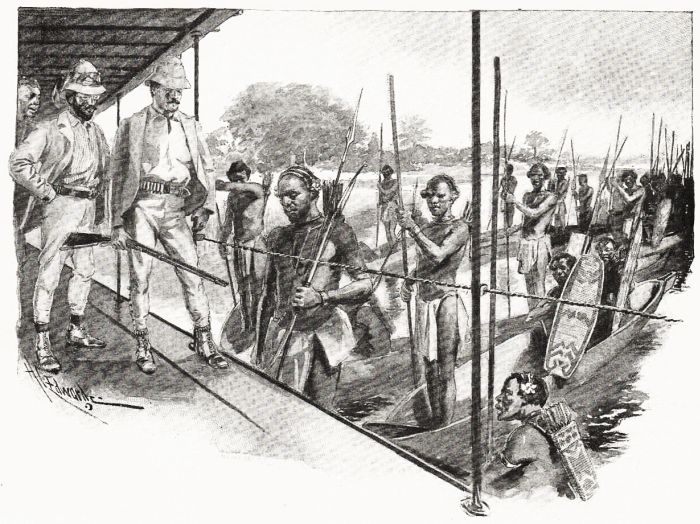
For a long distance the hostile tribes were found to speak practically the same language, and Dr. Wolf's interpreter was the most important person on the boat. The natives thought the strangers could not understand them, and so they freely talked of their plans for attacking them. One day, when Dr. Wolf stopped to repair the En Avant, natives armed with bows and arrows speedily surrounded the steamer. They were not a bit afraid, and drew right up alongside. Their chief, Tongolata, told his warriors that these strangers were entirely at his mercy. Why, he couldn't see a single weapon among them! He looked at a gun with great curiosity. "Whatever the thing is," he finally declared, "it is not a weapon." He told his people it would be easy enough to kill these folks and seize all the strange and beautiful things they were showing. Things were beginning to look squally. More canoes were coming every minute. Dr. Wolf was a man of peace, and would not take a human life unless it was necessary to save his own men. But he must do something to over-awe these savages. He showed the chief a revolver, and told him it carried lightning that killed men. Then he held the weapon so that its discharge would hurt no one, but the barrel was close to the King's ear. He pulled the trigger, and the chief fell to the bottom of his boat, stunned by the terrible noise. All the natives were stupefied with astonishment and fear. The chief held on to both his ears until he decided that he was not hurt, and then he declared that he was the white man's good brother, and honored his new friend with a present of two chickens. Some explorers—very few, it is hoped—would have fired into the crowd under such circumstances. But men who are fit to be trusted among barbarous peoples have very often been able to insure safety when danger threatened by some such expedient as that which Dr. Wolf adopted.
The actions of some of these tribes when they first caught sight of the wonderful "fire-canoe" were very curious. The Bena-Jehka, for instance, threw themselves on the ground—not in fear, however, for they greeted the coming vessel with a hearty clapping of hands. The friendly natives were greatly tickled to find that this puffing boat was no match in a race with their canoes. They could travel all around her; and no wonder, for some of their dugouts were nearly ninety feet long—twice the length of the En Avant—and eighty paddlers standing erect in the larger boats made them fairly skim through the water. Sometimes fifty of these canoes were darting here and there, playing tag with the slow steamer, and dodging her every time. It was great sport for the friendly natives of the south bank, and the hostiles across the river did not know how much fun they were missing. None of these people had ever heard of a gun.
The African telephone was busy, as the steamer advanced, carrying the news up the river. The deep notes of the big drum, or tomtom, are the signal of great events in those parts, and crowds flocked to the banks long before the vessel puffed into view, straining their eyes for the first glimpse of anything wonderful or menacing. These signals, however, do not compare with the ingenious system perfected by a few small tribes in the Cameroons, West Africa, where the sounds on the drum represent syllables and words, and so grow into sentences, like the ticks of a telegraph instrument. Only about two hundred natives have been instructed in the art, and the secret is so carefully guarded that no white man is yet able to interpret these drum-beats, which carry verbal messages from one drummer to another as fast as sound travels.
Far up the river Dr. Wolf discovered some remarkable houses built in the branches of trees. Many African tribes, like the people of New Guinea and the Solomon Islands, in the Pacific, build platforms high up in the trees, so that their lookouts may quickly discover the approach of an enemy, or their women and children take refuge among the branches in time of danger. An invention of the white men is destroying this custom of building tree refuges, and you can easily guess what it is. Traders have introduced many guns among the natives, and the women find that their rude perches in the air are no protection against bullets. But the tree houses Dr. Wolf saw serve a different purpose. The natives live in them to keep out of the wet when the land is flooded. A platform is firmly lodged in the widest fork of a tree, and a roof is built on the top of uprights that rest on the platform. The boys and girls are a happy lot when the floods subside and they can press the ground again with their bare feet.
It was a joyous lot of black men whom Dr. Wolf restored to their homes in Angola, after they had served him well for many months while he was adding this river to the maps. But on the way home they had one serious disappointment. One day they saw a group of baobab-trees, the largest plant that grows in Africa. It was many a day since they had seen the familiar sight. "Hurrah!" they cried; "we are near the sea. We are in Angola again." But they were still far from Angola.
These humble negroes helped to prepare the way for the busy white stations that are now planted on the Sankuru's banks. They should have their share of credit for the good work that was done.