A GIRL IN TRAINING.
Reading edition
BY MARY TAYLOR BISSELL.
There are three things which every girl would undoubtedly wish for if she believed they were within her reach. First, to be healthy, so that she might enjoy life with zest; second, to be graceful, for beauty's sake; and third, to be skilful, physically accomplished; and it is probable that if she knew that a certain training in life would give her these qualities she would follow it gladly.
Unfortunately there is no royal road to health or to skill any more than to learning. These are only gained by a little effort here and a little more there. It is known to every one, however, that training will do wonders in the way of improving and making over the human body.
Every girl who has a brother at college knows how ruddy and muscular and alert the college teams become when they have been in training for a season, and no one imagines that any miracle has been worked for their benefit. It is only that every man in the team is so devoted to the idea of being strong and skilful that he is faithful as the sun to the rules which regulate his eating and sleeping and exercise and bathing, so that he comes out of this so fortified that no ordinary exertion can fatigue him, and he enjoys life and its occupations with a zest which no weakling can imagine.
Of course this is the experience of men who are already healthy. Even greater differences could be shown between the condition of persons in originally poor health before and after they had adopted a suitable course of training. Now if girls of fourteen or fifteen would only agree among themselves to go into training for about four years, what fine types of young women we might hope for!
BICYCLING.
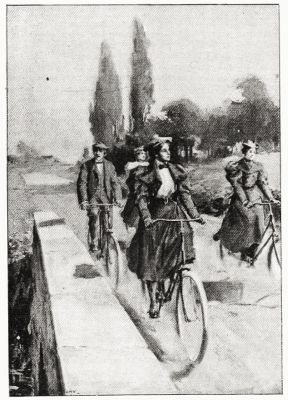
For our young American girl of fourteen or fifteen is a tall young creature, who seems for the most part to need only a little widening, and sometimes a little straightening, to give her a fine figure, and the systematic exercise and wholesome food and sleep, that are part of real training, to make her healthy.
Training does not mean exercise only, as many seem to think. It means the best sort of treatment of the body to develop and beautify and strengthen it. It means plenty of good food for bone and muscle and blood, it means plenty of sleep to keep the nerves calm and strong, plenty of pure air, and regular activity and exercise which shall be felt all over the body.
Now if this girl of fifteen or thereabouts is in earnest in wishing to develop herself into a fine specimen of womanhood, she must follow a few rules, which may be the text of her training. She can have them printed on the type-writer and hung up over her looking-glass, where she will be likely to see them often. They should include the following, and others may be added from time to time.
1. Sleep nine hours every night, beginning as early as 9.30 p.m. The beauty sleep is in the first part of the night. When thoroughly awake in the morning do not lounge in bed, but rise at once. Bathe first, or exercise before bathing as you prefer. In any case,
2. Take a sponge-bath every morning in water as it runs from the cold-water faucet. If you begin the practice in warm weather you will not notice the gradually lowered temperature of winter. Rub the skin well with a coarse towel until it is reddened. This will give you a fine sense of freshness, and prevent your catching cold easily.
3. Exercise for ten minutes at least before breakfast, if strong and hearty, in the way suggested later; if delicate, take five minutes' exercise, and the remainder two hours after breakfast or at five o'clock in the afternoon.
4. Wear no tight clothing of any kind. Tight bands about the limbs interfere with the circulation, change the natural curves of the part into ugly ones, and restrain the muscles unnaturally. About the waist, as a corset, they interfere with the lungs, with the stomach, and with other abdominal organs, and when all these are unnaturally cramped health and grace are impossible. The most graceful of actresses wear no stays, for they know that perfect ease and grace are impossible in tight clothing.
Also, if you would walk gracefully, never wear tight shoes, French heels, or pointed toes. The graceful Greek girl wore a broad sandal, and had the use of her toes, which our modern girls cannot have in the fashionable shoe, but which is essential for a dignified and graceful step.
5. Spend at least one hour out-of-doors every day in some form of exercise, and two or three whenever possible.
6. Use your mind actively in study for a few hours daily, for an idle mind is not a healthy one, but finish your studies at a definite hour, and then rest—i.e., play or exercise your body.
GOLF.
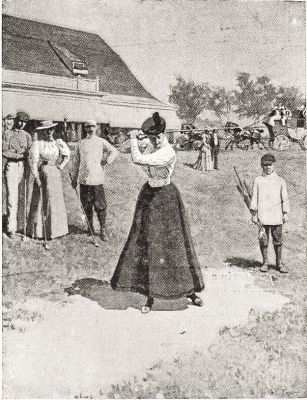
Some of the girls who may read this doubtless have the good fortune to be absolutely healthy, and perhaps their circumstances offer them all the exercise they need, although in city life this is improbable, and the healthiest will be benefited, kept in trim, physically, by following the rule for daily morning exercises.
But the girl who wishes to be strong and symmetrical often finds that in one way or another she needs a little help to straighten her shoulders, or to bring out her chest, or to give her an erect carriage; yet it is difficult for her to train herself, as she cannot see her own defects.
One device to aid self-instruction is the following: Take any old long mirror, and mark it with horizontal lines, about ten inches apart, in white chalk. The lines should be exactly straight. Then stand in front of this in your natural position, and notice whether the line of your shoulders agrees with the straight line across the mirror at their level. Probably you will see the reflection of a girl with one shoulder a little higher than the other, or perhaps standing unevenly, so that one hip is higher than the other. More than likely you will see that her chest is not full enough to make a fine figure. Perhaps the shoulders stoop a little, or possibly, while none of these defects are noticeable, the mirror shows a figure that needs only a little setting up, a more erect carriage, and the expression of a little more muscular energy, to make it satisfactory. A few special exercises that we shall add here will be excellent for all of these slight deviations from the normal; but it will be well to begin exercising every morning with two or three simple movements that will warm and limber the muscles and joints.
Begin by rising slowly on the toes and sinking back to the heels ten times. Then increase the speed, rising and falling quite rapidly twenty times, or more, if not fatigued. Then give the arm and shoulder-joint a chance. Swing the right arm out from the shoulder in a circle, and repeat this ten times. Then the left arm. After a week's practice use both arms fifteen times. Next use the trunk a little. Bend the body forward at the waist slowly as far as possible without bending the knees, and repeat this ten times. Next bend slowly to the right side without raising the left foot, and then to the left, each ten times.
Repeat the foot-raising rapidly five times, the arm-swinging and the body-bending five times each, and you will feel fresher already.
Now let us take a shoulder exercise. Take a one-pound dumbbell in each hand; face the mirror, standing firmly on both feet, with head erect and knees firm. Count one, strike the bells lightly against the thighs, with the palms turned in; on two, raise the arms to the sides, horizontally, shoulder high; and on three, stretch them backward as far as possible without lowering them, while the palms are turned forward. Hold them in this position a moment, then drop to the sides. Repeat this until slight fatigue is felt.
Exercise No, 2. Also for shoulders and back. Place both hands behind the neck, throwing the head and elbows back. Now bend stiffly forward from the waist, holding the body in that position for a moment. Rest a moment, and repeat this for a few times. If this is done properly it will be felt in the shoulder-blade region.
If fatigue is felt now, rest the upper muscles by skipping about the room. Use as many fancy steps as you can invent, or such as you may have learned in dancing-school or at the gymnasium.
Now take two or three movements for the chest. Take dumbbells, holding them down at the sides. On one, carry them forward in front, horizontally; on two, swing them back to shoulders with some force; on three, carry them straight up above the head, then back to the shoulders, horizontally; and on four, down again to the sides.
These movements can be done without dumbbells, but give a little more vigorous exercise with them.
Next take a breathing exercise. Hold arms at sides, palms forward. Inhale deeply and slowly with closed mouth, at the same time raising the arms slowly above the head, with the palms facing forward. Hold the breath with arms in this position for a moment, then slowly exhale it, lowering the arms slowly, as the breath goes out, until they reach the original positions at the sides. The elbows should be kept stiff all this time, and the palms facing forward. Repeat this slowly five times.
Another good breathing exercise may be taken with dumbbells. Hold the bells at the sides, waist high, palms up and elbows crooked. Then take a deep breath, and hold it while you swing the arms back vigorously past the hips, holding them in that position as long as you can retain the breath. The palms should face forward, and this position will throw out the upper chest finely. This movement should be repeated three or four times.
All of these movements should be taken in loose clothing, without corsets. If taken in the morning, they may be practised before the mirror in undress costume. At any time a loose waist is absolutely necessary.
Movements that keep the body balanced on the toes are good for grace and poise.
Such an exercise is walking on tiptoe on a narrow board about six inches high and thirty feet or more long, with arms extended wide, and a light weight on cushions balanced on the head. Such an exercise cultivates the spinal muscles, and helps to give the control over them that is necessary for a graceful and even carriage of the body.
Peasants in foreign countries, who carry baskets full of produce up and down hill, where walking is more difficult than on a level, are often noted for their graceful bearing, which is undoubtedly cultivated by this exercise.
What is called the deep-knee bend is another excellent balancing movement, and may be practised as follows: Stand erect, hands on hips. Rise on toes; then, bending the knees, sink down on the toes as far as possible, holding the upper part of the body erect. Rise and rest on the whole foot; then repeat. This is still more difficult if taken with arms held above the head, or sidewise, shoulder high.
When out-of-doors a girl should learn to climb nimbly and well, trying first on a low fence or a stout low tree. It is excellent practice, and gives her good control of herself. For the same reason practise climbing a ladder up and down, inside and outside. This is considered worthy of being taught in the gymnasium, and girls may well learn it at home in the country.
The practice and the courage it gives may some time save a girl's life, and to learn how to use one's body in every sort of position is a part of good training.
BASKET-BALL.
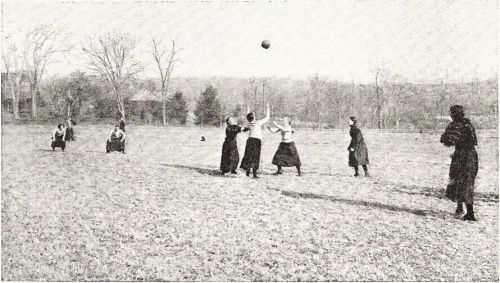
For the same reason girls should play ball or other games that cultivate dexterity and quick judgment, and that train the eye; and in the summer many such sports are open to them as well as to boys.
A girl should also practise running whenever possible, and learn to run in good form. It is an excellent exercise for the chest, and helps to cultivate physical endurance.
Very few girls run properly. In running the arms should be carried close to the sides, the elbows bent, and a rather long step taken, running on the ball of the foot. If new to the exercise, the first two or three trials should be made slowly and only for a short distance, perhaps the length of a city block. The speed, as well as the distance, may be gradually increased, always beginning and ending slowly, the highest speed being attained in the middle of the run.
In the country opportunities for this practice are numerous, but in town a gymnasium hall is the only opportunity that is always open.
Walking is indispensable for a girl who hopes for health and vigor, and training for this consists in beginning with moderation, but systematically, to walk short distances, gradually increasing the length of the excursion, until ordinary country jaunts and mountain climbs become easy and delightful matters.
Another exercise which is excellent for girls, and which is now being very widely indulged in by them, is bicycling. It is an excellent exercise if not overdone. Girls should remember when they first begin to ride that the muscles which are brought into play are not ready to stand the work which they may be able to perform after having been trained for some months. Therefore, only short rides of from four to five miles should be taken at the beginning, making the excursions a little longer week by week, but always stopping as soon as fatigue begins to be felt. Most girls will find that they can ride much farther, and with less fatigue, if they will rest for about fifteen minutes midway in their journey.