MARY KENT ON DECK.
Reading edition
BY W. J. HENDERSON.

he bark Bunker Hill, of Boston, homeward bound from Rio Janeiro, was staggering across as wild a stretch of the north Atlantic as ever frightened the heart of man. She had left Rio in early October, with a wafting of gentle winds among the swelling curves of her snowy studding-sails, and had floated northward to the equator in a sea of lucent blue that looked as if it had never known how to frown. Once across the line, the Bunker Hill had run into the doldrums, and for ten long days had slatted the lax folds of her canvas against her tall yellow masts, until Captain Elisha Kent's heart turned sore and heavy within him. Then the northeast trades reached down into those latitudes, and the bark began to fight her way northward against a breeze that would not let her lie within four points of her course.
But at length, early in November, she was somewhere to the northward and eastward of Bermuda, when the barometer began to go down with a steady rush, and the wind died completely out. A sickening roll of mountainous swell set in from the southeast, and the sky hardened down to a callous unbroken gray. Captain Kent walked the quarter-deck with his daughter Mary, a brown-cheeked, healthy girl of sixteen. Every day Mary took a trick at the wheel, for she could steer a compass course as well as any fore-mast hand. Better still, she could work out a ship's dead-reckoning, and "shoot" the sun for latitude or longitude, as well as her father, who had taught her how.
"It's coming, lassie," he said to her, as they walked the reeling deck together.
"Yea, father, there's a storm down there somewhere," she answered.
"Well, I think we're as snug as we can be," he said, gazing aloft.
The morning and forenoon watches had been spent in preparing for the gale, and with extra lashings on everything movable about the deck, and the bark down to a close-reefed main-topsail, a shred of spanker, and a storm jib, Captain Kent and his pretty little mate felt that all that was possible had been done.
"I'd feel easier in my mind, though," said the Captain, "if one of my mates was able to be on deck."
"I know I'm only a girl, father," said Mary, "but I think I've been of some use to you on this voyage."
"Bless you, my girl," said the Captain; "you've been the greatest help in the world to me with your bright face and cheerful ways. But I don't think you can stand watch in a heavy gale, dear, and I'm worried for fear this one that's coming may outlast my strength."
"Then I'll tell you what I think you ought to do, father."
"And what's that, Mary?"
"The bark is snug, so you go and lie down now. See if you can't get two or three hours of sleep before the gale begins. I'll keep the deck, and call you at the first change in the weather."
The Captain looked at her thoughtfully for a moment, and remembered how thorough her sea-training had been. But she was so young!
"Well," he said, "I fancy there's some sense in your idea. Now pay attention."
"Yes, father."
"You see that particularly hard-looking spot down there in the southeast?"
"Do you mean where the clouds look so much like slate-pencil?"
"That's the place exactly. Now you keep your eye on that spot, because that's where I'm expecting the wind to come from. If that spot grows lighter, you call me at once."
"All right, father," said the girl; "you make your mind easy. I sha'n't lose sight of that spot."
"But at the same time, Mary," continued the Captain, "you mustn't neglect to keep a sharp lookout all around, for the wind may come from some unexpected quarter."
"Don't be afraid, father dear," said Mary, smiling up at him bravely; "you know I've been at sea before."
"Yes, my girl, I know; but you've never had quite so much responsibility on your shoulders. There, now, I'll go below and lie down just to please you."
Captain Kent paused a moment at the door of his cabin and shook his head.
"It's a strange thing to leave a young girl like that on watch at such a time, but what else can I do? She knows more in a minute than those muttonheads forward do in a month."
And with that thought in his mind the Captain went below and tried to snatch a brief rest before the coming of the storm. Mary, who was well accustomed to the wild movements of a vessel's deck, stood balanced with her shapely feet well apart and her hands clasped behind her back. With her knitted woollen cap pulled down over her ears, a big muffler around her neck, a heavy pea-jacket, and a plain skirt, she looked not unlike a picture of one of those old Dutch skippers that one sees in pictures of the days when the Netherlands were a power on the high-seas. The sharp frosty air made her cheeks as red as roses, and her brown eyes sparkled like stars. The man at the wheel, who had little enough to do in such a villanous calm beyond keeping the spokes from jumping, gazed at her in admiration, and the men forward nodded their heads approvingly at one another as they saw the Captain go below.
"Sorra's the weather we'll be afther havin' afoor noight," said Pat Maginn, "an' it's good the Cap'n goes to resht lavin' the foinist mate oi iver see on watch. But oi wish thim fellies that's sick beyant war on the deck too."
At four o'clock in the afternoon, just at the beginning of the first dog-watch, Mary saw a sudden glow of ghastly light in the hard spot in the southeast. Springing to the head of the companionway, she called down into the cabin:
"Father! Father! It's coming!"
The next moment Captain Kent hastened on deck, and after a quick glance said:
"Good, Mary, you caught it at the start. We'll have a capful of wind here presently, and a sea fit to swallow us before morning, for the centre of this storm is southwest of us, and we're on its worst side. We must get the bark hove to on the port tack."
A few moments later ragged patches of grayish-brown cloud began to fly over the bark, and then the wind burst upon her with a wild and terrifying shriek. It came fair over the starboard-quarter, and drove the Bunker Hill's lee rail level with the water; but under Captain Kent's orders the canvas was trimmed, the bark's head fell off, she wore round, and came up to the wind on the port tack. The ocean was blown out into a flat plain of boiling foam for a few minutes, but that state of things could not last long. Before five o'clock a tremendous sea was running, and the Bunker Hill was reeling through it like a crazy vessel.
Mary was already tired. She would not have confessed it, but she felt the strain of the long voyage, with its succession of nursing and service as assistant to her father. So she was glad enough to see him looking fresh, hearty, and reliant as he stood near the lee rail.
"Well, dear," he roared in her ear, "we are as snug as we can be, and you and I'd better go below and get a bite to eat."
The girl willingly accompanied her father to the cabin, where they made shift to get such a meal as the crazy swoops and lurches of the vessel allowed. They had hardly finished when there was a report like a cannon-shot, and one of the men bawled down,
"The main-tops'l's gone, sir."
"Stay you here, Mary," said the Captain, as he sprang up the steps to the deck.
Mary heard his strong voice shouting orders that rang above the roaring of the gale. Then there was a confusion of cries forward and the crash of tons of water falling on the forecastle deck. Mary knew that the bark had shipped a great wave, and she felt instinctively that something had happened. She rushed on deck. The lee scuppers were running off water in great spouts, and the deck forward was littered with disarranged rigging. But that was not what terrified Mary. She saw her father half lying and half leaning against the lee rail, apparently in an agony of pain.
"Father! father!" she cried, as she ran to his side, "what is the matter?"
"A thump—in the ribs," he gasped. "I guess—something's broken."
For an instant the girl's courage faltered, and she felt as if she would faint; but her innate strength of character supported her.
"Something must be done for him at once," she said to herself, as she called to some of the men to come and help her. They picked the Captain up and carried him to his cabin, where they laid him gently on a cushioned locker.
"What on earth'll—we do—now?" gasped the Captain. "I'm laid out—for the rest—of the voyage."
"Oh no, father," said Mary, with a cheerfulness that she did not feel; "you'll be all right again before this gale is over, and we'll pull the Bunker Hill through that all right. Won't we, men?"
"Ay, ay, miss; that we will."
"God bless you, my child," gasped the Captain; "and you too, men; but—I've got two—broken ribs here."
They were all silent for a few minutes, while the cabin reeled from side to side, and the hollows of the vessel were full of groans from the straining of her timbers.
"Father," said Mary at length, "don't worry about the bark, anyhow. You've got a good crew, and they'll take care of the bark."
"Yes, sir, Cap'n Kent," said one of the men; "we're mortal sorry for to see you done up, sir, for you've treated us good, an' we knows it."
"Thank you—men," said the Captain, and then he fainted. Mary sent the men on deck, and with the assistance of the cook put her father in his bunk, where he presently recovered his consciousness, but was still in great pain. Mary sat beside him in deep thought.
"Dare I do it?" she said to herself. "I am so young; yet I am not inexperienced, and something must be done. Half the crew and the mates down with berri-berri, and the Captain disabled; the bark must be— I'll do it."
"What are you—thinking about, Mary?" asked her father.
"This. We must make for the nearest port that you may have proper medical attention, father, and we must do it the minute the gale moderates enough to let us clap more cloth on the bark. The barometer is rising, and the wind has shifted four points. The gale will break by morning. We are on the outside edge of it, and we'll soon be out of it. Now, father, put me in command of the bark, and I'll take her into New York."
"But will the crew—obey you?"
"Ask them."
Mary went on deck and asked the men, except the helmsman, to come to the cabin.
"Men," she said, "the Captain is hurt, the mates and half the crew are sick. The bark ought to go to the nearest port. I can take her there. Will you help me? What do you say?"
"That you're right, miss," said one of the men. "And we'll take our orders from you same as from the Cap'n. Won't we, lads?"
"Yes, yes!"
"Now, father," said Mary.
"I turn over—the command—to you, dear," said the Captain.
The next day at noon the gale had moderated to a fresh breeze, and though a heavy sea was running, the clouds had broken and the sun was peeping through. Mary went on deck with the sextant to get the ship's latitude. She poised herself on her graceful limbs, and handled the instrument like a veteran. Presently she got the sun's highest altitude.
"Make eight bells!" she cried.
"Ay, ay, sir—I mean, ma'am!" cried one of the men forward as he sprang to obey the order.
Mary went below and worked out her reckoning, while her father eyed her lovingly as she thumbed the navigation tables and the nautical almanac.
"It's three hundred and thirty miles west nor'west to Sandy Hook, father. The wind is sou' sou'west, and we can lay our course."
The Captain smiled faintly, for he was in much pain, and murmured, "Bless you!"
"ALL HANDS MAKE SAIL!"
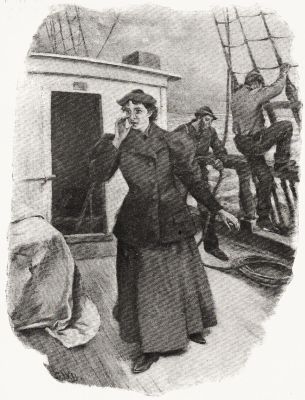
Mary went on deck and shouted, "All hands make sail!"
Every able man in the crew, including the cook, sprang on deck with the activity of cats, eager to show their willingness to serve her. The bark was still under the flying-jib, maintopmast stay-sail and reefed spanker which she had carried through the end of the gale. The men were anxious to know how their young skipperess would go to work. The girl's face was calm and confident. Her cheeks glowed and her eyes burned. In a clear musical voice she cried:
"Shake out the reefs in the spanker! Hoist the jib and haul out the spanker!"
As soon as these orders were executed she cried again, "Loose the foretop-sail and maintop-gallant sail!"
The men danced aloft to attend to these orders.
"Stand by! Let fall! Sheet home and hoist away!"
The men flew about like bees.
"That's sail enough till the sea goes down," she said. "Brace sharp up and haul out the tacks! West nor'west," she added to the man at the wheel.
"Three cheers for Miss Captain Kent!" cried one of the men, and they were given with a will. Two days later the bark Bunker Hill went up the Swash Channel behind a tug, and dropped anchor off Quarantine, where the ship-news reporters learned of her remarkable story and filled the papers with Mary's fame. In the following summer Mary was granted a master's license, and when Captain Kent went to rest in the old churchyard, his daughter took command of his ship, and was one of the few women sea-captains in the world.