THE NEW MOTHER GOOSE.
Reading edition
There was a man in our town Who was so wondrous wise, He didn't try the bramble-bush And scratch out both his eyes, But sat him in a big arm-chair, Upon a schooner-yacht, And said to those who jeered at him, "I'd rather see than not."
BY LIEUTENANT-COMMANDER J. D. JERROLD KELLEY, U.S.N.
(In Two Installments.)
In that happy hour or more after hammocks are piped down, and before tattoo is sounded on board ships of war, the sailor has his season of unvexed merriment. This leisure is a cherished one, and his pleasure runs the gamut of many physical bouts. He boxes, gives play with single-stick and quarter-staff, both vigorous, determined, and honestly punctuated with resounding whacks and grinning acceptances of pain. The bear is chased amid much license of noise, and Jack swims, dives, rows, wrestles, and dances. And how he dances! Save on board flag-ships, bands are extemporized affairs; for the sailor loves his music dearly, even when he has to pay his piper, and is a prentice hand with various instruments, though, I think, there is an unwritten law against the wheezy and soul-envenoming concertina and a respected prejudice concerning the piccolo.
I do not know that he hornpipes it so much as he jigs it, but when he does go in for form and style his traditional performance is filled with grace and honest delight.
It is at this hour, too, that the dumb pets of the crew have their rarest frolic; for, by the association—by the inspiration perhaps—of the same sentiment, this twilight season becomes to the sailor what the children's hour is to the luckier landsman in homes where love is sanctified by the tender witcheries of happy childhood. The isolation of the sailor, the craving during long years of exile for something that cares for him purely for himself, is a charm to conjure with, and lucky indeed is the dumb brute whose life falls in the pleasant places of the forecastle. Indeed, the fondness sailors show for their pets is proverbial, and so intimately are these associated with certain famous deeds of the sea that they have acquired a definite name and fame, and are as well known and as fondly remembered and lamented as are the races of bygone days by ancient jockeys and stable-boys.
With sailors this feeling often borders on a sincere affection, and in the early twilight of a second dog-watch I have seen weather-beaten, battle-scarred bluejackets fondling some pet as tenderly as a mother would her first-born; and then, when darkness fell, stowing it in a secure bed and bidding it a most affectionate good-night. The catalogue of sea pets would read almost like the Homeric enumeration of the ships, for these are of every description, from field-mice to bears. Those most generally found are dogs, cats, monkeys, and parrots. The accomplishments of the parrots are especially weird, and sometimes uncanny, and there is a tradition that sailors teach them to talk by feeding them with bread balls in which grains of red pepper are secreted. When the parrots taste the pepper they begin to scream and squawk most fiercely, and this is the apt season for their teachers to repeat fast and furiously the words they seek to have learned. In their rage the parrots repeat the words thus spoken, and by dint of mild torture and bad temper acquire a vocabulary which sometimes becomes very varied. Monkeys are usually dressed in ludicrous copies of foreign soldiers' uniforms, are taught to drill, and especially to salute and salaam profoundly at the word of command.
The west coast of Africa, Brazil, and the waters about the Asiatic station are famous for the queerness, variety, and cheapness of pets, and if the crews were not restrained the ship would soon become as riotous as a bear-garden and as clamorous as a menagerie. Among the animals that have been mustered among a ship's family are black pigs from Hong-kong; silvery gray squirrels from Shanghai; long-haired chrysanthemum-tailed dogs from Kobe; rabbits from Chin-kiang; bears, and quaint little black chickens with feathers that stick out like porcupine quills, from Nagasaki. From the mud shores of Yang-tse-kiang the sailors get "miners," birds of the crow family, which with patience and care soon learn to talk cleverly in the quaint dialect of the sea. At times more than one of these pets claims the allegiance of its owner. I recall an aged fore-mast-man of one of our sloops of war, the Vandalia, I think, who had collected a most interesting family, consisting of a dog, goat, cat, rabbit, hen, parrot, and monkey, all living in a harmony which put to shame the quarrelsome members of like households in stuffy museums. So well behaved and decorous were they that even the strictest of first lieutenants, watchful for holy-stone decks and shining paint-work, could not complain. Another of our war-ships mustered a pig, a bear, and a dog in its books.
These had become thoroughly sailorized, going at drum-beat to quarters, mustering with their divisions, and observing with a fine precision the routine of the day. By an unexplained but accepted assumption of rank, the pig took his station on the quarter-deck, the bear mustered amid-ships, and the dog clung to the eyes of the ship, each in the wake of his adopted guns' crew. Nothing was allowed to disturb this ceremonial precedence, not even the riot and roar and the slaughter sometimes when the ship was in action. At times the bear, with misty recollections of pine woods and underbrush, would cut adrift from the restraints of education and run amook in the gangways, more or less violently hugging members of the crew. He showed a fine discrimination between friend and foe, cherishing for days the remembrances of an affront, and never losing an opportunity of avenging it, as many a madcap youngster had occasion to remember.
Of all pets, none is better suited for ship life than the wily goat, and the traditions of the navy are jocund with quaint stories of this animal. Once in the good old days of tarpauling hats and true-lover's knots, a famous ship's company owned one that fell into evil ways, such as chewing tobacco, drinking grog, and challenging the best men in the ship to butting-matches. Indeed, he became a very rakish, swashbuckling, timber-shivering goat, who lived long and not well, and died after a prolonged debauch in a fit akin to what Jackie calls the "horrors."
Each day, by common consent, the men added a pint of water to the grog tub, and regularly in his turn Bill came for his tot. At seasons, when the master's mate of the spirit-room was disguised with over-much drink, the goat, like his two-legged messmates, doubled on the tub, securing a smuggled ration. He came to grief at last, for on an occasion when the grog was stiff to his liking he got well to windward of the tub, charged like a first boarder over a clear hammock rail at the mate and purser's clerk, took possession of the marine bar, and got so gloriously fuddled, so gloriously uncoo' fou, that he never recovered, but went overboard, in a middle watch, through sheer despair and misery.
Another goat was the prized shipmate of one of our vessels wrecked on the coast of India, fortunately in weather moderate enough to launch the boats and rafts. Each man was detailed for his place, and allowed to carry his bag of clothes or his hammock—no greater provision being needed, as the shore was close aboard. As the men slowly lowered themselves over the ship's side, the nanny-goat stood amongst the waiting ones, watching her master, the ship's cook, who stood irresolutely at the mast until his turn came. The cook was an old sailor, and his kit was very valuable to him—it was probably all he had in the world—but when his name was called, he dropped the bag, and touched his hat, and said:
"IF YOU PLEASE, SIR, I CAN'T BEAR TO LEAVE NANNY BEHIND."
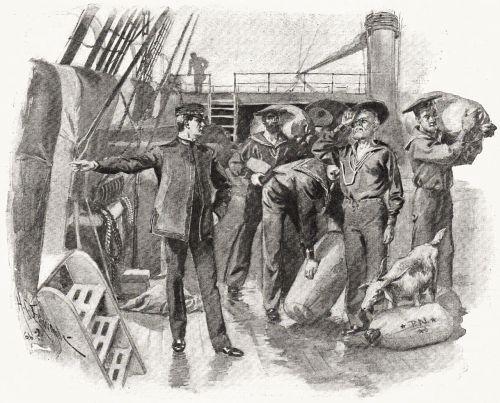
"If you please, sir, I can't bear to leave Nanny behind. I'll take her instead of the bag, for there isn't room for both." And then, appealingly, "Can I, sir?"
Nanny went over the side and landed with him, marched by him through the desert, and when relief came bleated her enjoyment in a way that repaid him for the sacrifice. For many years she browsed among the scrap-heaps and rare grass-plots of the Brooklyn Navy-Yard, where, surrounded by a numerous progeny, she doubtless told, with many butts, the yarn of the day when her cook and master saved her up Mozambique way.
I remember some pets of my sea-going days, cherished in life and mourned in death. One was a scraggy hen, of no known breed, raised in Polynesia, and given to one of our officers by a native woman in Nukahiva. Her abnormal thinness saved her from the steward's knife in the early days at sea; but finally all hopes of fattening her failed, and she was doomed for a ward-room ragout. One of the men, a queer character in his way, who had made a study of chickens, begged permission to keep her, and as we had fresh grub enough, Nell, as he called her, was saved. In a little while it was more dangerous than a Grain Coast fetich or a Hawaiian taboo to harm her, and Nell thrived and flourished.
She was carried through all the islands down to New Zealand and Australia, and back to Chili and Peru, improving daily, and displaying an intelligence that was marvellous. She was the queen-regnant of the coop, when she deigned to enter it, and was as jealous of her prerogatives as the King of Yvetot. Her cackle proclaimed the daylight, and then there was a row if Jemmy Ducks, guardian and feeder of sea poultry from time immemorial, didn't hobble aft to give her a morning ramble to leeward. The first of the corn and water was hers, and having the coigne of vantage beyond the coop bars, all the lesser chickens, save some favored chanticleer, suffered.
She displayed a passion for bananas and yams, had strong marked personal likes and dislikes, and though coquettish, manifested an affection that was not hampered by official rank, but ran by a descending scale of years—a white-haired quartermaster possessing more than a tender spot in her capacious heart, while the ship's boys were held in a contempt beyond expression. The men vowed by all the pet warrantees of their profession that she whistled and talked, and I know she was as good a storm-glass as any standard instrument on shipboard. Her favorite roost was over the ward-room skylight, her chosen time the dinner hour, and there she would perch, eying with respectful familiarity the senior lieutenant. Her interest gradually increased as the dessert stage approached, the appearance of the fruit awaking a cooing, beseeching cackle that invariably brought her the ripest banana or the juiciest mango.
She often kept the deck officers company in the middle watches, dozing to leeward of the mast until the bell struck, when she would straighten with an assertive air, as if she had never slept, and cooed a warning hail to the lookouts.
Poor Nell died during the Darien survey, from indigestion and old age, and when she was carried ashore for burial, in the neat coffin Chips, the Scotch carpenter's mate, had fashioned for her, we all felt that she had made a place in our lives and memories that some day deserved a record.