Breakfast Cocoa
Reading edition
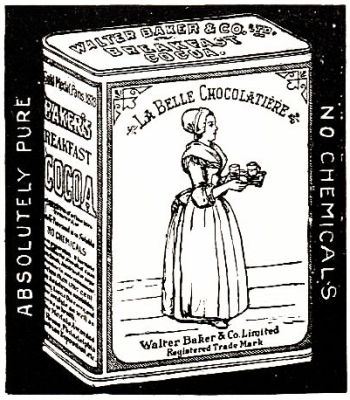
Always ask for Walter Baker & Co.'s
Breakfast Cocoa
Made at
DORCHESTER, MASS.
It bears their Trade Mark
"La Belle Chocolatiere" on every can.
Beware of Imitations.
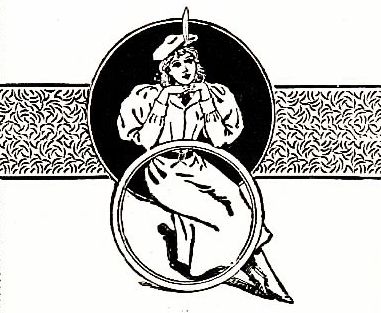
HARTFORD Single-Tubes are the easiest and quickest to repair. That saves time and patience. But this point would be of little worth apart from their strength, elasticity, safety and hill climbing power. The secret of making is ours. The tires are yours for any bicycle.
IF IT'S A HARTFORD TIRE IT'S RIGHT.
OF ANY DEALER.
THE HARTFORD RUBBER WORKS CO.
HARTFORD, CONN.
New York. Philadelphia. Chicago.
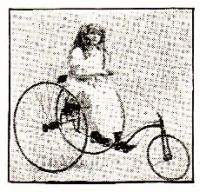
EARN A TRICYCLE.
We wish to introduce our Teas. Sell 30 lbs. and we will give you a Fairy Tricycle; sell 25 lbs. for a Solid Silver Watch and Chain; 50 lbs. for a Gold Watch and Chain; 75 lbs. for a Bicycle; 10 lbs. for a Gold Ring. Write for catalog and order sheet Dept. I
W. G. BAKER,
Springfield, Mass.
San Jacinto.
La Porte is a new town, situated on a point of land nearly surrounded by Galveston Bay, Morgan's Ship Canal, and San Jacinto Bay. It is about twenty miles from Houston, and thirty miles from Galveston. The scenery in this part of the coast country is beautiful, and the place is not without historic interest. On this point of land was formerly the town of New Washington, which was burned by Santa Anna before he left for San Jacinto battle-ground, which is only six or seven miles from here. It was there that the Texans under General Houston routed the Mexicans under Santa Anna on that memorable day, the 21st of April, 1836.
The battle-ground is located on Buffalo Bayou. It comprises twenty-three acres, ten of which are owned by the State. The "Daughters of the Republic" are raising funds to beautify it and erect a suitable monument. There is only one monument there now. It is a plain marble shaft about fifteen feet high, with inscriptions on the four sides of the base.
San Jacinto Day is a legal holiday in Texas, and large numbers of people celebrate it by picnicking at the battle-ground. Exercises are held in the public schools. This year I recited Lillie E. Barr's poem, "San Jacinto Corn," published in the Round Table for January 21, 1896. The battle of San Jacinto lasted only eighteen or twenty minutes. There were more than fifteen hundred Mexican troops opposed to seven hundred and eighty-three Texans. The loss of the Texans was two killed, and twenty-three wounded, six of them mortally. The loss of the Mexicans was six hundred and thirty killed, two hundred and eight wounded, and seven hundred and thirty prisoners. Santa Anna was taken prisoner on the 22d, and General Cos on the 24th.
Mercy Compton Marsh, R.T.L. La Porte, Texas.
My Escape.
The sun had set on yonder hill, The little brook was very still, And I went to bed with a cheerful heart, Knowing that all was well. But as the midnight rolled on still, There came the dreadful cry Of fire! fire! on the hill, And I prepared to fly. I rolled an egg up in a shawl, And saddled my horse near by; I sprang to the saddle and plied the paddle, And then commenced to fly. My horse flew up to the skies And landed on a cloud. And then I heard for the first time A thunder wild and loud. And there on the cloud beside me stood A giant large and tall, Who, in a voice of thunder, cried, "What right have you here at all?" I shivered and shook from head to foot, And the giant he roared with rage, "I'll take you home with me," he cried, "And shut you up in a cage." But I ran to the edge of the cloud And gave a fearful leap, And the shock awoke me, and I found That I had been asleep.
Composed jointly by Helen, Virginia, and Gladys Mackay-Smith, aged 9, 11, and 13 years.
A Delightful Morsel about Japan.
A Lady of the Order, aged twelve, living at 118 B. Bluff, Yokohama, Japan, writes to the Table: "Here is a brief description of Nikko, which we visited two summers ago, and I hope it is good enough to print." It is quite "good enough." The Table would be glad and thankful for other morsels equally delightful.
CHARMING NIKKO.
Many hundreds of years ago one of the Tycoons, as the Emperors of Japan were once called, sent one of his retainers to look for a burial-place in Japan for his father, who had just died. The retainer, after having looked for a long time found a barren place which was, however, very beautiful, and seemed suitable to him for an Emperor's burial-place. He planted there an avenue of trees now called the "Tokaido," and after many years Nikko was founded.
This is one of the most beautiful country-places, about seven hours in the railway from Yokohama. It is a lovely place in the mountains, about 3500 feet above the level of the sea, famous for its scenery and lovely temples. Many people go only to see these magnificent buildings. There is something so lonely, so mysterious, around these temples situated in damp low ground! Around these holy places grow huge cryptomerias, a kind of fir-tree, the stems covered with moss and climbing plants; altogether they are very beautiful to look at.
The interior of the temples is even more lovely and grand than the outside. The walls are decorated with valuable old carvings and glistening lacquer. Even the floors are sometimes lacquer, and here and there in some temples are images of gods entirely of gold. There is said to be one temple in Nikko wholly covered with gold. One other thing so lovely in Nikko is the abundance of running water and cascades. One cannot go out of hearing of the constant rushing and rippling of water. If you see this water, you will notice that it is as clear as crystal.
There are no hot springs in Nikko as there are in other Japanese country-places. Instead, all are icy cold. People are often tempted to drink this water, as it is so clear, but it is not so clean as it looks, because the Japanese wash all their pots and pans in it. There are also many pretty water-falls in Nikko. The "Kirifuri," which means "the beautiful mist," is the biggest and grandest. This water-fall falls about forty feet over stones into a rocky basin which leads into the little and wild river "Diagawa," which flows through the whole of Nikko. The way down to the water-fall is very steep and rocky, but on the damp rocky walls on both sides grows a kind of maiden-hair fern.
The "Urami" water-fall is the next in size and beauty. Before you get to this one you come to some tea-houses, where you are supposed to rest and take refreshments. Here the wild river comes rushing past. To get to the water-fall you must go through a kind of ravine which is very beautiful and rocky. One side of this is a damp wall overgrown with all sorts of climbing plants and beautiful moss. Moss, by-the-way, is another thing for which Nikko is famous. The Urami fall rushes down in three cascades, one on each side of the big one. You are able to go behind the big one so you can see it rushing in front of you.
The "Red Lacquered or Sacred Bridge" is another wonder of Nikko, and is known all over Japan. It is made entirely of red lacquer, and anybody who walks on it, except the Mikado, is shot! It is only unlocked when he is in the place. As lovely as Nikko is in summer-time, when all the various flowers are in blossom, it is even more lovely in autumn. Then the foliage takes the prettiest colors; the Japanese maple is wonderfully beautiful with its dark and light red or green shades. Nikko is a place which I should advise any one who comes to Japan to visit. I am sure he would be well paid for the tiresome journey there.
Cecile Rogers.
Handy to have in Mind.
The next time you are asked to tell a riddle, tell this one:
Lo, the poor Indian, imprisoned stands, Betwixt a bird and a feather. From aloft all three a warning send To ships in stormy weather.
The answer is Hen-lo-pen (the Cape).
Shadows Come Even Our Way.
We are sure there is no member who fails to recall the delightful morsels contributed to the Table by Lady Florence E. Cowan. They were dated Kingman, Arizona, and told us about the Indians, the plants, the folk-lore, etc., of that Territory. Her articles were exceedingly interesting, and always well written. Besides, her personal notes accompanying them were models of frankness and yet brevity. A brief note signed "S. Z. B." informs us she is dead. The Table and its readers are pained by the news.
Kinks.
No. 6.—NATURAL-HISTORY ENIGMAS.
I am loud and turbulent, yet incapable of noise;
I'm the forefront of battle, and the simplest of toys;
I live in the water, but must be always kept dry;
I am perfectly deaf, yet hear every cry;
I swim all the time, keep step when I travel;
I am fixed in one place, now this riddle unravel.
Of ten animals allowed in heaven, According to Moslem creed, My first is one. My second's another Of the same identical breed. My third each is when once he gets there, After they let him in. My whole the Moslem law keeps out, Since he is a man of sin.
I nourish my young, and so am a beast;
My four feet are tied, so I walk but the least;
I am hard as a rock, am soft as pure silk;
I'm a dark, ugly brown, am whiter than milk;
I am made from a tree, am dug from the ground;
I grow from a seed; in the rocks I abound;
With never a feather, like a bird I can fly;
I am entirely dumb, but still have a cry.
A bird that can fly, with never a feather;
A beast with four feet bound closely together;
A rock and a vegetable, an earth and a tree;
I am all of these things; now what can I be?
I am so lowly I cling to the ground, Yet soar to a heavenly height; I represent the only thing of my kind. Yet am owned by each human wight; Each person can have only one of me, true, Still, strange as it seems, he always has two: I can swim on the water, but am sure to sink through it, I am purely a spirit, going where man can't pursue it; I'm the oldest of matter, have form, weight, and feeling, I am simply a sound, loneliness revealing. Though owned by the English, I belong to no nation, Yet furnish support to all human creation.
Anybody May Enter this Journalism.
Frank Homer King contemplates starting an amateur paper, and asks whom he must apply to for a permit. Frank need apply to no one. He is free to name his paper anything he pleases, and to publish it as long and as often as he can pay the printer's bill. If he wishes to enter his publication in the mails, that it may be sent at newspaper rates, he applies to the postmaster of his city, who will give him a blank to fill out.
E. C. Hoff, Carroll, Iowa, and James M. Hughes, Richmond, Mo., contemplate starting amateur papers, and want contributions of stories, poems, etc. Joe Gibson. Jun., Ingersoll, Ont., and Cassius Morford, Banfield, Mich., want to receive samples of amateur papers.
A Glimpse of West Point.
In the summer the parade-ground at West Point is a perfect green sea of grass, so well is it kept. The many white duck tents make a picturesque sight, looking like so many sail-boats in green water. The view from Fort Putnam, above the Post, I cannot describe, so beautiful is it. The narrow Hudson, with its many turns, is indeed similar to a brand-new silver ribbon, while a sail-boat seen from this height can hardly be distinguished. It would look like a sea-gull seeking for food, and going at a speed which could only be determined by taking sight from some fixed object.
Hans W. Gerhard.
This Department is conducted in the interest of stamp and coin collectors, and the Editor will be pleased to answer any question on these subjects so far as possible. Correspondents should address Editor Stamp Department.
The London Philatelic Society and the stamp-dealers of London have appointed a joint committee to arrange for a postage-stamp exhibit in 1897. It is proposed to hold it at the Crystal Palace, and if proper conditions can be arranged to insure the stamps and take care of them during the exhibition, probably stamps to the value of nearly $2,000,000 will be shown.
The Swiss collectors will hold an exhibition this summer in Geneva, which will doubtless be very attractive. One of the largest collections of Swiss stamps is now for sale in New York city. It contains everything in used and unused condition—locals, general issues, singly and in blocks and sheets, post-cards, envelopes, money-order blanks, etc. The price asked is $6000, which is probably less than could be obtained if the collection were broken up and the stamps, etc., sold separately.
Holland holds a stamp exhibit at The Hague from July 17 to July 22, inclusive.
An elderly lady in British Guiana gave her rector an envelope addressed to "Miss Rose, Blankenberg," as an Easter offering. On the envelope was an unsevered pair of the extremely rare 1851 2c. rose British Guiana stamp. The envelope is probably worth $3000. A copy of this stamp, trimmed round, was sold in New York by auction, from the De Coppet collection, for $1050 several years ago.
The A.P.A. (American Philatelic Association) holds its annual meeting this year in the middle of August at Lake Minnetonka, a beautiful summer resort. The successor to President Tiffany will be elected, and preliminary canvassing for votes is now in active operation. Boston wants the 1897 convention.
Venezuela is out with another series of unnecessary stamps to commemorate "The Apotheosis of General Francisco de Miranda." Five varieties—5, 10, 25, 50, 100. It is a very good set to let alone.
J. C. Lunt, 109 Liberty Street, San Francisco, wishes to exchange stamps with Mexican collectors.
C. L. Pattison.—Columbian stamps, 1-30, inclusive, are worth 50c. per set, used. The Hawaiian Provisionals are worth $2.50 for the 2c. vermilion, 35c. for the 2c. brown, 8c. for the 2c. rose or violet.
Ross Baker.—Common coins have no selling value beyond their face if U.S. coins, or at bullion value if foreign.
E. L.—U.S. cents for 1806 worth 35c., 1826 and 1842 worth 5c., 1834 worth 10c. Half-cent 1806 worth 15c. These are the prices dealers ask. What they pay I do not know.
A. Hobbs.—In making a rubbing of a coin use thin transparent paper of a firm texture, and a hard lead-pencil. A soft pencil gives poor results.
J. Smythe.—Your Afghanistan stamp is all right. Practically all Afghanistan used stamps are badly damaged, for the reason that they cancel stamps by tearing off at least one corner. Sometimes more than half of the stamp is gone, and a part of the letter also.
Philatus.
A fine complexion is too rare To run the risk of losing; But everyone who takes good care (All other kinds refusing) To get pure Ivory, grows more fair With every day of using.
Copyright, 1896, by The Procter & Gamble Co., Cin'ti.