IN THE TOWER OF MANY STORIES.
Reading edition
THE EARL OF ESSEX AND HIS RING.
BY MRS. LEW. WALLACE.
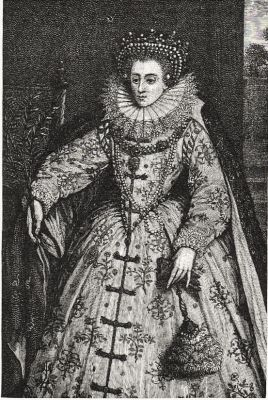
he name of Queen Elizabeth is dear to loyal English hearts, and her reign is named to-day as second only to that of the gentle and gracious Victoria. She was strong and wise, ready to sacrifice small things for a great end, and all things for the good of her subjects. The many portraits of her I have seen are much like the pictures of George Eliot: red hair, a pale high forehead, keen dark eyes, a nose hooked like the beak of an eagle, sharp chin. Such is not the face to win admiration, much less to waken love; yet, when nearly seventy—an age which no art can conceal—she listened to the soft flatteries of her courtiers as tributes to her beauty which they could not repress. When one shaded his eyes at her approach, as though the lustre of her face dazzled his sight like the sun, and said "he could not behold it with a fixed eye," she was delighted with the foolish speech, as a young girl with the roses of her first ball. One can hardly keep from laughing at the idea of high-born youths of twenty-five or thirty hanging breathless on her withered smiles and pretending worship of her charms. Such was her daily portion from the shining train of courtiers surrounding her, and she never tired of it. One said of her red hair: "A poet, madam, might call it a golden web wrought by Minerva; but to my thinking it was paler than even the purest gold—more like the last parting sunbeam of the softest day of spring."
The great ruler never learned to rule her own spirit. She swore at her maids of honor, and boxed the ears of the Lord-Lieutenant for appearing before her in muddy boots, and sent him in disgrace to the Tower. She vowed that England was her husband, whom she loved with a perfect love, and she would have none other; she had wedded herself to the kingdom at the coronation by the ring then placed upon her finger: in remembrance thereof she wished engraved on her tombstone these words: "Here lies Elizabeth, who lived and died a Maiden Queen."
There was another ring, of which I shall presently tell, more precious than that which went with the crown, because life and death were in its keeping.
It was her custom to select from her courtiers one on whom she lavished a fickle love and transient favor. When the court was beginning to tire of Raleigh, Leicester, a former favorite, introduced his step-son, Robert Devereux, second Earl of Essex, in hope of weakening the influence of Raleigh. Essex was a spirited boy of seventeen, fresh from Oxford, with handsome face and graceful mien. Clad in the pictorial dress of the period, wearing crest and plume, badges and ribbons of honor, he was a figure to claim the glance of a king as he greeted his sovereign, and it is not strange that the susceptible virgin felt the fascination of such a presence, although she was then fifty years old.
Before he was twenty he fought gallantly with the English army in Holland, and was foremost in the battle of Zütphen, where Sir Philip Sidney fell. On his return to court the Queen's fancy deepened into dotage, and, fond and foolish, she would hardly let him quit her presence. This became so irksome that he ran off to the war in Spain, and refused to return when she sent an officer after him. When he was pleased to come back she forgave all, and redoubled her favors in hope of keeping the wanderer; but in a short time he again disappeared, and secretly married the widow of Sir Philip Sidney. The Queen could never endure the marriage of her courtiers, still less that of a favorite. She banished him; but he reappeared in a few months, and only regained the Queen's grace by neglecting his fair, sweet wife, who lived in seclusion in the country while he shone at court.
When Essex was about twenty-nine years old he set out with the royal army for Cadiz, and at parting Elizabeth gave him a ring, telling him, "whatever crimes his enemies might accuse him of, or whatever offences he may have committed against her, if he sent it to her she would forgive him." The precious gift was probably a true-love-knot, set with a gem that means unchanging; for the time was rich with sentiment in trinkets, and we may be sure the compact was sealed with vows and kisses on the proffered hand. He returned from Spain unsuccessful, and although the Queen still petted him, from this time on they quarrelled. Essex was haughty and insolent; and she, violent and exacting with him, yet forgiving in the end.
When she decided to appoint a Lord-Deputy for Ireland, then in a state of revolt, she called to her private room three of her court officers—Cecil, the Clerk of the Seal, and Essex. He expected the appointment, but failed to get it, spoke angrily to the Queen, and turned his back on her. She boxed his ears, and told him to "go and be hanged." So furious was he that his hand reached for his short sword, but Cecil stepped between them; and Essex said, with an oath, "that he would not have taken that blow from King Henry, her father, and it was an indignity he neither could nor would endure from any one." Then muttering something about "a king in petticoats," he rushed madly from her presence. In any one else such conduct would have been death.
Again the Earl disappeared from court, and he and Elizabeth never were good friends afterwards, although a peace was patched up, and she made him Lord-Lieutenant of Ireland. His enemies persuaded her that the Lord-Lieutenant wanted to make himself King of Ireland; spies were sent to watch him, but one of them was kind enough to warn Essex of his danger. With his usual rashness, on learning this he at once returned to London, without permission of the Queen—an act in itself treason—and finding court adjourned to "Nonesuch" in the country, he rode at speed through mud and mire to anticipate his enemy, Lord Gray, who had heard of his arrival, and started in haste to give his version of the affair before Essex could reach her. Gray had been closeted with the Queen's councillors a half-hour when he arrived. Hearing this, Essex lost all sense of propriety, hurried unannounced to the Queen's apartments, and not finding her in the outer reception-room, pushed on into her private bedroom. Her maid was combing her hair, which, gray and thin, was hanging about her bony shoulders—for she had not yet made choice of her eighty wigs of many colors for the day—nor were her paint and powder on, and patches pasted over the wrinkled cheek.
He threw himself at her feet, covered her hand with kisses, poured out his story with oaths of fidelity, vowing that he had ever borne in his heart the picture of her beauty, completely winning the "most sweet Queen" to him. He retired to dress, and in an hour was recalled to an audience, and was again well received. But by night the fitful maiden had changed her mind, influenced by the Cecil faction, and perhaps by thinking how ugly she must have looked in the morning. She was then sixty-eight years old, and as vain as in youth. When he again offered respectful homage she received him with great sternness, and commanded him to confine himself in his apartments until sent for to appear before her council the following day. His ever-active enemy Cecil brought against him many charges—not least, "his over-bold going to her Majesty's presence in her bedchamber."
QUEEN ELIZABETH.
The Queen then ordered him to be held a prisoner at York House, where he remained many months. He pretended to be sick—a trick he had to gain forgiveness when his royal mistress was out of humor; but it did not move her this time, although it soon became reality. His wife was not permitted to visit him, nor even write to him. He had only one true friend at court, the gentle Lady Scroope, his cousin, and sister of the Countess of Nottingham. She wore mourning for him, and endured bad treatment from Elizabeth on his account, but stood faithful to the end.
Yet the lovesick woman could not entirely banish thought of her proud favorite, although her mind was constantly filled with suspicions by Cecil and Raleigh. To forget him she had bear-baitings, jousts at the ring, and a splendid tourney in honor of her coronation day. These frivolities filled the weeks that poor Essex passed alone and wretched in one room at York House. Elizabeth would not listen to the prayers of his sisters and Lady Scroope for his release, but she accepted the costly presents they offered, among them a gown worth £500 (about $2500). Essex finally fell so ill that his life was despaired of. On hearing his pitiable state the Queen wept, and sent him her own physician, and had prayers read for him in all the churches of London, but something changed her mood again, and she was harsher than ever. Not until March 16, 1600, did she allow him to go to his own home, Essex House on the river and the Fleet, first sending away his family and all the servants but two. Essex was kept there prisoner for seventeen weeks, when the Queen removed his keeper and allowed him to become a prisoner on parole.
During this time he was examined before a commission of his enemies, appointed for the purpose, and was treated most cruelly. They let him stand, occasionally leaning for rest against a cupboard, from nine in the morning till eight at night; and when accused of treason, he replied:
"I should do God and mine own conscience wrong if I do not justify myself as an honest man. This hand shall pull out this heart when any disloyal thought shall enter it."
The following August his tyrant again summoned him to York House, where he was told that her Majesty was pleased to give him his liberty, but he must not enter her presence nor come to court. Though free, he was constantly spied upon. Through the remainder of the summer his friends appealed to the Queen to restore him to favor. Essex wrote her imploring letters, that brought no answer. He brooded over his fall and loss of power, until he grew desperate, and gathered about him at Essex House all the disaffected people of London, among them a host of Puritans. They formed many wild schemes—at one time a plan to capture the Tower and palace; at another, to march to the court and compel Essex's enemies to give him a hearing. The Queen remained cold and silent. He talked of her and of his own wrongs, and said "she was an old woman crooked both in body and in mind." Sir Walter Raleigh insisted that this speech sealed his doom; for spies reported everything he said and did.
His last piece of folly was to raise a riot one morning in the streets of London with three hundred followers, declaring that "the kingdom was sold to Spain by Cecil and Raleigh." The mob was quickly dispersed, and Essex slipped back to his house alone in a small boat. He had shut up as prisoners there some officers of the court who had been sent to talk with him and bring him to reason. He had hoped to secure his own safety by giving these as hostages, but Sir Ferdinando Georges, one of his own men, had liberated them, and as he had already been proclaimed traitor, there was nothing to be done but to barricade the house. It was surrounded by the Queen's troops, and he held out till 10 o'clock at night, and only surrendered then because "he was sore vexed with the tears and incessant screams of the ladies." He was confined that night in Lambeth Palace, and on Monday, February 9, 1601, together with his followers, was taken to the Tower. When the boat glided through the Traitors' Gate beneath St. Thomas's Tower, he must have realized the hopelessness of his case, for those who went in by that low dark tunnel rarely came out again.
The apartment to which he was committed was only nineteen feet in diameter, the walls eleven feet thick, and, in memory of the chivalric Earl, it is to this day called Devereux Tower. When he passed the ponderous door his brightness of soul was yet undimmed, but a short while in that chill lone chamber would subdue it to silence if not to resignation. Love of life cannot long endure in such a prison, and rapid changes in the career of soldier, statesman, courtier, had taught him the uncertainty of fortune which hangs on the caprice of king or queen.
On the 19th of the same month he and Southampton were brought to trial, and, as usual, he was unfairly treated. Even Lord Bacon, to whom he had given an estate, and who was not of the Queen's counsels, appeared against him. One lawyer compared him to a crocodile; another called him an atheist and papist, when it was well known he was a Puritan. The trial lasted from nine o'clock in the morning to six o'clock in the evening. He was sentenced to death, and on hearing it, said: "I am not a whit dismayed to receive this doom. Death is welcome to me as life. Let my poor quarters, which have done her Majesty true service in divers parts of the world, be sacrificed and disposed of at her pleasure."
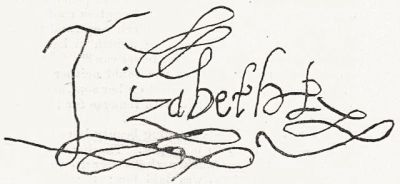
As he marched through the streets to the Tower, with the edge of the headsman's axe carried toward him—the custom when prisoners were condemned to die—he walked swiftly, with his head hanging down, and made no answers to persons who frequently spoke to him from the crowds. He was allowed six more days to prepare for death. It is said that Elizabeth signed his death-warrant firmly, and with even more than the customary flourishes, but she wept and hesitated about appointing the execution.
AUTOGRAPH OF QUEEN ELIZABETH.
Meanwhile where was the gay gold ring given to him in the bloom of his youth, as he marched to Spain with the beauty of banners and roll of drums, under no shadow deeper than the folds of the royal standard? Many times Essex must have looked at the amulet, and in the long, slow waiting sickened for gracious message or friendly sign, but none came. And Elizabeth, too, must have wondered what had become of the token; and why did not he, so wildly loved and deeply mourned, send the pledge and claim the pardon?
Early one morning while this time was passing, not knowing whom to trust, he chanced to see from his window, which overlooked the street, a lad with an honest, open face, which so pleased him it won his confidence. He managed to throw down a small bribe and the ring, and told him to take it to his good cousin Lady Scroope, and she would send it to the Queen. The boy took the keepsake, but gave it into the hand of the wife of one of Essex's worst enemies, the Countess of Nottingham, who passed it to her husband.
ESSEX AT THE TIME OF HIS EXECUTION.
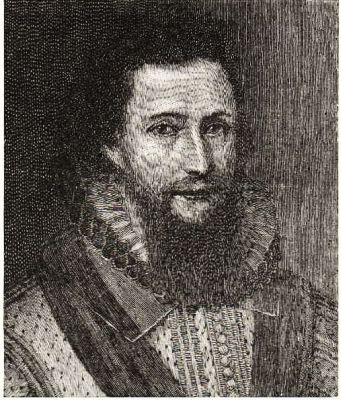
How terrible must have been the suspense of Essex, for, in spite of everything, he trusted the word of his sovereign. The day broke that was to see his execution. Still no sign of pardon or reprieve. Calmly he prepared for death, and dressed with his usual care and elegance. He wore a long black cloak of wrought velvet over a satin suit, which consisted of a doublet of brocade with ruffles of lace in the sleeves, a silken scarf confining it at the waist, short breeches of satin, silken hose, and leather buskins. Usually with this costume a jewelled sword was worn, and an immense ruff of lace around the neck. On this occasion both were omitted. His picture shows a well-turned head, with dark curling hair, straight nose, brown eyes, a mustache, and the pointed beard affected at that period.
Essex had begged as a last privilege that he might have a private execution. The poor petition was granted, and he was permitted to suffer death on Tower Hill. The Earl was then in his summer prime—only thirty-three years of age. Valor, beauty, fortune had been his from birth, but failed to avert his fate. The place of execution was hallowed by the best blood of England, and there two fair queens had laid their young heads on the block to satisfy the brutal rage of Elizabeth's father.
Ash-Wednesday, February 25, 1601, at 8 o'clock in the morning, he was led to the fatal block. As he knelt to place his head in position he showed no fear, and three strokes of the axe, the first one mortal, severed his head from his body. They were buried in the Tower Chapel, though some believed the Queen kept the skull in her own private room. Notwithstanding it was a cold gloomy day, one hundred gentlemen sat near the scaffold, and Sir Walter Raleigh secretly watched the execution from a window of the armory, little thinking that thirteen years later he would meet the same fate in the same place. During this tragedy Queen Elizabeth amused herself playing on the spinet. But there came an hour of repentance bitter as death.
About two years afterward the Countess of Nottingham was taken with an illness, which proved her last. She begged to see the Queen; she could not die in peace without it. Elizabeth came, and when the Countess confessed having kept the ring of Essex, the Queen wept, and then flew into a fury, and shook the dying woman in her bed, crying, "God may forgive you, but I never can!"
This disclosure affected her so she could neither sleep nor eat. The dreadful secret pressed on her soul, and the old love and longing came back with remorse for tenderness turned to hate.
Dreams of Devereux in his morning beauty kneeling at her feet must have risen to her sight. The hand whose touch had made her pulses quicken, that never drew sword except for England's glory, was laid low; the brilliant nobleman—a headless corpse—was buried among criminals in Tower Chapel, when a word from her would have saved him.
Who may tell her anguish when she lay on the palace floor ten days and nights, refusing to be comforted, haunted by memories of crime unpardonable, till death came to close the scene?