Strong
Reading edition
easy to hook; easy to unhook; if you do the hooking and unhooking. Can't let go itself. The DeLong Hook and Eye.
See that
hump?
Richardson & DeLong Bros., Philadelphia.
Also makers of the
CUPID Hairpin.
Don't take substitutes to save a few pennies. It won't pay you. Always insist on HIRES Rootbeer.
Made only by The Charles E. Hires Co., Philadelphia.
A 25c. package makes 5 gallons. Sold everywhere.

Reader: Have you seen the

It is a Collection which no one who loves music should fail to own; it should find a place in every home. Never before, it may truthfully be said, has a song book been published at once so cheap, so good, and so complete.—Colorado Springs Gazette.

This Song Collection is one of the most notable enterprises of the kind attempted by any publisher. The brief sketches and histories of the leading productions in the work add greatly to the value of the series.—Troy Times.

Sold Everywhere. Price, 50 cents; Cloth, $1.00. Full contents, with Specimen Pages mailed, without cost, on application to
Harper & Brothers, New York.

By CAPTAIN KING
CADET DAYS. Illustrated. Post 8vo, Cloth, Ornamental, $1.25.
CAMPAIGNING WITH CROOK, AND STORIES OF ARMY LIFE. Illustrated. Post 8vo, Cloth, $1.25.
A WAR-TIME WOOING. Illustrated by R. F. Zogbaum. Post 8vo, Cloth, $1.00.
BETWEEN THE LINES. A Story of the War. Illustrated by Gilbert Gaul. Post 8vo, Cloth, $1.25.
HARPER & BROTHERS, Publishers, New York.
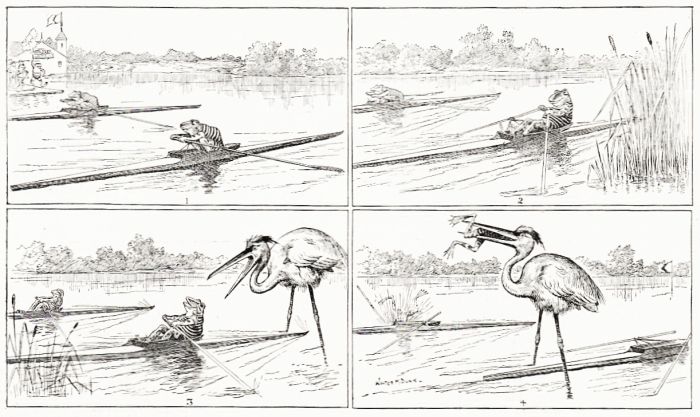
HOW FROGGY LOST THE RACE BY A FOWL.
Papa. "So, Bobby, you're the president of your bicycle club. That's very nice. How did they happen to choose you?"
Bobby. "Well, you see, papa, I'm the only boy that's got a bicycle."
A COSTLY THRONE.
At the time of the coronation of the Czar of Russia much was printed in the newspapers about the costly crown jewels and the magnificent imperial throne, but for all its magnificence and richness this nineteenth-century throne was nothing when compared to that of the Mogul Emperors of Delhi. This Indian throne was built in the reign of the Shah Jehan by a Frenchman who had been forced to seek an asylum in the Mogul empire. It was called the Peacock Throne, to distinguish it from other royal chairs, and because it was decorated with the figures of two huge peacocks. The throne was six feet long by four feet wide, and stood on six massive legs, which were of solid gold inlaid with rubies, emeralds, diamonds, and all kinds of precious stones. The tails of the peacocks were expanded fanlike behind the throne, and they too were inlaid with pearls, emeralds, and other gems of suitable coloring. The whole was surmounted by a canopy of gold supported by twelve pillars likewise studded with diamonds and precious gems, the border of the canopy being made of a fringe of beautiful pearls. Between the two peacocks perched a life-size parrot, which was carved out of a single emerald. The royal umbrellas, which are appendages to most Oriental thrones, were made of the finest silks, and were fringed with pearls, the handles being of solid gold studded with diamonds. It has been said by many writers that the famous Koh-i-noor diamond was originally set in this Peacock Throne. This story is very possibly true, inasmuch as the Koh-i-noor was at one time owned by the Shah Jehan. This throne has been valued at $30,000,000, and this figure is doubtless not exaggerated, for the Mogul Emperors were wonderfully rich monarchs. When the Persians sacked Delhi in 1739, they destroyed the Peacock Throne, and carried off its jewels. A simple block of white marble now stands in the private audience hall in the palace of the Mogul Emperors at Delhi to show where this gorgeous chair once stood.
TALKING TO THEM.
There is a fish-dealer in New York who has a large number of rich customers. Once or twice a week his store can be found full of ladies who are doing their own marketing. The dealer is all smiles to his customers on such days, and very anxious to keep their good-will and trade. For some time an Irishman had been coming in the place, and after going from stand to stand, and peering long and closely at the fish, he usually wound up by purchasing some cheap specimen of the finny tribe, and departing. This was annoying to the dealer when his place was full of customers, and so one morning when the Irishman entered and began going from one stand to another as usual, he called out:
"Look here, my good man, what are you always smelling my fish for?"
The question was heard by every one, and they all listened for the answer.
"Faith, oim not smellin' thim; it's talkin' to thim oi am."
"Talking, did you say?"
"Yis; sure oim askin' thim the news from the sea."
"Well," said the dealer, impatiently, "what did they say?"
"Sure, they didn't know, yer honor; they telt me they hadn't been there fer over a month."
"Well," said mamma, as she bathed Johnnie's blackened eye with Pond's Extract, "what were you and Tommy fighting about?"
"We weren't fighting," exclaimed Johnnie, indignantly; "we were only arguing."
The following sentence is a kind of literary curiosity: "Sator arepo tenet opera rotas." It is curious, because it spells the same words backwards as forwards; the first letter of each word, placed consecutively, spells the first word; the second letter of each word spells the second word, and so on to the end; the last letters read backwards spell the last word; the next to the last letters, the next to the last word, and so on throughout; and there are just as many letters in each word as there are words in the sentence.