THE CARE OF A DOG.
Reading edition
BY JAMES STEELE.
here are dogs and dogs, of course, and while some members of the canine family are gifted with the capacity of looking after themselves, because they cannot help it, and to all appearances thrive well when combating hardships, a good dog is worth all the care and trouble that his master may choose to expend upon him. This article is not intended to tell how to rear delicate dogs, but simply to give an idea how to make your canine friend and companion more happy and contented, and to give him a start in life.
END VIEW OF HOUSE.
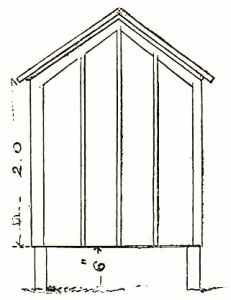
In looking to his comfort, the first thing to take up is the dog's home. Every one is familiar with the little house to which is attached a poor, unhappy specimen of the dog tribe, with a heavy collar about his neck and a jangling chain that admits of a few feet of freedom and is suggestive of confinement. Now, bear this in mind, no dog is happy when chained up; thus we take up the kennel first.
Dogs are liable to many ailments that afflict human beings. Rheumatism is a common disease with them, and they suffer from cold and heat and lack of shade and warmth quite as much as they suffer from lack of proper food and drink. Thus a dog owner is responsible for his dog's health, and this means a great deal, for if a human being's good spirits depend upon the way they feel, surely a dog's do also.
A kennel's first essential should be dryness; next, warmth and ventilation. To secure all this, the floor of a dog-house should always be raised off the ground. Especially is this true where the dog is young or in the state of puppyhood. Dampness is his foe. A good idea is to have the dog-house elevated at least six inches, and have the opening front upon the exercising yard, where the dog can have plenty of room to play and jump about without being hampered by a fraying, dangling chain.
Although we learn from the old adage that "dogs delight to bark and bite," this is not true. The dog is naturally gregarious, and loves companionship of his own kind. Therefore, two dogs are happier than one. If they are allowed to be together continually, each appears to adapt himself to the other's disposition, and it is only those who seldom meet their kind that love to fight.
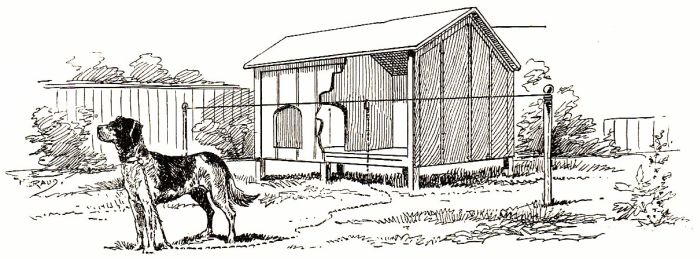
We will suppose that a kennel is to be built for one dog, for instance. He should have a yard of at least fifteen feet square to run about in, and opening on this should be a dog-house with two entrances, that could be shut in case of cold weather.
DOG-HOUSE AND YARD, WITH WIRE FOR HITCHING.
Fleas are the great enemies of a dog's comfort. The poor beast, whose thoughts and actions are interrupted constantly by a desire to scratch or nibble fruitlessly at the irritating little enemy to peace, is to be pitied. A great deal can be done, in constructing a dog-house, to do away with the pest. If possible, the floor and sides of the house itself should be made of good red cedar. For some reason, dogs domiciled in houses made or lined with this wood are almost entirely free from fleas, and this is a good thing to keep in mind.
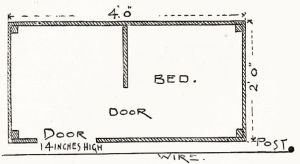
It does not pay to give a dog hay or straw to sleep on, and old carpets or blankets should not appear in any well-regulated kennel. Appended are diagrams and drawings of a house and yard for one dog. It can be enlarged or diminished, as may be necessary.
There is not space in this article to go into the subject of dogs' diseases and ailments. If a dog is ill, he needs a physician as much as you or I. In his puppyhood he is liable to distemper and mange—the childish diseases that carry off so many of his kind. But once safely through them, if he is well looked after, he can count upon a happy existence of from ten to twelve years if his master is kind and considerate.
Now let us suppose that the dog or dogs, whose proper care and bringing up we are to treat of, are of that intelligent and useful class known as sporting or hunting dogs, setters or pointers, and there are no finer kinds to have about even if their owner does not possess a gun or lives far from a game country. It is these dogs' first and natural instinct to have their attention arrested by the peculiar scent that attaches itself to game birds and animals. Most sporting dogs have to be taught to discriminate and to learn that chickens and sparrows are things to be left alone, however.
Now, to bring up a dog successfully his master should study the animal's character and individuality, and adapt himself to him the way a teacher should try to adapt himself to a pupil's natural gifts. There are ambitious dogs, bright dogs, lazy dogs, and dunces, and to make anything of the last requires both time and patience. It is a good dog's natural instinct to endeavor to please his master; he is conscious of the encouragement of praise, and knows well when he has not done his duty. It is firmly believed by many that dogs have a conscience, and proof is not wanting to substantiate this theory.
Truly, a dog has many attributes that we must admire—affection, constant and lasting; a sense of duty and responsibility; a devotion that triumphs over fear and pain; and a loyalty that never swerves. He may admit of friends and acquaintances, but if he is a proper dog he knows but one lord and master, and but one person does the well-brought up dog serve with all his heart.
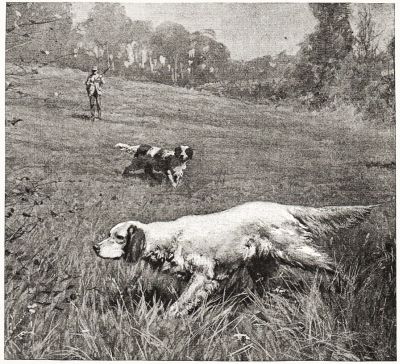
LEARNING TO LOCATE A BIRD WITHOUT FLUSHING IT.
Let us take a puppy and bring him up in the way he should go. He comes to you a little, good-natured, roly-poly thing, with a wide grin and an uncertain gait, and absolute unconsciousness that he may be of any use or value, the same as a child. You can do almost anything with him if he is a bright puppy. He can be taught to fetch and carry in a dozen lessons. It is his instinct to chase a ball and to tear everything to pieces with his sharp little teeth. His one idea is to have a good time and eat more than is good for him. But now we must take care of his health first, and then show that if he chases a ball it is not to chew it up, but to bring it back to you; that he must not tear things to pieces, for fear of a punishment, and that if he eats things he should not, he is filled with a consciousness that he is doing wrong. No puppy should ever feel hungry. With an old dog it is different; he has stopped growing. It is better to have a dog that has attained his full growth underfed than to give him all that he can eat. Milk and bread, or a little corn meal and a little finely chopped meat, should be given to a puppy, and plenty of it; but if you would have a healthy, wide-awake, grown-up dog, feed him sparingly. One meal a day is all-sufficient; more than that is unnecessary to his health. Prepared dog's food, made in the way of biscuit, is easy to procure. One of these a day, broken up into small bits, will keep a dog in excellent condition. Once a week he may be given a small amount of cooked meat or a mess of porridge and potatoes. Occasionally a bone for him to gnaw on should be given him as a tidbit, but no mess of scraps or chicken bones or fat-inducing things should be allowed him under any circumstances, unless he has been working hard in the field and is in for a day's work on the morrow. A dog should have all the water that he wishes to drink, and it is a good thing to have in the bottom of the pan a small bit of sulphur as large as the end of one's thumb.
By every means his acquaintance should be cultivated, and it should be impressed upon his mind that to his owner he owes everything. If possible, feed him yourself. Give him to understand that you are the one who lets him have his liberty, and whose whistle he must obey.
Never be too familiar with a young dog. He must have a certain respect, not necessarily a fear of you; but he must learn to obey. Any intelligent puppy will learn his name in a few lessons. Once you have given it to him, never change it. Mind you this—when he has once recognized you as being his master, his one idea is to please you and to deserve a pat on the head and a word of praise. Never tussle with him with a stick, and never deceive him under any pretence. More dogs have been spoiled by their masters not playing fair with them than one could reckon. Be honest with your dog, and he will be honest with you.
PLAN OF KENNEL.
If you possess a gun, and your dog is of that kind which has inherited the scent for game, the first thing to teach him is to fetch and carry—that is, to retrieve—and this without chewing or mutilating the object which he brings. A way to break a dog of this is to take an old glove, put a few tacks with the points extending outward, and fill it full of cotton. He will find that by picking it up gently he can carry it without discomfort, while if he attempts to worry it the consequences are not agreeable. This lesson is much better for him than any amount of whipping, and he will remember it much longer.
If you wish to shoot over your dog, the next thing is to make him find the bird. To do this, the best way is to procure a live quail, which can easily be had from any bird-fancier; put it in a small cage and show it to the pup, warning him not to touch it. Then conceal the cage in a copse of fern or grass, and bring him carefully in that direction. Never let him nearer than within four or five feet of it; then speak to him encouragingly. Under the influence of your words, he will become all attention, and a dog thus properly broken will never "flush a covey," unless he runs into, them by accident or when he is carried away by excitement, under which circumstances he will show contrition.