A NATURALIST'S BOYHOOD.
Reading edition
MR. WILLIAM HAMILTON GIBSON'S START.
BY BARNET PHILLIPS.

am enjoying a book, a picture, a statue, or say a piece of music. I know these to be the finished works of the man or the woman, but I invariably hark back to the boy or the girl.
What I want to discover is the precise time, in the lives of certain boys and girls, when the steel first struck the flint, the spark flew, and out streamed that jet of fire which never afterwards was extinguished.
I was reading an article entitled "Professor Wriggler," written by Mr. William Hamilton Gibson, which appeared in Harper's Young People, in the number of October 31, 1893. I need not tell you that both old and young, at home and abroad, delight in reading what Mr. Hamilton Gibson has written, because he was not alone the most observant of naturalists, but a distinguished artist and a sympathetic author.
THE LATE WILLIAM HAMILTON GIBSON.
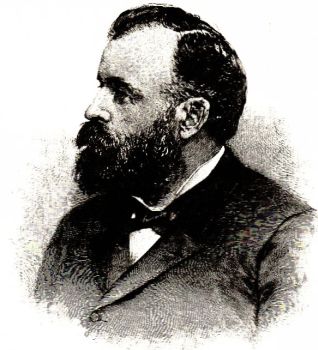
He thus filled a peculiar position in the literary and artistic world which is seldom given to any one man to fill. Besides being a naturalist from his boyhood, he was able to write better than most people what he wished to write, and to illustrate his articles in a way that was unique. Mr. Gibson's death a few days ago, therefore, has closed the career of a man who had the ability to interest a large number of people not only in natural history, but in art and literature.
The news of Mr. Gibson's death came to me suddenly, and as I was reading it I recalled an interesting talk I had with him less than a year ago about his work early in life and the way he got his start. I had been reading one of his articles to a lady, who, when she heard the name of the author, said:
"Why, I knew Mr. Hamilton Gibson long ago. When he was a lad he painted a lovely drop-curtain for us. He could not have been more than fifteen or sixteen then."
The next time I met Mr. Hamilton Gibson I asked him about this drop-curtain. "Do you remember it?"
"Certainly I do. We had a temperance society at Sandy Hook, Connecticut, and we gave a grand entertainment. I made the drop-curtain. It represented a wood. There was a rock in the foreground, and a Virginia-creeper was climbing over it."
"Was it an original composition?" I asked.
"I made many studies of the rock and the Virginia-creeper from nature. On the other side of the curtain I painted a drawing-room. There were a marble mantelpiece, a clock, and lace curtains. I don't think I enjoyed painting the clock as much as the Virginia-creeper."
"To paint a drop curtain at fifteen or sixteen means that you had then a certain facility. But that could not have been your beginning. When did you break your shell? What chipped or cracked your egg, so that your particular bird emerged, chirped, and finally took flight? That was what I wanted to know."
"Is that what you are after?" asked Mr. Hamilton Gibson. "From my baby days I was curious about flowers and insects. The two were always united in my mind. What could not have been more than a childish guess was confirmed in my later days." Then Mr. Hamilton Gibson paused. I could see he was recalling, not without emotion, some memories of the long past.
"I was very young, and playing in the woods. I tossed over the fallen leaves, when I came across a chrysalis. There was nothing remarkable in that, for I knew what it was. But, wonderful to relate, providentially I deem it, as I held the object in my hand a butterfly slowly emerged, then fluttered in my fingers."
"You were pleased with its beauty," I said.
"Oh! It was more than that. I do not know whether I was or was not a youngster with an imagination, but suddenly the spiritual view of a new or of another life struck me. I saw in this jewel born from an unadorned casket some inkling of immortality. Yes, that butterfly breaking from its chrysalis in my hand shaped my future career."
"But some young people may feel passing impulses, but how account for your artistic skill and literary powers?"
"As to the art side, at least deftness of hand came early. I had the most methodical of grandmothers. Every day I had a certain task. I made a square of patch-work for a quilt. I learned how to sew, and I can sew neatly to-day. I knew how to use my fingers."
"Did you like patch-work?" I inquired.
"I simply despised it. Sewing must have helped me, for it was eye-training, and when I went to work with a pencil and a paint-brush I really had no trouble. I read a great deal. I devoured Cooper's novels and the Rollo series; but there was one special volume, Harris on Insects, I never tired of. I studied that over and over again. It was the illustrations of Marsh which fascinated me. I never found a bug, caterpillar, or butterfly that I did not compare my specimens with the Marsh pictures. I learned this way much which I have never forgotten."
"Had you any particular advantages?"
"Yes; my brother was a doctor, and he let me use his microscope, and so I acquired a knowledge of the details of flowers and insects that escape the naked eye. I pulled flowers to pieces, but not in the spirit of destruction, but so that I might better understand their structure. When I was ten I had a long illness. When I was getting better, I was permitted to take an hour's or so turn in the garden. That hour I devoted to collecting insects and flowers. On my return to my room, what I had collected amused me until I could get out again next day or the day after."
"It was pleasure and study combined," I said.
"I was not conscious that I was studying. Then in my sick-room I began to draw and paint the insects. I think I was conscientious about it, and careful—perhaps minutely so. I tried to put on paper exactly what I saw, and nothing else. You say you like 'Professor Wriggler.' I drew him when I was ten or eleven, and I could not make him any more accurate to-day than I did thirty years ago."
"Were you encouraged at your work?" I inquired.
"Yes; once I was much pleased. I came across a curious insect. I could not find it in the books. I made a drawing of it and sent it to a professor of the Smithsonian, asking him to give me its scientific name. Back came by return mail my sketch, and under it the Latin name. The professor wrote me that if the people who were always annoying him with pictures of impossible bugs would only send him as accurate a picture as was mine, he never would have any more bother."
"Did you have any setbacks?"
"Yes; and I haven't forgotten it up to to-day. I was always collecting, and I had brought together every insect I had found in my neighborhood. As I took them home I pinned them in the drawers of an old-fashioned bureau. In time the whole of the drawers, bottom and sides, were full of pinned specimens, and there was room for no more. I had saved enough money to buy a cabinet, and I went to New York and purchased one. When I returned home the first thing I did was to look at my precious collection. When I opened a drawer there was a confused mass of wings only. One single wretch of a black ant had got in, and had passed the word to 10,000 other black ants. They had eaten the bodies of my insects in all the drawers. That quite broke my heart."
"But your writing. How did that come about?" I asked.
"I don't think that you can develop in one direction only. You must unbosom yourself. You are forced to tell or to write about the things you have most at heart. When I was a small boy I wrote a book for myself, and called it 'Botany on the Half-shell.' The first thing I ever wrote which was printed was an article for one of Messrs. Harper's publications, and I made the pictures for it. That was my début."
"Then your work went hand in hand?"
MR. GIBSON AT WORK IN HIS STUDIO.
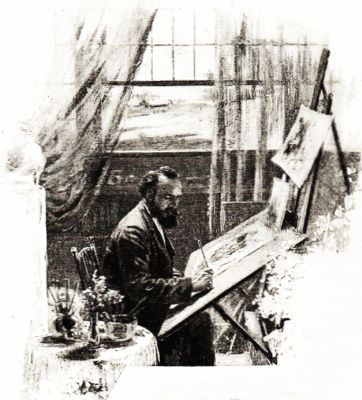
"Certainly. The one was the stimulant of the other. We all grew up together. The days spent in my room when I was ill helped me. I think I studied flowers then, so that their forms and colors were indelibly impressed on my mind. When I was older I made a small bunch of flowers in wax. Not a detail escaped me. I made moulds of all kinds of leaves. Once I put together a rose, some sprigs of mignonette and heliotrope in wax, and gave them to my dear old friend, Henry Ward Beecher. He was delighted with my flowers, and put them on his study table. Presently Mrs. Beecher came in. She ran to the flowers and broke the rose all to pieces.
"How could she have done that?" I asked.
"It must have been with her nose. She wanted to smell the rose."
Then Mr Hamilton Gibson showed me some monster drawings of flowers—Brobdingnagian ones. The flowers opened and closed when you pulled a string, showing their interior structure. Here were bees or other insects, and they flew into the flowers, collected the honey, and, above all, the pollen, and buzzed out again. He explained to me how plant life would perish were it not for certain insects, which bring a new existence to flowers; for without these winged helpers there would be no longer any varieties of flowers or seeds.
You will see, then, that in tracing the beginning of Mr. Hamilton Gibson's career what I mean by harking backwards.
I am certain, too, that in every boy and girl there is something good and excellent. Like the flower visited by the bee, all it wants is impulse. Then, as Mr. Hamilton Gibson explained it to me, will come the blossoming, and lastly perfect fruitage.

The choice of officials at the National Games is another subject which will bear discussion, and although I have reserved it until the last, it must not be considered that this is because I have considered it of any less importance than the various subjects connected with these games that have been discussed within the past few weeks in this Department. All who regularly attend interscholastic track and field games, especially graduates of the New York schools, and those who watch their young brothers and cousins in their indulgence in sport, were much surprised when they looked over the programme of the National Games and saw the list of men who had been invited to act as officials.
There is a certain number of gentlemen in this city who have become so thoroughly identified with school-boy sports that their names are always to be found on the list of officials at interscholastic games. At the National Games, however, it was different, and there are many who resented the change.
In the first place, school sports—and college sports, for that matter—are supposed to be somewhat different in tone from other sports, even from those of amateur athletic associations. We try to conduct them on a higher plane, and we try to give to them a purer spirit of amateurism and comradeship than can be obtained by other organizations. And in carrying out this idea it has always been the custom to have school or college graduates act as officials.
At the National Games this unwritten law or custom was not carried out, and many of the New York school-boys felt that the visiting athletes were receiving a wrong impression of the way in which we do things down here. Many questioned me concerning the change that they noticed on the first page of the programme, but being no wiser than they at the time, I was unable to enlighten them. Since then, however, I have learned that the change was due to ignorance on the part of the managers of the day rather than to any desire for reform.
INTERSCHOLASTIC RECORDS OF THE UNITED STATES.
Event.Maker.
100-yard dash10-1/5sec.F. H. Bigelow.
220-yard run22-2/5"F. H. Bigelow.
440-yard run50-3/5"T. E. Burke.
Half-mile run2m.1-1/5"R. H. Hanson.
Mile run4"32-2/5"W. T. Laing.
Mile walk7"11-3/5"J. S. Eells.
120-yard hurdle (3 ft. 6 in.)17"E. C. Perkins.
220-yard hurdle (2 ft. 6 in.)26½"E. D. Field.
Mile bicycle2"34-1/5"I. A. Powell.
Two-mile bicycle5"18-2/5"G. F. Baker, Jun.
Running high jump5ft.11in.S. A. W. Baltazzi.
Running broad jump21"7"A. Cheek.
Pole vault10"9"B. Johnson.
Throwing 12-lb. hammer125"R. T. Johnson.
Throwing 16-lb. hammer118"2¾"F. C. Ingalls.
Putting 12-lb. shot42"5½"Patterson.
Putting 16-lb. shot39"3"M. C. O'Brien.
Event.School.Time and Place.
100-yard dashWorcester H.-S.N.E.I.S.A.A. games, June 9, 1894.
220-yard runWorcester H.-S.N.E.I.S.A.A. games, June 9, 1894.
440-yard runBoston English H.-S.N.E.I.S.A.A. games, June 9, 1894.
Half-mile runBoston English H.-S.N.Y.I.S.A.A. games, June 5, 1896.
Mile runPhillips Academy, Andover.N.E.I.S.A.A. games, June 9, 1894.
Mile walkHotchkiss, Lakeville, Conn.Conn. H.-S.A.A. games, June 6, 1896.
120-yard hurdle (3 ft. 6 in.)Hartford H.-S.Conn. H.-S.A.A. games, 1894.
220-yard hurdle (2 ft. 6 in.)Hartford H.-S.Conn. H.-S.A.A. games, June 8, 1895.
Mile bicycleCutler, N.Y.N.Y.I.S.A.A. games, May 11, 1895.
Two-mile bicycleHotchkiss, Lakeville, Conn.Conn. H.-S.A.A. games, June 8, 1895.
Running high jumpHarvard, N.Y.N.Y.I.S.A.A. games, May 11, 1895.
Running broad jumpOakland, Cal., H.-S.A.A.L. field day, Oct. 16, 1894.
Pole vaultWorcester Academy.N.E.I.S.A.A. games, June 5, 1896.
Throwing 12-lb. hammerBrookline H.-S.N.E.I.S.A.A. games, June 9, 1894.
Throwing 16-lb. hammerHartford H.-S.Conn. H.-S.A.A. games, June 6, 1896.
Putting 12-lb. shotEvansville.Wis. I.S.A.A. games, May 30, 1896.
Putting 16-lb. shotBoston English H.-S.N.E.I.S.A.A. games, 1894.
The Knickerbocker Athletic Club is a newcomer in athletics, and its officials do not know yet, or did not know at the time of the National Games, that there are, as I have stated, half a dozen gentlemen in this city who almost always hold certain official positions on interscholastic occasions. Of course such ignorance is pardonable, but I do not think that the Knickerbocker managers should be so readily pardoned for inviting certain gentlemen to act as officials without consulting the officers of the National Association. So far as I am able to find out, the Knickerbocker Club did not submit the names of those whom they had chosen to act as officials to any officer of the National Association, and the latter, so I am told, did not know who were to act as referee and judges until shortly before they reached the Columbia Oval on the afternoon of June 20.
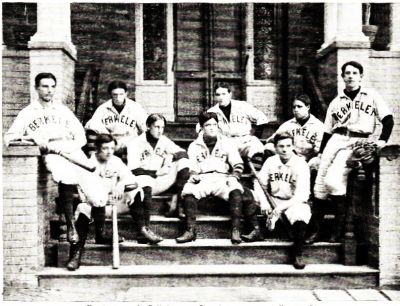
Bayne, c.f. Young, l.f. Grant, s.s. Hasbrouck, 2 b. Wiley, c. Huntington, r.f. Pell, 1 b. Bien, Jun., p. Fleming, 3 b. THE BERKELEY SCHOOL BASEBALL NINE.—Champions N.Y.I.S.A.A.
It was too late then to make any changes, of course, and all the officers of the National Association could do was to blame themselves for their own carelessness and thoughtlessness in not asking to see a list of the officials a week before the games. There was no fault to be found with the manner in which the gentlemen chosen by the Knickerbocker Club performed their duties, yet there was an indescribable something lacking on the field that day which we have always felt and appreciated at other interscholastic functions.
There was not exactly an air of professionalism about the proceedings, and yet the officials went about their work in such a "professional" way that the gentle, amateur, leisurely atmosphere of other times and seasons was not there. Furthermore, there was a slight inclination toward bossism in some quarters; and young men who are taking part in amateur sports do not care to be bossed, and if they have reason to suspect that they are going to be bossed, it may be put down as a certainty that they will not again compete under similar conditions. I haven't any doubt that next year, no matter under what conditions the National Games are held, the officers of the Association will choose their own officials, and there will be found among them the same gentlemen who for years have helped to make school-boy field days the pleasant affairs they always are.
But it is only just to say to any organization, whether it be in New York or in any other city, which hopes to succeed in the management of school-boy sports, that it must carry out the school-boy idea of the proprieties of things; and school-boys have very distinct ideas of what they want; and if school-boys are pleased to have certain gentlemen, school and college graduates, to act as officials at their sports, these same gentlemen must be asked to hold these same positions, or the organization will very soon lose favor in scholastic eyes. Nevertheless, the schools must remember that the Knickerbocker Athletic Club is the first that ever did anything for interscholastic sport, and for this reason they should be willing to overlook a great deal.
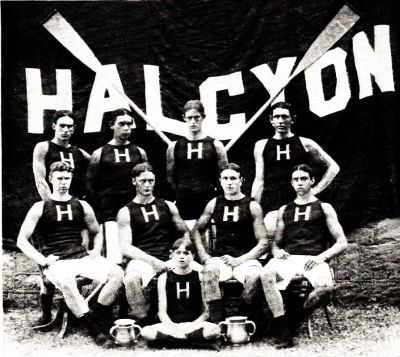
L. Biddle bow. Goodwin, 2. N. Biddle, 3. Niedecken, 4. Howard, 5. Brock, 6. Shiverick; cox. Wheeler, 7. Thomas, stroke. THE VICTORIOUS HALCYON CREW, ST. PAUL'S SCHOOL, CONCORD.
A number of years ago it was a very common thing for college men and other amateurs to devote a large part of their summer to the playing of baseball. So popular did this playing on "summer nines" become that a number of hotels offered inducements to clever amateur players to come and spend a few weeks at their resort in order that the locality might have a good baseball nine as a sort of summer attraction. The custom went from bad to worse, until summer resorts actually began to bid one against the other for the most capable players.
Many amateurs who would not for a moment have considered any other kind of proposition found that they had easy consciences when it was merely a question of taking a reduction in board and lodging. They seemed to fail to recognize the fact that by accepting such a reduction they were practically accepting the sum of money which the hotel-keeper subtracted from their bills at the end of their stay. In some cases, too, no bills at all were submitted to the baseball boarders. Thus amateurs were rapidly sliding into the path of professionalism, and the colleges found that they must take some steps to interfere with summer baseball playing.
All of the colleges now, I think, with the possible exception of Brown, have rules forbidding the playing of baseball on "summer nines," the penalty being that any member of the college who does this becomes ineligible to any university team. And thus summer playing for college men has been effectively put a stop to.
The colleges, however, cannot legislate against players who are not members of their institutions, and they have found it difficult to prevent sub-Freshmen or school-boy players from accepting the favors of hotel-keepers or others in return for belonging to the hotel's nine. Princeton, however, has seized the bull by the horns, and has issued a decree, which was sent around to all the preparatory schools last spring, stating that no one will be considered eligible to any of the university teams who has at any time played for any sort of compensation.
This is an excellent rule, and will effectively put a stop to summer ball-playing by young men who are preparing for Princeton, and who hope to achieve the honor of playing on the university nine. It is to be hoped that every other university and college in this country will adopt similar rules.
But aside from the penalties that are to be incurred for playing on "summer nines," there must be a number of other reasons that will prevent school-boys from running the risk of being looked upon as semi-professionals. I say "semi-professionals," although there is really no half-way house between amateurism and professionalism. If a young man accepts reduced board at any time, or a uniform, or a pair of shoes or stockings, or in fact anything that has any commercial value whatever, as a reward for any kind of services rendered in athletics, he is a professional.
NATIONAL INTERSCHOLASTIC RECORDS.
Event.Holder.
100-yard dash10-1/5sec.W. H. Jones, New England I.S.A.A.
220-yard dash22-2/5"W. H. Jones, New England I.S.A.A.
Quarter-mile run51-2/5"H. L. Washburn, New York I.S.A.A.
Half-mile run1m.59-3/5"W. S. Hipple, New York I.S.A.A.
One-mile run5"10-1/5"D. T. Sullivan, New England I.S.A.A.
120-yard hurdles (3 ft. 6 in.)16-4/5"A. F. Beers, New York I.S.A.A.
220-yard hurdles (2 ft. 6 in.)26-2/5"J. H. Converse, New England I.S.A.A.
One-mile walk7"53-2/5"A. L. O'Toole, New England I.S.A.A.
One-mile bicycle2"36"O. C. Roehr, Long Island I.S.A.A.
Running high jump5ft.8in.{ F. R. Sturtevant, Connecticut H.-S.A.A.
{ T. Flourney, Iowa State H.-S.A.A.
Running broad jump21"1"H. Brown, Connecticut H.-S.A.A.
Pole vault10"5"R. G. Clapp, New England I.S.A.A.
Throwing 12-lb. hammer129"10"F. C. Ingalls, Connecticut H.-S.A.A.
Putting 12-lb. shot43"4"F. C. Ingalls, Connecticut H.-S.A.A.
The word "professional" means an individual who performs in athletics for the sake of the reward that he is to receive. It does not make any difference whether this reward comes to him in cash, clothing, or pie. And he cannot evade being classed among professionals if he once accepts any kind of remuneration. Of course it seems different to those young men who do not think seriously about the ethics of sport. They think that they are not accepting any remuneration if they allow a hotel-keeper or an athletic club to furnish them with a suit of clothes—a baseball uniform—and pay their expenses.
They argue that it is only just, if they are playing baseball, that their expenses to and from neighboring resorts should be paid, and they do not see why the hotel or the club, if it chooses to, should not present uniforms to the young men who are playing ball. But it seems to me that this very argument is strongest when looked at from the other side. The young men who accept uniforms or expenses do so because they feel that it is worth while for the hotel man or the club to spend that money to have them play baseball.
Therefore, if it is worth anything to the hotel man to pay them this money, their services acquire a commercial value. As soon as services are recognized to have a commercial value, and are paid for, either directly or indirectly, the one who accepts the reward or remuneration, either directly in cash or clothing, or indirectly in railroad fare and hotel bills, becomes a professional, for he has made use of his ability as an athlete to obtain railroad transportation or board at no expense to himself beyond his skill as an athlete.
There is a difference in playing at summer resorts for the sport of the thing and in playing for the advantage of it. Young men who like to play baseball, and who can get up a nine wherever they happen to be this summer, should do so by all means, for there is nothing healthier than sport of this kind. But they should not allow any one to let them derive any kind of financial advantage from the fact that they know how to play baseball, and they should not allow any of their friends or admirers to induce them to go to any certain resort because they know how to play baseball.
Young men usually want to do what they consider the right thing, and what their older brothers and their friends among older men consider the right thing. College men have come to the conclusion that playing on summer nines is a bad thing for amateur sport, and if there are a number of young men, readers of this Department, not yet in college, who have not given sufficient thought to the matter, and who very possibly cannot see the serious side of the question just now, let them, for the present, rest upon the judgment of the college men, and abide by their decision, and when they get to be college men themselves they will appreciate the situation as they cannot now, and they will be very glad that they left playing on "summer nines" to others who were not such thorough sportsmen as they, and who by so doing lose much that they can never regain in after years.
This Department prints again this week a table of the Interscholastic records of the United States, and also a table of the National Interscholastic records, in order that many who have not made a distinction between these two classes of figures may see what this difference is. As was stated last week, a National Interscholastic record is one made at the National Games, whereas an Interscholastic record is one made at any interscholastic field-meeting. We may feel perfectly sure that the figures as printed in the National table are absolutely correct, for there has been only one National Interscholastic meeting, that of June 20 of this year.
The Berkeley School nine, which won the Interscholastic Championship this year, is undoubtedly one of the strongest baseball teams ever developed at any of the New York city schools. This team earned the championship of the Association by 167-10. The team was an unusually hard-hitting one, and in one game alone the Berkeley players pounded out eight home runs. The best individual work of the team was done by Wiley, Pell, and Huntington. Wiley will undoubtedly be known in a few years as one of the best amateur catchers, and if he goes to college he should make a record for himself on the diamond.
"TRACK ATHLETICS IN DETAIL."—Illustrated.—8vo, Cloth, Ornamental, $1.25.
The Graduate.