JOSEPH GILLOTT'S
Reading edition
STEEL PENS
Nos. 303, 404, 170, 604 E.F., 601 E.F.
And other styles to suit all hands.
THE MOST PERFECT OF PENS.
Midsummer Jaunt by a Bird-lover.
During the last week in June I decided to take a day off and go trout-fishing. Promptly after breakfast I mounted my bicycle, and was soon spinning up the "river road." In five minutes I arrived at the brook, leaned my "bike" against a neighboring barn, and started. I was at once interested in the swallows which were skimming around, almost touching the ground in their low sweeping flight. Once two of them tried to go in a hole at once, and a lively scrap resulted.
I soon found a willow rod, to which I tied my line, and after putting a little worm on my flies I commenced fishing. As usual, "skeeters" were plentiful, and I turned up my coat collar for protection. Robins were numerous in the pasture, hopping fearlessly among the cows. After going a mile and a half through pasture and bits of woodland, I came to the end of the brook without having caught a fish.
I recollected having been told of another brook about a quarter of a mile from the one I was fishing in, and I decided to hunt it up. I easily found the road which ran through the woods. I had not gone far before I became aware that birds were numerous, for a little oven-bird ran across the road into a brush-heap, where it was joined by its mate. I could not get through the underbrush as fast as they could, so they were soon lost to view. Further on a blue-jay flew screaming through the woods, starting the little red squirrels.
The woods were alive with chickadees, an unusual occurrence, and for some time all I heard was chickadee-dee-dee-chickadee-dee. The brook was a small one, and the woods were thick, so I rolled on the end of my pole all but a foot of my line. I fished the brook for about an eighth of a mile and succeeded in catching a great number of fingerlings, which of course I threw back, and one 6¼-inch trout. As the law said 6 inches, I kept it.
On the way back I spied a cat-bird on a maple sapling. Near the place where I saw the oven-bird my eye caught a glimpse of gaudy colors, and, following them up, I discovered a male Maryland yellow-throat. He was soon joined by his mate, and both of them hopped into a brush-heap. I was greatly elated, as yellow-throats are a rarity about Springfield. Near the barn were two huge chestnut-trees overhanging the brook, and as I was tired I sat down on the ground and leaned against the smaller tree. Suddenly a series of loud knocks and a pick-wick-wick-wick right over my head caused me to hop to my feet. My movements started the flickers, which flew up the brook, and, to my surprise, alighted on the ground.
Several kingbirds were perched on a rail fence near by, and now and then darted off after some insect. A meadow-lark whistled far up the pasture, and a solitary sand-piper teetered along the brook. While crossing the Connecticut River on my way home I noted a belted kingfisher on a dead limb. I arrived home in time for dinner, and you may be sure I had soon eaten my trout. While writing this a bird-note called me out-doors. There I found many bird-loving neighbors intently watching a pair of red-breasted grosbeaks. The male was resplendent in his fine colors, but the poor little brown and white female looked dilapidated.
Albert W. Atwater. Springfield, Mass.
"Where'd I leave That?"
To-day I paid a visit to the room in which are stored the articles left by passengers on one of the great railways entering New York. People leave many articles in the cars, and forget to call for all of them. Indeed, not more than one-third of the things found in the cars are ever claimed by owners. On the other hand, very few things that are claimed and accurately described fail to be recovered. Every railway keeps a store-room for lost articles, and employs are under strict orders to send all articles to it.
Perhaps you can guess what a lot of odd things I saw in this store-room! Of course there were such common things as books, umbrellas, and, rubbers. A few of each? Oh no, not a few only, but barrel upon barrel of rubbers, a library of books, and enough umbrellas to fill a twenty-bushel bin. But the queer things included—what do you think? Well, half a dozen sets of false teeth, more than one hundred night-robes, a score or more of eye-glasses, and two razors. Any live-stock? Not in this room, for the attendant told me such things had to be cared for, and could not be stored here; but during the past few weeks, he said, there had been turned in two canaries, three kittens, a lap-dog, and a parrot!
There are not a few pocket-books found, but these are invariably called for. Some months ago a man left a book containing $54,000 in one of the sleeping-cars, and books containing $100 to $1000 are quite often found. Rather odd, too, is the fact that the people who leave most of these things in the cars are old travellers. Excursionists and others unfamiliar with the ways of travel look after their possessions. It is the confident man or woman who leaves the car and leaves his or her valise or lap-dog behind.
If your friends are coming to New York soon, tell them that the value of articles forgotten by passengers entering this city every year foots up into the hundreds of thousands of dollars, and that they will do well not to contribute anything to this wasteful fund.
John B. Henderson, R.T.K. New York.
A Rare Bittern.
"In our reading lesson to-day occurred a reference to a tiger-bittern. Our natural history does not mention it. Can you tell me if there is such a bird? Ella F. Loomis, Steubenville, O." The tiger-bittern is found in the West Indies and in South America, but is rare. It is a trifle smaller than the United States blue heron, and has a bill much shorter. The coloring is most beautiful. From the top of the head to the last row of feathers on the legs it is barred precisely like the Bengal tiger, the stripes of bright yellow showing up in striking contrast to the black. The bars are most regular.
If the skin of this bittern were spread out on the floor at some distance from you, you would assert it to be a portion of a tiger-skin. Like many other varieties of crane, heron, and bittern, this bird is sought for its plumes, and is becoming rarer every year.
The Law She Intended to Practise.
In our day women enter occupations which earlier times thought belonged exclusively to men. The wife of one of the men now before the people as a candidate for President of the United States is a lawyer. At the time of her admission to the bar she was the head of a household and mother of two children. Asked her specialty in law practice, she replied, "Home-rule."
Answers to Kinks.
No. 8.
1, Lark—Shakespeare. 2, Cock—Longfellow. 3, Jay—Longfellow. 4, Bluebird—Longfellow. 5, Duck—O. W. Holmes. 6, Turtle-dove—D. Conway. 7, Cuckoo—Shakespeare. 8, Cuckoo—Shakespeare. 9, Pheasant—William Howitt. 10, Gull—O. W. Holmes. 11, White owl—Longfellow. 12, Eagle—Mrs. Barbauld. 13, Nightingale—Coleridge. 14, Nightingale—Coleridge.
Kinks.
No. 9.—Central Acrostic.
If the cross-words—of equal length—are correctly solved, the central letters, reading downward, will spell the name of a Greek hero whose life ended with the burning of a brand.
Cross-words.—1. A weight used in sounding. 2. Cuts into two parts. 3. A large wild-duck; the greenhead. 4. An overseer. 5. Imprisonment. 6. Long gaiters. 7. A plant clinging by tendrils. 8. Bespangled.
No. 10.—A Mathematical Melange.
From the date of the siege of Saragossa subtract that of Valentinian's death: add the number of letters in the name of a common article; divide by the number of Henry VIII.'s wives; multiply by a German word of denial; divide by the number of letters in a whip used for punishing criminals; subtract the age of the "Sage of Monticello"; add the weight of the giant anvil at the Woolwich Arsenal, England, and that of the Braganza diamond (in carats). The square root of the first half of this number multiplied by 1/37 of the second half will give the number of letters in the name of "The Blooming Grace." Who is she?
Vincent V. M. Beede.
No. 11.—A Riddle.
I have no substance, and generally no intelligent relation to time or times. Sometimes I am sensible, but oftener I am absurd. Yet I have great influence, and not infrequently change the plans of people. Indeed, I have helped to change the history of the world. What am I?
No. 12.—A Receipt.
To decapitate a notion Of course makes it dead, But gives what is put On the murderer's head. A further beheadment Will make what you pay When you purchase an article At a shop some day. Again you behead With a very quick motion, And at once there's a plant That is part of the notion. Behead once more And the first part you see Of what our confection Is going to be. Take a measure of paper To form the second. Prefix one hundred In proper shape reckoned. Join this to the first, And I'm sure you will say It's a delightful treat For a hot summer day.
No. 13.—An Endless Chain.
The first syllable of every word is the second of the preceding word. The first syllable of the first word is the second syllable of the last. All words are dissyllables.
An animal—the tonic—a brief communication—a longer one—fear—relating to dew—to assign—a game—a citadel—a disease of rye—obtained—delicate—the true skin—naval—pertaining to the kidneys—to frighten—steel covering—human—grease—a poet—not rare.
Simon T. Stern.
Any questions in regard to photograph matters will be willingly answered by the Editor of this column, and we should be glad to hear from any of our club who can make helpful suggestions.
COPYING PICTURES WITH A CAMERA.
Copying pictures may seem to be a very simple matter, for the subject does not even need to be posed, and will remain motionless for any length of time; but there are several points connected with the copying of pictures which are of importance if one wishes to make a correct copy. For convenience the pictures to be copied might be divided into three classes. I. Black and white pictures, such as engravings, wood-cuts, wash-drawings, etchings, etc. II. Photographs and half-tones. III. Oil-paintings, colored pastels, etc.
The first thing to be considered is the arranging of the camera so that it will be exactly perpendicular with the picture. A copying-stand is a great convenience, but, like many other conveniences, not an actual necessity. A vertical support, with the drawing or picture placed in such a manner that its centre shall come on an exact line with the centre of the lens is all that is required. A board the width of the bed of the camera, and perhaps five feet in length, will answer every purpose of a copying-stand. At one end of this board fasten a small piece of board in such a way that it shall be at exactly right angles with the long board. This small board is the support for the picture. The camera either rests on the board, or is raised a little above it by a small block, the adjustment depending on the size of the picture to be copied. To find whether the centre of the lens corresponds with that of the picture, place the camera quite near the picture, thread a piece of silk through the centre of the lens cap, place the cap on the lens, and carry the string to the centre of the picture. In this way one can readily see whether the two centres correspond with each other.
In copying a black and white picture we want no half-tones or shadows, so that if the paper has a grain it must be placed in a strong front light. An all-round illumination, which can be had by using the apparatus out-of-doors, is the best lighting, as there is no possibility of shadows.
The most suitable plate for copying a black and white picture is the brand called "photo-mechanical." If these plates are not easily obtained, use a very slow plate.
Place the picture on the support upside down, fastening it very securely with thumb-tacks. If the paper is thin, place a piece of red or black paper behind the picture. This should always be done if the picture is being copied from a book, or there is any printed matter on the reverse side of the picture.
In copying pictures from books a thin piece of flat board should be put back of the leaf, and the leaf held in place by two stout rubber straps.
In copying photographs or half-tone prints, a plate of medium rapidity should be used. If there are heavy shadows a more rapid plate is required. A small diaphragm must be used in order to have the picture sharp at the edges.
In copying colored pictures the only plate to use is the orthochromatic plate. This will render the true color values of the different tints in the picture. Oil-paintings require more care in lighting than other colored pictures, in order to avoid the brush marks appearing in the photographs.
The plates are developed in the same way as if made direct from the object, hydroquinon and pyro giving the best results.
If one has been unfortunate enough to break a valuable negative, but has a good print from it, a small negative may be made from the photograph, and from this small negative an enlargement can easily be produced.
Sir Knight Charles H. Woods asks if the "Eureka" camera is a good camera, as he wishes to buy a 4 by 5 camera and does not wish an expensive one. The "Eureka" does very good work, but is not as convenient a camera as one of the hand-cameras at the same price.

An experienced laundress will tell you that shirts never look as white as when washed with Ivory Soap.
The Procter & Gamble Co., Cin'ti.
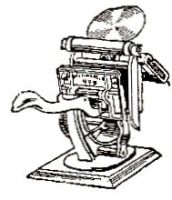
THE
BALTIMOREAN PRINTING-PRESS
has earned more money for boys than all other presses in the market. Boys, don't idle away your time when you can buy a self-inking printing-press, type, and complete outfit for $5.00. Write for particulars, there is money in it for you.
THE J. F. W. DORMAN CO.,
Baltimore, Md., U.S.A.
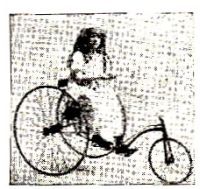
EARN A TRICYCLE.
We wish to Introduce our Teas. Sell 30 lbs. and we will give you a Fairy Tricycle: sell 25 lbs. for a solid Silver Watch and Chain; 50 lbs. for a Gold Watch and Chain; 75 lbs. for a Bicycle; 10 lbs. for a Gold Ring. Write for catalog and order sheet Dept. I
W. G. BAKER,
Springfield, Mass.
Hold their place in the front rank of the publications to which they belong.—Boston Journal, Feb. 19, 1896.