PUBLIC-SCHOOL BOY AFLOAT.
Reading edition
BY RICHARD BARRY.

o the passengers on the ferry-boats crossing between New York and Long Island City, through the sweeping tide of the East River, a view is given of a trim-looking craft lying just astern of the old battle-ship New Hampshire, moored to the Twenty-eighth-street wharf. She is very much dwarfed in appearance by the towering top sides of the three-decker, and during the winter months the deck-house that stretches above her bulwarks makes her look as if her days of freedom to plough the main were past and gone.
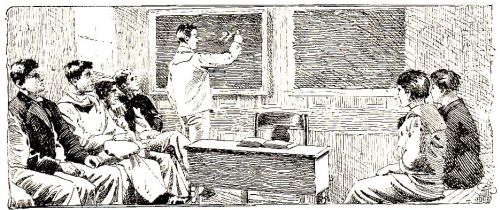
The vessel is the St. Mary's, the nautical training-ship connected with the public-school system of New York city. From the first of November to the middle of April she is indeed nothing but a floating school-house, and the long shed on her deck is divided into recitation-rooms, equipped with blackboards and chalk and benches, and presided over by uniformed teachers.
All this sounds dry enough, even if it is connected with a ship; but the scholars are very different in appearance from the lads who attend the public-schools, although they are drawn from the same sources. Every boy is togged out in the uniform of a naval apprentice, and he is very proud of his ship and of the name on the ribbon of his cap.
Life on a sailing-vessel, that depends entirely upon the wind for her motive power, is very different from the life on board a steamer or one of the steel cruisers of Uncle Sam's new navy. No boy who has ever read any of Marryat's stories, or those from the pen of Clarke Russell, but has been filled with a desire to try the sea for himself, and if he is able-bodied, and a boy with a good record and a desire to learn, he can step back, as it were, into the time when Marryat's or Russell's heroes lived and had their adventures. He can live on board the St. Mary's the life of the sailor-boy of the old school, and find extant all its pleasures and excitements. Indeed, it is not all school-work and blackboard and chalk; there are long months of cruising in blue waters, and strange countries to be seen, and a chance also for a fine occupation, and good paying positions awaiting him at the end of his term of service.
To begin at the beginning, let us see how the New York boy, who has known nothing but the streets and the crowded houses, can accomplish all this, and how he goes about it, and what he learns and sees.
In the first place, it must be well understood that the St. Mary's is not offered by the government as a floating reformatory for bad or unruly boys, or to help careless parents to get rid of them. It is exactly the reverse, and this is now well known.
Application for admission to the Nautical School must be made to the chairman of the executive committee of the Board of Education, or made in person to the Superintendent on board the St. Mary's herself.
But to state a few of the requirements before the papers are signed and the school-boy becomes a sailor. The applicant must be between the ages of sixteen and twenty years. He must be of average size, sound constitution, and free from all physical defects. This means that a rigid examination is enforced, and the boy is measured and given tests of strength to prove that he is worthy by nature to put on the blue suit of service.
He must show testimonials of good character, and, of course, must have been influenced to enter by a taste for a seafaring life, and he must come to a decision of his own free will. The examination, outside of the physical one, is very simple. He must be able to read and spell, to write legibly, and to know enough of arithmetic to figure simple sums up to and including percentage. Lastly, as the boy is not of age, his parent or guardian must sign the necessary papers. Once enlisted, he is maintained at the expense of the city, but has to come provided with numerous articles necessary to a sailor. The list includes two pairs of black leather shoes, rubber boots, one black silk hand-kerchief, one strong jack-knife, tooth-brushes, clothes-brushes, and hair-brushes; thread, needles, wax, tape, and buttons, and many other things to keep him comfortable.
The blue uniform and the canvas working suit are given to him, and only thirty dollars are required to defray the expense of clothing and bedding for the two years' cruise.
SAIL-MAKING ON THE "ST. MARY'S."
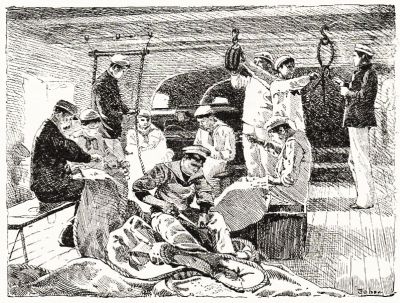
The winter's school term, which begins in November, ends on April 1, when the boys are given a vacation of ten days and bid their farewells. Upon their return to the ship they find the temporary deck-house taken down, and they are put to work rigging the ship and preparing for what they have so long been looking forward to—the summer's cruise.
About April 20 the yards are all up, and the St. Mary's is all-a-taunt-o and ready to go to sea. Now for a month, they cruise in the waters of Long Island Sound, learning to handle ship, and then when they have thoroughly learned their stations and the duties assigned to them, they set sail for the far countries and foreign ports which most of them are anxious to visit.
The writer remembers being in the harbor of Southampton, England, upon one occasion when the St. Mary's came into port. It made his heart beat with pride to see the beautiful vessel (just as if she had sailed out of the past history of the good old days) come sweeping in from the Channel. All her white sails were set when she first was sighted, and the nimble little sailors aloft began to take them in one by one as she drew up to her anchorage.
The flag flying at her peak is the most beautiful thing to an American to be seen in foreign countries, and proud indeed was the writer to turn to an English friend and explain what the trim craft was, and to tell that the crew were New York boys, and Americans every one.
A LESSON IN FURLING SAIL.
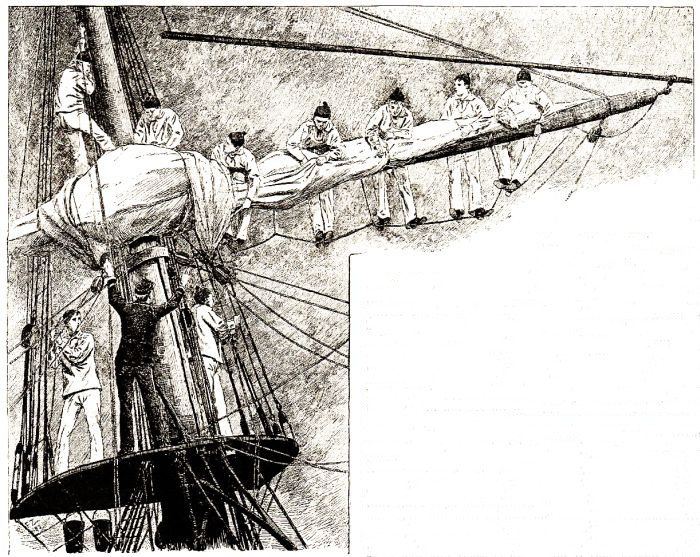
Soon after she dropped her anchor and trimmed ship a boat was lowered away, and it came dashing up to the pier. It was a pleasure to look at the brown, healthy faces, and to notice the well-kept cadence of the stroke pulled by the strong young arms.
Leaving one of the officers on shore, the lads pulled back to the ship, looking curiously at the town, and longing perhaps for the liberty which would be allowed them on the morrow.
Engaging a boatman to row us off, the author and his English friend were soon alongside the school-ship, where the former explained that he was a New-Yorker, and was asked to come on board.
Although she had been at anchor only an hour or so, all the running gear was being neatly stowed away, and the loose ends flemished (i.e., coiled down flat) on the deck. But a word as to the vessel herself:
The St. Mary's was an old United States sloop-of-war, the type of a vessel, modernized a little, that had won honor and glory for the country. The Wasp was such a one as this, and every one knows what she did during the war of 1812. The other craft that stung the English so badly when commanded by Lawrence, the gallant little Hornet, was about this type—a sloop-of-war—also. Although the St. Mary's was very peaceful looking, because she lacked the rows of black carronades along her sides, still it required but little stretching of the imagination to change her into a man-of-war.
We spoke to a little wiry youngster, who told us he lived in "West Twenty-thoid" Street, and asked him how he liked being a sailor. The grin that accompanied his answer—"It's bully good fun"—convinced us that he, at least, was happy, and had rightly chosen his calling. In fact, we did not see an unhappy face amongst the crew, and this speaks volumes.
The St. Mary's had stopped at the Azores, on the voyage out, where the boys had had fine times, according to account, and where the people had been looking forward to their coming, for they generally touched there on their cruises. Of course I had to explain to my English friend that these boys had nothing to do with the regular navy, but were intended for the merchant service, unless they wished, of course, to change it for life on board one of the new cruisers. Every one of them hoped to be an officer some day, and there is no reason, if they attend to duty, why this hope should not be fulfilled, for a better training for positions of command could not be had.
WINTER WORK ON BOARD THE "ST. MARY'S."
One of the officers told us of a little adventure that had happened upon one of the former voyages, which not only showed the spirit of the St. Mary's crew, but also proved that most of the lads had profited by New York's being surrounded by water. One of the boys, a little fellow, had fallen off the boat-yard into the water. The tide had swept him quite a distance from the ship before his cries were heard. When "man overboard!" was shouted, in half a jiffy a score or more of the crew had plunged headlong from the railing and bowsprit after him. In fact, it looked as if the whole ship's company was going for an impromptu swim. Two of the rescuers laid hold of the drowning boy and kept him afloat, while the rest paddled about like a flock of ducks. It took some time for the boat that was hurriedly manned to pick them all up, as the tide had carried some of them quite a distance out. But they were all taken aboard safe and sound, and, as everybody writes when telling of a rescue from "a watery grave," "none the worse for their wetting."
From Southampton the St. Mary's was bound to Cherbourg, France; then to Lisbon, Portugal; Cadiz, Spain; and Gibraltar.
I could well imagine what fun the boys were going to have at the last named place, thy strongest fortress of the English, and the "key of the Mediterranean," as every one says again when speaking of it.
It is from here that the lads always write the longest letters home, for there is much to tell about; and no matter how many times they visit the port afterwards, when in command of their own vessels, perhaps, they will never forget their first sight of the great frowning rock, and their visit to the hidden guns and casemates. In the harbor they find all sorts of strange sailing-craft of the Mediterranean, and hear the jargon of tongues of the multitude of foreign mariners that meet here from all quarters of the globe.
On the return voyage they stop at the Madeira Islands, and thence, setting sail, they make for home, arriving in Long Island Sound about, the last of August. Now, until the middle of October, they spend the time in practical exercises, cruising to and fro in calmer waters; and in the middle of October the St. Mary's returns to her dock in the city.
A leave of two weeks is granted the boys, and it is easy to imagine what heroes they are to their younger brothers and to their old companions who have spent the hot summer in the city.
When they return to the ship on the first of November they find the topmasts housed, the yards taken down, and the deck-house in position for the winter's term of schooling, which begins at once. During the cruise at sea the whole time has been taken up with the study of seamanship and the practice of professional branches of knowledge. They have learned to tie knots, to hand, reef, and steer, and may be pardoned a slight roll in their walk and a tendency to indulge in nautical phraseology.
The boys whose second cruise it has been are found positions on board the American vessels who receive a subsidy under the postal-subsidy bill, for all such are required to be officered by Americans, and to carry a "cadet" for each thousand tons burden. This enables the graduates of the school to step at once into a paying situation, where their education will be of great advantage to them. Maybe some of them make up their minds to go into the navy, or others decide that they are not cut out for the sea, and take up some life on shore; but no matter what they do, they cannot but be benefited by what they have learned and seen.
The first-year boys and the new recruits begin to take up their studies, which are those taught in the common schools—geography, history of the United States, English grammar, arithmetic, algebra, and last, but not least, theoretical navigation. Ship's routine is followed in their daily life, but there is plenty of time for play and skylarking.
When a boy has been graduated from this school, if he has paid attention to his duties and his studies, he is competent to navigate a vessel, he understands thoroughly dead reckoning, and he knows how to find the latitude and longitude by the sun, moon, planets, or stars, and besides this, he knows the duties of a seaman from beginning to end. There is nothing for him to learn about the handling of a sailing-vessel, for he has taken his trick at the wheel, he has learned the rule of the road, and how to give proper orders. He can heave the lead like an old hand, and has had plenty of practice in handling small boats under both oars and sails. The American sailor has proved himself often indeed to be the best afloat, and the lad from the St. Mary's is qualified to take first rank.
During the war of the rebellion many of the commissioned officers were drawn from the ranks of the merchant marine. Had the St. Mary's then been in existence, her boys would have given accounts of themselves, and there is no question that, should at some future time a war arise, there would be places aplenty for them to make use of the knowledge they have gained, or to win laurels in the service of their country. Not long ago a big sailing-ship, returning home from a long cruise, had the misfortune to lose, by death and accident, all of her officers fit to navigate and command her. On board at the time was one of the St. Mary's lads, only nineteen years of age, and the command and responsibility of bringing the great ship safely to port fell upon his shoulders. I am glad to state that he did not fear or shirk the responsibility, and that the grown men under him knew at once that they had a commander who was familiar with his business, and who could be trusted in any emergency, for they encountered severe storms after the boy Captain had assumed command.
The officers of the school-ship are all graduates of Annapolis and appointed by the government, and the petty officers are made up of old men-of-war's men, a few of whom are on board as assistant instructors. The boys, however, fill some of these positions themselves, and thus early assume the duties which teach them how to get on with men who are compelled to obey their orders.
If a boy has a taste for the sea, and his parents have no objections to his selecting it as a calling, he can find out a great deal about the world and not a little about himself by spending two years on board the school-ship St. Mary's.