WHAT IT MEANS TO RUN AN OCEAN GREYHOUND.
Reading edition
BY THE CAPTAIN OF THE "NEW YORK."
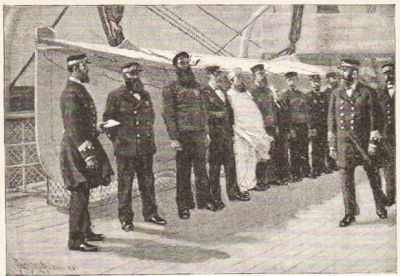
SUNDAY MORNING MUSTER OF THE CREW.
Above all, it means unceasing vigilance. It is said that a man who rides often over the same road can fall asleep in the saddle and still travel it safely. Such a man would be drummed out of the steamship service. Every man who has to do with the sailing of an ocean greyhound must be on the alert every moment of his tour of duty. No matter how many scores of times he may have sailed over the route between New York and Southampton, he must be constantly on the lookout for all that he can read in sea and sky, or in the earth beneath the sea. For two things he is responsible—the safety and speed with which the journey is made. Nothing else appeals to him. The greatest orator of the finest singer in the world might appear and perform on deck, and I doubt whether the men on the bridge would see him or hear him. The ship is like a great cannon-ball that has been shot out of one port to strike the other. The officers of the ship are to make that cannon-ball go true to the mark without deviating in the least degree from the course. That duty is so absorbing that nothing else can be allowed to interfere with it.
Gales cannot stop nor fogs hinder the swift passage of the transatlantic liner. She flies onward with what seems to be an entire disregard of storms. But these things are not disregarded. They are grappled with and fought against, and man triumphs over the fury of the elements. Nothing is left to chance. Every emergency that experience or imagination can suggest is prepared for and studied out long in advance. Friends sometimes ask the captain of a great ship if the nervous strain does not exhaust him; if he is not depressed by the responsibility for so many hundreds of lives and so many millions of dollars worth of property. The answer to that question is always no. If the captain were to give himself up to such reflections he would be unfit for his position. The captain's experience is long and varied before he becomes master of an ocean greyhound. His responsibility is small at first, but constantly grows greater, until he is no more worried by it than you would be worried by having to drive a pair of ponies.
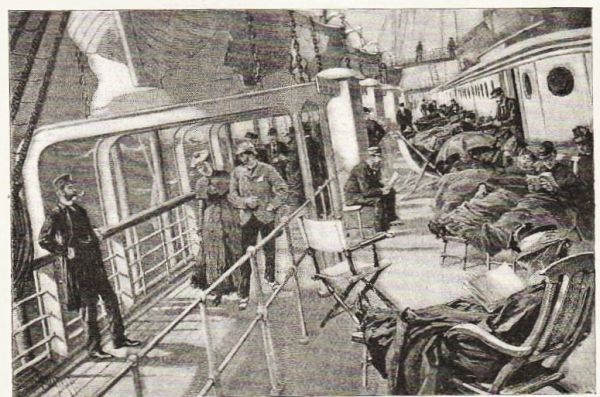
THE PROMENADE DECK OF THE "NEW YORK."
The best ships of to-day are gigantic compared with the best of twenty or even fifteen years ago. The New York is 565 feet long, and of 63 feet beam. She extends 27 feet beneath the water. These mere figures do not convey much of an impression of her size. If she should be lifted out of the water, however, she would fill Broadway, from curb-stone to curb-stone, from Chambers Street to Park Place, and a man standing on her bridge could easily look into the fifth story of the houses on either side. A ship of this size costs more than two millions of dollars. Her engines have power equivalent to that of 20,000 horses. The crew of the New York averages 400 men all the year around. There are 70 in the navigating department, 180 in the engine department, and the rest are in the steward's department.
Just as the government of the city of New York is divided among the Mayor, Aldermen, and boards and commissioners of various departments, so the administration of a giant steamship is divided into specialties. The Mayor is the chief officer of the city. The Captain is the chief officer of the ship. He is more than that. From the time she leaves port until she enters port he is master of the life and liberty of every person aboard the ship, as well as of all the property in it. He is an autocrat. Of course he must administer his authority wisely. Unwise autocrats don't last long, whether afloat or ashore.
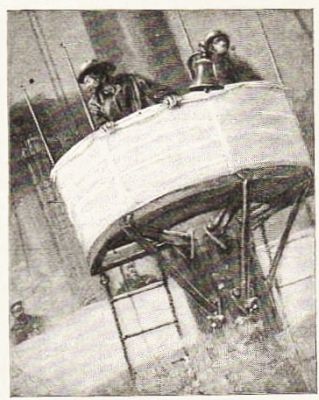
LOOKOUT IN THE FORETOP.
The head of each department is responsible for all that goes on in it. The first officer is at the head of the crew, or navigating department. The chief engineer directs everything connected with the engines. The chief steward has full control of all that has to do with the comfort of the passengers and crew. Each of these chiefs makes a written report at noon every day. Thus the Captain is kept informed of everything pertaining to the ship's welfare.
Every one of the senior officers of the ship is a duly qualified master, capable of taking her around the world if need be. The day is divided into "watches," or tours of duty, of four hours each. One junior officer is on the bridge with each senior officer on duty. The senior officer directs the ship's course. He never leaves the bridge while he is on watch. Should he do so he would be dismissed at once. There is no excuse possible. It would be just as if he had died suddenly. His friends would all feel sorry, but nothing could be done to help him. Two seamen are always on watch in the bow of the ship, and two more in the fore-top. Twice as many are on the lookout in thick weather. Observations are taken every two hours. In the good old sailing-ship days the Captain was content to "take the sun" at noon every day. If the sky was cloudy for a day or two, it really didn't matter much, for he could jog along on dead reckoning. But on an ocean greyhound, rushing over the course between New York and Europe at the rate of more than twenty miles an hour, it is highly important that the ship's position be known all the time. Fog may come down at any moment, observations may not be obtainable for ten or twelve hours. The positions of more than one hundred stars are known. By observing any one of these the ship's whereabouts can be ascertained in a few minutes. Of course the "road" becomes more or less familiar to a man who crosses the ocean along the same route year after year. Yet this familiarity never breeds contempt or any carelessness. No man knows all the influences that affect the currents of the ocean. You may find the current in one place the same forty times in succession; on the forty-first trip it may be entirely changed. Sometimes a big storm that has ended four or five hours before the steamship passes a certain place may have given the surface current a strong set in one direction. There is no means of telling when these influences may have been at work save by taking the ship's position frequently.
Those of you who are familiar with boat-racing know how often a race is lost by bad steering. The cockswain who lets his shell drift to one side and then to the other loses much valuable time in getting back to the course. You know that from the start of the race he has his eye fixed on a certain mark, and that he steers straight for that mark. It is the same way with the Captain of a steamship. His mark is the port on the other side of the ocean. He aims at it all the time. If his ship should go astray only for one hour she would lose valuable time getting back to her course. Every unnecessary mile travelled not only causes loss of time, but waste of coal, and wear and tear of machinery, ship, crew, etc.
Great caution must be used at all times, but especially on nearing the land. Old-fashioned ships use the lead and hand-line for finding the depth of water and nature of the bottom, so that by referring to the chart the navigator can tell just where he is. That apparatus is too clumsy for the swift steamship. We use Sir William Thompson's sounding-machine while the ship goes at full speed. A brass tube is fastened to the end of a piano-wire line. When this is lowered to the bottom the pressure of the water is exactly registered on a glass tube—somewhat resembling a thermometer—which is fastened inside the tube of brass. Upon reading the amount of pressure we know the exact depth. A cup on the end of the brass tube brings up a specimen of the bottom.
THE GREYHOUND IN A FOG—A CLOSE SHAVE.
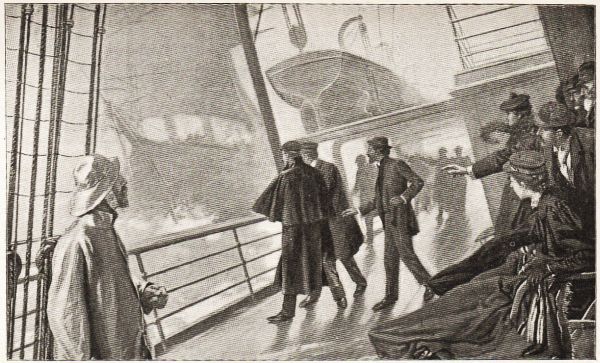
By taking soundings frequently when nearing the land, knowing the ship's course and her position at the last observation, one can prick out her track on the chart even in the heaviest fog. One never can tell what slant of tide or current is silently sending the ship toward the shore, so soundings are taken every fifteen minutes.
The presence of a pilot on board is no excuse for the Captain whose ship gets into trouble. The lives of the fifteen hundred persons on board, the value of the cargo, which is always very great, and of the vessel herself, which is worth at least two millions, all are in his hands. But, as I said before, the responsibility never worries him. He simply watches everything closely. The heads of departments report to him every day, and should any emergency arise, he is kept informed of every new occurrence.
How is it possible, we are often asked, to steer such a great vessel as the modern ocean liner? Steam and electricity have made the work almost seem like play. The senior officer on the bridge can tell at any moment just how fast the ship is going, how many revolutions the port and starboard screws are making per minute, just at what angle the rudder is set—in one word, all about the ship's progress. This is all reported to him on automatic registering machines.
You know, of course, that the ocean greyhound of to-day is a twin-screw ship—that is, that instead of being driven through the water by one propeller, she has two—one on each side of the end of her keel. Each screw is worked by its own set of engines. These engines are entirely independent of each other. The rudder is moved to one side or the other by steam or hydraulic power. Should the rudder become useless from any cause, it is possible to steer the ship by these screws. Most of you know that you can steer a row-boat by putting more force on one oar than on the other. If you want to turn sharply you back-water with one oar and row ahead with the other. So it is with these screws. By backing one screw and going ahead with the other, the ship can be turned around almost within her own length, as the phrase is. The ordinary vessel that loses her rudder is in a sad fix. The twin-screw ship simply needs a little extra care in handling. In fact, it has happened more than once that an ocean greyhound has been steered for more than a thousand miles straight into port while the rudder was useless.
It is easy to appreciate the necessity for making fast time across the ocean when you remember that each idle moment means a loss of earning power. The vessel costs $2,000,000. She will be worn out, say, in ten years. Her value will be very small. So that every moment of her ten good years must be made to tell. Suppose her navigators should be so careless as to let her wander one hour's journey off her course. Another hour would be lost bringing her back. That would mean a clear loss of two hours. Mathematical experts could tell you exactly what that loss would amount to. All we know is that not one instant shall be thrown away.
COALING.
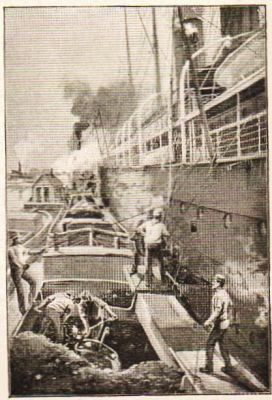
Perhaps you have been aboard one of the largest ships coming up the bay from Sandy Hook to New York. Have you noticed the churned-up white water that flows away behind her? Watch it, and you will observe that now on one side, now on the other, the foam ceases to flow so thickly. This shows that one screw or the other has almost stopped for a moment. The ship-channel coming up the bay is so narrow and shallow that at certain low stages of the tide a great steamship drags the water along with her body, just as your own body can drag the water in a bath-tub. The result is that the rudder has very little effect in guiding the ship. Under such circumstances the screw on one side or the other is slowed so as to steer the vessel.
Whole books might be written about the engines of an ocean greyhound. To inspect the engines thoroughly you go down through four decks. Every bit of machinery is constantly watched. A record is kept of every turn of the screw, of every engine's work. The chief engineer has three first assistants, and one of these three is always on duty. The engine-room is like a gigantic roaring factory—it is a factory that makes power for pushing the ship along. The four large dynamos that produce electricity for lighting and other uses are also in the vast engine-room. So is the machine that makes ice for the ship. This, by-the-way, is almost a magical apparatus. In it is made all the ice used by the ship's company, and from it pipes are led that supply the refrigerating-rooms. There are two of these immense refrigerators. They are on the fourth deck—away below the water-line. As nearly every article of food for the round trip is purchased in this country, practically all the perishable food is stored in these refrigerators—one being known as the "East-bound," and the other the "West-bound." The immense amount of provisions carried is something hard to imagine. A ship like the New York or the St. Paul, for example, takes 25,000 pounds of beef, more than three tons of game and poultry, 18,000 eggs, and other things in proportion. The law requires that enough provisions be carried to feed the ship's people for twenty-four additional days, in case of accident. We carry much more than that amount. In the refrigerating-rooms are also carried enough flowers to adorn the tables all the way to England and back.
Most of you, perhaps, think of an ocean greyhound as a swift-going floating hotel. I think you will admit she is more—that she is one of the greatest wonders of the deep.
J. K. Jamison.