A BLOW FOR CUBA.
Reading edition
BY WILLIAM BANKS, JUN.
t was a very hot day even for Cuba. Every living thing moved listlessly. The great Spanish flag, hanging from the tall slender staff just inside the gate of the fort, drooped like the wings of a tired bird. The sentries were almost gasping for breath. In the barracks the men grumbled and railed at the fate which had brought them from home and friends to fight in a country where fever thinned their ranks far more effectively than did the bullets of the insurgents.
On a slight hill about a mile from the fort a man and a youth were lolling lazily on the ground. The lad was about eighteen years of age, tall, well-built, and unmistakably an American. His companion, a native Cuban, was at least thirty years old, short, but with a frame denoting immense strength.
They had been watching the fort for an hour or more through a powerful field-glass, and following closely the movements of the sentries on the wall nearest them.
"Pah!" said the lad at last, "they're only a lot of boys."
The man smiled at him meaningly, and the lad blushed.
"I know," he continued, hesitatingly, "that you're thinking I'm just a boy too; but," proudly, "I'm an American."
"So," answered the man, softly; "and had I a few score such lads as you in my command I'd strike a great blow for Cuba to-day."
"How, Captain Marto?" was the eager question.
"By taking yonder fort by storm," was the quiet reply.
The youth's father was a prisoner in the fort, and the incidents which led up to his capture may be here described. For five years Mr. Hinton, a native of Pennsylvania State, had resided with his son Ben in Havana, where he carried on business as a general merchant. His wife had died while on a visit to her old American home. Among Cubans Mr. Hinton was well known as a sympathizer in their cause. Immediately on receipt of the news in Havana that General Antonio Maceo had taken the field he decided to lend his active aid to the Cuban leader. Not wishing his son to share in the dangers of a struggle in which he knew that the Spaniards would show no mercy to any who took up arms against them, Mr. Hinton had suggested that Ben go back to relatives in America. This proposition the lad stoutly opposed. Ben knew by heart the stories of the brave efforts which the Cubans had so often made in their attempts to throw off the Spanish yoke. The names of Maceo, Gomez, Marto, and other revolutionists were held in high estimation by him, and, with that intense love of freedom inherited by every American boy, he had determined, long before he knew his father's views on the subject, to strike a blow in the coming struggle for Cuban independence. His father was at last compelled to consent to Ben's accompanying him.
Accordingly, one evening Mr. Hinton, Marto, and Ben left Havana secretly. By travelling at night, and lying concealed during the day in the huts of natives, and sometimes in the woods, they reached the outskirts of the province of Puerto Principe. Here, at the little village in which Marto was born, thirty natives joined them. Marto was elected captain of the band. Feeling somewhat secure, on account of their numbers, the band travelled through the country by day, taking the most direct route for Maceo's camp. But one morning they were suddenly surrounded by an overwhelming force of Spanish soldiers. With desperate courage, Captain Marto, Ben, and some twenty-five men cut their way out of the cordon of soldiers and sought safety in flight.
It was not until the Spaniards gave up the chase that any one noticed that Mr. Hinton was not with the party. Poor Ben was in a frenzy, and, but for Captain Marto and a couple of men restraining him by force, would have rushed back to the scene of the conflict to seek for his father. Wiser counsel prevailed, however, and towards evening a man who joined the party brought comparative happiness to Ben by the report that he had watched from the woods a party of Spanish soldiers marching along with an American prisoner in their midst. The description of the prisoner tallied so closely with that of Mr. Hinton as to leave no doubt of his identity.
Then Marto, who loved Mr. Hinton as a brother, had determined that, at whatever cost, his American friend must be rescued.
"Why," he had said to Ben, "I dare not go to Maceo without him, and I would not if I could. Tho General is expecting him, and will give him a command as soon as he arrives at the camp."
"Which," Ben had answered, gloomily enough, "will never be."
"Which," Marto had retorted, somewhat testily, "must and will be."
Two days after the fight they located the fort which was the headquarters of the soldiers who had attacked them, and it was this Ben and Captain Marto were watching when our story opens. The band had spent three days in the neighborhood, but as yet had not even succeeded in letting the prisoner know that his friends had not totally deserted him.
The fort was a very rude affair, the walls being constructed of two thicknesses of logs with earth packed between. An earthen embankment ran around the inner side of the walls, and at such a height that when the soldiers appeared on it their bodies from the waist up offered a splendid target to an enemy. Some two hundred and fifty men formed the garrison, and they were quartered in a huge two-storied log barracks in the centre of the enclosed ground. In front of the barracks, and about twenty feet from it, was a small hut, in which Ben and Captain Marto, by the aid of the field-glass, had learnt Mr. Hinton was confined.
Continuing their conversation, Captain Marto and Ben had decided that the attempted rescue must be made that night. They knew that the great heat would have a depressing effect on the Spaniards, and they knew also that after nightfall not more than three sentries patrolled the walls of the fort. Many plans were discussed whereby success might reasonably be expected to attend their venture, but the one upon which it was finally decided to act was suggested by Ben.
MARTO GRASPED THE SENTRY AND THREW HIM OVER THE WALL.
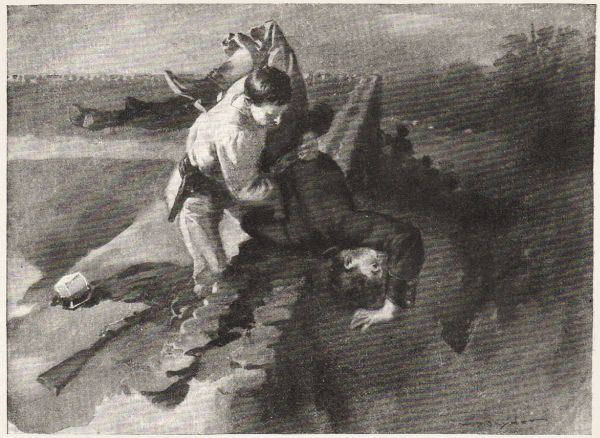
In accordance with that plan, after the night was well advanced, Captain Marto and Ben, with eight men, lay in the shadows under the eastern wall of the fort. They listened until they heard the sentry walk past the position they occupied, and then Marto, mounting upon the shoulders of two of the men, scrambled to the top of the wall. He dropped softly to the embankment, and lay as close to the logs as he possibly could. Shortly the sentry came along on his return patrol, humming a Spanish song. He did not notice the prostrate form until he almost trod upon it. It was then too late to give a warning, for Marto sprang up, and with all the strength of which he was capable, struck the man full on the mouth, and followed this up immediately by grasping him around the waist and fairly throwing him over the wall. Here a dozen hands quickly grasped the soldier, who was gagged and bound before he could utter a cry.
Then one by one the Cubans with Ben scrambled up, and the whole ten made a rush for the small hut. Three sleepy guards were cut down in a few seconds, the door of the building was forced open, and Mr. Hinton was led out by his son.
"Dad! dear old Dad!" cried Ben.
"Ben! my boy!" was the answer, and the voices of father and son betrayed deep emotion.
At this moment a shot was fired, and a sentry on the western wall fell. Instantly a tremendous hubbub arose within the barracks, and the Spaniards, some of whom had already been aroused by the scuffle with Mr. Hinton's guards, began to pour out of the building. All were armed, though many were only half dressed; but before they had time to load their rifles the remaining Cubans, who had got into the ground by way of the western wall, joined Captain Marto and those with him, and the little band of twenty-five flung themselves on the Spaniards.
While the fighting was going on Ben suddenly found himself thrust against something, which proved to be the flag-pole, and, looking up, discovered the Spanish flag waving overhead. The idea at once occurred to him to take advantage of the laxity of discipline among the Spanish troops. He hauled on the ropes, but for some reason they would not work. Placing his clasp-knife between his teeth, he climbed the staff, until he clasped the folds of the flag with his left hand; then he was compelled to sever the halyards with his knife.
From his airy perch Ben turned his eyes in the direction of the struggle. He could barely distinguish the outlines of the surging mass of men. But high above the din of oaths and cries in Spanish, the clash of bayonet, sword-blade, and the favorite Cuban weapon, the machete, arose the exulting cry: "Cuba libre! Cuba libre!"
The lad's soul was thrilled. "Surely," he muttered to himself, "Cuba for the Cubans will soon be a fact and not a dream. But they must retire."
Even as the word left his lips, a single long shrill note from a whistle pierced the air. It was a prearranged signal, and it came none too soon; for now, somewhat recovered from the suddenness of the attack, the Spaniards, realizing the small force opposed to them, were driving the Cubans back by sheer weight of numbers.
At the signal, however, the Cubans retired with surprising swiftness, carrying with them the bodies of several of their comrades who had fallen. As they passed the staff Ben slipped down amongst them, the flag bundled up under his left arm. The gate had already been opened by two Cubans, who had been assigned that duty. The whole band rushed through, three or four men in mere bravado lingering to pull the gate to after them.
As they fled several Spaniards mounted the embankment and sent a volley after them, one bullet striking Ben's left arm. A little cry of pain escaped him, but he clinched his teeth, and grasping the flag still tighter, hurried on.
No pursuit was made, and after placing two miles between themselves and the fort, a halt was called. Torches were lit, and by their fitful glare it was found that of the Cubans who had to be carried away none were dead, although in some cases the wounds were serious. When Ben produced the flag, all stained with his own blood, the impulsive Cubans showered such praise upon him that the lad felt almost shamed. His father said very little, but Ben knew by the silent hand-shake and the care for the wounded arm that Mr. Hinton was proud of his son.
The rest of the journey to Maceo's camp partook of the nature of a triumphal procession. The news of the gallant deeds of Marto's little band roused the whole countryside, and in a few weeks' time what had formerly been a quiet district was in arms against the Spaniard.
When Maceo's camp was reached Mr. Hinton, Marto, and Ben were at once conducted into his presence. He began to compliment Marto, but the latter interrupted respectfully.
"Sir, it was my gallant comrade here," pointing to Ben, "who planned the affair and captured the flag. To him the honor is due."
General Maceo stepped up to Ben and clasped the lad's right hand warmly in his own.
"What can I do for you, my hero?" he asked.
"Let me continue to fight in your cause," was the modest answer.
And, under the immediate command of his father, Ben Hinton is still fighting for Cuba.