THOMAS W. KNOX.
Reading edition
COLONEL THOMAS W. KNOX.
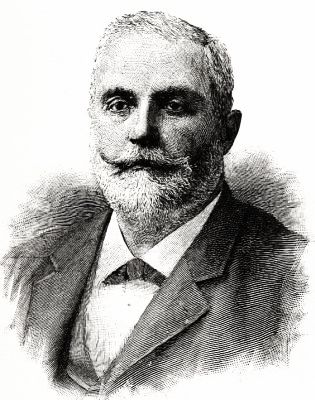
There are people with whom we never associate the thought of death, and whose bright, genial lives seem meant to go on and on to extreme old age. When they are taken away we hear the tidings with surprise and regret, and looking over the work they have done we realize how much we are in their debt for hours of pleasure and profit. Such a man was Colonel Knox, whose Boy Travellers are in every village library, and whose name is a household word wherever bright young people meet. He was well known to the readers of the Round Table, to which he has often contributed. A cheery comrade, a genial friend, he possessed the rare art of telling a story and imparting information at the same time, so that his books of travel are not only entertaining, but of permanent value. He wrote a great many books, but among them there is not one which has not a claim on the attentive reader; and now that he is gone, we are glad that he will still live, and teach, and amuse, and charm a great audience in his pleasant volumes.
Colonel Knox was born in New Hampshire in 1835. His was a typical American life. Born of plain people, he learned the trade of a shoemaker, having previously gone to the district school and worked on a farm, as many a bright lad is doing to-day. Shoe-making was not to be his occupation, however, and when twenty-three years old he undertook the more congenial task of teaching, and presently was at the head of a school. Later his love of adventure took him to the gold-fields of the West. But for the breaking out of the civil war it is probable that young Knox might have gone on either as an explorer or a preceptor, but fate decreed otherwise. When the war rallied the young men of the country on one or the other side, the most promising in every avocation enlisted, and as a matter of course such a man as Knox entered the Union army. Here he served in two campaigns, was rapidly promoted, and finally received the rank of Lieutenant-Colonel on the staff of the Governor of California. That he could write as well as fight was shown by the fact that he became a war correspondent, sending stirring letters from the front to the New York papers.
All this proves the pluck and versatility of the man. He was generally successful in his undertakings, bringing to bear on them the force of a clever and quick mind which could grasp a situation and did not neglect details.
There must have been a roving drop in the blood of the New Hampshire boy, for after the war he could not contentedly settle down and enjoy life at home, but started off on a journey with a scientific object. Organizing an expedition to establish a telegraph line through southern Asia, he entered on the life of a traveller, with all the hardships and the pleasures which combine to make such a life interesting and full of excitement. On sledges in Siberia, in palanquins in India, up and down rivers in China, wherever his fancy or business led him. Colonel Knox travelled, and wrote books about his experiences. The Emperor of Siam was so pleased with the story of Boy Travellers in his country that he conferred on the author the "Order of the White Elephant," a great distinction, which Colonel Knox was the first American to receive.
Colonel Knox was very practical, not specially imaginative, a clear-sighted, straight-forward man, noted for common-sense and energy. As the boys whom he has so often entertained turn the pages of their favorite volumes, they cannot do better than remember that the man who wrote them was in every throb of the pulse an American, simple-hearted, patriotic, and sincere. He loved his country, he studied other countries, and he spent his life in doing honestly and manfully whatever his hand found to do. A good example for us all.
Some Interesting Questions.
Last year I bought three of the dancing or jumping beans, which were then a great novelty. With them came a circular describing them and their habits, which, unfortunately, I have thrown away. However, it was to the effect that the beans were hollow shells which were found on some tree or shrub in Mexico. Each shell contained a small white worm, which would live, the circular said, about six months.
If one of the beans was placed on the palm of the hand, or on a slightly warmed surface, it would begin to move around in little jerks or jumps which were caused by the worm inside. One theory was that if the shell remains stationary in its native home something will destroy it. The worm has no desire to leave the shell. If a hole is bored in it he will straightway patch it up, and if removed from the shell entirely he will try to cover himself up, but cannot make a new shell.
My part of the story is different. Last spring, the beans being still alive, I put them in a small box and packed them away for the summer. When I unpacked them, what do you suppose I found? Three shells, each with a hole in it, the dried skin of the worm, and also a perfect specimen of a strange moth. I cut one of the shells in half, and there were a number of eggs as yet unhatched. Will the Editor please have these specimens conveyed to Mr. W. Hamilton Gibson, who writes such interesting articles for young folks about natural history, so that he may write on this subject if he thinks it of sufficient interest.
Why did the moth or worm bore the hole and lay the eggs? Did the moth die of hunger or suffocation; if so, why did not the worm die in the shell? How could it be a cocoon if the worm did not make it? Why did it lay all the eggs in one shell? All are questions which, when answered, will surely be interesting.
John Hawkesworth, R.T.F.. New York.
Writing One's Name.
Not a few persons fail to stick to one signature. Especially is this true of young persons. They sign their name in all sorts of ways—a practice that is most confusing to those of their correspondents who do not, through personal acquaintance, happen to know that "John A. Smith," "J. A. Smith," "J. Albert Smith," and "John Smith" are one and the same person.
Young persons coming into the world of affairs should select a form for their name and always use the same. It is a matter of fancy, probably, but we prefer the first name spelled out, since it tells something about the writer. A correspondent replying to a letter signed by initials only is often uncertain whether to begin his letter "Dear Sir," or "Dear Miss," or "Dear Madam."
Competition in Raisin Growing.
California is a great raisin country. Immense quantities of raisins from this valley are exported annually to all parts. The muscat is the raisin grape generally grown, but there are several other varieties. The Sultana and the Thompson seedless are small grapes without seeds. During grape-picking-time the country presents a lively aspect. Men, women, and children find employment during the grape season, and a quick worker may earn good wages. One may often see whole families having come from a distance to pick grapes on some large vineyard, camping out in light tents either in the field or beside the country road-side.
The grapes are picked in rows and placed upon trays. The bunches are detached from the vines by a sharp knife, and any injured or decayed grape is removed. A grape-picker is paid, generally, two and a half cents a tray. A good picker sometimes fills seventy-five trays in a day. But they will assure you it is no light work to pick grapes in the hot sun, the thermometer over one hundred in the shade. When the grapes are partially dried they are skilfully turned over into an empty tray so that the under side will be exposed to the sun.
As soon as the grapes are properly cured the trays are stacked, and the raisins are put into sweat boxes ready to be taken to the packing-house, where they are weighed. The loose raisins are set apart from the choice clusters, and are placed in a stemmer, which is worked by machinery, and which throws out the stems and any refuse matter. The clusters and layer raisins are pressed in forms and placed in the boxes, layer by layer. Paper is spread between each layer. Ribbons and beautiful chromos serve to give the final finish, and the dainty boxes of fruit are sent away by the car-load all over the United States.
At one time raisins were a source of great profit, but now vineyards have become more extensive, and as there is a greater supply of raisins prices have been much lower.
Bessie M. Roberts. Hanford, Kings Co., Cal.

Any questions in regard to photograph matters will be willingly answered by the Editor of this column, and we should be glad to hear from any of our club who can make helpful suggestions.
Sir Knight Willis H. Kerr sends the following formula for fogged plates, which he thinks the Camera Club will appreciate: Bromine water, 50 cc.; tincture of iodine, 20 cc.; distilled water, 1 litre. After immersing the plates in this solution for two or three minutes they should be washed and dried. If the plate has been only partially exposed to light, it should be exposed to lamp-light in order to make the fog impression uniform. The plates must be immersed in the solution by red light and tried in a dark room.
Sir Knight H. J. Maccoy asks how to print pictures from a negative where the glass is broken, but the film is not. If there is one clear break across the glass place the negative in the printing-frame, pushing the broken edges closely together, holding them firmly while adjusting the sensitive paper. Place the negative at such an angle with the light that the crack will not make a shadow on the paper, and print in the shade. If there are several cracks in the glass put the negative in the printing-frame, supporting it with a piece of plain glass; tie cords to the printing-frame so that it may be suspended by them, hang the frame from some projection where it will not hit anything, and keep it revolving during the printing. By keeping the plate moving all the time the cracks in the glass do not cast a shadow long enough in one place to leave any impression on the sensitive paper.
A correspondent sends us an envelope which he uses for storing purposes. The envelope is not as convenient as the commercial envelope made specially for negatives, for it has a flap and opens at the side, whereas the manila envelope opens at the end, has no flap, and there is a small crescent cut in the edge, which makes it convenient to remove the plate from the envelope. The open end of the envelope should be placed at the back of the pigeon-hole, both for preservation of the negative and to keep it free from dust.
This Department is conducted in the interest of Girls and Young Women, and the Editor will be pleased to answer any question on the subject so far as possible. Correspondents should address Editor.
I am sorry, dear Mildred and Nancy, that you and I have so very different an opinion on the subject of punctuality. You say, scornfully, "What does it matter about five minutes, or three minutes, and our teacher makes just as much fuss when we are two or three minutes tardy as if we were an hour late?"
Suppose you were going to Montreal to visit Aunt Katharine and your cousins, and you were to meet Uncle Leo and Cousin Margaret at quarter to eight o'clock. Don't you think Uncle Leo would be annoyed if you should fail to keep the appointment to the very minute, and what about the rail-way train in the case? For a traveller going anywhere on a boat or in the cars must be punctual to an instant, or he will be left. We find that very unpunctual people can accommodate themselves to the ways of trains in this particular.
We have no right to waste our own time, girls, and certainly we have no right to waste that of other people. To do so is most thoughtless and unkind. If you are in a class, your unpunctuality may inconvenience and disturb all the others, and very much annoy your teacher. If you are on a committee, and come late to the place of meeting, you throw every one else out of her orbit. People have many engagements in a single day. They can keep none of them to advantage if they are hindered by the careless person who does not keep hers conscientiously.
This whole matter of keeping engagements is one in which you must establish good habits. Never promise to go anywhere, or do anything, to make a visit, or take a table at a fair, or help a friend who needs assistance, and then break your word. A girl's word is a sacred thing. If it is only to sit for an hour with an older friend, or to take luncheon and a walk with Jenny on Saturday, or to write a letter for the cook, who cannot write her letter for herself, keep your word and be on time. Nothing else is worthy such a girl as the one I have in my mind while I write, so clever and sensible, and, in the main, so satisfactory that I cannot bear her to have even one little flaw. I don't want to think of her as one of those people who come hustling into church and Sunday-school ten minutes late, and who disturb everybody else in places of amusement by the same habit. And I cannot imagine one of my girls as, by-and-by, going anywhere late to dinner, a most grievous social fault.