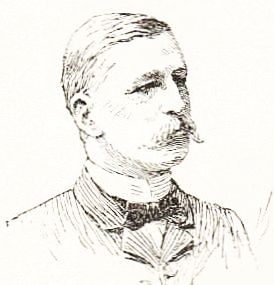
SAMUEL A. ANDRÉE, THE NORTH-POLE BALLOONIST.
Reading edition
BY WILFRID DE FOUVIELLE.
The year 1881 was a great date in North Pole exploration. The most influential civilized nations sent out a dozen scientific parties to study the peculiarities of those desolate regions as accurately as can be determined without paying a visit to the centre of that mysterious territory.
The Swedish explorers made their headquarters at Cape Thorsden, on the southeastern island of the Spitzberg archipelago. This expedition, led by Mr. Elkholm, a distinguished physicist attached to the celebrated Upsal University, achieved considerable success. The members returned home in good condition, after having wintered in an excellent observatory, collected a large number of important readings, and carrying back hundreds of photograms, minerals, and specimens of vegetable and animal life in that far northern land.
The youngest member of this party was Mr. Samuel A. Andrée, son of an apothecary in business near Stockholm, and a graduate of the Swedish Polytechnic School. At that moment Mr. Andrée had not completed his twenty-fifth year. He had been appointed a member of the scientific staff through the influence of the Baron Nordenskjöld, the greatest living Scandinavian polar explorer, and an intimate friend of the Swedish King. Mr. Andrée's special duty on this first expedition was to keep track of Sir William Thomson's (now Lord Kelvin) electrometers, and to report on other scientific peculiarities.
Mr. Andrée is a genuine offspring of the famous sea-kings. He is very tall, powerfully built, with a prominent forehead, blue eyes, and a forest of fair early hair, and is endowed with great muscular strength. As for his mental capacities, he is a talented writer and speaker, and can converse in German and English as fluently as in his native tongue, while he speaks French well enough to make himself easily understood by an audience. Mr. Andrée's practical education has not been neglected, and he knows how to use a hammer, a file, or a chisel as well as any trained workman. On account of his manual acquirements he was selected by the chief of the exploring party to keep the registering apparatus in order, a difficult and painful operation during the terrific cold of the dreary polar nights.
Before he had attained his thirtieth year Mr. Andrée received the appointment of chief engineer of the Swedish Patent-Office. It is probable that he would have devoted the whole of his life to the performance of these attractive official duties had he not felt, during his wintering in the northern regions, the irresistible spell of a more risky and enticing vocation. When he visited me in Paris last summer on his way to the International Geographical Congress, held in London, he confessed that it was in the presence of those grand and impressive scenes he had resolved to win for his native country the fame of having reached the North Pole first.
It was in 1889 that Mr. Andrée decided to make balloon ascensions. Receiving aid from a Swedish scientific fund and from the Stockholm Academy of Sciences, he had the Swea built in Paris, under the supervision of the Swedish Minister. (Swea is the poetic name for Sweden.) This balloon measured 30,000 cubic feet. Mr. Andrée's first ascension took place from Stockholm on July 15, 1893. He was quite alone in the car, and this enabled him to reach an altitude of 11,000 feet, after having passed successively through two layers of clouds, accurately ascertained the direction of the wind prevailing at several levels, and studied other important scientific matters, which have proved valuable to students in all branches of science the world over. He published a graphic account of his first experiences in the Aftonbladet, one of the most influential papers in Sweden, to which he had previously been a popular contributor. In this account he described his sensations as soon as he had lost sight of land, and also when he perceived that he would be immersed in the sea unless he found a serviceable breeze that would carry him towards land. Fortunately the breeze came in time.
ANDRÉE'S GUIDING SAIL.
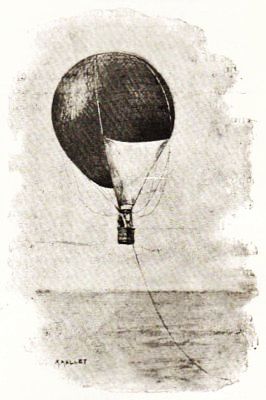
On October 19th of the same year Mr. Andrée made another ascension, in the course of which almost any inexperienced aeronaut would have been lost. As soon as he had passed through a layer of clouds, which up to that moment had entirely concealed the earth from view, he saw that he was passing at an immense distance from land over the very centre of the Baltic. With a calm hand he gently lowered his guide-rope, and observed that the friction on the water was greatly diminishing the velocity with which the wind was carrying the Swea away from the sea-ports, where he could reasonably expect to be rescued by casual ships. Then he tried to reduce the velocity even more by attaching two sacks of ballast to the end of his guide-rope. This simple combination, conceived under the pressure of a great danger, led him to a discovery. He found that he could make the balloon turn slightly to the right or left by using a sail when lowering the guide-rope, not only on sea, but on a vast expanse of land. Mr. Andrée tried this important experiment during an ascension made on July 14, 1894, at Gottenburg. The change of course that he obtained with a moderate-sized sail and a heavy guide-rope was estimated from ten to thirty degrees, not only as shown by his compass, but also according to the testimony of competent persons who had witnessed this extraordinary ascension, when, for the first time, a man had made a balloon sail on the wind.
IN THE CAR OF THE SWEA.
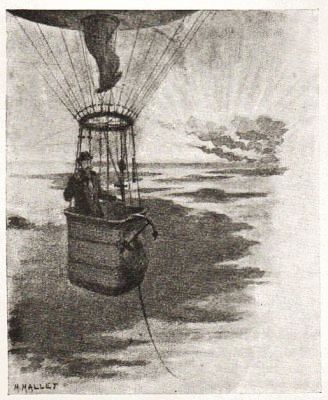
An eventful ending was reserved for this ascension, during which the young Swedish engineer had so cleverly combined the force of the wind with the friction it generates, and utilized both for varying at will the direction of the balloon to the right or left from the air current. The sun was fast declining when Mr. Andrée conceived for the first time this great idea, which may prove so useful for reaching the North Pole. He soon observed a small island straight ahead in the direction he was then following, and at once threw out a sack of ballast. His guide-rope was freed from the waves in an instant, and the Swea darted forward at a rapid rate for the desired land. Ten minutes had not elapsed when Mr. Andrée saw, with a feeling of deep satisfaction and even rapture, the shore lying about a hundred yards directly under his feet. Then he threw his whole weight on his valve-rope, hundreds of cubic feet of gas instantly escaped, the Swea struck land with a shock, and the car was overturned. Our aeronaut, to his great satisfaction, was thrown, at full length on the ground.
Being young in the art of balloon management, Mr. Andrée could not imagine how quickly events happen in aerial navigation. Before he could grasp a rope the Swea had vanished in the air, and he was left alone on the island, without any food or covering, exposed to the cold of those latitudes during a long and dismal October night. Naturally enough, he found in his pocket a box of matches, for the manufacture of these useful objects is a specialty in his native country. He gathered a few dry weeds and dead shrubs and lighted a fire. While warming his tired and hungry body he had plenty of time to meditate over the hardships of his unenviable position. The island, which seemed allotted to him by fate, was not two furlongs long and one wide, and had no water. It was one of the thousand rocky and barren islets composing the Finnish archipelago, and there was but slight possibility that any vessel sent from Sweden could discover his retreat in time to save him from the most terrible of fates, death from hunger and thirst.
As soon as the sun was up on the following morning Mr. Andrée ran to the crest of a little rocky eminence, and kept screaming at the top of his voice for more than an hour. Then he sat down exhausted and burst into tears. Finally his swollen eyes perceived a cloud of smoke upon the horizon. Surely it must be a steamer! No doubt the steamer was rapidly nearing the island! The unfortunate aeronaut wrecked from the skies was about to be rescued! In his joy he danced and resumed his screamings. For a while he was elated. He had some right to believe that he had been seen from the deck, as the ship was steering straight towards the island. But the vessel changed its course, and in spite of the balloonist's piercing cries, disappeared.
This unlucky departure would have driven many a resolute man to despair. For Mr. Andrée it was a lesson. He at once understood that it was impossible for any one on a vessel to see a human figure on this desolate island, and that he must contrive a more showy signal than his body, notwithstanding he was tall and strongly built. After having meditated for half an hour—an eternity under the circumstances—he made a sort of stout stick by tying together with weeds a lot of branches torn from the shrubs. At the end of this stick he attached his trousers, and waved them wildly over his head, after having mounted to the top of the hill.
ANDRÉE'S ESCAPE FROM THE ISLAND.
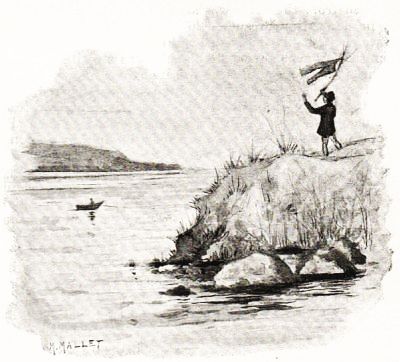
This unnamed island where Mr. Andrée was left is situated a few miles from Brunskär, which has two houses. One of the two is owned by a tailor, who goes around once or twice a week in a boat to visit his customers, who are dispersed over the archipelago. Of course the tailor's eyes were attracted by the sight of a pair of trousers floating in the air, and he rowed to the spot to see what such a signal meant. And this is how Mr. Andrée was restored to life, and thus enabled to pursue his grand idea of reaching the North Pole in a balloon.
Having given some idea of Mr. Andrée's career, and shown a few traits of his energetic character, I purpose, as soon as possible, to tell my young readers the story of the preparations he is now making for this great aerial voyage, which is attracting the interest of scientific people all over the world. Mr. Andrée will start on this perilous voyage some time this year, probably in July, if he can get all things ready by that time. His friend, Mr. Elkholm, will accompany him, and it is not impossible that the explorers may land somewhere in America, after having passed, perhaps, over the North Pole, or at least very near it.
SAMUEL A. ANDRÉE.