WOOD-CARVING.
Reading edition
BY J. HARRY ADAMS.
A knowledge of drawing and modelling will be very helpful to the young carver, as the outline of ornament can be readily drawn, while to carve objects from wood the art of modelling form is most desirable and essential to obtain a satisfactory result.
If the beginner possesses a knowledge of form acquired by drawing and modelling, then the art of wood-carving can be readily and quickly mastered; but even if these advantages should be lacking, it is possible that considerable progress can be made by those who will follow the instructions given on these pages.
The most important feature of carving is the ability to sharpen and maintain the little tools, and when this is mastered, more than half the difficulty has been overcome. Carving-tools can be purchased at most any large hardware store, and as there are a great many shapes and styles of edges to select from, a few suggestions will give a clear idea of necessary ones to begin with.
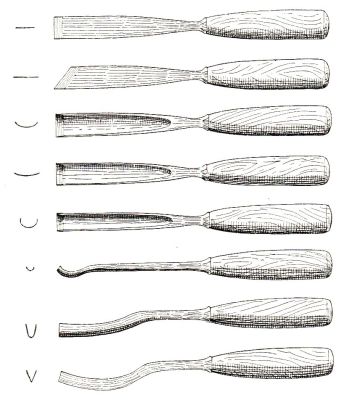
At the start a numerous assortment of tools will not be necessary, as the flat-work will meet with the best success at the hands of the beginner. Six or eight chisels will constitute a good set, and those shown in Fig. 3 will answer very well.
No. 1 is a plain flat chisel with a straight edge, commonly called a firmer. No. 2 is a flat one also, with an angle or oblique edge, and commonly called a skew firmer. Nos. 3 and 4 are flat and extra flat gouges, while No. 5 is an ordinary gouge with a half-circular sweep. No. 6 is a grounder, or bent back ground tool, and is very useful for reaching when a flat tool cannot. No. 7 is a "quick gouge," in the form of a U, and No. 8 is a V gouge, a very handy tool for cutting the veins in leaves and in "chip-carving."
A flannel or felt case should be made for the tools, so they may be kept nicely. The case can be made to roll up, and provided with pockets into which the tools are slipped.
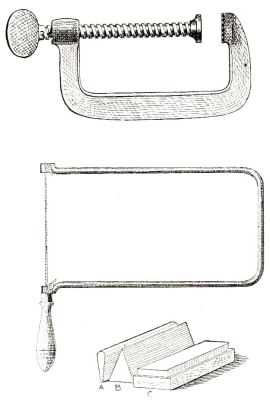
The stones needed on which to sharpen the tools will be an ordinary flat oil-stone, and two Turkey or Arkansas slips six or eight inches long, having the shape of those shown in Fig. 2, A and B. C is the flat stone, and every boy who carries a good pocket-knife should be provided with one on which to sharpen the blades.
The other tools necessary to complete the kit will be several clamps similar to the one shown in Fig. 2; also a glue-pot, and a fret-saw like the one depicted in Fig. 2.
The boy who possesses a bracket or jig saw, however, will not need the fret-saw, as more and better work can be done with it than with the hand affair.
A carver's bench on which to work is of course the greatest necessity; but if it is not possible to get one, a good wooden-top kitchen table will answer very well.
The proper kind of a bench gives greater facility for working; it is more convenient and solid, and as the height is better than that of an ordinary table, the carver works under more pleasant conditions.
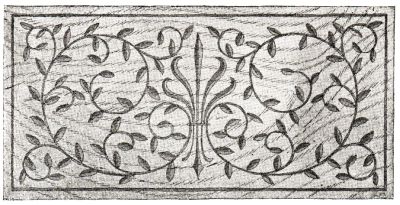
FIG. 1.—A DESIGN FOR WOOD-CARVING.
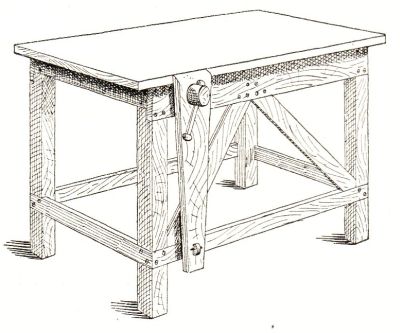
The boy who is handy with tools can make a good bench in a short time, and the design of one is shown in Fig. 5 that can easily be made from wood of the necessary kind that is free from knots and sappy places. The top should measure four feet long, two feet wide, and should be one inch and a half in thickness; it can be of yellow pine, ash, or oak, and the wood must be well seasoned. The framework must be well made, and the cross-pieces and braces securely mortised together, or firmly screwed to the uprights or legs, which can be of yellow pine or ash two inches square.
The top of the bench should be three feet and three inches high from the floor; and to one side of the bench a carpenter's vise may be attached, as shown in the figure.
The first essential to good clean cutting is that the tools shall be absolutely sharp and in a workmanlike condition. It is often the case that amateurs' tools are in such a state that no professional carver could produce satisfactory results, so that in every instance the condition of the tools governs the finished work.
FIG. 2.—CLAMP, SAW, AND CHISEL STONES.
The variety of carving-tools is so limited, that if the difficulties of sharpening a firmer and gouge are mastered, the task is practically ended.
If the tools should be unusually dull, they must first be ground on a grindstone. It should be remembered that carvers' tools are sharpened on both sides, and not only on one, like the carpenters' chisels. After grinding, the tools must be sharpened on the oil-stone or slips before they are ready for use. The firmers can be sharpened on the oil-stone laid flat on the bench, but the gouges must be held in the hand in order to sharpen the inside curve with a slip. The outer curve can be sharpened on the flat oil-stone.
Great care must be taken to give the tools a finished and smooth edge, and when they have reached the proper degree of sharpness it will be an easy matter to cut across the grain of white pine, leaving a furrow that is very smooth and almost polished.
In the use of the oil-stone and slips, neat's-foot oil or a good thin machine oil should be employed. Water must not be used, as it would spoil the stones and not produce the sharp edge on the tools.
The finest stones are the best for use, and although they take longer to produce the keen edge, the sharpest tools are made with them, and they will be found the most satisfactory in the end. Avoid grit and dust on the stones, and before using them they should be wiped off with an oiled rag.
For gouges of the various sweeps the slip shown in Fig. 2A will be necessary, but for the V gouges the triangular one, Fig. 2B, is the right one to use. The stone, Fig. 2C, can be used to sharpen the firmers.
The beginner must not consider any pains too great to make himself a thorough master of the tools, and to keep a perfect edge on all of them. It is necessary, when using them, to exercise care to prevent any unpleasant cut that would be the result of carelessness. Undivided attention and a little common-sense are necessary at all times.
FIG. 3.—CHISELS.
The tools being in proper condition, the next step is to acquire a knowledge of the best methods of handling them so as to produce any desired result. It will require some time and practice to become thoroughly familiar with the manner in which tools are handled, and, if it is possible, it would be well to watch some carver at work. The chisels should always be held with one hand on the handle and two fingers of the other hand near the edge of the tool. This is to give sufficient pressure at the end to keep it down to the wood, while the hand on the handle gives the necessary push to make the tool cut.
Of the woods that are adapted to carve in there are a great many, but perhaps yellow pine, walnut, or mahogany will be found most desirable, as they are easily cut, and do not split as some of the softer and harder woods.
To begin with, it is best to work out a simple pattern that can be followed easily and without a great deal of dexterity in handling the tools. Get a piece of yellow pine one inch thick, eight inches wide, and sixteen long.
On a piece of smooth paper draw one-half of a pattern similar to the one shown in Fig. 4, and on a piece of tracing-paper copy the design. Over the face of the wood lay a sheet of transfer-paper with the black surface down, and on it the tracing-paper, and go over all the lines with a lead-pencil, bearing down on the point so that the lines will be transferred to the wood. Repeat it at the other end, so that as a result the piece of wood will have the pattern.
To one corner of the bench clamp the piece of wood with three or four of the clamps shown in Fig. 2. Do not place the clamp directly on the wood, but place between the jaw and the pine a piece of heavy card-board or another piece of thin wood, to prevent the clamp from bruising the surface of the yellow pine. With a small wooden mallet and a firmer chisel begin to cut down into the face of the wood on the lines until they have all been cut. Then with the gouges and grounding tool cut away the surface not a part of the pattern to a depth of an eighth of an inch or more, until a result is obtained similar to that shown in the second cut of Fig. 4.
FIG. 4.—A SAMPLE Of WOOD-CARVING. 1. The Drawn Design. 2. The Preliminary Stage. 3. The Finished Carving.
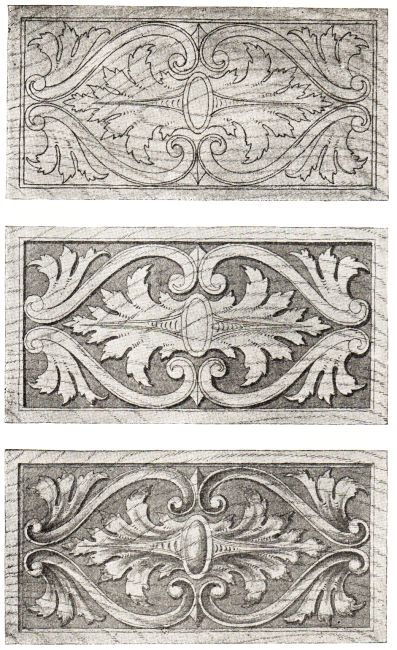
The entire design and edge will now be in relief, but its surface will be flat and entirely void of any "feeling." With the flat, extra flat, and plain gouges begin to carve some life in the ornament. A little practice will soon enable you to observe which parts should be high, the others that should be low, and the surfaces that can be left neutral or between high and low relief.
This part of carving is termed "life," or "feeling," and it is this quality that lends the beauty to the finest wood-carvings. The work when completed should have the appearance of the third cut in Fig. 4, and if nicely done it should be a credit to any beginner. The effect of this panel can be had also by applied carving, which is a very simple and less tedious process.
The design is transferred to a thin piece of wood, and cut out with the fret or jig saw. The pieces are then glued in position on a thick piece of wood, and the feeling carved in a similar manner as described. The former method is called carving in the solid, while the latter is known as applied carving.
Such pieces of carving can be used as panels to small drawers, to cabinets, and to form the sides and covers of useful little boxes, etc. If these simple suggestions are carefully followed, the inventive boy should be able to design some very pretty patterns that can be carved nicely in any desirable wood that is not too hard.
When flat, or relief, carving has been mastered, it would be well to attempt something in figure or bold work, such as animals, fruit, or heads, on all sides of which some careful study and good work can be done. It will be some time, however, before the amateur can successfully accomplish good results, so that for some time the flat-work should be practised, and as improvement is noticed the ornament can be undercut to lend it a richness and boldness.
Chip-carving, or engraving, is a simple but effective manner of ornamenting flat surfaces, and some very pretty results can be obtained in a little while with the gouges and V tools, also the spade chisel and veiner. There is no grounding out in chip-carving, as the pattern is produced by chipping out the figure itself.
Fig. 1 is a simple pattern of a vine and leaves; the stem is engraved with the V chisel, and with a small firmer the leaves are cut. Two curved incisions will cut the leaf, and the angle through the centre describes the main vein. The chipping can be shallow or deep, as a matter of choice, but more effect can be had by cutting fairly deep.
To finish wood-work in most any color, it is possible to obtain stains at a paint or hardware store, and over the stained surface, when dry, several thin coats of hard oil or furniture varnish can be applied. The back and edges of a carved panel should always be painted to protect it from moisture and dampness, and in this manner warping and splitting are avoided. Some pieces of carving only need oiling with raw linseed oil, while others may be varnished. A favorite mode of darkening oak in France and England before it is varnished is to expose it to the fumes of ammonia, or to paint ammonia on with a brush until the desired antique shade is obtained; this, however, is not so satisfactory as the colors resulting from the use of prepared stains that can be purchased.
FIG. 5.—A PRACTICAL WORKBENCH.

Although golf has been played for several years at Lawrenceville, it is only within the past year that the game has established itself on an equal footing of popularity with the other sports of the school. As soon as the students' interest in the game became apparent, however, the authorities, following their custom with regard to all departments of the school, engaged an instructor to take charge of those who desired to become proficient. They secured the services of Mr. James Swan, who was superintendent at the St. Andrew's Club last year and at the Shinnecock Club the year before. His first work on going to Lawrenceville was to select a site for the course and to lay out links.
As there are over two hundred acres in the school property, he was able to take up some thirty or forty acres directly north of the school buildings for this purpose, and when the course has been completely arranged, it will doubtless be one of the best short courses in the country. At present there have been only six holes laid out, although probably next year this number will be increased to nine. For the requirements of the players now, however, these links give just about the amount of ground that can be covered in the afternoon from the close of school exercises until the recreation hour ends.
At Lawrenceville every student is required to devote a certain time each day to out-door exercise, and each boy is allowed to choose the sport that suits him best. About one hundred have decided to play golf in preference to other required exercise, and already some of them have developed good form, notably Griggs, Drake, Childs, Hutchings, and Little. Doubtless one of the reasons for this favorable development is that the players are required to study the rules carefully, and each one follows the game under the supervision of the instructor, who allows no loose form or slouch play.
THE LAWRENCEVILLE GOLF LINKS.
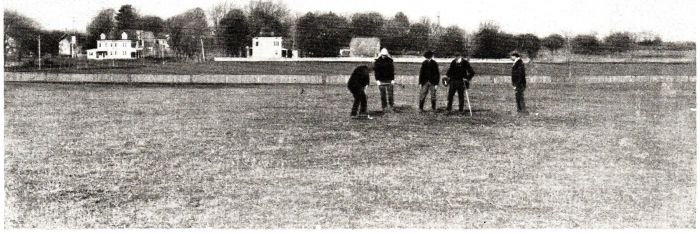
ONE STROKE FROM THE FIFTH HOLE.
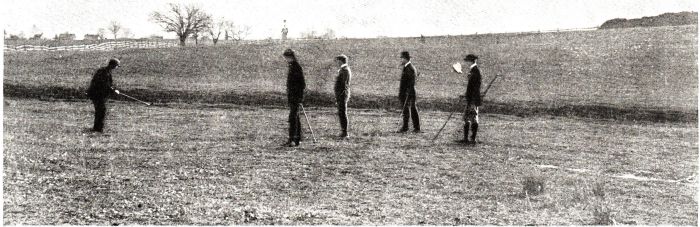
AT THE FIRST HOLE.
The start of the course, as it is at present laid out, is made from the first tee over comparatively level ground for 175 yards, starting near the fence that divides the central school property from the land which lies north of it. The barbed-wire fence which crosses this links forms an undesirable obstacle, but it will be removed in the spring and replaced by a short bunker.
The second tee begins the next link in a northerly direction, in a parallel line with the country road, or the Old King's Highway. This road is the one which was traversed for several decades by the mail-stages from New York to Washington. The ground sinks some eight feet at a distance of 140 yards in this second link of 304 yards, ending with a running brook some nine feet wide. The ground from the brook to the second hole rises slightly.
From the third tee to the third hole, a distance of 282 yards, the ground falls and rises considerably, the brook in this link proving a difficult hazard, as the south side of the bank is several feet higher than the north side. The rise from the brook to the third hole is but a light one. From the fourth tee to the fourth hole, 187 yards, the drive is comparatively good, the brook proving an insignificant hazard to the good driver, but a troublesome one to the beginner who, "topping" the ball, finds that here, as perhaps at no other part in the course, a resort must be made to "dropping" the ball. Indeed to the novice the fourth hole is a trial to the temper.
THE LAWRENCEVILLE SCHOOL GOLF LINKS.
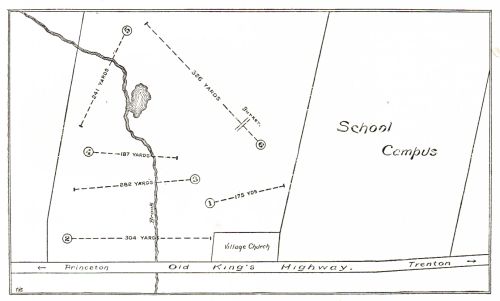
To the right of the third hole stands a farm-house; the course leading to the fourth hole might be across the miniature pond indicated in the plot plan. The ground falls gradually to the brook from the fifth tee, 241 yards, and beyond the brook the ground rises abruptly some 15 feet. The last link, 326 yards long, is the longest in the course, and is one of the most trying. At present it leads over a low hay-stack, which will be removed shortly, and before the hole is reached a bunker must be encountered. The fields are traversed pretty completely in making the course, 1¼ miles in length, and the sixth hole brings the player almost home.
The course has been made several times by the instructor in 27 strokes, and a few of the better players among the boys in 36 strokes, Griggs in 29. The majority of the boys, however, content themselves with some number between 40 and 50. In the course of a few months some twenty or thirty of the boys will be singled out and given more specific instructions, so that the tournaments to be held in the spring may be well played.
The announcement which came to us from New Haven some few days since, that the Hillhouse High-School would not put a track-athletic team into the field this year, brings up the question again of uniting the various athletic associations of the State. The football association of the Connecticut schools is a different organization from the track-athletic association, although both are made up of about the same schools. The football association is financially prosperous—in fact it came out some $400 to the good this year after paying all expenses, and this money is now doubtless drawing interest in the savings-bank.
The track-athletic association, however, is not so great a success from a financial point of view, and is now in debt, or, if not, it has been until very recently. This state of affairs is probably due to the fact that the expenses of a track-athletic meeting are heavy, and there is only one meeting a year, to which the small admission-fees charged are not sufficient to defray all the expenses.
On the other hand, there is a great popular interest in football in Connecticut, and the money contributed by spectators at the principal championship games is very much in excess of the requirements of the association. Perhaps, too, so far as track athletics are concerned, there has been a little mismanagement. The spring games of 1895 were very successfully managed, and proved a financial success, but the association was in heavy debt previous to that date, and the profits of 1895 went to make good some of the deficiencies of previous occasions.
In 1896, however, the managers of the games were incompetent, and the meeting proved a financial failure. The games were not properly advertised in New Haven, where they were held, and on the day of the meeting there were more spectators present from Hartford than there were from the home city. Furthermore, the managers were extravagant in the purchase of prize cups, and when they came to figure up their accounts there was a deficit.
It is the belief among a number of the young men interested in track athletics in Connecticut that if the track-athletic meetings cannot be conducted at a profit, they ought certainly, by good management, to be conducted without loss. It has been suggested that instead of having a football association, a track-athletic association, a baseball association, and perhaps other athletic organizations, it would be the better plan to have a single association that would govern all interscholastic sports in the State. The managers of this association would be the managers of each sport as it came up with the season, and the treasurer of the association would be responsible for all the moneys received and disbursed.
Thus if there was a profit from football, that profit could go to the assistance of any deficit there might be in track athletics. At the larger colleges this plan of uniting all branches of athletics under one financial management has been found to be the best plan, for in sport there must always be one branch that is self-supporting while another is not.
Furthermore this plan of uniting all school sports under one financial management in Connecticut would solve the problem of what to do with the surplus in the treasury at the end of the football season. It would seem that, knowing there was a deficit in the track-athletic treasury, the officials of the football association would have turned over from their surplus the amount necessary to make good the shortage. It is to be hoped that the desire of those who wish to unite all sports under one head will be carried out, for it would be to the benefit of athletics in Connecticut.
The Hartford High-School will have three representatives at the Knickerbocker A.C. games next month. F. R. Sturtevant will enter the high jump. He won the event last year with 5 ft. 7½ in. He will also enter the pole-vault. His record in this event is 10 ft. 5 in. J. F. Morris will enter the 100, 220, and 440 yard dashes. He has run the 100 in 10½ sec.; the 220 in 23-3/5 sec.; the 440 in 52-4/5 sec. C. A. Roberts will enter the walk. He is an unknown quantity.
The Board of Education of Chicago seems to be taking a hand in athletics, so far as the high-schools of that city are concerned. A rule has been passed which makes it necessary for the Cook County athletes to work hard at their lessons. No scholar at any of the high-schools who is not a regular student taking a regular course may represent his school in any athletic event. The principal of the school is required to sign a voucher certifying to these facts, and it is also required of him to see that no pupil lets his marks fall below a certain average, the penalty for this being that he must give up athletics until his school work is brought up to the required standard.
There is a lull in athletics among the Chicago schools just at present—the quiet before the storm, most likely. The in-door baseball games do not seem to be getting along very prosperously, and there is considerable opposition to them among some of the students, on the ground that an admission-fee is charged. Lake View High-School still leads for the championship, having won every game played, with Austin second.
There has been a protest game, of course. It was in the match between North Division and Evanston. In the last half of the ninth inning North Division was at the bat, with the score 7-9 in favor of Evanston. The crowd that was looking on got in pretty close to the Evanston fielders, who claimed that this prevented them from doing their proper and necessary work. The Evanston captain protested against the crowding, but as this had no effect with the on-lookers he left the floor with his team.
The matter was of course brought up at the next League meeting, but the executive committee decided that Evanston was in the wrong, gave the game to North Division, and legislated that in the future any nine that left the floor should forfeit the game to the opponents.
The Long Island Interscholastic Athletic League has decided to hold the first annual skating championships of the organization at the Clermont Avenue Ice-Skating Rink, on Clermont Avenue near Myrtle, Brooklyn. J. A. Forney, of Adelphi Academy, has been appointed to ascertain upon what conditions the Rink may be had for the races, which will probably be held the last week of this month.
The in-door games of the Long Island Interscholastic League will be held on February 20 at the Cycle Club, Brooklyn. There will be ten events contested, and among them one of those precious events for "juniors."
The basket ball championship series has already begun, and the schedule will be played out as follows:
Feb. 5. Poly. Prep. vs. Pratt Institute, and Adelphi Academy vs. Brooklyn High-School.
Feb. 12. Brooklyn High-School vs. Poly. Prep., and Pratt Institute vs. Brooklyn Latin School.
Feb. 19. Poly. Prep. vs. Brooklyn Latin School, and Adelphi Academy vs. Pratt Institute.
Feb. 26. Adelphi Academy vs. Brooklyn Latin School, and Brooklyn High-School vs. Pratt Institute.
March 2. Brooklyn High-School vs. Brooklyn Latin School, and Adelphi Academy vs. Poly. Prep.
Arrangements for the track meeting between Lawrenceville and the Hill School are about to be completed, and it is sincerely to be hoped that whatever arrangements are made will be carried out. Last year the meeting that was proposed, and the league of big schools in New Jersey and Pennsylvania, never came to anything; but as sport advances all these plans will doubtless be carried through, and a strong organization ought to grow out of them.
"TRACK ATHLETICS IN DETAIL."—Illustrated.—8vo, Cloth, Ornamental, $1.25.
The Graduate.
A CURIOSITY OF LITERATURE.
John Heywood, the playwright and epigrammatist, was patronized by Henry VIII. and Elizabeth. "What the 'Faery Queen,'" says Warton, "could not procure for Spenser from the penurious Elizabeth and her precise ministers, Heywood gained by puns and conceits." The object of one of his books, as disclosed by the title-page, is singular: "A Dialogue, containing in effect the Number of all the Proverbs in the English Tongue, compact in a Matter concerning Two Marriages."
When the Marquis of Winchester, Lord High Treasurer, was presented with a copy of this book by the author, he inquired what it contained, and being answered, "All the proverbs in English," replied, "What! all? No, no. 'Bate me an ace, quoth Bolton'"—a form of speech once much in vogue. "By my faith," said Heywood, "that is not in."
It happened that the marquis casually uttered the only proverb not in the book.
Camden mentions an interview of Heywood with Queen Mary, at which her Majesty inquired what wind blew him to court. He answered, "Two, specially—the one to see your Majesty."
"We thank you for that," said the Queen; "but I pray you, what is the other?"
"That your Grace," said he, "might see me."
The curious work on proverbs is in rhyme, and contains many sayings that are now forgotten, as well as allusions to superstitions still remaining.
ENGLISH AND ENGLISH.
Most American boys and girls feel confident that they are tolerably familiar with the English language, and they are right in so feeling; but sometimes one cannot but wonder, in reading over the English newspapers, whether some expressions which are common enough to the English mind would prove puzzling to the American reader or not. For instance, here is a specimen paragraph from the Western Morning News, published in England:
"An Extraordinary Express.—The Cornish corridor express from Paddington, on the morning of the 31st ult., was one of the heaviest fast trains ever sent out of a London terminus. It started with 15 eight-wheel bogie coaches on, reckoned as equal to 22½ ordinary vehicles. But as these corridor carriages weigh about 25 tons each, the coach load must have been over 370 tons, or quite equal to a train of 30 six-wheeled coaches. This for an express run at over 53 miles an hour! There were two engines on of the largest class. West of Swindon the train was split into two parts."
How many of us know what a "corridor express" is? or who can guess the meaning of the term "bogie coach"? and to how many of us, indeed, is the word "coach" a natural expression for car? and, finally, when a train or anything else is "split" into two parts, does not the expression convey to our minds something divided from end to end longitudinally, and not cut in two? After all, the English spoken in one place differs largely from the English spoken elsewhere, and probably ours is as good as that of any one else.