CAPTAIN LEARY'S SAMOAN EXPERIENCE.
Reading edition
SOME STIRRING INCIDENTS IN RECENT AMERICAN NAVAL HISTORY.
BY FRANKLIN MATTHEWS.
On October 23, 1888, there occurred an incident in Apia Harbor, Samoa, which sorely tried the patience of Commander Leary, in charge of the United States war-vessel Adams, and which soon led directly to other incidents that nearly caused a war between this country and Germany. The representatives of the foreign governments had met a few days before, and had decided that a "neutral zone" should be established in and about Apia. A party of unarmed natives were crossing the harbor in one of their canoes, singing one of their stirring native songs. The Samoans have beautiful voices, and the lusty melody of their song was rolling across the water. They had just dug up an old and practically worthless cannon which the Tamasese party in the civil war had thrown overboard.
A NATIVE WAR CANOE.
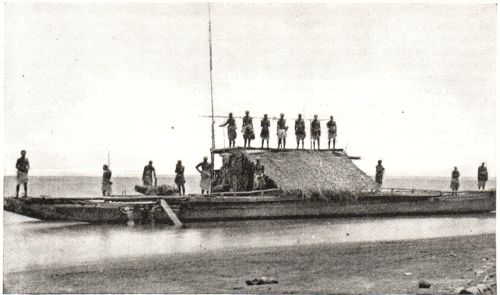
Suddenly two volleys of rifle-shots and several stray shots were fired from the German war-ship Adler on the canoe.
Fortunately none of the party was killed, but the boat was sunk, and the natives had to swim to the shore to save their lives. Some of the shots entered houses of foreigners on shore. Leary's blood boiled with anger that such an occurrence should happen within the neutral zone, that the war-ship of any nation should fire on a body of unarmed men, and that Germany should openly take the side of the Tamasese faction in the presence of another nation's war-ship. He at once sent a vigorous letter to the Captain of the Adler, in which he said:
"I have the honor to inform you that the hostile attack made last night in this harbor by an armed force under your command upon a boat manned by natives, who were harmlessly crossing the harbor, was an act that seriously endangered the lives of the Americans and others, afloat and ashore, in the vicinity of Matautu, and cannot but be regarded otherwise than a most serious affair, coming so soon after arranging and accepting terms establishing neutral ground within the limits of which no hostilities should occur, with a view to securing safety to the foreign residents in and around Apia.
"I am unable to understand your action, as the alleged causes of the attack cannot be accepted as justifying such dangerous and careless conduct. I shall report the affair to my government as a gross violation of the principles of international law, and as a breach of neutrality.
"For the security of Americans and others within the neutral lines I protest against the apparently unwarranted attack made by your men last night, and also against a recurrence of any hostile action within the harbor, whereby the lives of foreigners and non-combatants would be jeopardized."
Leary did as he said he would do, and the records of the Navy Department show that in his report to the Secretary of the Navy he characterized this conduct by the Germans as a "most dastardly disregard for the safety of human life, as well as a cowardly breach of faith and neutrality." In this connection it may be said that in some cases the language of Leary's reports was softened when they were transmitted to Congress. A close examination of the written and printed reports shows many adjectives and phrases omitted. One can imagine what was omitted.
THE VAISIGNANO BRIDGE.
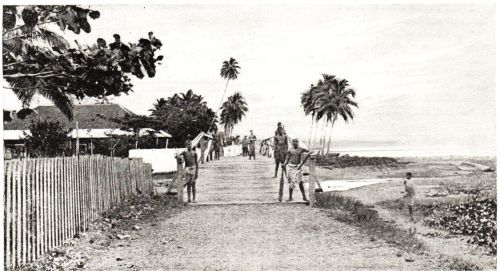
A few days before the natives were fired upon by the Adler's men another incident had occurred which showed the spirit that animated Leary. The Vaisignano bridge that connected the town of Apia with a suburb where most of the foreigners lived had been partly wrecked by a storm. Under the inspiration of the German authorities advertisements had been called for the removal of the bridge. This would have cut the foreigners off from the town, and have seriously crippled the work in the offices of the various consuls. It was proposed to establish a ferry instead of repairing the bridge. Leary saw the notice calling for the removal of the bridge posted on a tree near the bridge, and without hesitation tore it down, and sent word to the authorities that that bridge must not be removed. He then declared that he would repair the bridge, and protect it, if necessary, while this was being done with an armed force. Early the next day he lowered some boats from the Adams, and filled them with his sailors and marines fully armed. Then he sent his carpenters ashore, and they started to repair the bridge. The commander of the English war-ship in the harbor saw what was going on, and he also sent carpenters to assist in the work, and that bridge was never disturbed after that. The English and American residents on the island afterward co-operated in providing a suitable hospital for the wounded in the Samoan fights, and in caring for them.
By this time there was a state of almost open hostility between the German and American war-ships. The great crisis came on November 15, 1888. About seven miles from Apia the forts of the Tamasese party and the Mataafa party faced each other on property that was clearly under American protection. The Mataafa party had received notice from the Germans to vacate the place or take the consequences. Mataafa hastily sent a runner to Captain Leary and informed him of the situation. He asked for advice. Leary sent word that he had a right to remain where he was, giving him some simple information in international law. Leary also said that he would not permit the German war-ship to fire on property under his protection.
Leary received his information about dusk on November 14. The Adler was to start out the next morning just before daybreak. Leary at once sent word to all of his officers who were ashore to report on board the ship by midnight, and to ask no questions. He knew that the Germans expected to steal a march on him, and were watching him to see if he had steam up. Had they seen smoke coming out of the smoke-pipes of the Adams they would have probably postponed the proposed attack until some time when they might catch Leary napping. He was ready for them. He had some anthracite coal on board. He transferred some live coals from his galley fire to the furnace under one boiler of the ship, and by using hard coal had a fire started there without attracting the attention of the Germans. It was slow work. When the fire was going well under the first boiler, he transferred live coals to another boiler, and then to another, and soon after midnight had full steam up on board the ship. The Germans, who always kept steam up, had not the slightest inkling of Leary's action.
Then Leary had his anchor-chains muffled with native mats, and waited for the outcome. All hands were summoned at four o'clock in the morning. Soon the anchors of the German ship were drawn up. Leary shortened his anchors. At last the German vessel with a rush started out of the harbor. Leary's anchors were up in a jiffy. He didn't stop to take in the hawser holding his ship to a pier by the stern. He fastened one end of the rope to a buoy and threw it overboard. Leary was pointed straight out to sea. The German Captain had to make a turn to get out. By the time the Adler reached the entrance to the harbor the Adams was close behind. The Germans saw the real situation at once. There was great excitement on board both vessels, but the Germans would not compromise themselves by turning back.
As the two ships, which were about equally matched in size and in fighting strength, reached the open sea, Leary was in the rear only a few hundred yards. The German vessel took a wide turn, and headed for the point of attack. Day was breaking then. Leary made a short turn close to the coral reefs, and cut in between the German and the shore. His boat lapped the stern of the German vessel, only about three hundred yards away. Suddenly the orders to clear for action were heard throughout the American ship. All preparations had been made for this, and with despatch the decks were cleared, ammunition was brought up, and the guns were loaded. The Germans saw what was going on, and they cleared for action also. Then the two ships went down the coast, dipping to the swells, and stripped for war. It was a trying occasion, and both commanders knew what tremendous results were dependent upon the outcome of their actions that day. Steadily the ships held their course. When they approached the point where the forts were situated, the German ship slowed up and dropped anchor. Leary did the same. It was broad daylight now. Soon a boat was lowered from the German ship, and some German officials were sent ashore under a guard. Then it was that Leary ordered one of his boats cleared away to carry this note of warning to the Captain of the German ship, which Leary had written on the way down and after both ships had cleared for action:
"I AM HERE FOR THE PURPOSE OF PROTECTING THE SAME."
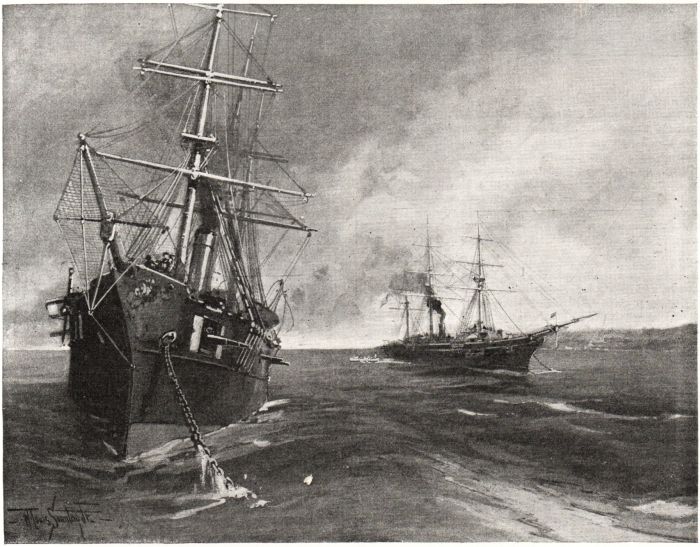
"I have the honor to inform you that having received information that American property in the Latogo vicinity of Laulii, Lotoanuu, and Solo Solo is liable to be invaded this day, I am here for the purpose of protecting the same, and I hope that the friendly relations existing between our respective governments may prevent the occasion from causing any complaint."
The American officer was rowed over to the German ship and gave the note to the officer of the deck, and returned without waiting for any reply. Then the crews of the two vessels stood by their guns for hours waiting for developments. Leary's note was polite and firm; but when such a note is sent from the commander of one war-ship to the commander of another war-ship, and when the decks of both ships are cleared for action, it can mean but one thing—war. Leary meant that no shot should go over his deck into the settlement on shore. For several hours the two ships lay at anchor, with the crews waiting to spring at each other. Soon after noon the Germans got under way again, and made a long detour down the coast, with the Americans close behind, and still ready for battle. Then slowly the German vessel turned about and steamed for Apia Harbor. Leary followed with his ship. Both came to anchor in the places from which they had started early in the day, and that incident, laden with frightful possibilities for two great nations, was ended.
Leary was ordered home soon afterward, and it is known that he received the personal thanks from our officials in the highest seats of government. The strangest part of the affair, however, is the fact that no official notice was ever taken of his splendid determination to uphold the honor of the American flag. Leary's friends say that he has not so much as a piece of paper to show from the Navy Department that he ever stood up for the honor of the flag in so signal a manner in Samoa. Congress passes votes of thanks to men who are conspicuous in saving life on the high seas. Congress never passed a vote of thanks to Leary. I need not go into the reasons for this apparent neglect. If republics are ungrateful, it may be said that Leary never asked for any such action, nor even desired it. He had performed his sworn duty, and that was sufficient for him. He was probably the youngest officer in the navy ever called upon to perform such a responsible task, and if there seemed to be envy on the part of those older and of higher rank in the service, "Dick" Leary went his way modestly, and asked for no public recognition of his services.
His native State, however, Maryland, could not let such a display of patriotism go unrewarded, and the Legislature voted him a handsome gold watch. It was presented to him in the presence of a brilliant company at the State Capitol. The national government kept silent officially, however, and that silence has never been broken.
Leary probably cares least of all for this apparent oversight. It has been given to few officers in the American navy to write,
"I am here for the purpose of protecting the same." (American property.)
That is Leary's reward. It is enough for him to know that he did his duty, and that the people respect him for it. As Americans, we are proud of certain sentiments uttered by those who have worn our country's uniform in time of war. "Don't give up the ship!" still rings in the ears of all patriotic citizens. "If any man hauls down the flag, shoot him on the spot!" still inspires and thrills us. With these, and other sentiments like them, I wish to write Leary's declaration,
"I am here for the purpose of protecting the same."