GORGONZOLA, THE AUTHOR.
Reading edition
BY JOHN KENDRICK BANGS.
It was upon the occasion of my second visit to Schnitzelhammerstein on the Zugvitz that my friend Hans Pumpernickel, who, as some of you may remember, is the Mayor of the queer old city, let me into the secret of poor old Gorgonzola's embarrassing situation. We were taking one of our usual summer-evening walks on the banks of the Zugvitz, and on our way back to Hans's residence we passed a gloomy-looking old house on the right-hand side of the Hochstrasse, near the public gardens. With the exception of a dim light which struggled through a window on the top floor, the mansion was in utter darkness, and was, in fact, in such strong contrast to the general air of cheerfulness which is one of the strongest attributes of this broad avenue that I remarked it.
"Dear me!" I cried, as I stood before it. "What a place of gloom! It reminds me of a small black cloud on an otherwise perfect sky. Who lives there?"
"It is the home of poor old Gorgonzola, the author," said Hans, shaking his head sadly. "The light you see is from his study—his den. It is there that he is at work."
I did not like to confess my ignorance by telling Hans that I had never heard of Gorgonzola, the author. For all I knew, Gorgonzola, the author, might be one of the features of the town, and so, wishing neither to betray my ignorance nor to offend my kindly host, I said:
"Oh! Really? How interesting!"
At this remark Hans threw his head back and laughed. "Is it so?" he said. "Indeed, now, how interesting do you find it?"
"Well," I replied, after some hesitation, "we have a word in our language which expresses it. 'Quite' is the word. I find it quite interesting, though, to tell you the truth, my dear Mr. Mayor, I never heard of Herr Gorgonzola before. In our country almost every town of importance has an author of which it is proud, and it was only my desire to be tactful that kept me from asking, when you mentioned Gorgonzola, who on earth he was. The fact that I never heard of him does not prove that he is not a great man. What has he written?"
"Nothing—practically nothing. He hasn't even written a poem for the Schnitzelhammerstein Blaetter."
"Then why do you call him an author?" I asked.
"Because," Hans replied, naïvely, "every man has to do something, and poor old Gorgonzola is nothing else. Besides, he called himself that."
There was a pause. I was more or less baffled to know what to say, and in accordance with the old German maxim, "When you nothing have to say already, do not say it yet," I deemed it well to keep silent. Fortunately, before the silence that followed became too deep, Pumpernickel himself put in with,
"He did not want to call himself an author, but he had to. You know we have a Directory here in our city—a great, thick, heavy book—"
"Which he wrote?" I suggested, desiring to say something, for I had in mind that other old proverb, "He who says nothing, has nothing to say; and having nothing to say, therefore thinks nothing in his brains."
"Not at all, not at all," cried Hans, impatiently. "He merely let them use his name in it for completeness' sake. You see, it was this way," the Mayor continued. "When Bingenburg and Rheinfels went to our Board of Trade and said let us get up the Directory of this city, the Board of Trade said: 'Donner and Blitzen! not unless you make it complete. The last Directory was full of addresses that no one wished to know, and had none that would help a stranger to our town.'
"'We will make it complete,' said Bingenburg and Rheinfels. 'There shall be no living soul in Schnitzelhammerstein on the Zugvitz whose name and occupation and domicile shall not be down in full.'
"'Then,' said the Board of Trade, 'you may make the Directory, but if we find one name left out, or without an occupation and an address, then will we not only not endorse your Directory, but we will say it is bad, and advise the citizens of this town not to go to those addresses which you print.'
"'We will do our best,' said Bingenburg and Rheinfels.
"'That's good,' replied the Board of Trade. 'Go ahead. What we have feared from experience is that you would do your worst.'
"And so," continued Hans Pumpernickel to me, "these persons were commissioned to prepare a Directory for Schnitzelhammerstein on the Zugvitz. They went ahead and got most everybody. In their original manuscript, submitted to the Board of Trade, they had entries like this: 'Hans Blumenthal, baby, Altgeldstrasse, 19 bis.' They had 'Gretchen Frorumelstine, doll-fancier, 4612 Funf Avenue'—in fact, they had every single human being in town, by name and by occupation, however trivial, mentioned.
"Now, of course, to do this they had to see everybody, and among others they saw poor old Gorgonzola, and he willingly gave them his address and his name.
"'But your occupation?' said the agent, instructed beforehand already.
"'I have none,' said he.
"'Then we put you down as "Wilhelm Gorgonzola, nothing,"' said the agent.
"'But I am not nothing,' cried Gorgonzola.
"'Then what are you—a butcher?" said the agent.
"'You are insulting,' said Gorgonzola, indignantly.
"'We may be, but we do not intend to be,' said the agent. 'The man who is nothing is nothing; if he is not nothing, he is something else. Therefore you may be a butcher.'
"'You cannot have my name at all, then,' said Gorgonzola, with an angry wave of his hand.
"'Oh yes, we can,' replied the agent. 'Your name is here. Therefore we have your name and address. Your occupation is what we wish to learn. If you are not occupied, we will put you down as "vacant," or "to let," or as "nothing." We are under contract to the Board of Trade to give them a complete Directory, and we intend to do so. What, then, are you?'
"'Well, you see,' said Gorgonzola, desperately, 'as yet I am nothing, but I hope to be an author—'
"'And how soon do you hope to be an author?" asked the agent.
"'It may come at any time—to-morrow, or the next day—or the day after—'
"'Oh, well, then, it is all right already,' put in the agent, 'for our Directory will not be out before that. Under no circumstances can we have it ready before to-morrow, or the next day, or the day after. I will therefore put you down as an "author," for doubtless you will be one before our Directory is published.'
"To this," Hans continued, "poor old Gorgonzola weakly consented. You see, he fully expected to be one before the Directory came out; but, alas! he was too hopeful. The day of publication arrived, and as yet he had not written a line. He sent word to Bingenburg and Rheinfels, and begged them to wait a month; but they said no, they would wait ten days and no longer.
"'But I have not yet even an idea for my book,' said Gorgonzola.
"'That is not our fault,' replied Bingenburg and Rheinfels. 'You have had six months in which to become an "author"; we grant you ten days more. If you are not one by that time, our Directory will have to come out, anyhow, and inasmuch as we have your authorization to put you down as such, we shall require that you shall be one at least in name by then, for we have promised that the book shall have no errors. If we get into trouble with the Board of Trade on your account, then shall we sue you for the damages!'"
"The poor old fellow," said I, my sympathy aroused.
BINGENBURG CAME IN PERSON TO SEE HIM.
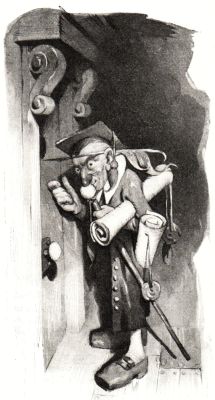
"It was a dreadfully hard position for him, no doubt," said Hans; "but, after all, it was his own fault, and has been so ever since. When the ten days were up, Gorgonzola had even yet not an idea, much less a book, and Bingenburg came in person to see him. Gorgonzola begged him to blot out the word author, but neither he nor Rheinfels would go to the expense, and they threatened that if he ever denied that he was an author, in public or in private, they would ruin him. 'It is all your own doings,' said Rheinfels. 'We would gladly have put you down as a butcher, or a baker, or anything else that is easy to be, and you would not let us. We offered to put you down as a nothing, and you grew angry, and it was yourself that said you expected to be an author before our Directory came out, and we put you down so with your consent. Now our Directory has cost us five thousand thalers to make, and if one mistake is found therein the Board of Trade will decline to take it off our hands, and we shall lose all that money; and so it comes that you have got to keep your promise to us and be what you said you would.'
"'I see,' moaned Gorgonzola; 'I cannot blame you, Rheinfels. But it is awfully hard.'
"'It would have been easier to be a butcher, but you would not,' put in Bingenburg.
"'I know, I know,' said Gorgonzola, 'but I hate butchering.'
"'Well, anyhow,' said Rheinfels, 'the entry is going to attract attention, and the Board of Trade will try to find an error in the book so that they may not have to pay us, and we want you to understand that we hold you responsible for this. If they summon you, you must confess.'
"'Confess?' cried Gorgonzola. 'Confess what?'
"'That you are an author,' said Rheinfels, calmly.
"'But suppose they ask me of what?' pleaded Gorgonzola, wringing his hands.
"'That is your business, not ours,' retorted Bingenburg and Rheinfels in one breath, and with that they left him.
"And so it happened," continued Hans. "The Directory was published, and the Board of Trade appointed a Committee of Three on Errors, who should read the book and see if it should be paid for or confiscated. Ten possible errors were discovered. Nine of them were found not to be errors, but in the case of Gorgonzola they reported that since he was not an author there was clearly one error in the book, and that they therefore recommended the non-acceptance of the Directory. The Board so decided, and Bingenburg and Rheinfels carried their case to the courts. The Board of Trade stated that they had rejected the book upon the agreement in the contract that one error should be sufficient to relieve them of the payment required, and they had fifty witnesses to say that Gorgonzola was not an author, but a mild-mannered gentleman who had struck them as being a querist.
"'A querist?' asked the Judge.
"'Yes,' said the witnesses. 'A querist—one who is only queer and nothing else.'
"Then Bingenburg and Rheinfels called Gorgonzola as a witness. Poor old fellow! he felt awfully about it, but he had to testify.
"'Your name,' said the lawyer.
HANS JOSEF WILHELM GORGONZOLA, AUTHOR.
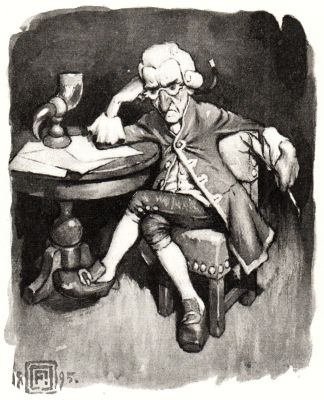
"'Hans Josef Wilhelm Gorgonzola,' he replied.
"'A good name for an author,' sneered the lawyer. 'What is your business?'
"'I am an author,' said Gorgonzola, with tears in his eyes.
"'He confesses it! he confesses it!' cried Bingenburg and Rheinfels, overjoyed, while the Board of Trade looked blue, and the Judge called the firm to order.
"'Author of what?' asked the lawyer, triumphantly.
"Gorgonzola hesitated, and Bingenburg and Rheinfels held their breath.
"'Of—what I have written,' said Gorgonzola, sadly.
"'And what is that?' insisted the lawyer.
"'I cannot tell,' said Gorgonzola, 'because it—it is my secret. If I told what I have written, some one else might steal it and publish it over his name, and all my work would be gone for nothing, which is hardly fair.'
"'A good point,' said the Judge, nodding pleasantly at Gorgonzola.
"'But you have never published anything?' said the lawyer in a manner so impressive as to affect the jury.
"'No,' said Gorgonzola. 'No, I have never published anything; but that is because I am not a publisher. If I were a publisher, I should publish. As I am only an author, I merely authorize.'
"'Do not authors frequently publish?' asked the lawyer.
"'Often,' returned Gorgonzola. 'But I am not of that kind. It is said by some who seem to know that the best books are still unwritten, much less published. I am writing one of the unwritten and unpublished books.'
"'Yet you have written something?' suggested the Judge, who admired the modest demeanor of Gorgonzola.
"'Yes,' said Gorgonzola. 'I have written the first paragraph of my new book.'
"'Then,' said the Judge, 'the entry is correct. If he has written the first paragraph, or even the first word of his new novel, he is an author, and I so decide. Next case.'
"So," said Hans, "it was decided that Gorgonzola was properly entered as an author on the pages of the Schnitzelhammerstein Directory, and the Board of Trade was compelled to pay for it. That," Hans added, "was twenty years ago."
"As long ago as that, eh?" said I. "And was Gorgonzola's novel published later?"
"No," said Hans. "Not yet. You see, he is still at work on it. That is why you see that dim light from his study window. Gorgonzola begins work at seven in the morning and retires at midnight. He is still at work on the novel, but, having written that first paragraph, we of course allude to him as the Author."
I laughed again. I had to, though I still had a great sympathy for Gorgonzola.
"What was his first paragraph?" I asked, very much interested; "or don't you know?"
"Yes, indeed, I know," replied Hans. "He has read it to me many times. Let's see—it is like this: 'It was a pleasant day in June. The buds were bursting on the trees, and all nature seemed alive, as Gretchen walked down the stairs and out into the garden.'"
"That's a good start," said I. "And tell me, Mr. Mayor, how far has he got in these twenty years?"
"He is still at work on his second paragraph," said the Mayor.
"Well," said I, "there's a good story for you—but, after all, Hans, it hasn't much of a moral."
"Oh yes, it has," retorted Hans. "It has a great moral. In fact you English-speaking people have the very moral well expressed."
"Indeed," said I, anxiously, "what is that?"
"First be sure you write, then go ahead," said Hans, simply.