THE RESTORATION OF "TIP."
Reading edition
BY J. PARMLY PARET.
Tip was a vicious young elephant, and during his brief life of twenty-three years he killed several of his keepers. His last act of violence came near causing the death of Snyder, the attendant who had charge of him at the Central Park Zoo, and as a result he now stands upon a wooden pedestal in New York's Museum of Natural History, where all may look at the brute which caused so much trouble for the circus people who owned him. For his attack upon Snyder, nearly two years ago, the Park Commissioners ordered his execution, and he was killed with powerful drugs given to him in his food. The process of mounting and stuffing his hide, to be exhibited at the museum, was very interesting, as the accompanying series of pictures will show.
1.—THE FIRST BOARD AND THE WOODEN BONES.
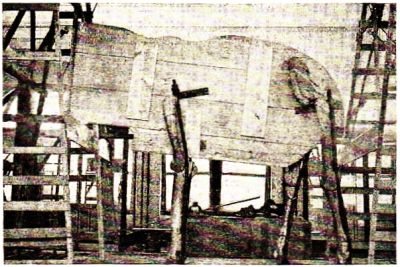
The preparation of the elephant's tough skin and the cleaning of his bones took nearly a year before the actual work of mounting was started. As it is intended to mount Tip's skeleton separately, exact reproductions of his skull and a few of the other large bones were carved in wood, to be used in modelling the form on which the hide was to be mounted. All of the flesh, of course, was destroyed, and in its place the museum workmen built up a dummy of his body, or manikin, as they call it, from measurements and photographs taken of him before his death. Building this lay figure and fitting the skin to it took nearly six weeks' work, and the stuffed elephant then stood over two months, to allow the hide to stretch and dry on its new body before the specimen was ready to be shown. It has been on exhibition only a few weeks now.
2.—THE WOODEN HEAD AND RIBS.
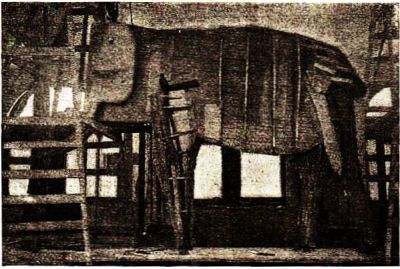
The first part in the difficult task of mounting Tip was to build the manikin. The workmen sawed out of heavy planking a flat piece about the general shape of the big brute's side. This was supported by iron rods, in place of legs, bolted to the frame-work and to the temporary pedestal upon which the work was done. The wooden skull and leg bones were then screwed to the body, and other pieces of wood the shape of Tip's sides were fastened in place like ribs. A pair of handsome ivory tusks taken from some other real elephant were fitted to the skull, while another long plank was hung down between them for his trunk. Tip was nine feet and a half high at the shoulder, and eleven feet in length, so it was no easy task to reach all parts of his great body. Great ladders were built at each end of the manikin, and ropes were rigged from the ceiling over it, to haul up the heavy parts of the wooden animal they were creating.
3.—AFTER THE LATHS HAVE BEEN PUT ON.
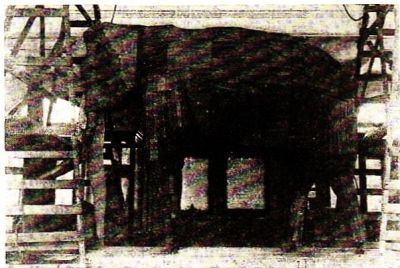
Just as the carpenters build the walls of a house, these workmen covered the great ribs of their wooden elephant all over with laths. They nailed them to the frame-work, leaving his body hollow, and then for the first time the manikin began to take on the shape of a real elephant. His body looked more like some huge barrel, perhaps, than that of Tip, and his legs were a trifle stumpy and unfinished at the ends; he lacked a tail as yet, too, and his trunk was only a rough pine board; but the gleaming ivory tusks were there, and his head had a lifelike appearance that was very encouraging. But the difficult part of the work was just beginning, for the body must be made to fit exactly to the shape of the hide before it could be put on.
Excelsior was next called into use, and the lath-covered frame-work was completely enveloped in those thin shavings from wood so often used for packing china and glass. Bunches of it were tacked to the laths, and in some places it was tied on with string, while here and there a little lump was glued to the frame-work. The many photographs of Tip were gotten out, and measuring-tapes were used to get the exact size in all parts. For days the men were busy with nothing else but this work. They trimmed off corners here, and added patches there, as the defects in the manikin's shape were shown by the photographs and measurements.
4.—THE CLAY MANIKIN READY FOR THE HIDE.
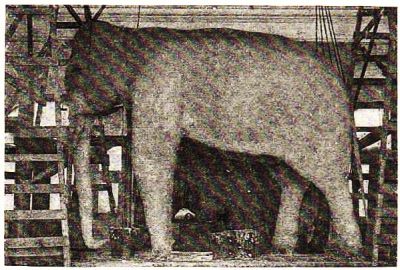
At last the great hide was brought up from the cellar, and for the first time fitted to the wooden elephant. When Tip was skinned a year before, the men were careful to cut off the hide so that it would be easy to work with when they came to mount it, the two sides and the head being skinned separately. Now these three pieces of hide had undergone an elaborate preparation. They had been soaked for months in acids, and had been scraped and pared down to about an inch in thickness. If this tough skin were kept long in the open air it would have hardened so stiff that it would have been almost impossible to mount it. So it had been kept in a solution the workmen call "tan liquor," and when the manikin was finished an enormous tub containing these soaking hides was brought up to where the dummy stood.
5.—ONE SIDE OF THE HIDE IN PLACE.
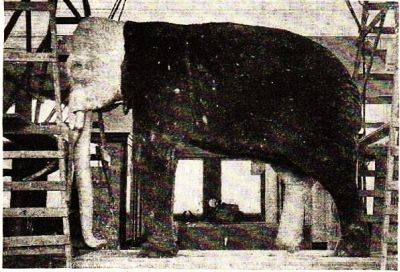
Ropes were fastened to one side of Tip's skin, and it was hauled up against the manikin and fitted around the body. Then it was lowered back into the tub again, and more excelsior added where the skin hung loose, or bits cut away to make room for the clumsy dimples in the elephant's hide. This was repeated over and over again, until the men were satisfied with the fit of the final covering for their specimen. But, like good tailors, they were not easily satisfied, and the patient manikin had to have its new coat "tried on" many, many times before it was ready to have the seams sewed up for good. Both sides had to be treated in this way, and then the head, which, of course, needed more fitting and alterations than the sides.
But it was finally finished, and the last work on the manikin was then done. The great body with its woolly coat of excelsior was hidden under a thin layer of modelling clay. This was spread over evenly and worked down smooth with the men's hands; the body, the legs, the head, the trunk, and even the tail were treated to this last coat, and at a little distance Tip looked very natural, except for the lack of eyes and soles for his feet. Again the big pieces of hide were hauled up out of the tan liquor, and again they were fitted to the manikin. Here and there a few final alterations were necessary, and then the body was ready to be sewed into its new coat forever.
Clumsy seamstresses these workmen would have made if fine linen and sewing-silk had been their materials, but with copper wire, and brad-awls to punch the needle-holes, they managed to make fully as strong, if not as neat, seams as the cleverest dressmakers. The two sides of the skin were hauled up and matched together at the top of the elephant's back. Then, with their clumsy needles and their wire thread, the workmen climbed up on top of the manikin, and sewed together the long seam where the knives of the skinners had opened the hide. Other seams down the back of the legs and under the elephant's belly were sewed up in this way, and Tip's hide once more held an elephant, although a very different kind of an elephant from that it was intended to cover. The skin of the head was put on in the same way, and the trunk-covering was sewed over the padded plank in a most natural position. Two large eyes of glass were fastened into the sockets, and Tip was put away to dry out.
6.—"TIP" RESTORED.
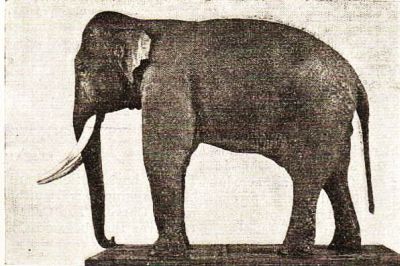
Had any one who did not know the secrets of the taxidermist come upon the elephant a few days later, he would have thought he had seen a ghost—and the ghost of the famous white elephant, too, at that. There stood Tip, to be sure, but all white. The effect of the chemicals in which his skin had soaked so long had been to bleach the hide to a streaky gray that looked almost ghostly. But the workmen expected this, and they soon altered the disguise. They went over to the zoo in the Park with big buckets of paint, and mixed a lot of it to match the skin of Tom, another elephant there, whose hide is almost exactly the same color as was Tip's. Then they painted the stuffed elephant from trunk to tail, and varnished over the paint, covering up all the stitches they had taken in his hide, and giving him once more the appearance of the familiar old friend on whose broad back the children used to ride about the circus ring until he got too ugly to be safe.
Never again will Tip attack his keepers. Behind a railing he stands in the museum, as harmless as old Jumbo, whose skeleton stands nearby, but still as natural as in life. On his label one reads,
ASIATIC ELEPHANT,
followed by a brief history of his twelve years' experience in America, his death and restoration. His skeleton will be mounted by the museum experts, and will stand at the side of the stuffed hide.