MYSTERIES OF STAGE SCENERY.
Reading edition
BY W. J. HENDERSON.
You have taken off your overcoat and made yourself as comfortable as possible in an angular little folding-chair that never was intended to give any human being a minute's comfort. The orchestra has crashed through the last measures of the overture. The footlights are turned up; the auditorium lights are turned down; the curtain rises. You see a beautiful valley, winding away among very purple mountains till it loses itself in the crimson of the glowing sunset. The sky is as luminous as if it were nature itself, and you are almost tempted to believe that the rear wall of the theatre has been removed, and that you are looking out at something real. Presently you notice a few soft fleecy clouds drifting across the sky. The crimson fades gradually, and the pale gray of a brief twilight follows. The sky grows darker and darker, and presently you see the twinkle of a single star, then another and another. And now a gentle greenish glow begins to pervade the scene. It increases in power till the stage is flooded with the bright refulgence of a summer moon. The whole thing is beautifully managed, and is most realistic.
MAKING THE FIRE IN THE LAST SCENE OF "DIE WALKÜRE." Calciums, Cloud-machine, Lycopodium Torch, Red Fire, and Steam-box in Operation.
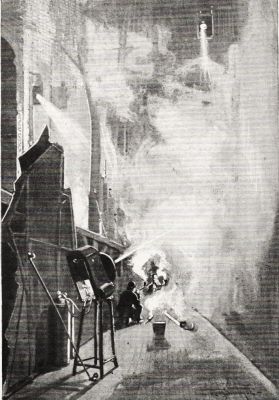
But after a time the moonlight fades out, and leaves behind it a threatening gloom. A dull distant peal of thunder proclaims the approach of a storm. There is a flash of lightning. The storm breaks. Peal upon peal of crashing thunder rends the sky. The wind howls and shrieks, and the sharp cut of the driving rain is distinctly heard. The curtain falls at the end of the act, and you rub your eyes and wonder if you have been dreaming or have really seen these things on a wooden stage.
The next act shows a scene in the forest, and as the sunlight filters through the rustling leaves, the dancing shadows on rock and trunk are plainly seen. Again the scene changes. This time it is a fire. The stage is filled with flames and smoke and the crash of falling timbers. You are almost tempted to believe that the house is really afire. But the same old curtain comes down at the end, and only a strong smell of powder reminds you of what you have seen. In the last act of this surprising play the hero and heroine, converted into disembodied spirits, go to the heavenly regions on a winged horse; and you see them, glowing with supernatural light, go flying across the deep blue sky. You leave the theatre in a state of wonder.
How is it all done?
Of course I have been imagining a play in which many different effects were combined; but nevertheless you have seen these illusions, though not all in the same play.
Spectral appearances are often managed nowadays with a stereopticon. For instance, in Siegfried there is a scene in the forest in which the music of the opera is supposed to depict the rustling of the leaves. In order to heighten the effect of this scene it is customary to produce the illusion of the flickering of the sunlight caused by the waving foliage. This is done by means of movable glasses, something like the arrangement of a kaleidoscope without the variety of colors. The white light is thrown through these moving glasses, and the audience sees the waving shadows, as if caused by sunlight filtering through wind-shaken leaves. In the last act of Die Walküre the sisters of Brünnhilde are heard coming through the air to their customary place of assembly to the wild measures of the "Ride of the Valkyries." It is also necessary that they should be seen. This necessity is fulfilled by the stereopticon. A picture of a Valkyr maid mounted on her steed is thrown on the dark drop-curtain at the back of the stage, and is made to pass from the upper left-hand corner down to the lower right-hand corner. By keeping the power of the light at a moderate pitch, the picture is prevented from being too hard and definite. Again, when the sisters, fleeing before the angry Wotan, depart in a body, a picture representing the group passes from the lower right-hand corner to the upper left-hand corner, while the stormy music of the "Ride" dies away. The effect is very fine indeed.
In the Flying Dutchman there is a view of the sea in the first scene, and a gale of wind is supposed to be blowing. The audience sees thin, gray, filmy scud scurrying across the sky from the beginning of the scene until the gale ends. This is also a stereopticon effect, and is produced by passing properly painted glasses across the opening of the lens. These few instances will give the reader some idea of the part which the stereopticon now plays in the illusions of the stage. It cannot be said that the results are always satisfactory, and, no doubt, in the course of time a better plan will be introduced.
One of the most familiar and beautiful effects produced upon the stage is the change from day to night or from night to day. The former, owing to the conditions surrounding stage illusions, is the more striking, and is that most frequently seen. In order to produce this effect the rearmost piece of scenery is a "drop," which is made about double the height of the ordinary scenes. This drop is painted to represent sky. The lower half is colored with the bright tints of the sunset, and these gradually blend in the middle of the drop into the subdued shades of a moonlit night. Sometimes the setting sun itself is shown, and this is effected by cutting a circular hole in the drop, pasting a piece of red muslin over the back of it, and putting a light behind it. The drop is now hung so that the lower half alone is visible. Now the scenery of the distance is painted upon a separate piece, which is "profiled"—that is, the irregular line made by trees, houses, mountains, etc., is cut out with a circular saw. This profile piece is set about four feet in front of the sky drop. Some six or eight feet further toward the front is hung what is called a cut-gauze drop, though this is sometimes omitted, especially if the view at the rear embraces an expanse of water. If it is woods, however, the cut-gauze drop is always used. This drop has sides and a top of canvas, painted as the case requires. The open central part is filled with stout gauze netting, which gives a charming aerial effect to the distance.
Now all is ready for the sunset except the lights, which are arranged thus: Behind the profile a row runs across the stage to throw its light on the lower part of the sky drop. The top part is illuminated by the border lights. A similar arrangement is made in front of the profile, while the foreground depends for its light on the borders and footlights. In all new theatres these are electric lights in three circuits. One circuit consists of lights with white globes, another red, and the third green. For broad daylight effects the white are used. In the scene we are describing, beginning with sunset, the red circuit is turned on. Calcium-lights with red glasses are stationed at the sides of the stage, and thus the whole scene is suffused with a glow of red light. The change from sunset to moonlight is effected by slowly and imperceptibly lowering the sky drop. As the sun disappears behind the distant hills the red "mediums," as they are called, are turned off and the green ones gradually turned on. When the night sky has fairly got down to its place the green mediums are all turned on at full force, and green glasses are placed in front of the calciums. The stage appears now to be flooded with moonlight. Of course the moon cannot be shown, for it would naturally be too far toward the audience. I was once in a theatre where the sun went down behind a mountain, and in half a minute the moon rose in the very same place. And the strangest part of it was that the audience did not pay any attention to this astounding freak of nature.
BEHIND THE SCENES. Man up in the Flies producing flickering Sunlight.
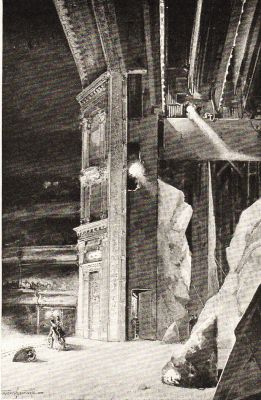
The change from moonlight to sunrise is, of course, effected by simply reversing the process just described. Either one of these changes may be rendered more effective by certain additions. For instance, in the sunset part of the drop all the spaces between the clouds may be cut out. Muslin is then pasted over these openings, and is painted to represent the sky between the clouds. By placing lights behind this muslin a beautiful transparent sky is produced, and by gradually changing the color and intensity of the light as the sun goes down the appearance of the scene is made very realistic. This method is seldom employed, except in plays in which the scenic effects are an important element. A moonlit river is made also by cutting out the canvas, putting in muslin, and lighting it from the rear.
Moonrise is produced with a sky drop, cut out between the clouds, as in the case of the sunset just described, and a "moon-box." This moon-box is simply a box with a circular hole cut in one side of it. Over this hole is pasted a piece of white muslin, and inside the box is a light. The box is placed behind the muslin sky drop, with the hole against the drop. The light is turned on, and the moon is drawn slowly upward by wires. Of course the illuminated face of the moon shows through the muslin, and disappears when it passes behind the thick canvas clouds. By having another piece of muslin painted red, and imperceptibly fading to white in its upper part, the orb of night can be made to appear red at the horizon, and gradually change to pale yellow as it floats upward, just as it does on a summer night. A few floating clouds may be added to the general effect by hanging in front of the sky drop a gauze drop with a few muslin clouds sewn on it, and moving the whole slowly. These matters charm the eye and create an illusion when they are skilfully managed.
I spoke of a moonlit river. Sometimes you see in the theatre a river or a bay which does not simply lie calmly luminous under the rays of the stage moon, but which sparkles with dancing ripples. This is a very pretty stage effect, and is by no means difficult to produce. The position of the moon having been determined, the next thing is to make what Mr. Howard Pyle so gracefully describes as the "moon path." Beginning at the upper edge of the water, a number of irregular holes are cut in the scene. These are then covered on the back with muslin, and the whole is painted over to represent water. Behind these holes is placed an endless sheet of canvas, passing around two cylinders of wood, one at the top and the other at the bottom. The lower cylinder has a crank by which the sheet is turned. In the sheet are cut a number of holes similar to those in the scene. A strong light is now placed between the two sides of the sheet. When the crank is turned the flashing of the light from the moving holes in the sheet through the stationary ones in the scene produces a fine ripple. It is necessary to turn the crank so that the front part of the sheet is always ascending, because in this way the holes through which the light flows pass upward, and that makes the mimic waves seem to dance upward toward the sky. Sometimes the man who turns the crank becomes tired, and the audience is surprised to see the ripples go by fits and starts. For this reason an electric motor is better, or a steam attachment, if such a thing can be had in the theatre. The moonlit sky above the waters may be improved by the addition of a few twinkling stars, and these are easily enough produced by hanging large spangles on bent pins. The slightest tremor of the drop will cause them to shake, and the flashing of the light which they reflect produces the illusion of twinkling.