STUDYING TO BE MUSICIANS.
Reading edition
Some agreeable writer, whose name I have forgotten, said that there was no art which had so many devotees as music, and none of which there was such widespread ignorance. If I should say that there must be in the city of New York not less than 50,000 girls engaged in learning how to play upon the piano, I should perhaps astonish some of the readers of this paper, yet it is my firm belief that these figures are much too small. Such institutions as the National Conservatory of Music and the New York College of Music have each from 600 to 800 piano students, and there are some thirty smaller conservatories in the city. The number of private pupils is enormous, and one often wonders whether it can be possible that Americans are so fond of music that every family contains a student. The truth is, however, that nine-tenths of the girls who study the piano—I had almost said study music, but they do not do that—are actuated not by a love of music, but simply by a desire to possess an accomplishment. These young women are quite contented if they can acquire sufficient technical skill to perform a few brilliant, showy pieces in such a manner as to surprise their friends. There are a few, of course, who learn to play the piano because they are really fond of music, and desire to be able to give themselves artistic pleasure. And there are a few others who are studying seriously in the hope of becoming fine artists, capable of delighting the public, or, at the worst, of becoming professors in conservatories. Even then they are not much worse off than the great artists of the concert stage, for it is only once in a generation that a man like Paderewski arises, who can earn hundreds of thousands of dollars. Most of the noted pianists are compelled to teach in order to make a living, for concert engagements are not numerous. Their devotion to their art is the result of a deep and absorbing love for it, which must be its own reward.
Life in the music schools of New York is by no means as picturesque as life in the art schools, so charmingly described by Mr. Ralph; but it is interesting, and it has a remarkable jargon of its own, quite unintelligible to the non-musical person. The girls—the boy students are very few—flock to the New York schools from the entire surrounding country. Every morning train brings them from Newark, Paterson, Elizabeth, Yonkers, Tarrytown, Nyack, Greenwich, and other outlying towns and cities, where, indeed, good teachers may often be found, but not the advantage of conservatory systems. The New York girls come in street cars, in carriages with liveried coachmen, and on foot, for the students are of all classes. It is an inspiriting sight to see them trooping in on a stormy winter morning, with their heavy wraps, their snow-covered furs, their stout overshoes, their arms full of music, their cheeks full of roses, and their eyes dancing with the glow of exercise. Then there is the usual chatter about the lessons as they assemble in the waiting-room.
"Oh, I don't believe I shall ever manage that queer passage in the bass—the one where the chord of five notes is, don't you know?"
"Yes, I had that sonata last year; but, my dear, it's child's play to the Schumann piece I have now."
"Oh, dear!" says another, drearily, "I do wish that Bach had never lived. I'm sure I can't see anything pretty in his eternal fugues."
"Well, I don't think they're any worse than these Deppe two-finger exercises."
"Wait till you begin counterpoint, dear," says another, consolingly.
And then the bell strikes, and off they all go, still chattering, to the various class-rooms or lesson-rooms. A few minutes later the conservatory becomes a dreadful babel of confused sounds. Down in the basement some one is groaning out an organ fugue by Thiele, with a great clattering of heels on the pedals. On the first floor the sight-reading class is droning angularly a part song by Weinzierl in the large room, while in the apartment next to them the "gold medal" pupil is pounding Schumann's Etudes Symphoniques into sounding brass without any tinkling of cymbals. Upstairs one young woman is pursuing the uneven sopranos of her way up and down the scale, a boy is playing a violin étude in several kinds of pitch, and a dozen girls are hammering out their semi-weekly allowance of Bach, Beethoven, Weber, Mozart, and Chopin all at once. The teachers—German, Polish, Russian, French, Italian, occasionally American—sit, stand, or pace the floor, according to their temperaments, and correct, guide, and urge gently or excitably as the case may be.
"No, my dear, the accent on the second beat, and the pedal taken after it, and held over to the first beat of the next bar."
"Ach! You, dere! You play mit your knuckle! Vat is dat? Bay, bay; hit de bay!"
"Ah, mon enfant! You sing wiz ze troat vide oppen, so—ba-a-a-ah. Is it not? Vell, I vish you sing viz ze glottis a lettle pinch, so—bu-u-u-uh. Now, sing."
And the unhappy pupil closes her throat up, as if she had a sort of artistic croup, and tries to force her voice through by main strength. In the mass of pupils in the conservatory there are always twenty or thirty who are studying seriously, with the hope of making artistic careers for themselves. These do not simply study the pianos or singing; they study music, which is a vastly more laborious undertaking. For once a week there is the lesson in harmony, which is one of the driest and most discouraging topics in the world. Yet no one can be said to know anything about music who does not understand harmony. Just think of it—harmony, counterpoint and fugue, form, theory, composition, instrumentation, sight-reading, history of music. Those are the subjects which the educated musician must know, and they are all taught in the regular music-schools. Harmony is the science of chords, you know. The teacher explains the laws by which the various intervals are governed, leading the pupil step by step till he has advanced from a simple "resolution" like this:
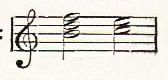
to something like this:
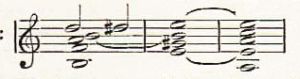
Then comes that wonderful art of counterpoint, culminating in the building of a grand and complex composition out of two little phrases, called subject and answer, which flash and frown one against the other like lightnings against a blue-black sky. The student has to learn all about form—how a symphony is constructed from the humble beginning of a simple motive like this:
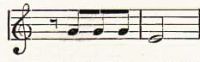
Furthermore, he must study instrumentation, and learn how the small army of voices in the modern orchestra are to be used. He must know their compass, their capacity for fast performance, the notes upon which it is possible to make trills, the keys in which they stand, and, above all, the character of the writing best suited to them. And again, he must be acquainted with the history of his art, for without it he is quite ignorant of the purposes of the composers whose works he attempts to perform. What a light it throws upon the correct interpretation of Mozart to know that in his day smoothness, finish, and a singing tone were the requisites of good playing. What a valuable thing it is for the pupil to know that Mozart desired to have the passages flow like oil, and that he was opposed to all decided violations of the time. What a flood of illumination it throws on all music to know the meaning of the three great periods of musical history, polyphonic, classic, and romantic. These subjects are taught to classes by lectures and special teachers; but it is a sufficient evidence of the light-mindedness with which most pupils approach, music that not more than five per cent. of the conservatory students enter these classes. The composition classes, of course, are only for very advanced students. Indeed, in Dr. Antonin Dvoràk's composition class at the National Conservatory several well-known composers are to be found.
And what do the music students outside of their study and practice hours? You can see them by the dozen at concerts and at the opera. They are especially conspicuous at the matinée entertainments. They have a school-girlish look, coupled with an air of wisdom, and they devote great attention to pianists' hands and arms. If the student is an aspiring young vocalist, she uses her opera-glass continually. I said to one of them at an opera matinée once,
"Why do you constantly watch Madame Lehmann through your opera-glass?"
"Well," she replied, "my teacher says that I must keep my tongue flat, because all good singers do, and I'm trying to see how Madame Lehmann holds hers."
"And how does she?"
"I can't see it all; I believe she has swallowed it."
Another said to me:
"I am watching Mr. Paderewski's wrists. My teacher says I must keep my wrists up, and there he goes every few minutes and lets his drop below the key-board."
"Perhaps when you are as far advanced as Mr. Paderewski," I suggested, "your teacher will allow you to do as you please with your wrists."
It takes time and devotion to make a good musician. I know that Mr. Paderewski is in the habit of practising from four to six hours a day, in addition to the performance of his long and difficult concert programmes, in order to preserve the skill which he acquired by long and wearisome labor. Even the men who play in the orchestras spend several hours each day in practice, for fingers will grow stiff and awkward unless they are used constantly.