Constable & Co
Reading edition
Cotton Dress
Fabrics.
D. & J. Anderson's Zephyrs,
Chene and Persian Effects,
Silk Mixtures,
Stripes, Checks, and Plaids.
Wash Fabrics.
French Piqué,
Printed Dimity,
White Emb'd Nainsook.
Printed Linen Lawns.
Frères Koechlin's Organdies.
NOVELTIES.
Broadway & 19th st.
NEW YORK.
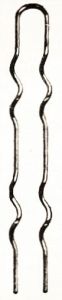
No
you haven't seen it if you say it's like any other.
The CUPID Hair Pin never slips out.
It's in the TWIST.
Richardson & De Long Bros., makers of the famous DeLong Hook and Eye.
HARPER'S CATALOGUE thoroughly revised, classified, and indexed, will be sent by mail to any address on receipt of ten cents.


This Department is conducted in the interest of Bicyclers, and the Editor will be pleased to answer any question on the subject. Our maps and tours contain much valuable data kindly supplied from the official maps and road-books of the League of American Wheelmen. Recognizing the value of the work being done by the L. A. W., the Editor will be pleased to furnish subscribers with membership blanks and information so far as possible.
It is practically impossible in this Department to give satisfactory answers to inquiries in bicycle matters. The questions are in many cases so similar, and yet just different enough to require separate answers, that it would require a good portion of this periodical to answer them. For example, many inquiries are received as to the best route from some town or city in one State to another town or city in an adjoining State. Of course these letters require separate answers in each case, which would be impossible. It is, however, quite possible to give here some general information as to the best methods of finding out such answers, each man for himself. In the first place, it is wiser in the end to join the L. A. W. You pay $2 per year for membership, which brings you free the road-book of your State, if there is one, and the L. A. W. Bulletin and Good Roads—a periodical that, among other things of value, gives you all the addresses, up to date, of consuls, chief consuls, and other State and central officers of the League. From these men all such information can be obtained. If you do not belong to the L. A. W., you have to pay $1.50 for the road-book and $2 for the Bulletin, which is the only paper in which you can find all the officers and consuls of the United States. The question then presenting itself to you, How can I ride best from A in Pennsylvania to B in Ohio? your course in seeking information is clear. Write to the chief consul of Pennsylvania and the chief consul of Ohio—whose addresses are in the Bulletin—and ask each to send you the road-book of his State. You will receive the Pennsylvania book free if you live in Pennsylvania yourself, but you must, of course, pay for the Ohio book. Having obtained these road-books, or book of maps, or tour-books (for each State has a different plan in getting up its books), pick out A, Pennsylvania, and B, Ohio, on the maps of each book, and then follow the routes on the maps which lead to some common point on the border. Here, then, is your trip marked out carefully, well described, and in a form that you can carry with you—and all at a cost of $3.50. If either State happens to have no road-book of any kind, write to the chief consul, tell him your proposed plan, and he will be glad to answer your questions to the best of his ability. If there is no chief consul, then that State is indeed benighted and behind the times—at least from a wheelman's point of view.
Another general set of questions which can be classified in an indefinite sort of way is the set which refers to training for long distances or short distances either for racing or for pleasure trips. General rules here can be laid down for training. In fact, the Interscholastic Sport Department is constantly giving suggestions in training for one particular event or another. Bicycle-training is practically the same as the preparation gone through by a man who is to run in the longer distances. Of course the principal part of the work is wheeling constantly day after day for certain distances, depending on the event for which we are training, gradually increasing speed or distance as the event is a short distance or a long tour. Muscular development and lung-power are required, and these must be practised by constant gymnasium work. Running slowly on the toes, rising and falling on one leg and then on the other many times, rising on the toes and falling back slowly on the heels two or three or four hundred times in succession without bending the knees—these exercise the proper leg muscles. But when the lungs and heart come into the question more care should be taken. Many strong men find that while their lungs and heart are vigorous for ordinary games, bicycling puts too great a strain on both, especially the latter. For instance, after riding steadily up hill and down hill for twenty miles at fifteen miles an hour, you begin to feel a stricture across the chest, you have that peculiar sensation as if you were tasting blood, and it is impossible to take a long satisfying breath which seems to "go" beyond a certain point down into your lungs. When these facts become noticeable, especially if you are not in the best of training, it is well to dismount and walk a little by your wheel, until you can mount again and ride with the mouth closed and the air entering your lungs through the nostrils. In fact, all riding should stop when the wheelman cannot breathe most of the time through his nose; otherwise the lungs are overtaxed, which may do no harm in occasional instances, but will in the end, if kept up, be injurious.